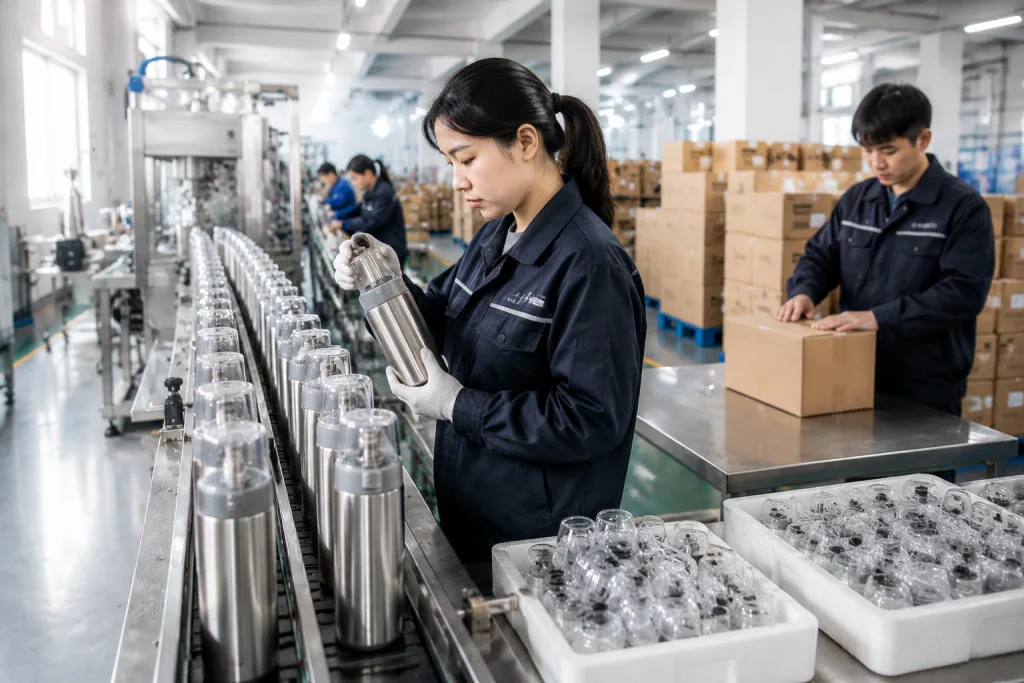
Key Takeaways
- PETG bottles usually start around USD 0.85-1.80 FOB, while 500ml double-wall stainless thermos units commonly land at USD 2.80-4.80 FOB at 3,000 pcs
- For real heat retention, 304 stainless vacuum construction can hold 45-60°C after 6 hours; PETG cannot match insulated thermos performance
- Typical MOQ is 1,000-3,000 pcs for stock molds and 5,000+ pcs for new molds; lead time in Zhejiang, China is often 25-45 days after sample approval
- Outdoor retail usually fits powder-coated stainless; promotional thermos campaigns often fit simpler custom thermos specs with 0.4-0.5mm body thickness
You searched for a petg thermos bottle supplier, but if you sell into outdoor retail or promo programs, the wrong material choice costs money twice: first on the PO, then on returns, complaints, or dead stock. We see buyers start with a shape and a target FOB, then the line stops at sampling because PETG and insulated stainless do different jobs. Last month a buyer flagged a 0.8mm wall PETG sample and still asked for “thermos” heat hold. That’s the wrong question to ask. A clear bottle sells one story. A vacuum flask sells another.
Here in Zhejiang, this comes across our desk every week. A distributor sends an inquiry for a 700ml PETG body with “thermos” performance, but PETG is a copolyester plastic, not a vacuum-insulated metal structure with an inner and outer wall welded on the line. If you need 6 to 12 hours of heat retention, a stainless custom thermos is usually the right call. If you need lower cost, transparency, and cold-only use, PETG can work. We’ve seen this go sideways after artwork approval, then QC pulled the sample and the spec still didn’t match the use case. You need a clean comparison before you lock artwork, MOQ, and compliance testing.
Start with the real requirement
Buyers throw around the word “thermos” for 2 different products, and that is where the mistakes start. If you are talking to a petg thermos bottle supplier, ask the direct question first: does your end user need insulation or just a bottle format? PETG works for cold drinks, shelf display, and low shipping weight. It is not a vacuum flask material. On our line, the first check is wall structure, not color, because a clear PETG body at 1.2 mm tells you one thing fast: this is a cold-use bottle. Stainless steel is still the standard if you need real heat retention, rough outdoor use, or a stronger premium feel.
For outdoor retailers, the choice is usually straightforward. If the bottle is for hiking, camping, commuting, or winter promotions, a stainless thermos manufacturer is the safer route. Double-wall vacuum designs in food-grade 18/8 stainless steel, usually SUS304 inside and outside, remain the commercial standard. We ship these with vacuum hold tests pulled by QC every 2 hours, and the buyer usually cares about 12 hours hot, not “looks insulated.” If the program is a summer giveaway, gym membership pack, or a hard price-point event item, a PETG supplier thermos option can still fit. But this is the wrong question to ask if the brief says “keep coffee hot.”
At BottleForge Industrial in Zhejiang, China, our monthly output across drinkware lines is over 400,000 units, but capacity is not the point. Matching structure to use case comes first, before logo print, cap color, or carton marks. We have seen first-time buyers ask for a customizable thermos with transparency, low weight, hot-fill safety, dishwasher durability, and vacuum performance at under USD 2.00 FOB. The math doesn’t work. Last month one PO even had “vacumm clear bottle” typed on it, and the buyer flagged the quote as high after we corrected the structure. That spec set does not exist in one product.
You are not choosing between two finishes. You are choosing between two product architectures.
Define the job clearly: hot or cold, retail or giveaway, shelf life target, claim language, compliance destination, and target FOB. Put numbers on it if you can. For example, 6 hours hot vs no insulation claim, MOQ 3,000 pcs vs 10,000 pcs, or gift-box retail vs bulk-packed promo. We run into delays when this stays vague, and we have seen this go sideways after sampling. A cap gauge, drop test standard, or label claim often decides the factory path faster than the artwork. That will tell you fast whether a PETG bottle supplier or a stainless thermos factory should lead the project.
Head-to-head spec table that matters
This is the comparison buyers ask for after the first quote. The ranges below are standard for China stock-mold programs we run every week. Final numbers shift with lid structure, surface finish, pack-out method, and test scope—change a straw lid to a screw lid and freight weight can move by 0.08 kg per carton.
PETG bottle vs stainless thermos
- Material: PETG copolyester vs SUS304/SUS201 or SUS304/SUS304 depending on tier
- Insulation: Single-wall only vs double-wall vacuum
- Heat retention: Not rated as a thermos vs typically 45-60°C after 6 hours for a 500ml unit
- Cold retention: Good for cold carry, no insulation vs 8-24 hours depending on ice load and cap structure
- FOB price: USD 0.85-1.80 vs USD 2.80-4.80 at 3,000 pcs
- MOQ: 1,000-3,000 pcs stock mold vs 1,000-3,000 pcs stock mold, 5,000+ pcs for some special lid systems
- Weight: Lower, often 120-220g vs 260-420g for 500ml vacuum units
- Brand feel: Budget to mid-tier vs mid-tier to premium
- Decoration: Silk screen, heat transfer label, sleeve vs silk screen, laser, UV print, powder coat, digital wrap
- Compliance focus: LFGB/REACH food-contact migration for EU, CPSIA as needed vs same plus thermal performance and coating adhesion checks
For a promotional thermos order, this table matters more than catalog wording. Buyers compare a PETG thermos vendor with a stainless thermos supplier on landed cost, breakage rate, and what sales claims they can print on the sheet. We have seen this go sideways: one PO called a PETG bottle a “thermal flask,” and the buyer flagged returns after the first 2,000 pcs hit retail. PETG should not be sold as a heat-retention flask. That is the wrong claim.
For retail, stainless usually protects margin better because the customer feels the weight in hand at once. A 0.4-0.5mm outer wall, powder coat line finish, copper-plated vacuum layer on some models, and leak-tested screw lids give the product a stronger shelf story. QC pulled the sample on one project because lid torque was under spec, and that kind of detail matters more than fancy copy. PETG wins if the brief is visible drink color, fruit infusion display, or low-cost distribution at 10,000 pcs and up. Different job. Different math.
Use-case fit by channel and buyer type
The deciding factor is usually the sales channel, not the bottle wall itself. We’ve seen buyers mix this up on the first RFQ, then change spec after one sample review. Outdoor retail and promo sourcing do not buy to the same logic.
Outdoor retail: Choose stainless. A 500-750ml vacuum flask with powder coat, carry loop, and leak-proof PP lid is the standard play, and most buyers ask for a body dent test after QC pulled the sample from the drop bench. Retailers look at dent resistance, thermal hold time, shelf appeal, and repeat purchase rate. For this channel, a manufacturer thermos partner needs to show drop test data, coating adhesion results from the cross-cut tape test, and stable production under AQL 2.5 inspection. If your assortment already carries premium coolers or camp cookware, PETG usually feels off on the shelf unless it is a secondary cold-use SKU. We’ve seen this go sideways.
Promotional campaigns: Here the spec can move either way. If the client needs a low-cost item under a USD 2.00 FOB target at 5,000 pcs, PETG deserves a quote, and the math is simple. If the campaign is built around perceived value, gifting quality, or holiday-season use, go stainless. A custom thermos in stainless usually keeps a stronger retention rate after the event than a plastic bottle, which matters when the buyer is working from cost per impression, not just unit price. One common pushback we get: “Can you make stainless hit the same budget?” Usually no. The math doesn't work.
Distributor programs: For a distributor thermos or distributors thermos business model, stock molds are your friend. You want repeatable SKU architecture, fast sample turnaround, and simple carton specs, down to details like a 24 pcs master carton and common cap thread across 350ml and 500ml bodies. A reliable thermos distributor channel usually performs better with 2-4 core body styles plus multiple decoration options than with a long list of fresh molds. This is the wrong question to ask: “How many new shapes can we launch?” Better question: how fast can we ship repeat orders with the same lid system? Keep cap systems common across sizes where possible.
Corporate gifting: Stainless almost always wins. A matte powder coat body, laser logo, and individual kraft box can move a simple 500ml flask from commodity to gift-grade with only USD 0.35-0.80 added FOB depending on finish, and the line usually packs these in a 3-layer insert box to avoid logo rub. That is a better path than trying to force a PETG bottle to behave like a premium thermos customized product. Buyers have flagged this before: clear plastic reads cheap, even when the print is clean.
What custom options change the quote
Buyers often ask for a customized thermos quote and compare one number only. That is the wrong question to ask. On PETG and stainless jobs, we see five cost drivers change the factory thermos price fast, and one missed detail on the PO can swing the quote more than the buyer expects.
- Decoration method: One-color silk screen is the baseline, usually with a simple jig on the line. Laser engraving on stainless costs more up front but wears better after 500 to 1,000 rub tests. Full-wrap digital print or hydrographic finish pushes scrap risk up because registration drift of 1-2 mm is enough for QC to pull the sample.
- Surface finish: Plain spray or bare stainless is cheaper than powder coat. Fine texture powder adds grip and better shelf feel, but it usually adds USD 0.18-0.45 per unit, and the line runs slower because the coating thickness has to stay in range.
- Lid complexity: Standard screw lids are stable and easy to control on leak test. Flip lids, push-button stoppers, and tea filter systems add parts, more assembly stations, and more rejects at vacuum or upside-down leak check. We have seen buyers push for a fancy lid on a low target price, and the math doesn't work.
- Packaging: Polybag plus export carton is straightforward. Color box, PDQ tray, barcode labeling, and Amazon FNSKU prep add handwork, extra checks, and carton drop-test risk. One small print error on a barcode label can hold a shipment.
- Testing scope: REACH, LFGB, California Proposition 65 screenings, and ASTM or CPSIA requirements add cost and time. They are market-entry items, not nice extras. We ship plenty of orders where the lab fee is lower than the rework cost after a failed migration result.
A PETG thermos custom request often includes Pantone color matching, translucent tint control, or an embossed mold logo. At 5,000 pcs, those options are usually easier to absorb. Stainless has different value points: copper-coated vacuum for heat retention, tea strainer inserts, dual-tone powder coat, or a stainless base cap. On one run last season, the buyer flagged a 0.5 mm logo depth change on an embossed PETG mold, so yes, small details do affect cost.
Ask your thermos manufacturers for a quote grid, not one number. You want 3,000 pcs and 5,000 pcs pricing, decoration options, and separate sample charges. In China, sample lead time is often 5-10 days for existing models and 15-25 days if new tooling or special color development is needed. Production lead time is usually 25-45 days after deposit and artwork approval. If a supplier promises 12 days for a new customized thermos with packaging and compliance reports, assume corners will be cut somewhere. We have seen this go sideways, especially when the first white sample still needs lid fit adjustment.
Compliance, quality checks, and failure points
If you import into Europe or North America, good appearance is only step one. The product is finished when it clears the required checks. A serious thermos supplier should talk through test standards, sample size, and fail points without reading from a sales script. We hear this from buyers all the time: “Looks fine” is not a release standard.
For PETG bottles, check food-contact compliance, odor, impact resistance, print adhesion, and cap leakage. For stainless, add vacuum performance, corrosion risk, and coating durability. Common frameworks include REACH for the EU, LFGB for Germany and wider EU retail expectations, and specific buyer protocols for migration, heavy metals, and phthalates where applicable. For children’s lines, CPSIA and ASTM elements may apply depending on design and age grading. On the line, we usually see buyers miss one basic point: they ask for the lowest test cost first. This is the wrong question to ask if the bottle is headed to chain retail.
On the factory side, ask about AQL levels, incoming material checks, and leak-test method. We suggest at least AQL 2.5 for major defects and clear defect definitions before production starts. Put it in the PO. We have seen one typo in a PO—“matte black body, gloss black lid” typed as “gloss black body”—turn into 3,000 pcs of argument. For stainless vacuum bottles, each unit should go through leak and vacuum checks, with additional hot-water or heat-retention verification by batch. QC pulled the sample, filled 95°C water, and logged the temperature drop after 6 hours. For PETG, watch stress cracking around threaded necks and hinge areas if a flip-top lid is used, especially if the neck wall is under 2.0 mm.
Typical stainless failure points include pinhole vacuum loss, dented rims, loose silicone seals, and paint scratching during packing. Typical PETG failure points include surface scratching, cloudy appearance after rough handling, and cap fit inconsistency. These are routine factory issues. Nothing exotic. We have seen stainless rims dent after a 1.2-meter carton drop because the divider board was too soft, and we have seen PETG lids fail after the hinge pin sat off-center by less than 1 mm. A disciplined supplier thermos partner controls these with SOPs, fixture checks, and packing trials, not excuses after shipment.
If you are sourcing from Zhejiang or elsewhere in China, also ask whether the factory has BSCI or ISO-aligned systems if your customer requires social or process audits. Not every order needs every certificate, but every buyer needs clarity before the PO is issued. We ship plenty of orders where the audit is not the deciding factor; the real issue is whether the factory can show records fast when the buyer flagged it.
How to buy from China without rework
The smoothest projects are boring. Spec locked. Approval path clear. Cartons ship on time. If you buy through PETG thermos suppliers thermos channels or direct from a stainless thermos manufacturer, cut ambiguity at the start, not after the line runs 5,000 pcs and QC pulled the sample too late.
Start with a written product brief: capacity, dimensions, weight target, material grade, insulation requirement, decoration method, packaging, testing scope, and destination market. Put numbers on it. If body diameter is 72 mm, write 72 mm, not “about standard size.” Same for weight tolerance and carton drop test standard. Then ask for a pre-production sample with the final logo process already on it. A blank sample proves mold shape only. It does not prove print registration, coating adhesion, or whether the laser mark sits 3 mm off-center.
Then lock the commercial terms. Most China factories quote FOB Ningbo or FOB Shanghai. Confirm MOQ by color and logo, not just total order quantity. A 3,000-piece MOQ often means 1,000 pcs per colorway with one logo position, and buyers miss that point every month. Also confirm carton size, GW/NW, and palletization if you ship into 3PL warehouses or retailer DCs. We have seen a PO marked “mix color ok” while the master carton spec still required solid-color packing. That kind of typo becomes a chargeback fast.
For outdoor retailers, ask the manufacturer thermos team for thermal test data and durability checks before mass production. Ask what the test method was, how many hours, and whether the drop test used a loaded bottle. For promotional thermos campaigns, lock barcode placement, carton mark format, and delivery schedule against the event date. If you are a thermos distributors or suppliers thermos buyer managing 6 customer accounts at once, reserve time for photo approval before production starts. One wrong Pantone on 5,000 units is still your problem, even if the FOB was cheap. The buyer flagged this on us once because the silk screen shifted half a shade under warehouse lighting. The math doesn’t work if the rework cost wipes out the price advantage.
Do not over-customize your first order. This is the wrong question to ask: “How custom can you make it?” Better ask what already runs well on the line. Start with a stock mold, standard lid, and proven finish. New buyers chase a fully thermos customizable concept too early, then hit tooling delay, unstable yield, and QC risk that was easy to avoid. We have seen first orders slip from 12 days to 18 days just because a new lid needed one gasket revision. Build the first SKU on stable ground. After sell-through is proven, move to unique lids, exclusive mold details, or broader distributors thermos assortments.
Get the right thermos spec before you order
Send your target price, use case, market, and artwork. We will quote PETG and stainless options side by side with MOQ, lead time, and compliance notes.
Frequently asked questions
Can a PETG bottle be sold as a thermos?
Not if you mean vacuum insulation or meaningful heat retention. PETG is a plastic bottle material, usually for cold or ambient beverages. It can handle a practical low-cost bottle program, but it will not perform like a double-wall stainless thermos. If your product page claims hot retention for 6-12 hours, you should source stainless, typically SUS304 inner with vacuum construction. A PETG bottle might quote at USD 0.90-1.50 FOB at 3,000 pcs, while a 500ml stainless vacuum bottle may be USD 2.80-4.20 FOB. The extra cost is paying for structure, not branding language.
What MOQ should I expect from a thermos supplier in China?
For stock molds, the normal MOQ is 1,000-3,000 pcs per model, often split by 500-1,000 pcs per color depending on finish and logo method. For a new mold or a specialized lid system, expect 5,000 pcs or more plus tooling charges. Powder-coated stainless with laser logo is usually easier to run at lower MOQs than full-wrap printed designs. In Zhejiang, China, many factories will sample in 5-10 days and mass produce in 25-45 days after deposit. Always confirm whether MOQ applies per SKU, per color, or per artwork version, because that changes your real buying cost.
Which is better for outdoor retail: PETG or stainless?
Stainless is usually the better fit. Outdoor retail customers expect insulation, durability, and a premium hand feel. A 500-750ml stainless vacuum bottle with 0.4-0.5mm outer wall, powder coat, and leak-tested screw lid is easier to position at retail than PETG. PETG can still work for lightweight cold-use items, but it is rarely the hero SKU in camping, commuting, or winter assortments. If your target market is specialty outdoor shops in Europe or North America, stainless generally supports stronger sell-through and fewer complaints. PETG works better as a value add-on or seasonal cold-drink option.
What tests should I ask a custom thermos manufacturer to provide?
Ask for food-contact compliance first: REACH or LFGB depending on your market, plus any buyer-specific migration testing. For stainless, also request leak test records, vacuum or heat-retention checks, and coating adhesion results if powder coated. For promotional orders, print adhesion and barcode accuracy also matter. If the item is for children, review CPSIA or ASTM requirements based on the product design. At inspection stage, many importers use AQL 2.5 for major defects and AQL 4.0 for minor defects. If a supplier cannot explain its QC checkpoints, test scope, or defect standards, that is a bigger risk than a slightly higher FOB price.
How do I choose between a promotional thermos and a premium customized thermos?
Start with your end use, not the artwork. If the bottle is a mass giveaway with a target FOB under USD 2.00, simple PETG or entry stainless may be enough. If it is corporate gifting, retail resale, or a branded outdoor line, spend more on double-wall stainless, powder coat, and a stronger logo method like laser engraving. A premium customized thermos may cost USD 3.20-5.50 FOB depending on size and finish, but it usually has a higher keep rate and lower complaint rate. For first orders, use stock molds and standard lids. Add exclusive tooling only after the SKU proves demand.