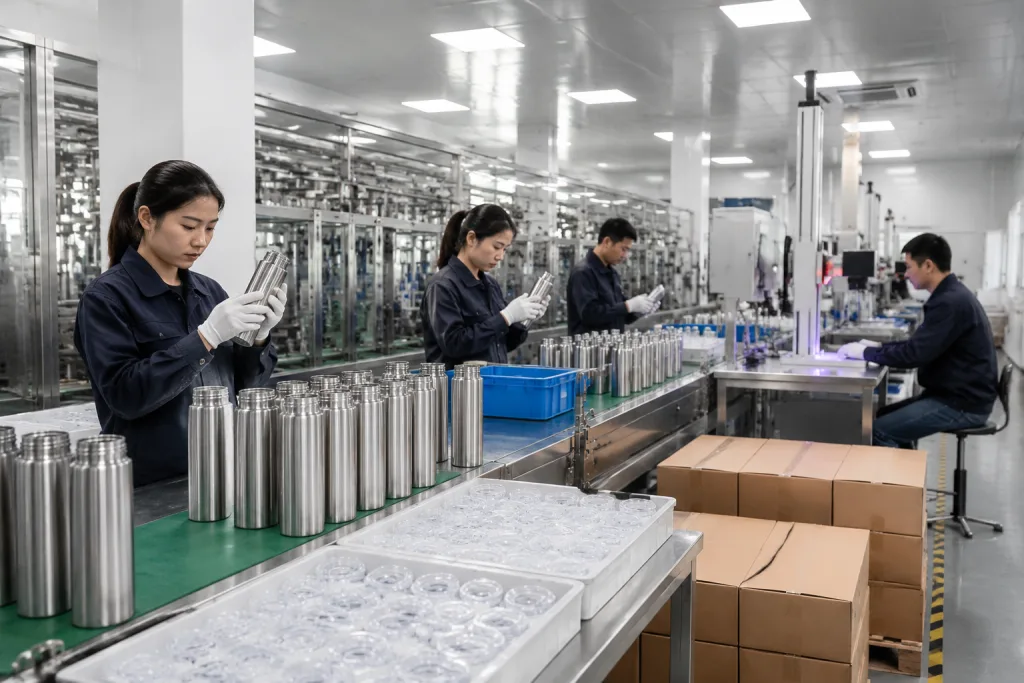
Key Takeaways
- State bottle structure in the RFQ: 18/8 stainless inner and outer, or PETG body with PP lid; one missing detail can move price by USD 0.60-1.80 per unit
- For custom thermos projects, ask for 3 line-item prices: sample fee, tooling or print setup, and FOB bulk cost at 1,000 / 3,000 / 10,000 pcs
- A realistic lead time from Zhejiang, China is 7-12 days for pre-production samples and 30-45 days for bulk after approval
- Use AQL 2.5/4.0, leak test, vacuum retention, coating adhesion, and REACH or FDA declarations in the PO before thermos bulk starts
If you search for a petg thermos bottle manufacturer, you are usually buying one of two products: a plastic outer-body flask for price-driven promos, or a stainless vacuum bottle with PETG parts like lids, straws, sleeves, or infusers. Buyers mix these up all the time. Factories in China do not always fix the brief, especially when the RFQ just says “thermos bottle” and the PO misses the body material. Then the quotes look comparable, but they are not.
For outdoor retailers and promotional brands, the costly mistake is rarely the unit price. It is signing off on the wrong structure, decoration method, compliance scope, or carton plan before the PO is locked. We see this every week in Zhejiang; QC pulled one sample last month where the buyer asked for a vacuum bottle and the line set up a single-wall PETG outer body with a 0.4 mm spec note buried in the artwork file. This is the wrong question to ask. Ask what the bottle is built from, what PETG part is included, and what standard applies. A clean sourcing process from RFQ to sample to bulk thermos production will save you 2 to 4 weeks, cut claim rates, and make your landed cost more predictable.
Start by fixing the bottle structure
The term petg thermos bottle manufacturer trips up a lot of buyers because PETG is not a vacuum insulation material. A real thermos is normally double-wall stainless steel with vacuum sealed between the inner and outer shells. On our line, PETG usually shows up in the lid window, clear sleeve, tea filter, infuser chamber, or a single-wall body for cold drinks. If you need heat retention for outdoor retail, say it straight in the RFQ: double-wall vacuum stainless bottle, 304/18-8 inner, 304 or 201 outer, PETG lid component if required.
If you skip that in the first email, the supplier may quote a PETG body bottle that looks close in studio photos but performs like a different product. We have seen buyers flag this after sample approval because the picture looked right and the structure was wrong. For promo campaigns, that can still work if the target is under USD 2.00 FOB. For retail shelf programs, the math usually does not work.
What to lock before asking for price
- Capacity: 350 ml, 500 ml, 750 ml, 1,000 ml
- Body structure: single-wall PETG, double-wall plastic, or vacuum stainless
- Steel grade: 18/8 stainless inner; specify if you accept 201 outer
- Lid materials: PP, PETG, Tritan, silicone gasket, stainless cap top
- Wall thickness: common range 0.4 mm inner / 0.45 mm outer for vacuum bottles
- Performance target: 12 hours hot, 24 hours cold, or tested data at starting temperature
- Compliance market: EU REACH, LFGB if needed, US FDA, California Prop 65 warning review
A usable thermos RFQ is not long. It is precise. This is the wrong question to ask: “What is your best price for a PETG thermos bottle?” We quote faster when the structure is fixed, the material is fixed, and the test target is fixed. At BottleForge Industrial in Hangzhou, Zhejiang, a clean RFQ usually takes 24 hours to quote, while a vague one takes 4 days because sales has to go back to the line, check the neck finish, and ask engineering what you actually meant. That gap matters if you are comparing thermos manufacturers across China on the same deadline.
Build an RFQ factories can price
Buyers often send the same RFQ to five thermos suppliers, then get five prices back with a spread of 18% or more. The reason is plain: each factory priced a different bottle. We see this every week on the line. Your RFQ should read like a stripped-down purchase order, not a sales brief. You are telling the thermos factory what to cost, down to logo size and carton pack.
For a customized thermos project, include the product spec and the commercial spec. Both matter. Product spec means dimensions, materials, coating, logo method, and test needs. If the body diameter is 72 mm and the lid uses PETG plus a PP inner part, write it that way. Commercial spec means target MOQ, Incoterm, destination port, carton rules, and timeline. This is where buyers get loose, then the math doesn't work.
Useful rule: if a factory cannot quote from your RFQ without asking 10 follow-up questions, your RFQ is still too loose.
PO-style line items to put in the RFQ
- Item name: 500 ml vacuum stainless bottle with PETG flip lid
- SKU code: your internal code, for example TH-500-FLIP-BLK
- Qty tiers: 1,000 pcs / 3,000 pcs / 5,000 pcs
- Color: Pantone Black C body, Pantone 186 C logo
- Finish: powder coating 60-80 microns, matte
- Logo: 1-color silk screen or laser engraving, front center, 35 x 45 mm
- Packaging: white box, barcode sticker, export carton of 24 pcs
- Testing: leak test 100%, vacuum retention sample test per batch
- QC standard: AQL 2.5 major / 4.0 minor
- Trade term: FOB Ningbo or FOB Shanghai
For distributor thermos and distributors thermos programs, ask for a quote table with sample cost, tooling, carton upgrade, and FNSKU labeling if you sell through Amazon channels. Ask line by line. A supplier who sends one all-in number will save time on day one and create arguments on day 20. QC pulled the sample on one Amazon order last month because the outer carton print was changed but the FNSKU location was never confirmed. You need cost visibility because logo revisions, insert cards, and carton changes are where margin leaks out.
Typical MOQ in Zhejiang, China for a factory thermos order is 1,000 pcs per color for standard molds, though some supplier thermos programs can start at 500 pcs with plain carton packing. Full custom molds are another story; expect 3,000 to 5,000 pcs minimum in most cases. Buyers push back on this point all the time, asking for 300 pcs with a custom lid color and printed gift box. We've seen this go sideways. If the mold is standard and the deco is simple, 500 pcs might run. If you need a new silicone seal, a new handle part, and a drop-test carton, the line will not price it the same way.
Ask for samples that prove the claim
The sample stage tells you fast if a factory can build the spec or just talk well on WeChat. Do not ask for only a photo sample. Ask for three sample types if the timeline allows: an existing-stock reference sample, a logo sample, and a pre-production sample built to your final spec. We run this sequence every week, and it cuts the usual argument at bulk stage. For a customizable thermos, this is the right question to ask.
Outdoor retail orders care about performance first. Promotional thermos orders usually care more about decoration consistency. Say that up front. We have seen buyers reject a clean 12-hour heat result because the print sat 2 mm off-center, and we have seen the opposite on camping SKUs where the line used a gloss sample but the buyer only watched retention.
What to verify on the sample
- Net weight and dimension tolerance, usually plus or minus 3%
- Lid fit, thread smoothness, gasket seating, and one-hand usability
- Leak test upside down for 30 minutes and shake test for 1 minute
- Vacuum retention: for example, fill at 95°C and measure after 6 and 12 hours
- Coating adhesion using cross-hatch tape test
- Logo position tolerance, often plus or minus 1.5 mm
- Odor check after hot water fill for PETG and silicone components
Sample fees for a thermos custom order are usually USD 50-100 for a standard color logo sample and USD 100-300 for a more complex pre-production sample. New tooling for a lid, handle, or PETG insert can add USD 800-3,500 depending on cavity count and complexity. The mold shop will usually quote by cavity count first, then slider structure and polishing grade. Most thermos manufacturer and manufacturer thermos programs refund part of the sample or setup cost against a bulk PO, usually after the MOQ clears 1,000 pcs.
Good factories in China send photos, dimensions, and test notes with the sample. Better factories flag the weak points before approval. QC pulled the sample once and found a logo sitting too close to the weld line; that print looked fine in photos but stretched after the dishwasher cycle. If the PETG lid may stress-crack under aggressive dishwasher use, you need that warning before the thermos bulk order starts. After container booking, the math doesn't work.
Write the PO like a control document
Once the sample is approved, a lot of buyers ease off too early. Then the claims start. The purchase order for a custom thermos must do more than confirm quantity and price. It needs to lock the production standard line by line. If it is missing from the PO or approved spec sheet, the factory can treat it as open during peak season, especially when the line is full and sales is pushing for shipment. We have seen this go sideways over a 2 mm logo shift that was never written down.
Smart thermos distributors treat the PO like a control document. A clean PO cuts ambiguity for sales, engineering, QC, and logistics, and it saves trouble if a new merchandiser takes over on day 18 of production. QC pulled the sample, the buyer flagged the lid color, and the PO still showed the old Pantone. That happens. This is the wrong question to ask: “Do we trust the factory?” The right question is whether the document can survive a staff handover without guesswork.
Core PO line items you should include
- Final approved sample reference with date and photo code
- Material callout: inner 304, outer 304 or 201, PETG lid insert, food-grade silicone
- Capacity tolerance and finished product weight range
- Decoration method and approved artwork file revision
- Carton spec: 5-ply brown outer, drop requirement, carton marks, carton size limit
- Barcode requirements: EAN, UPC, FNSKU, position, sticker material
- Inspection standard: AQL 2.5/4.0, critical defects zero acceptance
- Testing list: leak, vacuum retention, coating adhesion, packaging drop check
- Delivery term and ship window, for example FOB Ningbo by 15 October
- Claim window and replacement or credit terms
For thermos promotional campaigns, add event-date penalties if launch timing matters. For retail orders, add packaging approval status and inner-box photo approval if shelf presentation drives sell-through. If you are buying from thermos suppliers or suppliers thermos teams in Zhejiang, ask them to stamp the final specification sheet. Old-school, yes. It still works. We ship plenty of orders where the stamped spec sheet settles the argument in 10 minutes, while an email thread drags for 3 days.
At factory level, capacity matters. A site producing 300,000 to 500,000 units per month can absorb rework with less risk than a 30,000-unit workshop running one coating line and one vacuum furnace. Ask directly. On one PO, the buyer typed “PETG indert” instead of “insert,” and nobody caught it until pre-production. Small mistake, real delay. You are checking whether the thermos vendor can still hold your ship date if coating rejects hit 6% or the PETG part needs a second molding run. The math does not work if their backup plan is only overtime.
Control testing before full production
Before the main run, lock the test plan: what gets tested, who signs it off, and at which production step. We see this mistake a lot. Buyers read food grade and quality checked on a quote sheet and assume the supplier means the same thing they mean. Usually not. On our side, QC pulled the sample before mass production and matched it against the sealed golden sample plus the PO note, because one wrong line like “PET” instead of “PETG” can send the whole order sideways. A written test plan costs less than one returned container.
For stainless vacuum bottles with PETG parts, split the checks into material compliance, functional performance, and finish inspection. Keep it clean. Material compliance is about what can legally enter your market, down to the resin declaration and coating paperwork. Functional testing proves the bottle actually holds vacuum and does not leak after the line runs 3,000 pieces. Finish inspection is simpler: color, logo position, scratch tolerance, and whether the final goods match the approved sample within agreed limits. This is the wrong question to ask if a buyer only asks, “Did you test quality?”
Typical test plan for thermos bulk orders
- Incoming material verification for stainless grade and plastic resin declaration
- Vacuum test by spot check each batch; many factories use water temperature retention checks plus vacuum meter checks on suspect pieces
- 100% leak test after assembly
- Salt spray or abrasion testing if the coating will see hard outdoor use
- Migration or contact-material declaration for EU or US requirements
- Drop test on packed master carton for e-commerce or club-store shipments
If you sell into Europe, ask which REACH items and packaging rules are covered in the supplier thermos file. Ask for the report list, not a sales promise. If you sell in the US, review FDA contact-material declarations and Prop 65 risk by component, especially for paints, decals, and metal trims. We have seen buyers flag a lid paint only after production, and then the lab had to rerun the panel from scratch. ASTM matters more for kids products and some mechanical points, so if the bottle is for children, state that on day 1 because the test scope changes fast.
A manufacturer already running BSCI-audited systems and ISO-based procedures will usually document this with fewer gaps, but audit status alone proves little. Ask for actual reports, revision dates, and the component list used for testing. We ship plenty of orders where the buyer asked for third-party pre-shipment inspection at 20% packed quantity, and that is a fair checkpoint. The point is not to catch every defect one by one. The point is to confirm the line stayed inside the agreed window, carton drop results were acceptable, and balance payment is released against process control instead of guesswork.
Move from approval to bulk shipment
After sample approval and test sign-off, this stage is all about schedule control. Price alone tells you little. The better thermos manufacturer is the one that holds color delta, carton mark, and ship date steady when we run 10,000 to 30,000 pcs on the line. We have seen buyers chase the lowest FOB, then lose 8 days because the Pantone on the spray booth panel did not match the signed chip.
A realistic timeline for a standard stainless vacuum order from Zhejiang is 7-12 days for pre-production sample, 3-5 days for artwork and carton confirmation, 30-45 days for bulk production, and another 3-7 days for inspection and export booking. In peak season, add 7-10 days. If your order includes a new PETG lid mold, add 20-30 days for tooling and first-shot correction. First-shot correction is not a paper step. On a new lid, we often adjust thread fit by 0.15 mm after the first mold trial, because the buyer flagged leakage at the silicone seat.
Bulk stage checkpoints
- Approve pre-production sample with signed spec sheet
- Approve packaging dummy, barcode placement, and carton mark photo
- Confirm production schedule by process: body forming, welding, vacuuming, coating, printing, assembly, packing
- Receive in-line photos or video from the thermos factory during first day of mass decoration
- Book inspection date before 80% of goods are packed
- Match commercial invoice, packing list, HS code, and destination labeling before sailing
For bulk thermos or thermos bulk orders, watch carton count and cubic meter closely. This is the wrong question to ask: "What is your cheapest bottle?" Ask for landed math. A bottle that is USD 0.08 cheaper can still cost more landed if the retail box design inflates carton size by 12%. We ship by cubic meter, not by good intentions, and a 5-layer master carton that grows from 58 cm to 65 cm changes the freight fast. Outdoor retailers usually care about sell-through and drop performance. Promotional brands usually care about event date and logo size.
If you are comparing thermos distributors, thermos suppliers, and direct thermos factory options in China, direct factory sourcing usually gives you tighter control on sample corrections and lead time. The trade-off is simple: you need cleaner specs and faster sign-off. QC pulled the sample, found the PO said "mat silver" while the artwork file said "matt sliver," and that typo alone can send decoration the wrong way. If you manage the spec well, a custom thermos or thermos customized program becomes routine. If not, we have seen this go sideways.
Send your thermos RFQ, get a usable quote fast
Share your target price, spec, artwork, and delivery window. We will review structure, flag risks, and quote MOQ, sample cost, and FOB options clearly.
Frequently asked questions
Can a PETG bottle be a real thermos?
Usually no. A real thermos relies on vacuum insulation, most commonly double-wall stainless steel. PETG is a useful plastic for clear lids, infusers, or exterior components, but a PETG body alone will not give vacuum heat retention. If you need 8-12 hours hot holding for retail or outdoor use, specify 18/8 stainless inner and outer walls with vacuum insulation. If your budget target is below about USD 2.00 FOB, a PETG or single-wall plastic bottle may still work for promotional use, but you should not market it as a vacuum thermos. Put the material stack in the RFQ so quotes from China are comparable.
What MOQ should I expect for a custom stainless thermos with PETG lid parts?
For standard molds, a practical MOQ is 1,000 pcs per color and often 1,000-3,000 pcs per logo design. Some China factories will accept 500 pcs if you use stock colors, simple carton packing, and one print position, but the FOB price usually rises by USD 0.20-0.50 per unit. If you need a fully new PETG lid mold, expect 3,000-5,000 pcs minimum plus tooling around USD 800-3,500. Ask for tiered pricing at 1,000, 3,000, and 10,000 pcs. That tells you whether the factory has real volume economics or is simply adding margin at low quantities.
How long does sampling and bulk production normally take?
For a standard vacuum bottle using an existing mold, allow 2-3 days for quoting, 7-12 days for logo or pre-production samples, and 30-45 days for bulk after sample approval and deposit. Inspection and export booking usually add 3-7 days. During the August to November rush, lead time can stretch by 7-10 days. If your project includes a new PETG lid, handle, or infuser component, tooling and first-shot correction can add 20-30 days. The fastest projects happen when the PO already includes artwork, Pantone colors, packaging details, barcode rules, and AQL standards.
What tests should I require before paying the balance?
At minimum, require 100% leak testing and batch vacuum retention checks. For finish quality, add coating adhesion and logo rub testing. For market compliance, ask for material declarations covering food-contact parts, and request REACH-related support for Europe or FDA-related support for the US. If the bottle is for e-commerce, include packed-carton drop checks. In the PO, specify AQL 2.5 for major defects and 4.0 for minor defects, with zero tolerance on critical defects such as leakage, sharp edges, or wrong material use. A third-party pre-shipment inspection when 20% or more is packed is a sensible control point before balance payment.
Is it better to buy from a trading company or a direct factory?
A direct factory usually gives you better control over sample corrections, technical details, and production timing, especially on a custom thermos project. You can discuss wall thickness, weld quality, powder coating range, and PETG component fit with the people actually making it. That said, a good trading company can help if you need mixed SKUs, lower administrative load, or combined shipments from several categories. The key is transparency. Ask who owns the mold, where the goods are produced, who performs QC, and whether the quoted lead time is factory-confirmed. In Zhejiang, strong direct factories commonly run 300,000 or more units per month and can document sample-to-bulk changes more cleanly.