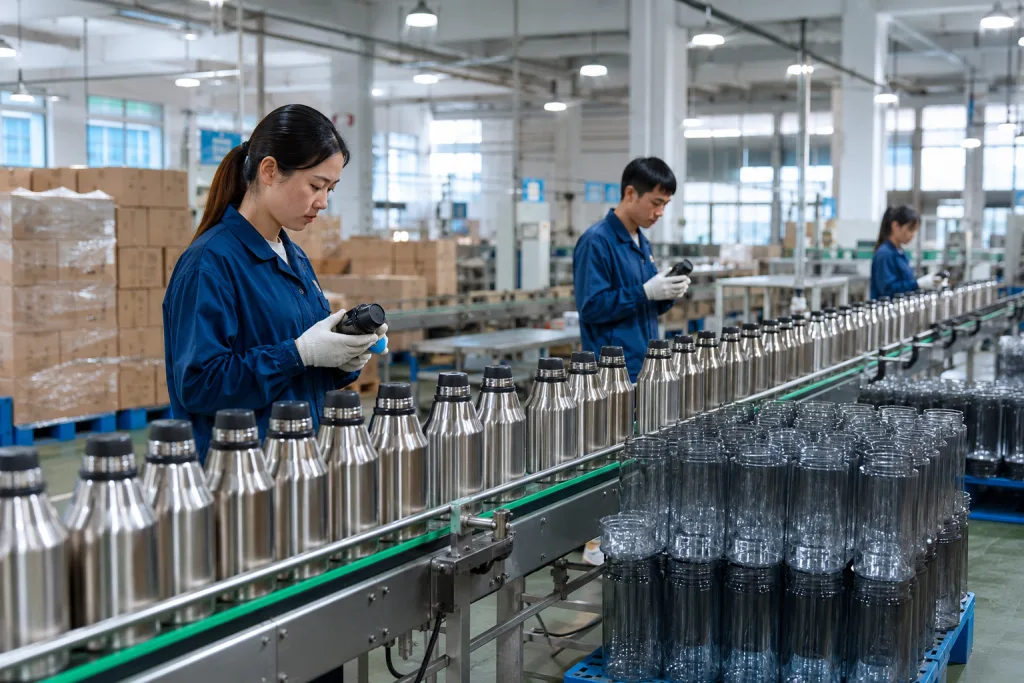
Key Takeaways
- For custom thermos orders, define leak test, coating adhesion, and vacuum retention before mass production; 80% of disputes come from undefined QC points.
- A practical MOQ is 1,000 to 3,000 pcs per SKU, with 25-35 days lead time and typical FOB China pricing from USD 2.80 to 6.90 depending on size and finish.
- Use AQL 2.5 for major defects and AQL 4.0 for minor defects, or your thermos supplier and your inspector will judge defects differently.
- If you are mixing PETG bodies with stainless components, specify temperature range, BPA-free declaration, REACH status, and cap torque values in writing.
You searched for a petg thermos bottle factory. First correction: PETG and stainless steel do not run the same on the line. We see buyers mix them up on the first RFQ, then approve one clean-looking sample and end up with 5,000 units showing lid leaks, paint adhesion failure, weak vacuum hold, or logos fading after one dishwasher cycle. QC pulled a sample last month with a 0.4 mm lid fit gap, and the buyer flagged it only after mass production photos. That is where claims start.
At BottleForge Industrial in Hangzhou, Zhejiang, we see this shift all the time: a basic bulk thermos inquiry turns into a custom program with gift box packing, Pantone color matching, and compliance testing. Zhejiang factories can move in 12 days vs 18 days, but this is the wrong question to ask. Fast output hides the failure points. We run into them at the screen-print station, at vacuum testing, and during carton drop checks. You need the exact specs locked before deposit, from coating standard to leak test method to barcode position, or we have seen this go sideways over one PO typo and one missed approval sample.
Start With The Material Mismatch
The phrase petg thermos bottle factory trips up buyers fast because PETG is plastic, and a real thermos body is vacuum-insulated stainless steel. On the line, we see China suppliers use this term for 3 different builds: a stainless vacuum bottle with PETG lid parts, a PETG outer shell over steel, or a single-wall PETG sports bottle. Sort this out at quotation stage. If you miss it, you compare the wrong build and the wrong price, and we have seen this go sideways over one PO line that only said "PETG thermos 500ml."
For outdoor retail, stainless 18/8 inner and outer walls are still the practical choice for heat and cold retention. PETG fits visible lids, clear sleeves, and straw parts because it takes impact well and looks cleaner than standard PP after mold polish on a 600-grit tool. Still, PETG is not a substitute for a vacuum thermos body. This is the wrong question to ask: "Can PETG do the same job cheaper?" The math does not work. A manufacturer thermos quote at USD 2.20 per unit usually points to a single-wall PETG sports bottle or a hybrid build, not a true insulated bottle.
Ask your thermos manufacturer these points before sampling:
- Body structure: single wall, double wall, or vacuum insulated; QC pulled the sample last month on a "double wall" bottle that had no vacuum point at the base
- Steel grade: SUS304 inside, SUS201 outside, or full 304; buyers push back on cost here, but 201 outside and full 304 do not quote the same
- PETG location: cap shell, straw, window, sleeve, or body; this changes mold count and assembly time on the line
- Wall thickness: 0.4 mm, 0.45 mm, or 0.5 mm steel changes dent resistance and cost; 0.05 mm sounds small until drop-test results come back
- Temperature claim: 6 hours hot, 12 hours hot, or 24 hours cold are not interchangeable; we test this with a digital probe, not sales wording
At our Zhejiang plant, standard stainless vacuum capacity is 450,000 units per month across tumblers and thermos SKUs, but hybrid PETG plus steel models need tighter tooling review because part shrinkage and thread fit behave differently. A PETG cap can shrink 0.3 mm and start cross-threading if the mold correction is late. We run a thread gauge before mass production for that reason. If your quote says customizable thermos and the drawing says nothing about materials, you are still exposed, and the buyer usually flags it after sampling instead of before.
Leakage Usually Starts At The Lid
Most complaints on custom thermos projects do not come from the bottle body. They start at the lid assembly. Buyers spend days on powder coat color, logo size, and carton marks, then sign off the cap without fixing gasket hardness, thread tolerance, or flip-top cycle life. That is where returns start. On our line, QC pulled a sample last month because the silicone ring was 0.3 mm thinner than the signed sample, and that small gap was enough to cause seepage.
The usual failure path is plain. The pre-production sample passes a quick hand test, mass production starts, then 3% to 8% of finished units seep at the thread or vent after long transit. We have seen this go sideways after a 12-day sea transit test versus an 18-day bonded-warehouse hold, where pressure change exposed a weak vent plug. The thermos supplier says end users over-tightened the cap. The buyer says the molding was off. Most of the time both sides own part of it, because nobody set a torque range or a real leak standard. This is the wrong question to ask: “Does it leak?” Ask “At what torque, after how many cycles, and under what water temperature?”
What to lock before production
- Leak test: inverted 30 minutes at room temperature, then 70 degrees C hot water for 30 minutes
- Torque spec: for example 8 to 12 kgf-cm for screw caps
- Gasket material: food-grade silicone, Shore A 50 to 60
- Cycle test: 2,000 open-close cycles for retail, 500 cycles minimum for promotional thermos programs
- Thread standard: approved against master sample and go/no-go gauge
If you are buying bulk thermos for distributors thermos channels, complaint tolerance is lower than on a short-term promotional run. A distributor thermos account selling through outdoor stores will feel a 1% leak rate fast, because reviews go public and replacement freight kills margin. We normally recommend 100% vacuum check, 100% lid fit check, and random hot-water leakage verification every 500 pcs during assembly in China. We run the go/no-go gauge at the cap station, and the line lead records failed thread starts by shift. If the buyer flagged lid scratches on a prior PO, we also add a fit-and-appearance check before packing.
When a lid design is new, do not jump straight to 10,000 pcs. Build 300 to 500 pilot units and abuse them first.
Vacuum Failure Is A Silent Defect
A bottle can pass appearance and still fail in use. We see this on the line. Vacuum loss is one of the most expensive defects because final appearance inspection will not catch it. QC pulled the sample, the logo was clean, the carton drop looked fine, and the short leak test passed. Then 7 to 14 days later, the weak vacuum seal shows up and your custom thermos performs like a standard double-wall bottle.
The usual causes are poor welding at the bottom plug, unstable vacuum extraction, or damage during polishing and powder coating. We have seen hairline distortion after sanding on thin bodies. Thinner steel such as 0.35 mm can cut cost on a thermos bulk order, but the math does not work if the body deforms at the neck or base during handling. For a manufacturer thermos built for outdoor retail, 0.4 mm inner and 0.45 mm outer is a safer baseline than pushing for the lowest FOB China price. We check this with a wall-thickness gauge, not guesswork.
QC for insulation should be written into the PO, not left as a sales promise. This is the wrong question to ask: “Does it hold temperature?” Write the test method. A workable spec is:
- Heat retention: fill at 95 degrees C, measure after 6 hours and 12 hours
- Cold retention: fill with 0 to 4 degrees C water, measure after 12 hours and 24 hours
- Vacuum test: 100% automated vacuum inspection on line
- Drop test: 3 drops from 80 cm in retail pack for transit risk review
Outdoor retailers usually need a stronger performance claim than promotional brands. We ship both, and the buyer pushback is different. If your packaging says 12 hours hot and the lab result is 9.5 hours on average, that is not a small gap. It is a claim-risk issue. For customized thermos projects shipping to Europe or North America, keep a retained sample from first article, from pilot run, and from final production. Mark the cartons by date and PO number. We have seen this go sideways when the buyer flagged insulation loss and the PO even had a typo on the item code.
Surface Finish Fails Faster Than Buyers Expect
Paint and decoration failures are the first thing buyers see. A custom thermos with a scratched powder coat or a logo rubbing off after 7 days looks low-grade, even if the insulation test passed 12 hours. We ship plenty of vacuum bottles where the heat hold is fine, but the buyer flagged the logo edge because it scuffed in carton transit. For thermos promotional campaigns, that logo is the product.
These failures are predictable on the line. Usual causes are weak pretreatment before coating, under-cured powder, the wrong pad print ink, or a Pantone expectation that the finish cannot hold on curved steel. Matte black covers a lot; beige and white show every dust point and oil mark from a glove. We run adhesion checks after cleaning, and QC pulled the sample more than once because a 0.3 mm speck showed through a pastel coat. If you are buying thermos custom finishes from China, ask how the steel is cleaned before coating and which in-house adhesion test the factory actually runs. This is the right question.
For most supplier thermos programs, these specs are practical:
- Powder coat thickness: 60 to 80 microns
- Adhesion: cross-hatch test minimum 4B
- Salt spray: 24 to 48 hours depending on finish claim
- Color tolerance: Delta E under 1.5 against approved standard for critical brand colors
- Logo durability: 100 rubs with alcohol for screen print check, or laser engraving for permanent mark
Promotional brands often pick the cheapest decoration and then push back when the graphics age badly after 3 months on shelf. The math doesn't work. Silkscreen on a curved thermos bottle is cost-effective, usually adding USD 0.08 to 0.18 per color, but it is not the toughest option once bottles start knocking together in export cartons. Laser adds around USD 0.12 to 0.25 and usually solves long-term abrasion issues on coated stainless. We have seen POs with the logo position typoed by 5 mm, then the buyer still blamed print durability after approval. For high-volume distributors thermos programs, match the decoration method to the sales channel, not just to how the pre-production sample looks under showroom lights.
Compliance Paperwork Gets Misread
One reason buyers get stuck in a petg thermos bottle factory search is simple: mixed-material bottles create mixed compliance paperwork. A stainless body, PETG lid shell, PP inner parts, silicone seal, and painted exterior do not sit under one lazy "food safe" statement. We see this on the line all the time. One buyer sent a PO for a 650ml bottle and expected one declaration to cover the lid, straw, and spray paint; QC pulled the sample and flagged that gap in 15 minutes. For serious retail, that paperwork does not pass.
For Europe, buyers usually ask for REACH SVHC screening and, based on the exact structure, food-contact declarations for the materials that touch liquid or mouth. For North America, ASTM standards often hit kids items more directly, while California Proposition 65 comes up on adult drinkware almost every week. BSCI or Sedex is still not a product test. This is the wrong question to ask, but buyers ask it anyway, and we ship the audit file separately from the lab file so nothing gets mixed. Last month a buyer flagged a Sedex report and thought it covered a silicone straw; it did not.
The practical rule is straightforward: ask for reports that match the exact bill of materials for your SKU, not a random bottle from last season. A thermos factory can hold valid reports and still send the wrong set if the cap resin changed from Tritan to PETG or the seal hardness moved from 50 to 60 Shore A. We've seen this go sideways. One mismatch on a lid insert that was 0.3 mm thinner forced a retest.
- Ask for: stainless grade declaration, BPA-free declaration for PETG and PP parts, REACH statement, packaging material statement, and test lab name
- Check dates: reports older than 2 years need a second look if material source changed
- Verify scope: report should match lid, straw, paint, seal, and decoration where relevant
At BottleForge in Zhejiang, we normally build compliance files during sample approval, not after deposit, because a late cap resin change can add 10 to 14 days. The math doesn't work if your booking window is tight. We run that review while the sample room is still adjusting mold fit and thread torque, usually at MOQ 3000 pcs, because 30 days can slip to 45 days fast and the buyer misses the retail floor set.
Packaging Damage Is Usually Self-Inflicted
Factories do not cause every dent and scratch. We see this on the line all the time: the bottle passes final check, then the buyer signs off on weak packing and the claim comes back after transit. Outer cartons get crushed in container stacking, and handles or painted shoulders pick up marks. Last month QC pulled the sample and the bottle was clean, but the corner drop on a 5-ply carton left a 14 mm shoulder rub. The supplier thermos gets blamed because the packing spec was never written tight enough.
If you sell through outdoor chains, the pack has to survive container stacking, domestic courier handling, and shelf display. Those are three different abuse points. We ship promo thermos orders loose in master cartons all the time, and the cosmetic risk is acceptable at that price level. Gift box and e-commerce mailer jobs are different. A 0.6 kg bottle with powder coating needs transit protection built around actual product weight, box fit, and how much empty space is left after the insert is locked.
Use real packaging specs, not generic notes like export carton. This is the wrong question to ask, by the way. The right question is what load, drop, and scan condition the pack must pass:
- Individual pack: polybag plus egg-crate divider, or color box with EPE tray; we usually check tray float at 3-5 mm on each side
- Drop standard: ISTA-inspired internal check from 76 cm with filled master carton; QC pulled the sample after 6 faces and 2 corners
- Master carton: 5-ply or 7-ply, burst strength stated; the math does not work if a 12 oz bottle and a 40 oz bottle share one carton spec
- Carton weight: keep under 12 kg when possible to reduce throw damage; once cartons hit 14 kg, we've seen this go sideways at parcel hubs
- Shipping marks: SKU, color, quantity, gross/net weight, PO, and country of origin; one PO typo in the color code can hold receiving for 2 days
For Amazon or DTC projects, review FNSKU placement, suffocation warnings, and barcode scan windows before printing. We run a quick scanner check on the curved panel and on the box seam because the buyer flagged this before on a 5,000-piece order. A thermos vendor can pack exactly what the PO says and still create a warehouse receiving problem if the barcode sits over a seam or curved panel. Good packaging is not glamorous. On a 1x40HQ thermos bulk shipment, it is usually the cheapest insurance in the whole order.
Bad Sampling Creates Expensive Mass Production
The sample stage is where most thermos factory disputes get stopped or locked in. We see buyers ask for a free sample, approve it from 3 phone photos, then place a 3,000-piece order. Bad move. It saves USD 40 on the front end and can cost USD 4,000 in rework after the line starts.
A serious custom thermos program needs clear sample gates: concept sample, pre-production sample, and golden sample. If the design has PETG visual parts, a special texture, or a new lid platform, add a pilot run. This is where the line tells the truth. We have seen cap warp at 0.8 mm, color drift between Pantone chips and molded PETG, sleeve scratches after carton drop tests, and poor nesting that cut one master carton from 24 pcs to 20. In Zhejiang, a factory can hand-build one clean sample on a bench. The wrong question is whether that sample looks good. Ask if we can run the same result at 20 pcs per minute without QC pulling the sample every hour.
We recommend writing these checkpoints into your order file:
- Sample approval: signed drawing with dimensions, capacity tolerance, and decoration position; we usually mark key points in mm on the print so the buyer cannot flag logo shift later
- Pre-production meeting: confirm BOM, QC plan, and packaging standard; one typo on a PO can change a straw lid to a flip lid, and we have seen this go sideways
- Inline QC: vacuum, leak, appearance, and logo checks every 500 pcs; the line should record results by station, not by guess
- Final inspection: AQL 2.5 major, AQL 4.0 minor, based on packed goods; packed goods matter because loose samples hide carton rub marks
- Lead time buffer: keep 7 days margin for rework on new customized thermos designs; if a lid torque test fails at 1.2 N.m, those 7 days disappear fast
For most thermos manufacturers, MOQ for a standard stainless bottle is 1,000 pcs per color, while custom lid tooling can add USD 800 to 2,500 and another 12 to 20 days. That is normal. Vague drawings are not. We ship against approved specs, not guesswork, and the math does not work if the supplier has to fill missing details after tooling starts. Clear specs are what make a reliable thermos factory relationship, whether you buy factory thermos for retail shelves or thermos promotional stock for a campaign deadline.
Send your thermos spec before you place the order
We will review drawings, materials, lid structure, packaging, and QC points for your stainless or PETG-related drinkware project from Zhejiang, China.
Frequently asked questions
Can a petg thermos bottle factory also make true insulated stainless thermos bottles?
Sometimes yes, but you need to verify what they actually produce in-house. Many China suppliers use broad wording and may offer PETG bottles, stainless vacuum bottles, and hybrid models under one catalog. Ask for the exact body construction, monthly capacity, and workshop photos. A real insulated stainless line should have vacuuming equipment, leak-testing stations, polishing, coating, and assembly control. If the factory only injects PETG parts and outsources steel bodies, that affects lead time and QC accountability. A practical check is to request a BOM, steel grade declaration, and recent production photos of the vacuum line. For retail-grade custom thermos orders, I would also ask whether they can support MOQ 1,000 to 3,000 pcs per SKU and 25-35 day lead times consistently.
What MOQ should I expect for bulk thermos with custom logo and packaging?
For a standard stainless vacuum bottle with existing mold, MOQ is usually 1,000 pcs per color and around 500 pcs for simple logo tests if the factory allows it. If you want a new lid, custom handle, or PETG visual component in a special color, MOQ often moves to 2,000 to 3,000 pcs because molding setup, resin matching, and spare loss all increase. Basic silkscreen may add USD 0.08 to 0.18 per color, laser marking about USD 0.12 to 0.25, and a custom color box another USD 0.25 to 0.60 depending on print coverage and insert type. The mistake is chasing the lowest MOQ from a thermos supplier, then paying more through quality instability and split production.
How do I inspect a customized thermos order before shipment?
Use a written inspection plan with measurable criteria. For final inspection, AQL 2.5 for major defects and AQL 4.0 for minor is a workable starting point on packed goods. Major defects include leakage, vacuum loss, wrong logo, sharp edges, or incorrect barcode. Minor defects cover light scratches, small paint dots, or carton print issues within agreed tolerance. I would require 100% vacuum inspection during production, 100% lid fit check, and random leak tests with hot water every 500 pcs. Also inspect packaging drop resistance, carton markings, and assortment count. If the order is for outdoor retail rather than one-off promotional thermos use, keep retained samples from approved pre-production and finished bulk lots so disputes are tied to a real standard.
What compliance documents should I ask for on stainless and PETG thermos products?
At minimum, ask for stainless material declaration, BPA-free declaration for PETG and PP parts, silicone gasket declaration, and REACH-related paperwork for the EU market. If the product is for kids or has child-oriented branding, ASTM-related questions may become relevant depending on the market. For large retail programs, buyers often also request BSCI or Sedex audit documents from the China factory, although those are social compliance records, not product tests. Make sure the paperwork matches the exact SKU BOM. A report from another bottle with a different lid or paint system is not enough. Check report dates too. If the reports are older than 24 months and the supplier changed resin, seal source, or coating line, retesting is the safer decision.
How long should custom thermos production take from sample to shipment?
For an existing stainless model with standard coating and one logo, expect about 5-7 days for sampling and 25-35 days for bulk production after sample approval and deposit. If you add custom packaging, molded PETG parts, or a new cap tool, sampling can take 10-20 days and mass production 35-45 days. Sea freight booking and export paperwork from Zhejiang or other China ports add more time, so do not plan only around factory days. I usually tell buyers to keep a 7-day buffer for rework on first orders. The biggest delays are not random. They come from late artwork approval, unclear packaging specs, or compliance files requested after production has already started.