Key Takeaways
- PETG bottles usually start around USD 1.10-2.40 FOB for 1,000-3,000 pcs, while double-wall 304 stainless thermos orders are more often USD 3.20-6.80 FOB at 500-1,000 pcs
- If you need 6-12 hour heat retention, PETG is the wrong spec; vacuum stainless with 0.4 mm inner and 0.5 mm outer walls is the practical choice
- Typical custom logo lead time from Zhejiang, China is 25-35 days after sample approval, with pre-production samples in 5-7 days
- For promotional thermos programs, decoration and compliance matter as much as price: REACH, LFGB, FDA contact safety, and AQL 2.5 inspection should be standard
You searched for petg thermos bottle bulk, but PETG is usually not the real decision point. The real question is whether it fits your temperature claim, decoration method, target retail price, and return rate. We have seen buyers bring a clean bottle concept to the table, then the buyer flagged the same issue at sampling: a lower-cost PETG body looks good, but it does not sell like a true insulated stainless build once the cold-hold claim hits the carton.
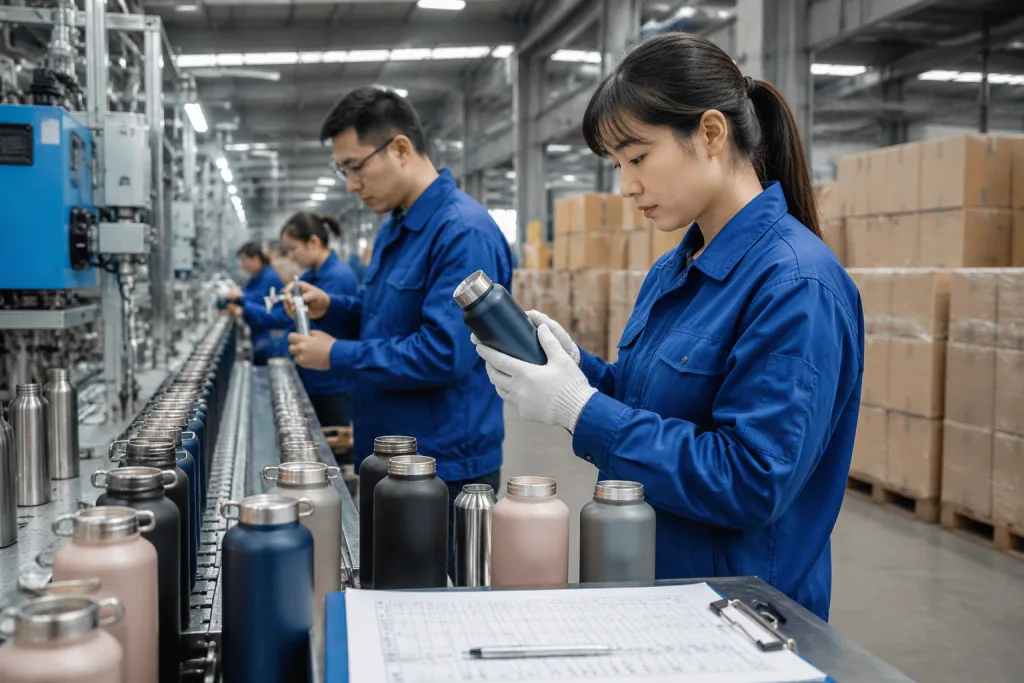
From our factory in Hangzhou, Zhejiang, China, we run into this every month. Buyers ask for a custom thermos, but the use case splits fast. If you need cold retention, drop resistance, and repeat orders through distributor programs, stainless usually wins; on our line, QC pulled the sample after a 1.2 m drop test and the stainless unit stayed in spec. If you need lower weight, lower FOB cost, and faster color matching, PETG still has a place. You need the numbers, not sales talk. This is the wrong question to ask if the product still has to perform like a thermos.
Start With The Real Split
The term petg thermos bottle bulk trips buyers up. We see this on RFQs every week in Hangzhou. PETG bottles get labeled as thermos bottles in search results, but in 8 out of 10 cases the buyer actually wants insulated performance. PETG is a clear or tinted copolyester plastic. It looks clean, takes strong color well, and works for promo programs where the logo has to pop on a transparent body. Still, it is not a vacuum flask material. Stainless is. This is the split that matters before you talk artwork, 5-layer pack-out, or carton marks printed at 32 mm height.
For outdoor retail, start with use-case. If the end user carries the bottle for hiking, commuting, or winter sports, heat retention for 12 hours and dent resistance usually matter more than saving USD 1.50 per unit. We have seen buyers push on price first, then come back after a drop test on the trail sample. For promotional brands, the first filter is different: landed cost, logo area, and how fast we can ship a repeat order under a thermos custom or customizable thermos program. On the line, that usually means faster screen setup and simpler color approval.
At our Zhejiang operation in China, we frame the choice like this. This is the right question to ask first.
- PETG: lower unit cost, lighter weight at roughly 180 g to 260 g for common sizes, visually clean, easier for transparent or bright color concepts, but weak on insulation credibility. If a buyer wants a "thermos" look with no vacuum build, this is where the claim usually goes sideways.
- Stainless thermos: higher FOB cost, heavier at roughly 280 g to 420 g, stronger for repeated use, better gift value, and real hot/cold retention. We run leak tests after vacuuming, and QC pulled the sample more than once because the cap fit was off by 0.3 mm.
If you are buying for distributors thermos channels, consistency matters more than a clever product title. The buyer flagged this before on a PO that said "thermal bottle" while the approved sample was single-wall. A line that claims thermal performance but acts like a single-wall bottle creates complaints fast, and the math does not work once returns start. That is why the product page name matters less than the actual build: PETG single-wall, stainless single-wall, or stainless double-wall vacuum.
When a buyer asks for a custom thermos and the target price is under USD 2.00 FOB, we check immediately whether they truly need insulation. Most of the time, the answer changes the entire project.
Head To Head Spec Table
Below is the side-by-side spec check most buyers ask for before they request samples from a supplier thermos source or a manufacturer thermos factory. We usually send this after QC pulled the sample and weighed the bottle on the bench scale.
| Spec | PETG Bottle | Stainless Vacuum Thermos |
|---|---|---|
| Common capacity | 500-1000 ml | 350-1200 ml |
| Body material | PETG, often 0.8-1.2 mm wall | 304 SS inner 0.4 mm, outer 0.5 mm common |
| Insulation | Single-wall only | Double-wall vacuum |
| Heat retention | Minimal | 6-12 hrs common at usable temp |
| Cold retention | Short-term only | 12-24 hrs with ice depending on lid |
| FOB price | USD 1.10-2.40 | USD 3.20-6.80 |
| MOQ | 1000-3000 pcs | 500-1000 pcs on standard molds |
| Decoration | Silkscreen, heat transfer, UV print | Silkscreen, laser, powder coat, digital wrap |
| Drop performance | Good, but scratch-prone | Strong body, may dent on impact |
| Perceived value | Entry to mid | Mid to premium |
The price spread above is based on standard lids, one-color print, brown box pack, and FOB Ningbo or Shanghai from Zhejiang, China. That is the clean baseline. Once you add powder coating, custom lid tooling, gift box, or multi-position print, stainless can move up by USD 0.60-1.80 per piece. We see this on the line all the time, especially when the powder coat spec calls for 60-80 micron thickness. PETG also climbs fast if you ask for tight Pantone matching, wide-wrap graphics, or 4-SKU low-volume assortments. The buyer flagged this before on a PO that said "same red as cap" with no Pantone code, and the math did not work.
Where buyers get misled
A lot of thermos suppliers sell with lifestyle copy instead of build data. This is the wrong question to ask: "Does it feel premium?" Ask for the exact body structure, steel grade, plastic resin, and retention test method. Ask for numbers. Ask for cross-section photos. A real thermos factory should answer with details like 304 stainless inner, 0.4 mm wall, 95C fill test, and a 6-hour reading. We ship these reports with sample sets.
If they cannot tell you whether the inner tank is 201 or 304, or whether PETG parts contact liquid directly, keep pushing. Last month a buyer sent us a competitor sheet that missed the inner steel grade and had a lid weight gap of 18 g from actual sample check. That is not a small miss. It usually means the trading side copied old data. You are not being difficult. You are buying correctly.
Use Case Fit By Channel
The right material depends on the sales channel and what the end user will do with the bottle after delivery. We see this on the line all the time. A bulk thermos order for outdoor retail gets judged by 2-hour heat hold and shelf comparison, while a conference giveaway order gets judged by logo size, landed cost, and whether 3,000 pcs can ship before the event date on the PO.
Outdoor retail: Stainless is usually the better fit. Customers expect actual performance, especially in the 500-750 ml range where they compare bottles side by side. If a PETG bottle sits next to insulated drinkware, the label has to be clear. We have seen this go sideways. Buyers pour in hot coffee at 7 a.m., check again around 9 a.m., then the return rate moves. For this channel, a 304 stainless vacuum build with a leak-tested lid, powder coat, and retail box is the sensible factory thermos specification. We run lid leak checks at 0.03 MPa, and QC pulled the sample more than once because a silicone ring was seated 1 mm off.
Promotional brands: PETG can work when the budget is tight, the event date is close, and the client cares more about visual branding than heat retention. The big logo area helps. The parcel weight is lower too. On one 5,000 pc campus job, the buyer flagged freight first, not insulation. Lower entry cost fits campus campaigns, wellness programs, and summer promotions, especially when MOQ needs to stay practical. Still, call it a bottle, not a high-performance thermos, unless the construction supports that claim. This is the wrong question to ask if the first target is just "cheapest thermo look."
Distributor thermos programs: This is where stainless usually becomes the safer long-term SKU. Distributors want fewer complaints and broader seasonality. They also want one item they can ship into corporate gifting, outdoor accounts, or commuter programs without rewriting the pitch every time. A 450 ml or 500 ml stainless vacuum bottle does that job better than PETG in most catalogs. We have had buyers try to stretch one PETG item across all channels, and the math doesn't work once claim risk, return handling, and repeat orders are counted.
- Choose PETG when the target FOB is under USD 2.50, visual impact matters more than insulation, and the project size is 3,000 pcs or above. At that volume, we can usually keep printing efficient on the line with a larger logo panel and lighter carton weight.
- Choose stainless when you need gift-grade perceived value, real thermal retention, or a reusable product that can carry a higher MSRP. We ship more repeat programs in stainless because buyers get fewer after-sales complaints and more honest thermos positioning.
For most thermos distributor and thermos vendor buyers in Europe and North America, the final decision comes down to claim risk. That is the part buyers miss. If your catalog says thermos, stainless keeps that claim honest. AQL 2.5 inspection will not save a weak product claim, even if the sample approval was signed with a typo on the PO.
Customization Changes The Math
A standard bottle is easy. A custom thermos changes the math on lead time, MOQ, and rejection risk. Buyers often treat decoration like a small add-on. This is the wrong question to ask. On PETG and stainless, the print method drives unit cost, defect rate on the line, and the shelf look after shipping.
For PETG, the common options are silkscreen, UV print, and shrink or heat-transfer graphics. PETG gives strong color and a clean surface, but it shows scratches and print registration drift faster than powder-coated steel. QC pulled samples last month with a 0.3 mm logo shift, and the buyer flagged it right away. If your artwork has fine lines under 0.2 mm, test first.
For stainless, the common options are powder coating plus silkscreen, laser engraving, or full-wrap printing. Powder coat adds grip and hides light handling marks; we usually run 60-80 μm film thickness on the line. Laser lasts and looks more premium, but it disappears on some dark colors if the coating stack is wrong. We’ve seen this go sideways on matte black when the customer approved the color chip but not the engraved contrast.
Normal custom costs from a manufacturers thermos factory in China look like this:
- Silkscreen logo: about USD 0.05-0.18 per color per position
- Laser engraving: about USD 0.08-0.25 per position
- Powder coating: about USD 0.35-0.90 per piece
- Custom color masterbatch for PETG: often USD 80-200 per Pantone run
- New lid mold: typically USD 3,500-8,000 depending on complexity
Our Hangzhou, Zhejiang factory planning usually runs 5-7 days for pre-production sample approval and 25-35 days for mass production. Standard stainless lines ship roughly 30,000-50,000 units per day when components are in stock and cartons are booked. Miss one lid part, and 12 days turns into 18 days. That matters if you are building a thermos bulk program across multiple SKUs.
What to lock before deposit
- Artwork size in mm, not just a PDF visual
- Logo position reference from bottle seam or handle centerline
- Color standard such as Pantone C code
- Packaging method: egg crate, polybag, white box, color box, PDQ
- Barcode needs such as FNSKU or EAN placement
Most preventable claims start with vague approvals, not bad factories. We have seen POs with a barcode typo and no distance from seam callout, then the whole 3,000 pcs lot gets held for rework.
Compliance, Testing, And Inspection
If you buy from thermos manufacturers in China without locking compliance at the RFQ stage, you usually pay in two places: lead time and customs risk. We have seen orders slip 12 days vs 18 days just because the buyer flagged LFGB after sampling, not before mass production. Outdoor retail and promo programs in Europe and North America usually ask for a mixed file set: material safety, social audit status, and pre-shipment inspection.
For PETG or stainless drink-contact items, ask for the exact standard set for your market and sales channel. Typical requests include FDA or LFGB food-contact testing, REACH for EU chemical compliance, and CA Prop 65 screening for some US programs. If the item is for children, you may also need ASTM or CPSIA-related checks depending on the lid, straw, sleeve, or small accessories under 3.2 mm review points. This is the wrong question to ask late.
Factory system standards matter too. A solid thermos supplier should speak clearly about ISO 9001, BSCI or Sedex audit status, raw material traceability, and incoming QC records. If you are sourcing stainless vacuum bottles, ask how they check weld integrity, vacuum rate, and leak performance on the line; on our side, QC pulled the sample and checks seam welds after vacuuming, then we run a pressure and soak check before packing. If the supplier gets vague here, we have seen this go sideways.
Inspection should be fixed before production starts. Put it on the PO. We once saw a PO typo on carton drop requirement, and the buyer meant 3 drops while the factory read 1 drop. That cost a retest. For example:
- AQL: Major 2.5 / Minor 4.0 is common for finished drinkware
- Leak test: 100% on assembly line for screw-lid insulated bottles
- Temperature retention test: sample-based, defined method such as hot water at 95 degrees C checked after 6 hours
- Drop test: usually 1-3 drops depending on packaging and sales channel
Do not let a thermos supplier say a product is “export standard” without naming the standard. That phrase means nothing. Good Zhejiang factories hear buyer protocols every week, and we ship against named specs, not slogans. The issue is not whether testing is unusual. It is that new buyers often ask after the line starts, and then the math doesn't work.
MOQ, Lead Time, And Landed Cost
For 7 out of 10 buyers, the best-looking bottle still loses on the spreadsheet. Landed cost decides the order. We look at unit price, tooling, sample charge, packaging, inspection, duty, and freight in one sheet, and the line usually catches the problem at carton spec, not bottle cost.
PETG often wins on FOB unit price at first glance. That is not the right question to ask. If your PETG order needs a 3,000-piece MOQ, mixed custom colors, and retail box packing, the cash tied up can land higher than a 500-piece stainless run on an existing mold, especially once we add carton drop-test work and a 1.2 mm EVA insert.
Typical planning numbers for supplier thermos projects from Zhejiang, China:
- PETG bottle MOQ: 1,000-3,000 pcs depending on color and mold
- Stainless thermos MOQ: 500-1,000 pcs on standard shapes; 3,000+ for fully new tooling
- Sample charge: USD 50-150 for logo sample, often refundable after order
- Mass production lead time: 25-35 days standard, 40-50 days in peak season
- Third-party inspection: roughly USD 250-350 per man-day in East China
Freight shifts the math again. Stainless is heavier, so we ship it best when carton loading is tight and pallet height stays under 1.6 m; PETG is lighter, but air freight usually makes no sense on low-margin promo orders unless the buyer flagged a launch delay and the stockout cost is worse than the freight bill.
A practical buying rule
If the product needs to support a retail price above USD 19.99, stainless usually gives a stronger value story. If the product is a short-run giveaway with a hard landed cost under USD 3.50, PETG is often the cleaner answer. We have seen this go sideways when a buyer tries to make one material cover both jobs, then QC pulled the sample and found the packaging spec was wrong for the channel.
When you ask thermos suppliers for quotes, request FOB price, carton count, carton gross weight, CBM, and lead time in the same sheet. Ask for the outer carton size in mm too. We run quote comparisons this way because the buyer flagged more than one offer that looked cheap until the PO showed a typo on carton quantity and the freight spread erased the savings.
Get the right thermos spec before you place bulk
Send your target price, quantity, market, and use case. We will recommend PETG or stainless with MOQ, lead time, FOB pricing, and compliance checkpoints.
Frequently asked questions
Can PETG really be sold as a thermos bottle in bulk?
You can sell PETG bottles in bulk, but calling them a thermos is risky unless your market accepts the term loosely. PETG is usually single-wall and does not provide vacuum insulation. In practical terms, it may hold a cold drink for normal daily use, but it will not deliver 6-12 hour heat retention like a double-wall stainless vacuum bottle. For promotional programs under USD 2.50 FOB, PETG still works well if the client wants visual branding and low weight. For outdoor retail, most buyers shift to 304 stainless once they define the actual performance claim. If your carton, PDP, or catalog says insulated, ask your thermos supplier to provide a documented retention test before you approve production.
What MOQ should I expect for custom stainless thermos orders?
On existing molds, a realistic MOQ for custom stainless thermos orders is 500-1,000 pieces per size and color. If you want a fully custom lid, new base shape, or exclusive body tooling, MOQ often moves to 3,000 pieces or more, plus mold cost of roughly USD 3,500-8,000. For PETG bottle projects, MOQ is commonly 1,000-3,000 pieces because color setup and production batching are less flexible. In Hangzhou and broader Zhejiang, China, many factories will allow lower trial quantities for standard items, but you usually give up some price efficiency. If a supplier quotes a very low MOQ and a very low price together, check whether they are offering old stock, mixed components, or limited color options.
How long does a customized thermos project usually take?
For a standard customized thermos using an existing mold, plan 5-7 days for a pre-production sample and 25-35 days for mass production after approval and deposit. In peak season, especially from August to November, lead time can stretch to 40-50 days if coating lines or lid suppliers are tight. New tooling adds another 20-35 days depending on the lid complexity and whether sealing parts need repeated testing. Add 2-5 days for third-party inspection booking and report release. If you need retail barcodes such as FNSKU, shelf-ready packaging, or multiple logo placements, lock that artwork before sampling. Most delays in China are not from steel forming. They come from late approvals on color, packaging, or print position.
What compliance documents should I ask thermos manufacturers for?
Ask for the documents tied to your actual market, not a generic compliance file. For Europe, that usually means REACH and often LFGB for food-contact confidence. For the US, FDA food-contact testing is common, and some programs also request CA Prop 65 screening. If the item is marketed to children, ASTM or CPSIA-related requirements may apply depending on design and accessories. Beyond lab reports, ask the factory for ISO 9001 status, BSCI or Sedex social audit records if your brand requires them, and a clear product spec sheet showing steel grade, plastic resin, and gasket material. Good thermos manufacturers in Zhejiang, China should also accept an AQL standard such as Major 2.5 and Minor 4.0 written into the PO.
How should I compare quotes from different thermos suppliers?
Use one quote sheet and force every thermos supplier to fill the same fields. At minimum, compare FOB price, MOQ, sample cost, production lead time, carton quantity, carton size, gross weight, decoration cost, and included compliance reports. Ask whether the bottle uses 304 or 201 stainless, whether the lid contact parts are PP, Tritan, or PETG, and whether leak testing is 100% or sample-based. For PETG projects, confirm wall thickness and scratch resistance expectations. For stainless, request the temperature retention test method, not just the claim. A quote that is USD 0.30 cheaper can become worse overall if the carton weight is 15% higher or the supplier excludes inspection support. Spreadsheet discipline saves more money than bargaining noise.