Key Takeaways
- For PETG thermal bottle custom, wall thickness below 0.7 mm often leads to haze, stress marks, or drop-test failures; 0.8-1.0 mm is a safer commercial range.
- A 1,000-3,000 unit MOQ is common, but print method, color matching, and mold changes can push lead time from 25 days to 45 days.
- Leakage issues usually come from cap geometry and silicone hardness; specify 50-60 Shore A gaskets and 100% vacuum or inversion testing.
- Set QC upfront with AQL 2.5 for major defects and AQL 4.0 for minor defects, or your canteen customized order will be judged differently by every batch.
You can approve a PETG bottle that looks good on the showroom table and still end up with a costly mess once we run mass production. We have seen leaks after 3 weeks, cloudy walls after 28 days on sea transit, logos rubbing off inside the carton, and a cap that passed one 1.2 m drop test while the next batch failed. This is the real risk in petg thermal bottle custom projects. Usually it is not one big failure. It is 5 or 6 small spec gaps stacking up, and QC pulled the sample too late.
If you are sourcing from China or comparing a canteen supplier in Zhejiang with another canteen factory inland, write the product spec around failure points, not a pretty rendering. At BottleForge Industrial in Hangzhou, Zhejiang, we see this every month: the buyer flagged the finish, the PO missed a 0.3 mm thread tolerance, and the line had to stop for cap fit checks. Buyers ask for custom drinkware, but what they need is a tighter RFQ, clear QC limits, and realistic production tolerances. This is the wrong question to ask if the first discussion is only about shape and color.
Start With Material Reality
PETG fixes some problems and brings new ones. Buyers use petg thermal bottle custom too loosely, like PETG can do the same job as stainless vacuum ware. It cannot. PETG is a copolyester, and on our line the empty 650 ml body comes out about 120-150 g lighter than a comparable double-wall flask. You get clean clarity, lower weight, and tighter color control. You do not get true vacuum insulation. If your market expects 12-hour hot retention like a double-wall 304 flask, this is the wrong question to ask. PETG is the wrong base material. We have seen buyers push for a "thermal look" at PETG cost, and the math does not work. In that case, use a stainless structure with an outer custom shell, or move to a different custom canteen program.
PETG works best in a canteen customizable format for school, promo, gym, and entry-price retail. We ship a lot of these in 500 ml and 700 ml programs where shelf look matters more than heat retention. You want visual appeal, better impact resistance than brittle standard plastics, and unit cost around USD 1.60-3.20 FOB China depending on size, lid set, print, and packout. Last season one buyer flagged scratches after carton drop, and QC pulled the sample back to compare body hardness by resin lot. The common mistake is assuming all PETG resin grades run the same. They do not.
- Food-contact grade: Ask for documented REACH and LFGB or FDA declaration depending on market. We usually tie this back to the resin lot code on the bag, not a loose supplier promise.
- Clarity target: Define acceptable haze level by approved golden sample, not by casual wording like “clear enough.” We check this against a retained sample under a 6000K light box.
- Wall thickness: For 500-750 ml bodies, 0.8-1.0 mm usually balances drop resistance and resin cost. On the factory floor, a 0.1 mm cut saves material fast, and that is exactly where weak sidewalls start.
- Temperature limit: PETG should be specified for warm-fill or ambient use unless validated otherwise. We have seen this go sideways when a PO says "hot drink bottle" but the test standard was never written down.
If your canteen manufacturer in Zhejiang quotes unusually low pricing, check what they cut first. Usually it is wall thickness, downgraded regrind blend, or a simpler cap with fewer sealing parts. Last month we saw a sample with thread flash around 0.3 mm and a lighter cap insert; the buyer caught leakage on the second drop test. That is where future claims start. A reliable canteen factory in China should state the resin source, regrind percentage if any, and intended use condition in writing. If they will not write it down, do not treat the quote as comparable.
Where Leaks Actually Begin
Most leak claims get blamed on the bottle body. That is usually the wrong call. We see the failure start in the cap system: thread pitch off by 0.2 mm, gasket compression too light, spout plug fit too loose, vent hole cut wrong, or a hinge that warps after 600 openings on the line. If you buy from a canteen vendor or canteen distributors and approve only a hand-tight sample, you are guessing, and we have seen that go sideways.
You need a cap spec with numbers, not nice wording. We run this from drawing to line check. That means neck finish drawing, thread start position, torque range, gasket material, gasket hardness, and a pass-fail leak method written on the PO, because one buyer once typed "silcon" and the supplier shipped the wrong seal. For a standard custom drinkware bottle, we recommend these checkpoints before mass production:
- Gasket: Food-grade silicone, 50-60 Shore A, consistent cross-section. QC pulled the sample and checked flash at the parting line; anything over 0.3 mm is asking for trouble.
- Torque: Define cap closing torque, for example 0.8-1.2 N·m for a medium PETG bottle. The math does not work if the seal needs brute force to pass.
- Leak test: 100% inversion test for 30 minutes, plus random vacuum or air-pressure verification per batch. We ship only after the line passes this, not before.
- Cycle test: 500-1,000 open-close cycles on flip lids for distributor drinkware programs. Use a fixture, not thumb testing, or the result means nothing.
One practical point: a cap that seals on a polished T1 sample mold can start leaking after the production mold wears or after a supplier swaps silicone source. This happens fast. We have seen a gasket compression change from 1.4 mm to 1.1 mm between sample stage and bulk run, and the buyer flagged it only after drop testing. That is why you should approve both a pre-production sample and a production-line sample. They are different checks.
“Leakproof” is not a marketing adjective. It is a test condition with a temperature, orientation, torque value, and duration.
If you are buying for a canteen distributor network in Europe or North America, ask your canteen supplier to define major defect criteria clearly: any visible drip after inversion, thread skip, or mis-seated gasket should be major, not minor. AQL 2.5 does not fix a loose definition. We have had inspectors argue over one hanging drop at shipment stage, and that argument usually starts because nobody wrote the standard clearly at the start.
Clouding, Scratches, and Surface Shame
A PETG bottle can leave the line clean and land in your warehouse looking rough. We see this often. Surface damage is one of the hidden costs in a petg thermal bottle custom order because clear and translucent bodies show every mark under retail lights. QC pulled the sample last month and a 0.8 mm haze band near the shoulder was obvious from 30 cm. Micro-scratches, rub marks, gate blush, and light clouding all show up fast.
The root causes are usually basic shop-floor issues: uneven wall thickness, hard de-molding, bad carton partitions, or no PE bag between units. One buyer pushed for USD 0.03-0.06 less per unit on packing, then the line came back with a 2-4% appearance defect rate. The math doesn't work. We have seen this go sideways on drop test cartons where bottles touched shoulder to shoulder.
What to lock down in the spec
- Appearance standard: Define viewing distance, for example 30 cm under daylight-equivalent lighting.
- Color tolerance: If tinted, set a Pantone reference and acceptable delta by approved sample.
- Packaging: PE bag or recycled bag per unit, egg-crate divider or partition if the bottle shoulder is exposed.
- Transit test: ISTA-style carton drop and vibration check for export pack.
In 7 out of 10 canteen custom programs, especially canteen promotional orders, the bottle is not the only appearance risk. Coatings matter. Frosted finishes and soft-touch paints look good on the approval sample, but they scratch faster than most buyers expect once 48 units are packed into a master carton. If the use case is an event giveaway, school program, or ecommerce replenishment, a plain tinted PETG body with direct print usually ships cleaner than a sprayed finish.
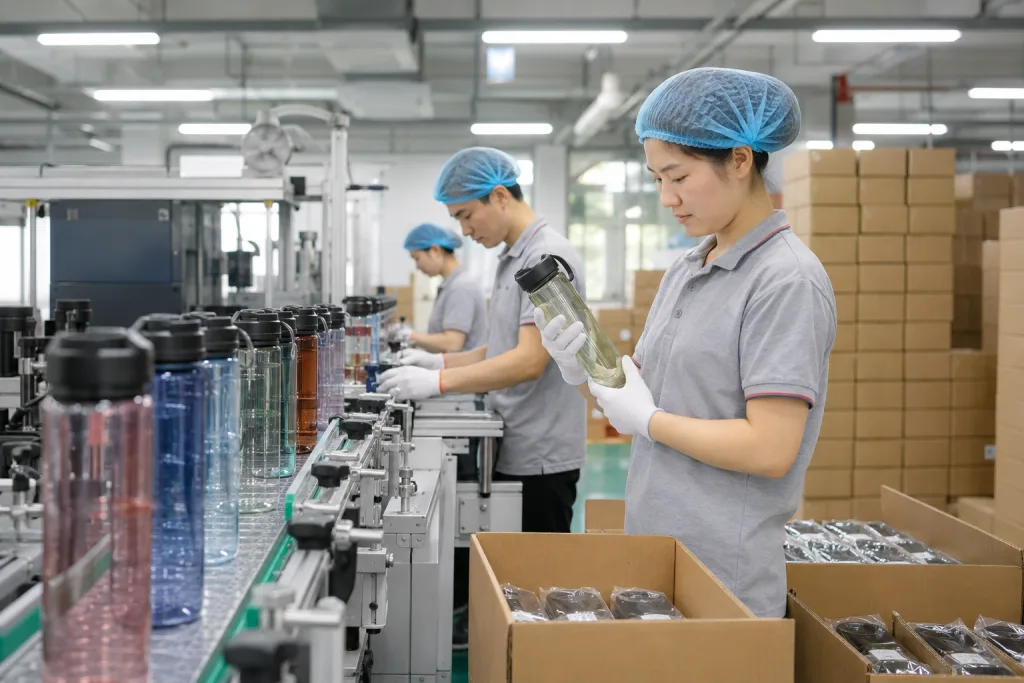
Factories in Zhejiang and other parts of China that run 300,000 to 500,000 units per month usually have solid molding capacity. Packing is where problems start. This is the wrong question to ask if you only compare molding tonnage. Ask for photos or video from the actual pack-out line, not the front office sample room. If bottles are sliding loose in bulk bins before bagging, the defect rate was already built on the floor.
Print Failures Cost More Than Resin
On 7 out of 10 custom drinkware projects we quote, the bottle body is fine and the branding is where the order gets burned. Logos rub off after carton friction, registration walks 1.8 mm on the line, metallic ink cracks near a 42 mm curved panel, or the dishwasher claim was wrong from day one. For a custom canteen or customizable growler program, decoration is where margin disappears, because one bad print run turns a good molded bottle into scrap. We have seen QC pull 300 pieces from a 5,000-unit lot for logo loss alone.
Pick the print process by end use first. Artwork is the second question, and sometimes this is the wrong question to ask. Screen printing is the usual low-cost option for bold spot graphics, and we run it fast on straight-wall sections with a steel screen frame. Heat transfer gives wider color range, but the line needs tighter temperature and pressure control or you get edge lift on day one. UV print looks clean on sample photos, but adhesion lives or dies on surface treatment and curing time. A dyne pen will tell you fast if pretreatment is weak. Laser is not usually relevant for PETG body decoration the way it is on stainless.
- Silkscreen: Typical low-cost option, often USD 0.08-0.20 per color per unit.
- Heat transfer: Better for complex graphics, often USD 0.18-0.45 per unit.
- Pad print on caps: Fine for small marks, but not for high-wear zones.
Ask for the adhesion test method in the QC plan. Do not leave this vague. A basic cross-hatch tape test is better than nothing, and QC should record the tape grade used and the cut spacing, usually 1 mm. For higher-risk orders, add rub testing such as 50 dry rubs and 20 wet rubs with no obvious ink loss. If your customer is a distributor growler or distributor canteen buyer selling into rough commercial use, push harder on validation. We ship into gym chains and school programs, and those accounts will flag print wear in the first week.
Specify logo position tolerance in the PO. Saying “centered” is not a production instruction, and the buyer flagged this exact wording on a 12,000-piece reorder last year after first article approval. A sensible standard might be +/-1.5 mm horizontal and +/-2 mm vertical on a 600 ml bottle. The more curved the print panel, the tighter-looking artwork becomes harder to hold, so the math does not work if the tolerance is written like a flat carton print job. Too many disputes with canteen vendors start because the buyer approved flat artwork only and never signed off on a printed 3D sample from the actual production tooling.
Compliance Delays Nobody Budgets For
Most buyers ask about compliance too late. The bottle is almost done, cartons are booked, and then the buyer flagged REACH, LFGB, Proposition 65, or ASTM paperwork. If you are buying customized canteen products for Europe, North America, or a major retail chain, that gap can kill the launch window. We have seen a 12-day test booking push shipment to 18 days, and the line was already waiting on a 0.8 mm straw sample.
A serious canteen manufacturer should map this out at the RFQ stage. They should tell you which documents are standard, and which ones need third-party testing. Do not assume every canteen manufacturer in China keeps current reports for every colorant, lid component, straw, and print ink. Reports expire. Suppliers switch. One substituted masterbatch can void the old file, and QC pulled the sample on one order here because the blue lid pigment did not match the approved batch card.
- EU market: Ask for REACH SVHC declaration and food-contact test support if relevant.
- US market: FDA food-contact declaration, plus California Proposition 65 review when applicable.
- Kids programs: Add ASTM or CPSIA-related checks where the product category requires it.
- Factory systems: ISO 9001 and BSCI are useful indicators, but they are not product compliance by themselves.
If you are sourcing a customizable drinkware line with straws, bite valves, or mixed-material lids, each component needs traceability back to the BOM. The body resin may pass, while the decoration ink or silicone pigment fails. This is the wrong question to ask if you only ask whether "the bottle" passed. You need the full build checked. Your approved sample should tie to a signed specification sheet listing resin grade, gasket grade, color code, and print process, and we usually stamp that sheet after a lid torque check at 12-15 lbf.in.
For timing, allow 7-12 days for routine third-party test scheduling in China, and 15-20 days if samples need remake after a failure or color change. A canteen factory promising 20-day shipment on a fully new customized growler or custom drinkware project without discussing testing is skipping a step or assuming you will accept standard paperwork without review. We ship fast when the file is clean. If not, the math does not work, especially once a PO typo on the color code forces a new sample set.
QC Without Clear Tolerances Fails
Buyers often say they want “strict QC.” On the line, that means nothing. You need an inspection plan with numbers people can actually run against. For petg thermal bottle custom orders, the safer setup is a short QC sheet with clear limits, so the factory, the third-party inspector, and your team read the same standard. We have seen this go sideways over a 1.5 mm logo shift that one side called acceptable and the other side rejected.
At BottleForge Industrial in Hangzhou, Zhejiang, we usually suggest a practical baseline: AQL 2.5 for major defects, AQL 4.0 for minor defects, and 100% inspection for leakage before packing. We run leak checks with an air-pressure fixture before cartons are sealed. This is not the only standard, but it beats arguing after 5,000 bottles are already on pallets and the buyer flagged defects from phone photos.
Define these points before deposit
- Critical defects: Sharp burrs that cut a finger, failed food-contact compliance, or a missing safety component. QC pulled the sample once for a burr around the mouth edge at 0.3 mm, and the whole lot had to be reworked.
- Major defects: Leaks, a cracked body, an unreadable logo, wrong color, or severe haze. This is the wrong question to ask late in production; if “wrong blue” is not tied to a signed Pantone or approved sample, the math does not work.
- Minor defects: Small specks, slight print shift within commercial tolerance, or a light carton scuff. We usually set the print shift against an approved sample, not someone’s memory after mass production starts.
- Dimensional tolerance: Height, diameter, neck finish, and weight range. Put the numbers down in mm and g, then check them with a caliper and scale instead of vague words like “close enough.”
- Functional checks: Drop test, cap torque, odor check, and assembly fit. On one PO, the buyer typed the lid code wrong, and the assembly fit issue showed up only after trial fitting on the first 200 units.
For a 5,000-unit custom canteen order, ask for pilot-run retention samples from the first 100-300 units. Do that early. Then require shipment photos by pallet and by carton marking. We ship these photos before balance payment in most programs, and they need to show pallet labels, carton count, and barcode position clearly. If the goods are going to Amazon FBA or another distributor channel, add barcode placement, carton weight limit, and FNSKU instruction into the pack spec. A 3 cm barcode offset sounds small until Amazon refuses the carton.
Lead time needs realism too. A repeat bottle with old tooling may run in 25-30 days. A new lid color, new print, new package insert, and fresh testing can stretch to 35-45 days fast. On the factory side, a new insert card often causes more delay than molding, because the line stops while packing details get fixed. Our own MOQ for many bottle programs starts at 1,000 units per color, but schedule risk usually sits in decoration and packaging complexity, not the injection machine cycle time. Good canteen suppliers should tell you that up front.
Send your PETG bottle spec before you place it
We will review drawings, leak points, print method, and QC limits, then tell you where the order is likely to fail before production starts in China.
Frequently asked questions
Is PETG a good choice for a thermal bottle project?
It depends on what you mean by thermal. PETG is suitable for a bottle that handles ambient or moderately warm beverages and where low weight, clarity, and lower FOB cost matter. It is not a substitute for true double-wall vacuum insulation. If your retail promise is 8-12 hours hot retention, use stainless construction instead. For promo, school, and entry-level retail custom drinkware, PETG can work well at roughly USD 1.60-3.20 FOB China for 500-750 ml, depending on lid and print. Ask your canteen manufacturer to state the intended use temperature, wall thickness, and whether the bottle is single-wall, air-gap, or decorative double-wall. That prevents sales language from outrunning the actual product.
What MOQ should I expect for petg thermal bottle custom orders?
For a standard existing bottle shape, MOQ is commonly 1,000 units per color or 3,000 units mixed across a program, depending on the canteen factory and print method. If you need a custom lid, body mold change, or exclusive color masterbatch, MOQ can jump to 5,000-10,000 units because tooling, setup scrap, and packaging minimums all increase. A plain silkscreen custom canteen is easier to run than a heat-transfer customized growler with a gift box. In Zhejiang and other export hubs in China, the practical question is not just MOQ. It is whether the MOQ matches a stable process. A factory offering 300 units on a complex bottle often builds hidden cost into unit price or loosens QC.
How do I reduce leakage claims before shipment?
Put the leak standard into the purchase order and QC sheet. Do not accept generic wording like leakproof. Specify lid torque, gasket material, gasket hardness, and test method. A good commercial baseline is silicone gasket at 50-60 Shore A, 100% inversion test for 30 minutes after filling, and random pressure or vacuum validation by batch. For flip lids or straw caps, add 500-cycle opening and closing checks because hinge fatigue causes many later failures. On a 5,000-unit order, the added test cost is small compared with returns. Also approve a production-line sample, not only a polished pre-production sample, because thread fit and gasket seating can change once the line runs at volume.
What compliance documents should a canteen supplier provide?
For Europe, ask at minimum for REACH SVHC declaration and food-contact support if the product is sold for beverage use. For the US, ask for FDA food-contact declaration and review whether Proposition 65 is relevant for inks, pigments, or accessories. If the bottle is for children, additional ASTM or CPSIA-related requirements may apply depending on how the item is marketed. Also ask the canteen supplier for the BOM list tied to the approved sample, because compliance can fail on a straw, gasket pigment, or print ink rather than on the PETG body. Third-party testing in China usually takes 7-12 working days once the final sample is ready, so build that into lead time.
How should I inspect a first order from a new canteen manufacturer?
Use a staged approach. First, approve a specification sheet with dimensions, weight, resin, print method, and packaging details. Second, approve a pre-production sample and then a production-line sample. Third, set inspection criteria: AQL 2.5 major, AQL 4.0 minor is a workable starting point for many custom drinkware projects. Require 100% leak test before packing and define appearance at a fixed viewing distance, such as 30 cm under standard lighting. On a first order, I would also book a pre-shipment inspection when 80% of goods are packed and ask for retention samples from the first production run. That gives you something objective to compare against reorder batches.