Key Takeaways
- For petg sport bottle wholesale, send a 12-point RFQ with capacity, weight, lid type, color standard, print method, packaging, target price, and destination port before asking for FOB pricing.
- Typical MOQ is 3,000 pcs per SKU and lead time is 25-35 days after deposit and pre-production sample approval in Zhejiang, China.
- Approve a sealed golden sample with tolerance notes: capacity ±3%, weight ±5 g, color ΔE target, and leak test standard before bulk starts.
- Write PO line items down to carton drop requirement, AQL 2.5 inspection level, REACH or FDA request, and spare parts ratio of 1%-2%.
You can buy a PETG bottle at a low price from 20 factories in China by Friday. That part is easy. The hard part is getting the same color, the same lid torque, the same print registration, and cartons that still pass drop test after sample approval all the way to 20,000 units on water. We’ve seen this go sideways when the RFQ is one page, the sample was approved on looks only, or the PO missed basic tolerances like ±1 mm on bottle height and cap fit.
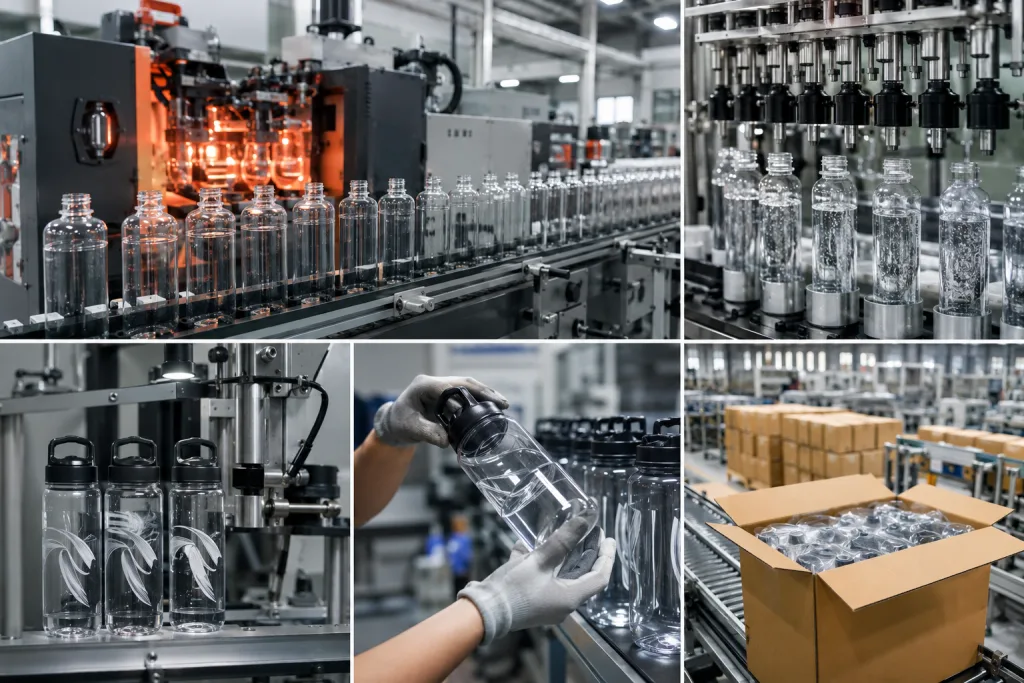
If you are comparing petg sport bottle wholesale options against wholesale drinkware, wholesale canteen, or even a broader drinkware bulk program, ask for the process first, not just the quote sheet. This is the right question. At BottleForge Industrial in Zhejiang, China, we build around 600,000 units per month across drinkware lines, with typical MOQ from 3,000 to 5,000 pieces per color. We run incoming resin checks, lid fit tests on the line, and pre-shipment inspection before loading. The steps below are the practical path from first RFQ to bulk shipment without expensive surprises.
Start with an RFQ buyers can quote
Most sourcing mistakes start before the first quote. A buyer asks for a "best wholesale drink bottle" and gets 6 prices for 6 different products. One factory quotes a 650 ml PETG body at 118 g with a PP flip lid. Another quotes 700 ml at 135 g with a Tritan-like look but a different resin. A third sends a canteen wholesale price for a wide-mouth bottle with no carry loop. On paper, the numbers look close. They are not the same item. We’ve seen this go sideways after tooling review, when QC pulled the sample and the body weight was 11 g off the PO.
Your RFQ should read like a buying spec, even if 2 or 3 points are still open. This is the right way to ask for petg sport bottle wholesale. The wrong question is “what’s your best price?” Price without spec is noise. Put these line items in the RFQ so the line, the sales team, and QC all quote the same bottle:
- Body material: PETG resin grade, food-contact requirement, BPA-free declaration
- Capacity: nominal and brimful, for example 750 ml nominal / 790 ml brimful
- Unit weight: target 125 g ±5 g
- Wall thickness: for example 1.8-2.2 mm average body wall
- Lid construction: PP screw cap, TPR seal, carry loop, one-hand flip, straw or chug
- Decoration: 1-color silkscreen, 2-color wrap, heat transfer, or UV print
- Color standard: Pantone reference and transparency level
- Packaging: polybag, egg-crate divider, white box, color box, barcode label
- Compliance: REACH, LFGB, FDA, CA Prop 65 if needed
- Trade term: FOB Ningbo or Shanghai, or DDP by destination
- Volume: trial 3,000 pcs, annual forecast 60,000 pcs
- Target timing: sample in 7-10 days, mass production in 30 days
The same RFQ structure also works if your team buys bulk canteen, wholesale growler, beer tumbler wholesale bulk, or alcohol flask wholesale bulk. Different SKU, same discipline. In Zhejiang, China, factories reply faster when the RFQ already locks the commercial points that affect cost and lead time. We run quotes every day, and a clean RFQ usually gets you an accurate offer in 1 round instead of 3. Last month one buyer flagged a lid mismatch that came from a single typo on the PO: “straw” instead of “chug.” That cost 4 days.
Judge the quotation beyond unit price
Once the offers come back, do not stare at the first price column. A PETG sport bottle at USD 1.42 FOB can cost more than one at USD 1.51 FOB if the body weight is cut by 18 g and the bottle ovalizes in transit, if the cap leaks after 20 cycles on our torque tester, or if the print reject rate goes past 4% and QC pulled the sample on the line.
Ask every supplier to quote on the same basis. This is the right starting point. A clean quote sheet should show:
- FOB port in China, usually Ningbo or Shanghai
- MOQ per color and per logo, such as 3,000 pcs/SKU
- Mold status: existing mold or new tooling fee
- Sample charge and refund terms
- Production lead time after deposit and artwork approval
- Carton size, GW/NW, and container loading quantity
- Testing cost if third-party lab work is required
- Spare lids or extra units included or charged separately
Then push on the number with commercial questions, not small talk. First, is the resin virgin PETG or mixed with regrind? For export drinkware wholesale, you want a straight answer, not “same as market.” We have seen buyers flag black specks in clear bottles after regrind was added at 8%. Second, what is included in decoration setup? Screen charge, film charge, Pantone matching, and print position check should be spelled out. Third, what are the payment terms? Typical export terms from Zhejiang are 30% deposit and 70% balance against inspection or copy B/L. If a supplier offers 100% before production for a standard item, that is not normal for established B2B work. Frankly, this is the wrong question to ask last.
Example PO planning at quote stage: 5,000 pcs x 750 ml PETG bottle, smoke gray body, black PP lid, 1-color white print, FOB Ningbo, target unit price USD 1.48, outer carton 24 pcs, 1% spare lids packed separately. Put these assumptions in writing now. We ship plenty of orders where the trouble starts from one loose line on the PI: carton count changed from 24 pcs to 36 pcs, or the cap gasket switched without notice. One PO even came in with the logo color typoed as “while” instead of “white.” That kind of mistake costs 12 days, not 2.
You do not need the lowest quote. You need the one that still works after inspection, transit, and customer use.
Make samples carry the real risk
Buyers often approve a sample because it looks fine on a desk under office lights. That is the wrong standard. For petg sport bottle wholesale, the sample stage is where we push risk out of bulk production and into a controlled test cycle, before the line runs 5,000 pieces with the same mistake.
Ask for three sample levels if timing allows:
1. Counter sample
This confirms shape, dimensions, lid function, and approximate weight. We usually check body height, mouth diameter, and base OD with a digital caliper, then do a quick cap-on torque check. It works for early sales review. It is not for bulk approval.
2. Pre-production sample
This should use the actual PETG body, actual lid tooling, actual gasket, and the intended print process. No substitutions. If the silk screen on the sample uses one ink set and mass production uses another, QC pulled the sample for the wrong reason. If you sell into Europe, include migration and odor checks where required. We have seen buyers skip this, then flag a smell issue after 12 days in transit.
3. Golden sample
Once approved, seal one or two pieces, sign and date them, and tie them to the PO number. Put the PO number on the bag and on the outer label; we once got a PO with one digit typed wrong, and the approved sample was matched to the wrong SKU. This becomes the reference for production and final inspection.
Testing should be practical, not theatrical. For a sport bottle, run a 24-hour inverted leak test, hot-fill simulation only if claimed, 10-20 dishwasher cycles only if the product is marketed that way, odor check after 48 hours closed, and a simple drop test in carton from 80 cm to 100 cm depending on your retail channel. We run these on the bench, not as a showroom demo. PETG is not the same as stainless steel. If your market needs insulated product, compare that separately with bulk drinkware in stainless categories rather than pushing PETG to do a job it was not built for. We have seen this go sideways when a buyer wanted PETG to hold heat like a double-wall flask; the math doesn't work.
Sample-stage PO notes: item code, color code, approved logo size in mm, print position from bottom seam, capacity tolerance, bottle body transparency standard, and carton mark layout. Put all of it in writing. If you also source canteen bulk, growler bulk, or alcohol flask in bulk from the same factory group, keep approval files separate by SKU family. The buyer flagged this once on a mixed order because the transparency standard from one SKU was copied onto another. Buyers get into trouble when they mix approval standards across categories.
Write the purchase order like a spec
A weak purchase order creates claims. A tight one shuts them down. For procurement teams, this is where sourcing turns into contract control. We’ve seen this go sideways over a 2 mm logo shift that was never written on the PO.
Your PO for petg sport bottle wholesale needs more than quantity and price. Put in acceptance points the line can check with a scale, Pantone card, and caliper. This is the wrong question to ask: “Is the PO detailed enough?” Ask instead: “Can QC pull the sample and approve or reject it in 3 minutes?” A basic but usable line-item structure looks like this:
- Item: 750 ml PETG sport bottle, item BF-P750
- Order qty: 10,000 pcs
- Colors: 6,000 smoke gray Pantone Cool Gray 10C, 4,000 clear blue Pantone 7690C
- Lid: black PP screw cap with TPR seal and woven carry strap
- Net weight: 125 g ±5 g body, 28 g ±3 g lid
- Decoration: silkscreen 1C white, max logo width 65 mm
- Packaging: each in polybag, 24 pcs/ctn, export 5-layer corrugated carton
- Carton spec: burst strength or edge crush requirement if you use it, carton marking artwork attached
- Compliance: REACH Annex XVII, LFGB or FDA on request, no phthalates in seals
- Inspection: AQL 2.5 major / 4.0 minor, based on ANSI/ASQ Z1.4 unless otherwise agreed
- Lead time: 30 days after deposit and golden sample approval
- Shipment term: FOB Ningbo
- Payment: 30/70
- Spare parts: 1% extra lids free of charge
If your buying team also handles wholesale canteen, wholesale growler, beer growler wholesale bulk, beer tumbler in bulk, or alcohol flask wholesale, use the same PO discipline. It works across categories because the factory still needs the same checkpoints: color, weight, print, pack-out, and inspection basis. Simple rule. If you might argue about it later, write it now. Last month a buyer flagged “matte black lid” on email, but the PO only said “black PP,” and the line ran gloss.
Factories in Zhejiang move fast once the PO is locked. We run tooling prep, raw material booking, and carton print in parallel. The delay usually comes from buyer changes after artwork approval, or from carton revisions after board stock is booked. One common issue is a PO typo on carton count—24 pcs/ctn became 24 ctns total—and then shipping had to stop and reconfirm before we packed.
Control production before cartons close
The best time to catch a problem is before 10,000 lids hit the assembly table. On standard drinkware bulk orders, we run three checkpoints: pre-production review, in-line inspection, and final random inspection.
Pre-production review is where the factory confirms raw material, color masterbatch, print film or screen, gasket hardness, and packaging materials. For PETG, ask if they dry the resin before molding and at what setting. We’ve seen haze show up after a hopper dryer was set wrong for one night shift. Poor drying leads to brittleness, haze, and uneven clarity. This is the right question to ask early, not after the first pallet is wrapped.
In-line inspection matters because bottle problems usually show up after the line has been running for 2 hours, not on the first 20 pieces. Watch cap torque variation, neck finish mismatch, print shift, and color drift. A solid in-line check covers dimensions, leak test results, weight, cosmetic defects, and assembly fit every 1-2 hours. QC pulled the sample, checked weight on a digital scale, and found a 3 g swing between cavities on one PETG bottle run last month. If you are buying from China for Amazon FBA or a retailer with strict packaging rules, confirm barcode location and carton labels before more than 20% of production is packed. We’ve seen this go sideways over one PO typo on a carton mark.
Final random inspection should happen when at least 80% of goods are packed. Use AQL levels agreed on the PO. Typical checks for a PETG sport bottle include odor, leakage, print adhesion, quantity count, carton drop check, and verification that actual packed assortments match the shipping mark. If the order includes related SKUs like wholesale drinkware sets, canteen wholesale items, or beer tumbler wholesale, inspect each SKU separately. Mixed cartons hide mistakes. The buyer flagged this on a 3-SKU shipment after one carton had the right outer mark and the wrong bottle inside.
At BottleForge Industrial, our normal lead time for this category is 25-35 days depending on color count and packaging complexity. A rush order can sometimes be compressed to 18-22 days, but only if artwork, deposit, and sample approval are locked early. We ship fast from Zhejiang, China. That part is easy. Uncontrolled fast production is just a faster way to make defects, and the math doesn’t work once 500 cartons need rework before loading.
Plan shipment, compliance, and repeat orders
Bulk approval is not the end of the job. Freight and compliance decide if the order still makes money. PETG sport bottles ship well, but carton planning changes the result fast. A 750 ml bottle with handle lid might load around 11,000-13,000 pcs in a 40HQ depending on nested packing and carton dimensions. We usually ask the packing team for a load plan with carton size, GW per carton, and pallet notes before the line finishes. If you are consolidating with bulk growler, beer growler in bulk, or wholesale canteen lines, ask early. We’ve seen this go sideways when one PO used a 5 mm taller lid and the last 280 cartons no longer matched the booking.
For Europe and North America, keep the document set clean: commercial invoice, packing list, bill of lading, testing reports if required, and origin documents if your customs broker asks for them. Check paperwork before shipment, not after the vessel cut-off. On our side, QC usually pulls the sample set and document file together so the item code, carton count, and PO wording match; one typo in the consignee line is enough to hold a draft. If you need retailer compliance or social audits, ask at sampling stage whether the factory can support BSCI, ISO-style QA documentation, or specific retailer checklist formats. Do not assume every plant in China has the same paperwork readiness. This is the wrong question to ask at booking week.
For repeat orders, build a simple scorecard after the first shipment. Use numbers. Track on-time delivery, defect rate, claim closure in 48 hours or 7 days, unit price movement, and communication accuracy. If a supplier misses the promised ex-factory date by 9 days on each order, they are not a 30-day lead-time supplier. They are a 39-day supplier with optimistic emails. We run this check against the PO date, sample sign-off date, and final inspection date, because the buyer flagged “late shipment” once when their own artwork approval was 6 days late.
This is where category expansion gets easier. Once the factory relationship is stable, you can add adjacent items such as drinkware wholesale assortments, growler wholesale programs, or alcohol flask bulk accessories under the same QA setup. Still, keep the sourcing logic straight. Approve each material family on its own merits. PETG for sport hydration. Stainless for heat retention. Separate specs, separate tests, separate POs. The math doesn't work if you use one checklist for all of it; a 304 stainless vacuum body and a PETG single-wall bottle fail in different ways on the line.
Buy carefully from Zhejiang and keep PO line items disciplined. Then petg sport bottle wholesale turns into a repeatable supply program, not a quarterly rescue mission. Even a small detail matters: MOQ split by color, spare straw ratio, or a carton mark that matches the customs file.
Send your PETG bottle RFQ with full specs
Share your target capacity, MOQ, logo method, packaging, and destination port. We will quote practical options from Zhejiang, China within 24-48 hours.
Frequently asked questions
What MOQ should I expect for petg sport bottle wholesale?
For export-ready PETG sport bottles, a realistic MOQ is usually 3,000 to 5,000 pcs per SKU per color, depending on lid style, print method, and packaging. If you use an existing mold, some factories in Zhejiang, China will accept 2,000 pcs for a trial order, but unit price may rise by USD 0.08 to USD 0.18. If you need a custom lid or body mold, MOQ often moves to 5,000-10,000 pcs to amortize tooling and setup. For simple clear bottles with one stock lid, 3,000 pcs is common. For mixed-color runs, ask whether MOQ is per color or total PO quantity. That changes your actual landed cost.
How much does a PETG sport bottle cost in bulk?
A standard 600-750 ml PETG sport bottle with a PP screw lid usually lands in the USD 1.10 to USD 1.90 FOB range from China, depending on weight, resin quality, decoration, and packaging. A lighter 100-115 g body with plain polybag packing sits near the low end. A heavier 125-145 g body with strap lid, 2-color print, and color box can move above USD 1.70. If you add custom Pantone matching, special seals, or retail-ready inserts, expect another USD 0.05 to USD 0.20. Always compare quotes on the same weight, wall thickness, and packing basis. Cheap bottles often become expensive claim files.
What tests should I require before placing bulk production?
At minimum, require a 24-hour leak test, dimensional check, net weight check, print adhesion test, odor evaluation, and packaging drop check. For regulated markets, ask for food-contact compliance aligned with your market, such as FDA, LFGB, or REACH-related declarations and test reports where applicable. If the bottle is sold as dishwasher safe, test at least 10-20 cycles on the approved sample. If it includes a strap or carry loop, ask for pull-force checking. For mass production, tie the golden sample to the PO and inspect to AQL 2.5 major / 4.0 minor. If your order ships to Amazon, also verify carton labels and FNSKU placement before final packing.
How long does production take after sample approval?
For a standard petg sport bottle wholesale order using existing tooling, normal lead time is 25-35 days after deposit, artwork confirmation, and golden sample approval. A plain bottle with one stock color and simple one-color print can sometimes ship in 20-25 days. If you need custom lid colors, multiple SKUs, or retail packaging, 30-40 days is more realistic. Add 5-10 days if third-party lab testing must be completed before shipment release. During peak seasons, especially before summer promotions and Q4 gifting, book production slots early. In Zhejiang, China, factories can run fast, but raw material color matching and print setup still take time.
Can one supplier handle sport bottles plus growlers, tumblers, and flasks?
Sometimes, but you should verify category depth before consolidating. A supplier strong in PETG sport bottles may also handle some wholesale drinkware lines such as stainless tumblers or canteen bulk items, but that does not automatically mean they are equally strong in wholesale growler, beer tumbler wholesale bulk, or alcohol flask wholesale programs. Ask which products are made in-house versus subcontracted, and request separate QC standards by category. PETG, stainless steel, glass, and flask-grade metal products have different production controls and compliance risks. Consolidation can reduce admin cost, but only if QA responsibility remains clear and every SKU has its own approved sample and PO specification.