Key Takeaways
- For petg polypropylene bottle bulk, a realistic MOQ is 3,000-5,000 pcs per color, with 25-35 days lead time after sample approval
- A $0.18 cheaper quote can disappear fast if lid leakage exceeds 2% or decoration scrap runs above 5%
- Ask for AQL 2.5 final inspection, REACH testing on food-contact parts, and drop testing from 1.2 meters with filled samples
- For export from Zhejiang, standard 650-750 ml PETG bottles with PP lids often land around FOB China USD 1.10-2.40 depending on mold, print, and pack-out
You are not buying a bottle. You are buying an order that has to ship on time, pass compliance, survive a 1.2 m drop test, and still look clean on a retail shelf or in a distributor catalog. We see first-time buyers get stuck here with petg polypropylene bottle bulk. The bottle looks simple on the drawing. Then the buyer flagged a loose lid fit, the silk print scratched in carton transit, or the PO had a cap color typo, and the cheap quote stopped looking cheap. This is the wrong question to ask: price first, details later.
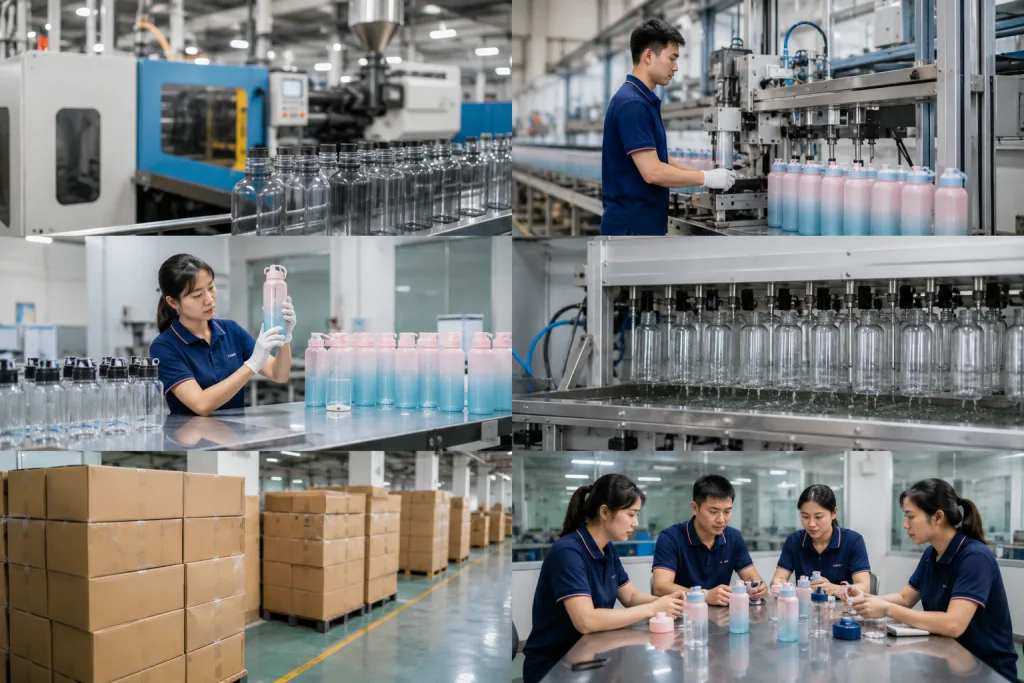
A practical way to source from China is to walk one order from spec sheet to final inspection, step by step, the same way we run the line in Hangzhou. Experienced buyers in Europe and North America do this on bulk drinkware, canteen wholesale projects, and adjacent lines like beer growler wholesale bulk or alcohol flask wholesale bulk. QC pulled the sample, checked thread match on a go/no-go gauge, then signed against the approved sample before packing. In Zhejiang, the factories that ship clean orders usually work this way too. We have seen this go sideways when a buyer skips one 0.5 mm tolerance callout and tries to fix it after mass production.
Start with the real use case
Say you are a brand owner launching a hydration line for gym chains and outdoor retail. The target spec is clear enough: 700 ml bottle, screw lid, carry loop, one-color logo, retail-ready box. Your landed cost has to stay below USD 2.80. So you ask for petg polypropylene bottle bulk. Fair ask. You want a clear body, decent drop performance, and a PP lid that color-matches cleanly on the Pantone book at the line.
This combination works for a reason. PETG gives the bottle body that glass-clear look without the breakage issue, and we usually check wall thickness around 1.2 mm to make sure the sample does not feel soft in hand. PP, usually called polypropylene or just PP, is the standard lid resin for threads, flip parts, and food-contact use. We run this body-plus-lid setup every month in Zhejiang for wholesale drinkware, wholesale canteen, and best wholesale drink bottle programs going to promo buyers, retail shelves, and private label. One buyer flagged haze on a first sample last year, and QC pulled the sample right after blow molding to trace it back to drying time.
At this stage, most buyers make the same mistake. They ask for a quote before the commercial basics are fixed. This is the wrong question to ask. Before we price anything, we need these points locked, because a 5,000 pcs MOQ quote and a 30,000 pcs quote do not carry the same tooling load or packing cost:
- Capacity: 500 ml, 650 ml, 700 ml, or 1000 ml
- Body weight: for example 110 g, 135 g, or 160 g PETG
- Lid style: screw cap, flip straw, or spout
- Seal structure: silicone ring or TPE gasket
- Decoration: silk screen, heat transfer, in-mold label, or sticker
- Packaging: bulk pack, egg-crate divider, or individual color box
- Compliance market: EU REACH, LFGB where needed, or U.S. FDA-contact expectations
That short list moves the quote more than most buyers expect. A plain canteen bulk order for a gym chain does not price the same as a retail color box pack for e-commerce; we have seen freight cube jump fast when the box insert adds 18 mm. It also does not price the same as growler bulk or beer tumbler wholesale bulk. Same factory. Different labor hours, inspection points, and claim risk. The math does not work if you compare them as one item.
Build the spec before price
Once the use case is clear, the factory needs to turn the concept into a working spec sheet. If that step is missing, you are buying from a sales chat, not from a production system. For petg polypropylene bottle bulk, the sheet should lock the key points: dimensions, capacity tolerance, material grade, color reference, logo position, carton details, and test requirements. We run this on paper before the line runs resin, and a missing 0.5 mm on the drawing has already cost buyers a new sample round.
A typical bottle body wall thickness for PETG sits around 1.8-2.5 mm, depending on shape and volume. That range is not random. At 1.6 mm, QC pulled the sample and saw panel deformation after hot-room storage; at 2.8 mm, the math doesn't work because resin cost goes up and the shelf look barely changes. For PP lids, thread engagement and gasket compression matter more than cap cosmetics. If torque is off, leakage starts fast. We usually check cap torque with a handheld torque tester, and this is the wrong question to ask if the discussion stays on glossy finish only.
What you should ask to see
- 2D drawing or 3D file with neck finish, thread spec, total height, and diameter
- Material declaration listing PETG for body, PP for cap, and silicone or TPE for seal
- Unit weight tolerance such as plus or minus 3%
- Capacity tolerance such as plus or minus 5%
- Color standard Pantone for lid and loop parts
- Logo artwork standard including print size and position tolerance, often plus or minus 1.5 mm
- Outer carton limit usually under 15 kg for manual handling
For 5,000 pcs drinkware bulk orders, FOB China pricing usually breaks like this: a standard 650-750 ml PETG bottle with PP screw lid in bulk carton lands around USD 1.10-1.55. Add a silicone sleeve, printed color box, or a flip-top lid with more moving parts, and price usually moves to USD 1.80-2.40. Tooling for a new cap can range from USD 1,500 to 4,500. A full new bottle mold can be much higher, often USD 4,000 to 12,000 depending on cavity count. We have seen this go sideways when the buyer flagged price first, then changed carton pack from 48 pcs to 36 pcs after drop-test review.
You do not control cost by asking for the lowest unit price first. You control cost by freezing the right specification early, then stripping out hidden waste in packaging, scrap, and rework. On one PO, the carton mark even had “QTY: 5000 SETS” typed as “500 SETS,” and that kind of loose front-end work always comes back on shipment week.
Sample approval is where margins move
Assume your Zhejiang supplier sends 3 pre-production samples in 7-10 days. That part is normal. One looks fine in photos, one leaks after horizontal storage, and one comes back with the logo 2 mm off-center when QC pulled the sample. Sampling is where margins move. You fix the problem here, before the line runs 5,000 or 20,000 units and the rework bill lands on your side.
For petg polypropylene bottle bulk, ask for at least 2 rounds on any custom project. Round one checks structure, fit, and seal. Round two checks production detail, like print position, color match, and whether the cap torque holds after assembly on the line. Do not approve from appearance alone. This is the wrong question to ask. Ask the supplier to test the actual assembled bottle, with the final lid, gasket, straw, and print process in place.
- Leak test: filled with water, inverted for 4 hours, then horizontal for 12 hours
- Drop test: filled bottle dropped 3 times from 1.2 meters onto hard surface
- Dishwasher statement: either tested and documented, or clearly marked hand-wash only
- Odor test: no strong resin or print smell after 24 hours closed storage
- Print adhesion: 3M tape test and 50 rub cycles minimum
This is also where adjacent keyword categories start to matter in real orders. We ship mixed POs all the time. A buyer will ask one factory to combine canteen wholesale with alcohol flask in bulk, or add beer tumbler in bulk and wholesale growler for a seasonal promotion, then flag it later because one item uses a silicone plug and another uses a threaded seal. That is workable with clean BOM control and one owner on the project. We have seen this go sideways when each SKU runs a different decoration line and the outer carton spec changes from 24 pcs to 36 pcs without anyone catching the PO typo.
At BottleForge-scale operations in Hangzhou, Zhejiang, a practical benchmark is 600,000 units per month across standard drinkware lines, with sample lead times around 7 days for existing molds and 25-35 days for repeat production after deposit and artwork approval. Those are usable numbers. If a factory cannot give output, MOQ, and timing that clearly, expect vague answers later, and the math does not work once booking space and promo dates start closing.
QC the order like a buyer
After you place the PO, QC needs to run with production. Do not wait until the container is half-booked and the line is already closing cartons. For petg polypropylene bottle bulk, we watch three checkpoints on the floor: incoming materials at IQC, in-process assembly during mass run, and final random inspection after packing. This is the wrong question to ask if a supplier says they will "check everything at the end." We have seen that go sideways.
Incoming checks need hard data, not guesses. IQC should confirm resin grade, masterbatch color, gasket hardness, and print materials against the approved sample and PO; on our side, QC pulled the sample and checks gasket Shore hardness with a durometer before the line starts. In-process checks should stay on thread fit, cap torque, weld lines, scratches, black specks, and leak rate. Final inspection should follow an agreed sampling level, usually AQL 2.5 for major defects and AQL 4.0 for minor defects unless your retailer already wrote stricter rules into the PO.
Typical defect classification
- Critical: leakage, cracked neck, odor contamination, wrong material declaration
- Major: loose cap fit, missing seal ring, incorrect logo color, deep scratches over 10 mm
- Minor: small specks, slight print shift within tolerance, light carton scuffing
Write the performance standard into the order. A bottle for children can trigger ASTM-related review depending on the accessory set and the market claim; we have had one buyer flag a straw topper at pre-production because the PO only said "kids use" with no test scope attached. If the item sells in the EU, ask for REACH conformity on the food-contact parts and colorants involved. If a factory brings up ISO 9001 or BSCI, take it as background only. It does not replace product-level checks.
For a 5,000-piece order, final inspection usually takes 1 day after 100% packing is done and at least 80% of cartons are sealed. We ship plenty of orders at this size, and a third-party inspection in China may run about USD 250-350, which is cheap next to one failed wholesale drinkware shipment. The math is simple. A 2% leak rate on arrival can burn a distributor account faster than a slightly higher FOB price, especially if the buyer opens 12 cartons and finds wet inner boxes on day one.
Packaging decides freight and damage
Buyers usually stare at bottle price because it is easy to line up on one sheet. Freight damage and slow pack-out are less visible, so they get missed until the claim comes in. We have seen this go sideways. For petg polypropylene bottle bulk, packaging changes carton crush, container cube, and the labor bill at destination. On our line, QC pulled the sample after a sidewall dent issue and the problem was not the bottle at all. It was the pack.
If the order is for distributor stock, bulk carton with dividers is usually the lowest-cost route. If you sell DTC or marketplace channels, you will likely need individual boxes, barcode labels, and carton drop performance that passes after transit. The packaging choice can add USD 0.12-0.45 per unit fast. This is the wrong question to ask if you only compare bottle body cost. We quote the same body as canteen bulk, wholesale drinkware, or best wholesale drink bottle, and the total cost moves because the pack spec moves. Last month a buyer flagged a PO typo on "inner box" vs "master carton," and that one line changed the whole quote.
- Bulk pack: lowest unit cost, common for canteen wholesale and drinkware wholesale; we run divider grids when the shoulder diameter is tight
- White box: basic retail protection, but it adds hand-packing time and more carton cube per 24 pcs
- Color box: better shelf impact, but artwork control gets stricter and thin board crushes; 350 gsm works, 250 gsm often does not
- PDQ/display pack: good for promotions, but the math doesn't work on freight for most export orders
Ask for carton data, not just a photo. You need outer carton size, gross weight, net weight, pieces per carton, and board strength. For export from China, a reasonable master carton target might be 24 pcs with gross weight under 14 kg, using 5-layer corrugate if the bottle shape is tall and narrow. We also check carton height on a tape measure because 8 mm extra on the master can waste container space across 1,200 cartons. Add a drop test standard for packed cartons, often 76 cm for shipper evaluation.
If you run Amazon or similar channels, carton markings and item labels matter. FNSKU, suffocation warnings where applicable, scan readability, and country-of-origin marking should be checked before mass packing. We ship projects where the label scanner rejects 2 out of 50 pieces because the black mark is too close to the seam. Fix it before packing, not after. The same issue shows up on mixed programs involving growler wholesale, beer growler bulk, or alcohol flask wholesale. Product category changes. Carton discipline does not.
Negotiating the order without drama
You already have the approved sample, locked spec, packaging method, and QC plan. Now we talk order terms. The target is not beating the factory down until the line swaps a 0.5 mm wall or cheaper masterbatch without saying it. The target is simpler: line up price, risk, and timing so both sides can ship.
For a first petg polypropylene bottle bulk order, standard terms from Zhejiang suppliers are often 30% deposit and 70% balance before shipment against inspection approval. MOQ may be 3,000 pcs for existing models, but custom colors or custom packaging can push practical MOQ to 5,000 pcs. If you need two lid colors and one body color, ask whether the MOQ applies per SKU or per total order. Ask that early. We have seen buyers skip it, then the buyer flagged the PI after finding the MOQ was per color, not per order, and the math did not work.
Lead time should be written in calendar days from all approvals, not from deposit alone. This is the wrong question to ask if you only ask, "How fast can you finish?" Ask what date starts the clock: signed artwork, Pantone approval, and pre-pro sample signoff. On our floor, QC pulled the sample before mass run and found logo position off by 1.8 mm, which cost 2 days. A realistic schedule might be:
- Day 1-3: deposit, artwork, and color confirmation
- Day 4-10: pre-production sample final check
- Day 11-28: injection, blowing, printing, assembly
- Day 29-31: final packing and inspection
- Day 32-35: balance payment and vessel booking
If your launch date is fixed, ask the supplier what can actually be expedited. We run molds first, but custom box printing and insert cards usually eat 4 to 7 days, while bottle molding might stay on plan. On mixed container programs covering wholesale growler, beer tumbler wholesale, canteen bulk, and alcohol flask bulk, the slowest SKU controls shipment readiness unless you split the booking. We have seen this go sideways when one flask gift box failed a drop test at 76 cm and held the whole container.
Good suppliers in China will tell you where the schedule is tight. Listen to that pushback. Silence is worse. One PO we got last year had "ship by Sep 15" typed in the remarks, while the approved artwork came on Sep 9, and there was no way to print, pack, inspect, and book cleanly. That is true whether you are buying 5,000 bottles or building a wider drinkware wholesale line out of Zhejiang over the next 12 months.
Get a workable PETG bottle quote fast
Send your target size, lid style, logo file, and quantity. We will review MOQ, FOB price, compliance, and lead time before you commit.
Frequently asked questions
What is a normal MOQ for petg polypropylene bottle bulk?
For existing bottle molds, 3,000 pcs is a common starting point in China, but 5,000 pcs is more realistic once you add custom lid color, logo printing, or retail packaging. If you need one clear PETG body with two PP lid colors, some factories will count MOQ per color, not per total order. That matters. For fully custom tooling, the commercial MOQ can jump to 10,000 pcs because the supplier needs to recover setup time, sampling, and scrap. In Zhejiang, a factory may quote 3,000 pcs to start the conversation, but the useful question is what MOQ applies after color box, barcode labels, and spare gasket requirements are added. Always ask for MOQ by SKU, by color, and by packaging method.
Is PETG with a PP lid a good choice for wholesale drinkware?
Yes, if your target is clear, lightweight, food-contact drinkware at a moderate price. PETG gives you better clarity than most PP bottles, and PP lids are durable, easy to pigment, and cost-efficient. For a 650-750 ml retail bottle, this combination is often a practical middle ground between very low-cost commodity plastic and heavier stainless options. It works well for drinkware bulk, canteen wholesale, and gym, school, or outdoor promotions. The limits are also clear: PETG is not the best choice for very high heat, and you need proper leak testing because the body and lid materials expand differently. If hot-fill or insulated performance matters, you should look at another structure rather than forcing this one into the wrong application.
How do I control leakage on a bulk canteen order?
Start with the closure system, not the bottle body. You need the neck finish drawing, cap thread spec, gasket material, and target torque range. A leak-proof bottle usually depends on consistent gasket compression, not just tight closing force. Ask the factory to test filled samples inverted for 4 hours and horizontally for 12 hours before approval. During production, require in-line leak checks and final AQL inspection with leakage treated as a critical defect. If your order is 5,000 pcs, even a 1.5% leak rate means 75 bad units, which is enough to trigger returns in distributor channels. Also confirm that assembly operators are checking gasket presence 100%, because missing seals are one of the most common causes of failure on canteen bulk and wholesale drinkware orders.
What certifications or compliance documents should I ask for?
Ask for documents tied to the product and your sales market. For EU sales, REACH conformity is a baseline request for relevant food-contact components and colorants. Depending on the use case, LFGB testing may also be appropriate. For North America, buyers often ask for food-contact declarations and test reports from recognized labs. If the bottle is marketed to children, accessory and claim details may pull in ASTM-related review. Factory certificates such as ISO 9001 or BSCI can be useful, but they do not replace product-level compliance. Ask for the material declaration for PETG body, PP lid, and gasket compound, plus current reports dated within the last 12-24 months. If the report is for a different lid, different color, or older construction, it has limited value.
Can I combine PETG bottles with growlers, tumblers, or alcohol flasks in one order?
Yes, many importers do that, especially when building a broader wholesale drinkware range. A single supplier in Zhejiang may handle petg polypropylene bottle bulk alongside wholesale growler, beer tumbler bulk, or alcohol flask wholesale bulk if those are standard lines. The risk is not the mixed order itself. The risk is that each SKU may have different MOQ, tooling status, compliance needs, and packaging lead time. A PETG bottle might run in 30 days, while a printed beer growler wholesale bulk item with custom carton could need 40 days. If you ship together, the slowest line sets the date. The clean way to manage this is one master PO with separate SKU schedules, separate QC checkpoints, and a clear rule on whether partial shipment is allowed.