Key Takeaways
- Set leak-test, odor, drop, and print-adhesion limits before deposit; a 2.5 AQL general inspection is not enough on its own
- For PETG bottles, wall thickness tolerance of plus or minus 0.15 mm can change top-load strength and visual clarity on large-volume orders
- Typical custom PETG MOQ is 3,000-5,000 pcs per color, with tooling revisions adding 7-12 days and USD 150-800 depending on part complexity
- Request REACH, LFGB or FDA-contact declarations, plus migration and dishwasher disclaimers in writing to avoid post-shipment claims
You do not lose money because a bottle sample looks bad. You lose money when the first 5,000 units land with lids that seep at the thread, logos that fail the 3M tape test, color drifting outside the signed chip, or cartons collapsing after a wet warehouse transfer. PETG looks easy on paper. On the line, it is not. If you are buying from a petg drinkware supplier in Zhejiang or elsewhere in China, the wrong question is whether the sample passed. Ask what fails at volume and what must be frozen before deposit. We have seen this go sideways over a 0.3 mm thread tolerance that nobody wrote into the PO.
For procurement teams, brand owners, and canteen distributors, the math gets tight fast on promotional and retail orders. A PETG bottle at USD 1.25 is not cheap if 4% leaks or 8% carries print defects that QC pulled from the sample table. Our Hangzhou, Zhejiang factory runs up to 600,000 units/month across drinkware lines, with PETG project MOQs commonly starting at 3,000 pcs per color and lead times around 25-35 days after sample approval. Buyers still push for lower MOQ and mixed colors in one run; sometimes we can do it, but the setup loss and carton split cost need to be counted first.
Clarity fails before buyers notice
The first thing that fails with a PETG drinkware supplier is usually clarity. The cause sits on the line. PETG gets picked for clear appearance, impact resistance, and easier molding than some other resins, so buyers expect a glass-like look. What lands in the carton is sometimes haze, flow lines, gate blush, black specks, or slight yellowing from lot to lot. On a plain bottle, you see it fast. On a canteen custom project with dark tint or heavy print, the buyer flagged it only after the bottle hit retail shelf lighting at 4000K.
Most clarity problems come from four points on the factory floor: resin drying, regrind ratio, mold venting, and cycle settings. PETG absorbs moisture, so if the hopper dryer is off spec, you get splay and haze within the first run. If the canteen factory mixes in 10% or 15% regrind to save resin cost, optical quality drops fast; we've seen this go sideways on wide panels. Venting and gate design matter too, especially on wide-body customizable drinkware with integrated handles or thick shoulder sections where melt flow slows and blush shows near the gate.
What you should specify
- Material: virgin PETG, regrind 0% for food-contact body unless approved in writing.
- Color tolerance: masterbatch standard against signed chip or Pantone reference under D65 light.
- Visual standard: no black specks above 0.3 mm on A-surface; no visible flow marks at 30 cm.
- Wall thickness: target and tolerance by section, for example 1.8 mm plus or minus 0.15 mm.
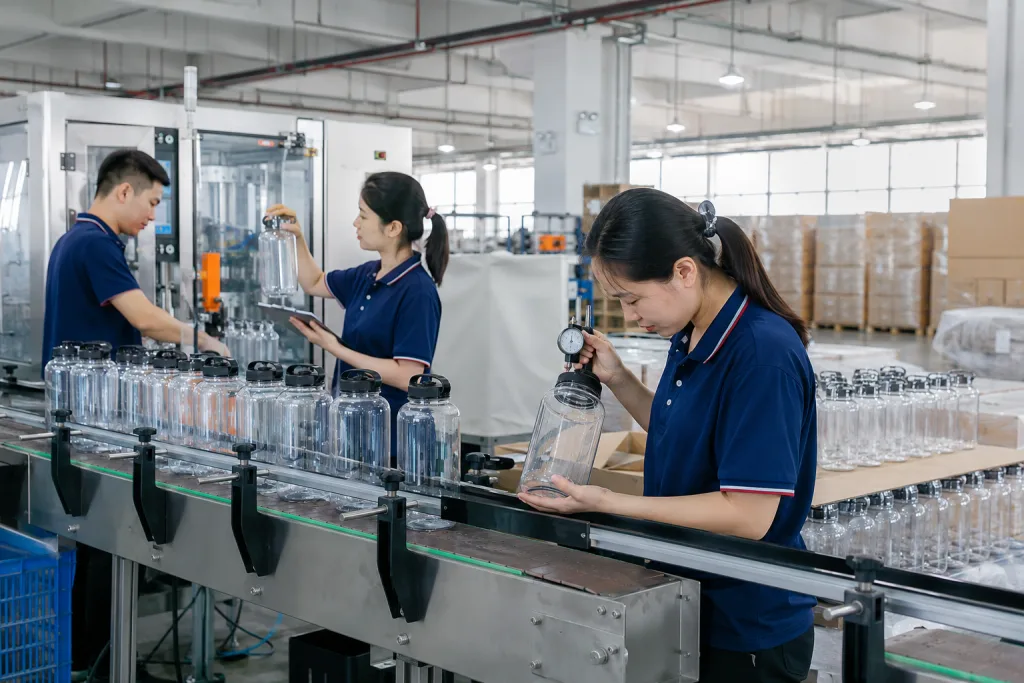
If you are buying from canteen manufacturers in China, ask for first-shot photos, resin brand, drying record, and cavity-by-cavity comparison on pre-production. This is not the wrong place to be strict. It is cheaper than arguing after 20,000 pieces are packed and 3 cartons already show mixed shade. A serious canteen supplier should show incoming material control, lot traceability, and visual defect criteria tied to an AQL plan. QC pulled the sample; the record should match the bottle in hand.
Leak complaints usually start at the lid
Buyers usually blame the bottle body first. On the line, leak complaints start at the lid. We see most field failures from thread mismatch, a sealing face out by 0.2 mm, silicone gasket compression set after transit, loose vent-plug fit, or straw assembly variation. This shows up fast on custom canteen and customizable canteen programs where the bottle shape changed in week 3, then the closure got pulled from another model to save a new mold charge. We've seen this go sideways.
For a canteen manufacturer or canteen vendor, “same lid, no problem” is where trouble starts. The thread finish can look close and still fail. PETG neck tolerances, shrink rate, and torque window do not match Tritan, PP, or stainless programs just because the sample threads on by hand. We run a go/no-go gauge on first-off samples for this reason. Add decoration heat exposure or 32 days at sea from Zhejiang, China, and a small stack-up turns into seepage the buyer flagged after arrival.
Leak testing should be defined by method, not by promise.
- Static inversion test: 24 hours, filled to nominal line, room temperature, zero leakage.
- Air pressure test: 20-30 kPa for 30 seconds where design allows.
- Torque range: for example 0.8-1.2 N·m application torque on screw lids.
- Drop test: 3 filled drops from 80 cm onto plywood over concrete, no cap release, no functional leak.
If you buy canteen promotional items, define “leakproof” on paper. This is the wrong question to ask if it stays vague. Does it mean bag-safe for still water only, or are carbonated drinks, hot fill, and shaking excluded? We ship to Europe where one distributor drinkware program expected commuter-bag use, while the factory test record only covered upright desk use; QC pulled the sample and the gap was obvious. A lot of supplier disputes are just language problems, sometimes as small as a PO note saying “no leak” with no test method. Put the use case on the specification sheet and on the artwork approval if needed.
Decoration breaks after the first week
Print failure turns a decent bottle into a return case fast. On PETG, we usually run silkscreen, heat transfer, pad print, UV print, or shrink sleeve; for some high-volume programs, 50,000 pcs and up, we also quote in-mold labels if the artwork fits the mold layout. Buyers on customized drinkware or canteen customized projects often lock in logo size and Pantone first, then skip the test items that matter on the line: adhesion, rub resistance, and chemical wipe resistance. That is the wrong question to ask. Last month a buyer flagged a 0.8 mm tagline shift but had no tape-test spec in the PO.
PETG takes decoration well if the surface prep and ink system are matched. If flame or corona treatment drifts, ink hold drops fast; we check dyne level before print, and QC pulled the sample on one run where treatment was uneven across a 90 mm wrap area. If curing gets squeezed to catch a vessel cutoff, the print can pass visual check at 2 pm and still fail after hand lotion, alcohol wipes, or 50 carton-friction cycles in transit. We have seen this go sideways on custom growler and customized growler orders with full-wrap graphics, because a big ink block shows every weak spot in pretreatment, ink mix, and cure time.
Controls worth putting into the PO
- Adhesion: cross-hatch tape test to ASTM-style internal standard, minimum 4B after 24 hours cure.
- Abrasion: 50-100 dry rub cycles with no major ink loss on principal display panel.
- Chemical resistance: no visible damage after 10 wipes with 75% alcohol if your market expects sanitizing use.
- Dishwasher claim: avoid it unless you have validated cycles and written label instructions.
If the program is price-sensitive, ask the canteen factory to quote two decoration routes and state the risk in plain terms. We ship plenty of jobs where single-color silkscreen is USD 0.05-0.10 cheaper, but the math does not work if the bottle lands in sporting goods or school retail and comes back scratched in the first 7 days. On one PO, the buyer even typed "dishwaser safe" by mistake while asking for a budget print route. An experienced canteen supplier earns margin by pushing back early and telling you exactly where the decoration will fail first.
Odor, migration, and compliance gaps
Another failure mode is less visible and more serious: the bottle looks fine, the lid threads pass, then the buyer flags odor, taste transfer, or missing compliance paperwork. PETG itself is a standard food-contact material, but a full bottle set includes the body resin, masterbatch colorant, lid, straw, silicone seal, printing ink, and sometimes a carry strap. We have seen one 2.5 mm silicone gasket hold up a shipment because the declaration did not match the destination market. QC pulled the sample, filled it with 60°C water, capped it for 2 hours, and the smell was obvious.
For Europe and North America, do not buy on "food grade" as a slogan. Ask for the exact compliance scope and the exact part list. This is the wrong question to ask: "Do you have a certificate?" The right question is whether the complete SKU, including decoration and accessory parts, is covered for REACH, LFGB expectations, FDA food-contact declarations, California Proposition 65 review, and CPSIA or ASTM-related points if the product is sold for children. For kids' bottles, canteen manufacturers also need to understand bite-valve wear and small-parts risk; we have had buyers push back on a straw stopper that measured 31 mm because their team wanted a wider safety margin.
- Request documents before mass production: material declaration for each food-contact part, a test report list tied to the actual BOM, and the factory self-inspection standard. We usually ask for this before the 500-piece pre-production run.
- Ask about odor control: sealed hot-water odor check, 60°C water soak, and packaging outgas management. On the line, cartons packed too fast after printing are a common cause of trapped smell.
- Specify exclusions: not for microwave, not for hot liquids above a defined temperature if applicable. Put the limit in writing, such as 50°C or 60°C, not "warm drinks."
About 7 out of 10 canteen vendors in China will send a generic report from a similar model. That is not enough for a serious distributor canteen or distributor growler program. You need reports or declarations that match the actual structure and decoration set. If the final bottle uses a soft-touch coating, metallic ink, or a straw additive, the old report may not cover it, and we have seen this go sideways in final review. One PO we received even listed the wrong lid code by one letter, and the buyer did not catch it until document check. A careful buyer in Zhejiang sourcing or elsewhere in China should tie compliance document approval to pre-production sample signoff, not the week before shipment.
Packaging damage hides margin erosion
Buyers will spend 3 weeks on bottle shape and print color, then give cartons 10 minutes. Then the claim lands. PETG takes impact better than some rigid plastics, but silk-print logos, straw lids that stick out 18 mm, and clipped-on accessories still get hit in transit. For canteen distributors and vendor programs moving stock through 2 or 3 warehouses, weak packaging turns a workable factory price into a bad landed cost. We’ve seen this go sideways.
The weak points are usually plain. Inner boxes at 250 gsm crush too fast, bottles rub because there is no PE bag separation, master cartons shift because the dimensions are not stable, and nobody ran a top-load test before pallet stacking. On one line, QC pulled the sample and found the hangtag metal eyelet had already dented the next bottle before sealing. If your order includes custom growler or customizable growler packs with premium sleeves or hangtags, damage rates usually jump from 1.2% to 3.8% because presentation packs protect less. Sea shipment from China to Europe or North America means 30-45 days in container conditions, then inland transfer. Condensation is real. Compression is real.
Packaging specs that save money
- Master carton: 5-ply export carton, burst strength or edge crush test defined by load; we usually confirm carton gross weight at 12-14 kg before pack-out.
- Drop test: ISTA-style internal test, 1 corner, 3 edges, 6 faces from 76 cm for packed carton; the line should use actual sealed samples, not empty fillers.
- Pallet pattern: overhang not allowed; stretch-wrap layers and corner boards defined, with pallet overhang held at 0 mm because the math doesn’t work any other way.
- Barcode control: FNSKU or retailer label position locked on pack-out guide if applicable; we ship with a taped sample board so the buyer does not flag mixed label positions later.
For Amazon or e-commerce channels, tell the canteen manufacturers early. Retail shelf packaging and parcel packaging are different jobs. If you need scannable labels, suffocation warnings, or mail-order survivability, add that before tooling and artwork approval. This is the wrong question to ask after sampling. A canteen distributor often finds the gap too late, when first inspection is already booked and the PO even has a typo on the ship mark. At that point, any repack in Zhejiang costs days and often USD 0.08-0.25 per unit in labor and materials.
MOQ, tooling, and lead-time traps
Commercial failures usually start before production. The bigger mistake is picking the wrong structure for your volume and ship date. We see this on the line all the time: a new buyer asks a PETG drinkware supplier for a fully custom canteen with a new lid, handle, color, and gift box, then wants 1,000 pcs shipped in 20 days. The math doesn't work. Last month one PO even had "1,000 sets" typed where the email approval said "3,000 pcs," and the buyer flagged it only after sample sign-off.
On normal projects, a standard-body PETG item with a stock lid usually starts at MOQ 3,000 pcs per color. If you add a new mold insert, a custom strap, or a two-shot lid, MOQ often moves to 5,000-10,000 pcs because we run separate material prep, trial shots, and assembly checks. A small cap change can cost USD 150-500 in tooling. A new body mold can cost several thousand dollars and usually adds 20-30 days for T1, fit correction, and a second sample round. QC pulled the sample on one 0.3 mm thread mismatch last quarter, and that alone cost 6 days. After sample approval, production lead time is commonly 25-35 days in normal season and 35-45 days before peak gifting months.
Ask how the canteen factory actually books capacity. A plant can quote 600,000 units/month and still give you only one PETG machine window if silk print is backed up or strap assembly sits with a third-party workshop. We ship plenty of orders where the injection side finished first, but outsourced printing added 4 extra days because the Pantone drawdown was still under approval. This is the wrong question to ask: "What is your total monthly capacity?" Ask how many units they can run for your body, your decoration, and your pack-out.
- Ask for a critical path: list the real dates for mold revision, sample approval, material booking, production, inspection, and vessel cut-off. We usually ask for this in a simple 6-column sheet, not a sales promise in WhatsApp.
- Confirm commercial tolerances: overrun/underrun is usually plus or minus 5% on custom production unless otherwise agreed. Buyer pushback often starts here, especially on color assortments packed 24 pcs per carton.
- Define payment trigger: do not release balance before final inspection report and packing list are aligned. QC pulled one case where the outer carton said 48 pcs but the packing list showed 36 pcs, and that kind of mismatch creates trouble fast.
Experienced canteen suppliers in China will usually steer you to an existing platform when volume is low. That is not laziness; it is how you hit the launch date with fewer surprises. We have seen full custom body programs at 1,000 pcs go sideways over a single new handle mold or box size change. If repeat demand is there, build the tooling. For a one-off canteen promotional campaign, stock architecture with custom color and print is usually the better call.
Inspection plans that actually catch problems
The last failure mode is assuming QC runs by itself. It does not. AQL works only if the defect definitions match your real commercial risk. For PETG bottles, we usually see 4 failure points on the line: slow seepage after 30 minutes upside down, faint odor right after unpacking, crooked straw fit by 1-2 mm, and logo abrasion after a 20-cycle rub test. If your checklist stops at color and carton count, you miss the failures that trigger claims and rework.
A usable QC plan for custom drinkware needs 3 control points: pre-production sample approval, in-line checks during molding and decoration, and pre-shipment inspection at finished-goods stage. For B2B orders, AQL 2.5 for major and 4.0 for minor is a solid starting point, but this is the wrong question to ask if the defect categories are loose. Leakage, wrong barcode, missing compliance mark, or wrong lid assembly are major defects. Tiny gate blush on the base can stay minor if it is off-shelf and QC pulled the sample under normal light, not under a torch.
What to include in the inspection protocol
- Quantity: order count, assortment, carton count, spare parts count.
- Visual: color, transparency, contamination, print registration, flash, sink, scratches.
- Functional: leakage, torque, carry-loop strength, straw fit, volume check.
- Packaging: carton markings, drop condition, palletization, shipping marks.
- Documentation: test reports, carton spec, barcode file, approved golden sample photos.
If you are a canteen distributor, distributor growler buyer, or sourcing manager new to Zhejiang, ask the supplier to keep a sealed golden sample set from the approved lot. One stays in your office. One stays at the China factory. We label ours with PO number, color code, and approval date because we have seen a buyer flag a 1-letter typo on a lid sticker 6 weeks later. That one habit closes a lot of arguments on color drift and assembly fit. Good canteen manufacturers do not mind detailed QC language. We prefer it, because vague standards are where projects go sideways.
Send your PETG bottle spec for a practical review
We will flag the likely failure points, MOQ, decoration risks, and lead time before you place a deposit with any canteen supplier in China.
Frequently asked questions
What is a realistic MOQ for a petg drinkware supplier?
For standard PETG bottle shapes using existing molds, a realistic MOQ is usually 3,000 pcs per color, sometimes 2,000 pcs if the body, lid, and packaging are all stock. Once you request a custom canteen body, new lid color, strap, or gift box, MOQ often moves to 5,000-10,000 pcs because the factory has to control material minimums, setup loss, and decoration efficiency. For a canteen promotional program, ask the supplier to separate MOQ by body, lid, print, and carton. That helps you see where flexibility exists. In China, some factories advertise low MOQs but recover margin through print surcharges or mixed-lot packaging fees, so compare the full landed structure, not just the headline MOQ.
Is PETG a good choice for custom drinkware compared with other plastics?
PETG is a good choice when you want high clarity, good impact resistance, and competitive cost for cold-drink bottles. It works well for customizable drinkware, especially clear or tinted bottles with retail presentation value. The trade-off is that PETG is not the best option for high-heat use, aggressive dishwasher claims, or some premium durability expectations. If your project involves school bottles, gym bottles, or canteen customized programs for daily cold-water use, PETG is often a practical middle ground. You should define temperature limits clearly, usually avoiding very hot liquids. Ask the supplier for actual test data on drop, odor, and print adhesion rather than broad material claims.
How do I qualify a canteen manufacturer or canteen supplier in China?
Start with process questions, not brochure claims. Ask whether the factory owns molding, printing, and assembly, or outsources part of the work. Request monthly capacity, common lead time, and the exact MOQ for your structure. A serious canteen factory in Zhejiang or other parts of China should provide quality documents, sample approval steps, and a defect standard tied to AQL. You should also ask for compliance scope such as REACH or food-contact declarations, plus social audit status like BSCI if your customer requires it. If the product is for Europe or North America, confirm barcode control, carton specification, and final inspection method. Suppliers that answer with specific numbers are usually easier to manage than those speaking only in general promises.
What tests should I require before approving mass production?
At minimum, require visual approval against a signed golden sample, 24-hour inversion leak testing, torque verification on screw lids, basic drop testing with filled bottles, and decoration adhesion checks after full cure. For printed custom growler or customized drinkware programs, add rub resistance and alcohol-wipe resistance if the channel expects frequent cleaning. If the bottle will be sold to children or in regulated markets, request matching compliance declarations for all food-contact components, not only the bottle body. A practical pre-production package also includes color comparison under controlled light, odor check after hot-water rinse, and packaging verification. These tests cost far less than a post-arrival claim on 5,000 or 10,000 units.
How long does a PETG custom project usually take from sample to shipment?
If you select an existing body and only change color, logo, and standard packaging, sample approval can take 5-10 days and mass production usually 25-35 days after approval and deposit. If you need a customizable canteen with modified lid parts, new inserts, or custom retail packaging, add 7-12 days for revisions. A fully new body mold can add 20-30 days before final sample signoff. Shipping from China then depends on destination and mode, but sea freight to Europe or North America often needs another 25-45 days door to port range. The practical lesson is simple: lock artwork, carton spec, and testing standards early, because most delays come from changes after tooling or pre-production sampling.