Key Takeaways
- A workable PETG private label MOQ is usually 3,000-5,000 units per color, with repeat orders dropping to 2,000 units on standard molds.
- For daily-use PETG bottles, target 2.0-2.5 mm body wall thickness and leak testing at 0.2 bar before packing.
- Typical lead time from Zhejiang, China is 25-35 days after sample approval, plus 3-7 days for third-party inspection and booking.
- Silkscreen on PETG is cheaper at about USD 0.05-0.12 per color, while heat transfer or wrap decoration runs closer to USD 0.18-0.40 per unit.
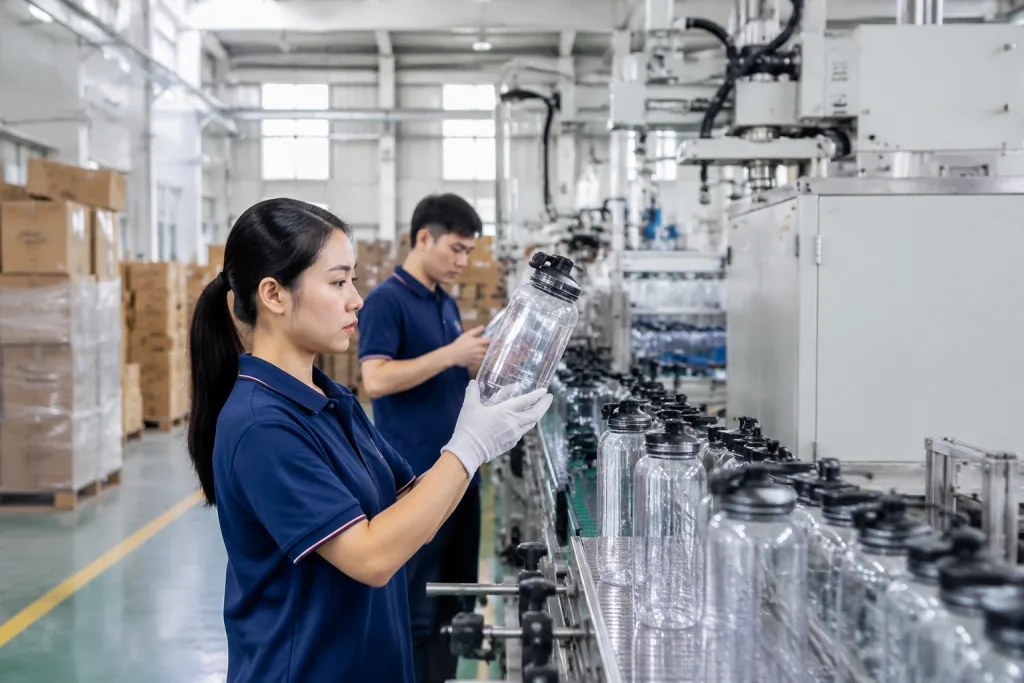
You can buy a PETG bottle that looks clean in a catalog and still get stress whitening at the handle, leaking lids, or print that fails after one dishwasher cycle. We have seen this on the line: QC pulled the sample, flexed the handle 15 times, and the whitening showed up right at the gate. That is the usual mess in petg drinkware private label. Two factories can quote the same 700ml shape, then run different resin grades, different wall thickness like 1.8 mm vs 2.2 mm, and different QA checks.
If you source for retail, promotions, or a canteen distributor network in Europe or North America, you need a comparison sheet that works on the factory floor, not just on a quote file. From Zhejiang, China, we ship these programs every month, and the buyer usually flags the same issue: the cheapest FOB price on day one tells you almost nothing if the decoration rubs off, compliance papers are late by 12 days vs 18 days, or the bottle does not fit the actual use case. This is the wrong question to ask. Put capacity, decoration method, compliance status, and real-use fit side by side, then the math starts to make sense.
What PETG Actually Buys You
PETG sits in the middle for custom drinkware, and that is usually where the volume is. It looks cleaner than basic PP on shelf, runs lighter than stainless, and takes a hit better than standard AS; on our line, a 1.2 mm wall PETG body usually survives drops that crack cheaper acrylic. Buyers care for a simple reason. Good looks drive first sell-through, but returns and chargebacks come from field failure. If the item is for cold beverages, gym use, school programs, office hydration, or canteen promos with a price target, PETG often fits and the math works.
PETG does not buy you heat resistance. If your market wants boiling water, tea at 95 C, or dishwasher sanitizing above 70 C, this is the wrong question to ask. Use stainless or a Tritan-type copolyester program instead. We have seen this go sideways: the buyer flagged bottle deformation after repeated hot wash cycles, and the original PO still said PETG. That is not a factory issue. It is a spec issue.
From a canteen manufacturer viewpoint in Zhejiang, the main PETG strengths are:
- Good clarity for transparent and tinted bodies; QC pulled the sample under a 6500K light box and haze was low enough for clean retail display
- Stable decoration surface for silkscreen, heat transfer, and shrink sleeve, with the line holding registration tighter than 1.5 mm on common bottle shapes
- Reasonable impact resistance in everyday handling, which matters more than lab talk when cartons get dropped in school distribution
- Lower unit cost than double-wall stainless programs; at 3,000 pcs MOQ, we usually ship PETG well below comparable insulated steel bottles
The weak points are also predictable:
- Not suitable for hot-fill; neck distortion starts fast once filling temperature is pushed past the spec
- Scratch resistance is only moderate, and a rough conveyor guide will mark glossy bodies by the end of the shift
- Dishwasher resistance depends heavily on decoration method; we have seen print loss after 20 cycles where the buyer chose the cheapest ink set
- Low-grade resin can haze or crack around threaded necks, and this usually shows up first at the cap torque check
Buy PETG when you need a clean retail look at a controlled cost, and you can define the bottle clearly as cold-drink use.
That is why 8 out of 10 China canteen suppliers position PETG for school bottles, sports bottles, infuser styles, and customized growler formats for cold brew or infused water. We do not pitch it for thermal drinkware. The line, the resin, and the use case do not match.
Head-to-Head Spec Table
If you are comparing a custom canteen program across suppliers, stop asking only for volume and FOB Ningbo price. Ask for the full build sheet. Two 700 ml bottles can be 15% apart in cost and 50% apart in complaint rate because one runs a 1.6 mm wall, a lighter lid, or weaker print adhesion that failed a 3M tape pull on the line. Here is the comparison buyers actually use.
PETG bottle spec comparison
- Economy promo bottle: 500-700 ml, 1.6-1.8 mm wall, single-color silkscreen, PP lid, MOQ 5,000 pcs, FOB China about USD 1.10-1.55. Built for short-run canteen promotions and event giveaways. We ship this grade fast, but buyers often flag scratch marks after carton drop tests if the bottle body is too light.
- Mainstream retail bottle: 650-900 ml, 2.0-2.3 mm wall, carry loop or flip lid, 2-color print or wrap, MOQ 3,000 pcs, FOB Zhejiang about USD 1.65-2.40. Fits private label retail and distributor drinkware catalogs. This is the volume runner in our factory, and QC pulled the sample first on lid torque and wrap alignment within 1.5 mm.
- Premium fitness bottle: 700-1,000 ml, 2.3-2.5 mm wall, one-hand lid, TPE seal, matte finish, MOQ 3,000 pcs, FOB China about USD 2.20-3.10. Made for specialty retail and brand-led custom drinkware launches. Good hand feel. We have seen buyers ask for this spec under EUR 9.99 shelf price, and the math doesn't work.
- PETG growler style: 1.2-1.9 L, 2.5-3.0 mm wall, wide-mouth screw cap, handle, MOQ 2,000-3,000 pcs, FOB about USD 3.20-4.80. Suited to customizable growler or customized growler projects for cold beverages only. The heavier body helps, but the line watches handle joint stress and cap fit because one loose thread can kill the order.
Use-case fit matters more than headline price. An economy bottle works for a one-off canteen campaign, especially if the buyer only needs 60 days of shelf life and a basic PP lid, but it usually fails in year-round retail because the lighter body shows scratches faster and the lid feel is basic. The premium fitness bottle can also be the wrong call for a distributor canteen program capped at EUR 9.99 retail. We have seen this go sideways.
At BottleForge Industrial in Hangzhou, Zhejiang, standard PETG output can reach 300,000 units per month across shared bottle platforms, with private label lead times of 25-35 days. On paper, that looks good. In production, it only matters if the selected spec fits your channel, your target complaint rate, and your carton pack-out. We run shared molds to hold lead time, but if a canteen factory sells you a premium build for a promo job, it is burning your margin. If a canteen supplier pushes an economy build into a retail chain, it is setting up returns.
Use-Case Fit by Sales Channel
The same bottle does not fit every channel. Buyers who get the channel right usually avoid 2 or 3 mold revisions, a full repack, and the kind of emergency claim that starts with scratched units at inbound. We run this backward on the factory side: start with the sales channel, then lock the spec. That saves time on the line.
Retail private label needs shelf appeal and repeatability, but packaging discipline is what usually decides whether the launch goes smooth. If you sell through chain stores or Amazon FBA, target 2.0 mm or above wall thickness, drop testing from 80 cm, barcode placement control within 3 mm, and individual polybag or box specs that stop transit scratches. QC pulled the sample once on a retail PO because the barcode shifted into the bottle curve and the scanner missed 2 out of 10 reads. For retail, a canteen customizable body shape only works if the decoration area stays large and the labeler stays stable. Fancy shape alone is the wrong question to ask.
Promotional and corporate gifting is more cost-sensitive. The math is simple. A customized canteen with a standard mold and one-color print usually wins because the setup is lower, the lead time is shorter, and the reorder rate after a 90-day campaign is often under 15%. You do not need to pay for custom lid tooling if the campaign lasts 90 days and the reorder chance is low. We have seen buyers flag a new lid sketch, then cut it after seeing the MOQ jump by 3,000 pcs. A lot of canteen vendors in Europe overbuild these projects and lose margin. The math does not work.
Distributor programs sit in the middle. A canteen distributor or distributor growler buyer usually needs modularity: 2-3 body sizes, 3 lid options, with decoration methods that can switch between customers without fresh tooling. This is where a stable canteen factory in China earns its keep. You want a supplier who can hold color consistency across repeat POs and stock common accessories like straws, spouts, and handle lids in the warehouse rack by lot. The buyer flagged it on one PO last year because “navy” was typed twice but the Pantone suffix changed. We ship these programs smoother when the accessory bank is already in stock.
- School and kids channels: prioritize BPA-free declarations, ASTM-related testing where relevant, easy-clean lids, and lower opening force. On this type, we usually target a lid opening force around 1.5-2.0 kg so kids can use it without fighting the cap.
- Gym and outdoor channels: prioritize one-hand lids, carry loops tested to at least 10 kg static load, and sweat-resistant matte coatings. The line usually does a quick hanging test with a 10 kg weight before final packout.
- Large-volume hydration: use PETG only for cold-drink custom growler or customizable canteen formats, not insulated claims. We have seen this go sideways when a buyer tried to market PETG like double-wall stainless.
If you are buying for North America, ask upfront whether the bottle is meant for top-rack dishwasher language or hand-wash-only packaging. That wording affects artwork, carton marks, and claim risk, and QC will check it against the approved sample before shipment. If you are buying for Europe, make sure REACH and food-contact declarations are aligned before mass production. Most canteen manufacturers can provide the paperwork. Fewer can explain why the wall thickness, colorant, and lid material on the BOM actually support that paperwork. That gap causes delays.
Decoration, Branding, and Real Limits
Private label buyers usually start with body color and logo position. Fair enough. On PETG, the decoration method is an engineering call as much as a branding one. We have seen pre-production samples pass on the table, then fail after a 1.2 m drop test or a 7-day sea shipment carton rub test. The buyer flagged it late. That is the wrong stage to find out.
For standard custom drinkware projects, we run four decoration routes on PETG most often: silkscreen, heat transfer, shrink sleeve, and pad print for small date codes or 8 mm marks near the base. Laser engraving is usually the wrong question on clear PETG bodies. The effect looks weak compared with stainless, and QC pulled the sample more than once because the mark looked hazy.
- Silkscreen: cheapest and fastest on the line. Good for 1-2 spot colors and clean logo blocks. Expect USD 0.05-0.12 per color per unit. Best fit when the artwork is simple, the print area is flat, and abrasion standards are moderate. We usually ask for at least a 12 mm gap from heavy curves.
- Heat transfer: stronger choice for multi-color graphics or retail-facing artwork with gradients and small text. Usually USD 0.18-0.30 per unit. Adhesion testing matters on matte coatings; we run a cross-hatch tape test first, and we have seen this go sideways when buyers approve coating before print trials.
- Shrink sleeve: full 360-degree branding and strong shelf effect. Usually USD 0.25-0.40 per unit. Good for customizable drinkware built for retail display, but pack-out gets slower because sleeve seam position, cap orientation, and carton friction all need tighter control. On one run, the sleeve tunnel had to be reset by 3 mm to stop top-edge warping.
There is another limit buyers should accept early: a canteen customized body shape can be unique, but more custom geometry brings more decoration risk. Deep curves, ribs, and grip panels cut down clean print area fast. They also push unit cost up because reject rates climb during printing and packing. The math does not work if the artwork needs a flat 70 mm panel and the bottle only gives you 52 mm.
From Zhejiang production experience, the most efficient path for a canteen custom program is often a standard bottle platform with custom color, a custom lid accent, and upgraded packaging. You still get a differentiated product, and tooling stays under control. Full new mold development for PETG bodies often starts around USD 3,000-8,000 depending on cavity count and complexity. For 3,000-5,000 pcs MOQ buyers, that budget is usually better spent on packaging, compliance testing, and inventory depth. We ship more repeat orders that way, and the PO errors are smaller too; one buyer even sent "PET" instead of "PETG" on the first artwork sheet, which would have caused trouble later.
Compliance and Quality Checkpoints
This is where 7 out of 10 new importers get soft answers. Do not accept that. If a canteen manufacturer or canteen vendor says a bottle is food-safe, ask which tests, which lab, which resin grade, and which market the report covers. We have seen buyers get a 2-year-old resin datasheet while the actual finished bottle used a different color masterbatch on the line. PETG drinkware private label for Europe and North America needs paperwork tied to the real finished product, not a file someone pulled from an old folder.
For most B2B buyers, the baseline checkpoint list should include:
- Food-contact declaration for the target market
- REACH screening for EU programs
- California Proposition 65 awareness for relevant US programs
- BPA-free declaration where marketed
- Leak test on finished assembled unit
- AQL inspection before shipment, commonly AQL 2.5 for major defects and 4.0 for minor defects
If your product targets children, add extra scrutiny on small parts, bite risk, and relevant ASTM or CPSIA-related requirements. QC pulled the sample once on a kids lid and found a silicone valve at 11.8 mm, which the buyer flagged right away. BSCI or ISO 9001 is fine to have, but this is the wrong question to ask if you are checking product compliance. Social audit paperwork and product compliance are two different files.
A reliable canteen supplier in China should also define the production controls clearly. For PETG, I would ask for:
- Incoming resin lot traceability
- Thread fit checks every 2 hours
- 100% leak testing or at minimum sampling per batch with recorded standard
- Drop test standard, for example 3 drops from 80 cm on packed sample
- Print adhesion cross-hatch or tape test after curing
At our side in Hangzhou, Zhejiang, we normally advise buyers to budget 2-3% of PO value for third-party inspection when the order exceeds USD 10,000. That is cheap insurance. We ship plenty of repeat orders without inspection every time, but on a new customized drinkware program or after a decoration supplier change, the math does not work without it. Last year one PO even had the lid color code typed wrong, and a pre-shipment inspection caught it before the carton drop test stage.
MOQ, Cost, and Supply Reality
The cleanest quote is not always the cheapest landed result. We see this on the line all the time. Private label PETG pricing moves with body weight in grams, resin grade, lid structure, decoration method, packaging spec, and whether you run a standard mold or an exclusive one. A buyer once pushed us on a low FOB number, then flagged the quote later because the 5-layer mailer carton was missing. This is the wrong question to ask. Compare total landed cost, not one headline price.
For standard-mold PETG bottles from China, realistic MOQs are usually:
- 3,000 pcs per size for standard body with standard color
- 5,000 pcs if you want custom body color matched to Pantone and custom print
- 2,000-3,000 pcs for some repeat orders if the canteen factory already stocks components
Tooling needs a straight answer. A custom lid may cost USD 1,500-4,000. A new body mold can run USD 3,000-8,000 or higher if the shape is large or heavily textured. We have seen buyers test a new concept with a full custom body, then stop after 2,000 pcs equivalent demand. The math does not work. On one project, the buyer PO even had the wrong neck size typed as 53mm instead of 63mm, and QC pulled the sample before steel cut. If you are a canteen distributor testing a new concept, start with the standard platform. Then go deeper on version two.
Lead time needs a reality check too. Sample revision can take 7-12 days. Mass production is usually 25-35 days after deposit and approved pre-production sample. From August to November in Zhejiang, China, we normally tell buyers to expect 32 days vs 25 days if the line is full and injection slots are tight. If the order needs retail gift box assembly, barcode labeling, or FNSKU stickering for Amazon, lock that in early. We ship orders every week, and late carton artwork approval is one of the most common delays.
The buyers who control cost best follow one simple rule: standardize what the consumer does not notice, customize what the consumer sees and touches. In practice, we run common threads, proven seals, and shared cartons at the back end, then spend money on color match, logo print registration, and lid feel at the front. Last month, QC found a 0.8 mm logo shift on one PETG sample set, and the buyer caught it right away. That is how sensible buying works with canteen manufacturers, canteen suppliers, or canteen vendors without adding avoidable risk.
Compare your PETG bottle specs before you place PO
Send your target volume, artwork, and channel. We will match the right PETG build, MOQ, compliance path, and lead time from Zhejiang, China.
Frequently asked questions
Is PETG good enough for a retail private label bottle, or should I move to another material?
PETG is good enough for many retail programs if the use case is cold drinks and the build spec is right. For a serious retail launch, I would target 2.0-2.3 mm wall thickness, a tested TPE or silicone seal, and decoration that survives at least a tape adhesion test plus normal transport abrasion. FOB price from China is usually around USD 1.65-2.40 for a mainstream 650-900 ml bottle on a standard mold. If your brand promise includes hot beverages, dishwasher-heavy use, or premium impact resistance, PETG may not be the right fit. In that case, you should compare against copolyester or stainless. PETG works best when you want clear appearance, moderate cost, and controlled compliance for EU or US cold-drink channels.
What MOQ should I expect for petg drinkware private label in China?
For standard molds, most canteen manufacturers in China will quote 3,000-5,000 units per item per color. If you need a basic bottle with stock lid and one-color logo, some canteen suppliers will accept 2,000-3,000 units on repeat orders. Once you ask for custom Pantone body color, special lids, or retail box packing, MOQ usually moves up because the factory needs to cover color mixing, setup waste, and packaging procurement. A new custom lid mold can add USD 1,500-4,000 in tooling, and a new bottle body mold may be USD 3,000-8,000. If you are testing a new market, use a proven standard bottle first. That keeps MOQ manageable and gives you real sales data before you commit to exclusive tooling.
Can I develop a custom growler or large PETG canteen for cold beverages?
Yes, but stay disciplined on the use case. A custom growler in PETG is suitable for cold brew, infused water, or large-format hydration, typically from 1.2 L to 1.9 L. It is not the right choice for pressure, carbonation retention, or high-heat filling. For large PETG bodies, I would look for 2.5-3.0 mm wall thickness, a handle pull test of at least 10 kg static load, and a wide-mouth cap with a seal that passes leak testing after torque application. MOQ is often 2,000-3,000 pieces on standard molds and higher for exclusive shapes. FOB pricing commonly lands around USD 3.20-4.80 depending on decoration and packing. For distributor growler projects, standardize cap threads early so reorders stay simple.
Which quality checks matter most before shipment?
The basics matter more than impressive paperwork. For PETG drinkware private label, I would require leak testing, thread-fit checks, print adhesion testing, drop testing on packed samples, and a final AQL inspection. AQL 2.5 for major defects and 4.0 for minor defects is a common starting point for drinkware. Ask the canteen factory for resin traceability by lot, and confirm that the final assembled bottle matches the compliance documents, not just the raw material declaration. If the order is over about USD 10,000, paying 2-3% of PO value for third-party inspection in China is usually worth it. That is especially true on first orders, new colors, or when you are using heat transfer or shrink sleeve decoration with retail packaging.
How do I choose between a standard bottle platform and a fully customized canteen?
Choose the standard platform unless your forecast justifies tooling. A standard bottle with custom color, logo, lid accent, and packaging usually gives you 70-80% of the branding value with much lower risk. You avoid mold cost, shorten development by roughly 15-25 days, and keep MOQ closer to 3,000-5,000 units instead of pushing higher. A fully customized canteen makes sense when your annual volume is strong, your buyer has channel protection, or your brand needs a shape that distributors cannot find elsewhere. Even then, be practical: unique geometry often reduces print area and increases reject rates. Good buyers in Zhejiang and wider China usually customize where consumers notice it most and leave hidden technical parts standardized for easier supply.