Key Takeaways
- For custom PETG bottles, MOQ is usually 3,000 to 5,000 units per color, with 20 to 35 days production lead time after sample approval
- A PETG bottle body around 0.6 to 0.8 mm wall thickness balances clarity, impact resistance, and freight cost better than chasing the lightest possible weight
- For EU and North America, ask for REACH, LFGB or FDA contact compliance by SKU, not just a generic material statement
- AQL 2.5 for major defects and 4.0 for minor defects is a reasonable outbound inspection standard for customized drinkware
You can buy PETG drinkware from 40-plus factories in China, and 12 of them will send a quote the same day. That part is easy. The harder part is knowing whether the sample on your desk can run on the line, pass your market tests, and land with the right logo finish, carton marks, and packing method. We have seen this go sideways after a good-looking sample cracked at 1.8 mm wall thickness during drop test. If you buy for retail, promo, or a canteen distributor channel, small misses turn into chargebacks fast.
At BottleForge Industrial in Hangzhou, Zhejiang, we see the same pattern every month: the buyer asks for the lowest unit price first, then flags problems later because wall thickness, lid fit, odor control, or drop resistance were never written into the spec. QC pulled the sample on one order and found the PO marked matte print, while the approval sample was glossy. This is the wrong question to ask at the start. A workable PETG program starts with material limits, decoration method, compliance scope, and a real MOQ like 3,000 pcs before you approve anything.
What PETG Actually Solves
If you are searching for a petg drinkware manufacturer, you are usually trying to fix 2 or 3 hard cost and product issues, not chase a trend. First, you want the clean clear-plastic look without the easy cracking seen on brittle bodies after a 0.8 m drop test. Second, you want lower landed cost than stainless steel; on simple bottle programs, we usually ship PETG at a better total number once you factor freight by kg. Third, you may need a shape that fits custom drinkware, gym bottles, school programs, event merchandise, or a custom canteen line where weight matters and the buyer flagged shipping cost on the PO.
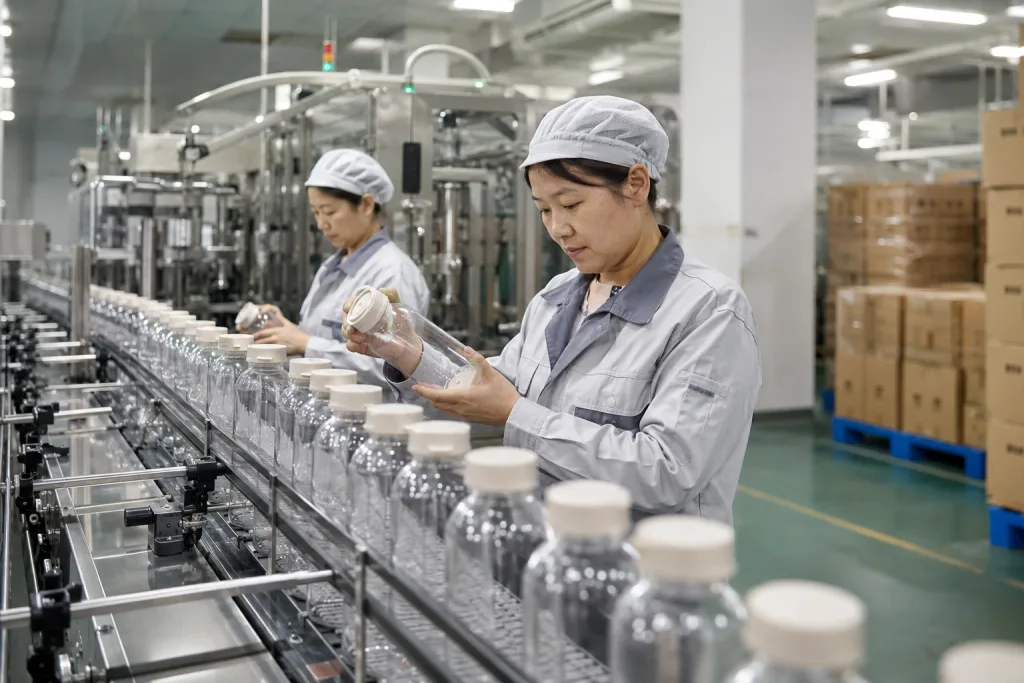
PETG solves a practical job. It is clear, tougher than buyers expect, takes color well, and we run it on both injection and blow molding lines depending on the bottle structure. For a lot of China bottle programs, PETG sits in the middle where the math works: better appearance than lower-grade options, lower cost than stainless, and fewer breakage complaints if wall thickness is set right at, say, 1.8 mm instead of getting pushed too thin. It is not the cheapest resin on every quote, and it is not built for high-heat filling. Cold-fill drinkware is where it performs. QC pulled the sample on one 700 ml run last month, and the body passed repeated handling, short drops, and carton movement because the design was balanced, not over-stretched.
What PETG does not solve is just as important, and this is where we have seen programs go sideways. It is the wrong material for boiling water use, aggressive dishwasher cycles, or weight targets that cut too much resin from the sidewall. If your Europe or North America market expects a bottle to handle 90 to 100 degrees C liquid, PETG is the wrong choice. Full stop. If your sales team wants a tall 1.2L customizable canteen with a thin body and a carry loop that never leaks, this is the wrong question to ask; first check neck finish, thread match, and body stability on the line before talking about looks.
- Typical PETG bottle capacity range: 400 ml to 1,000 ml
- Common FOB China unit price: about USD 1.10 to 2.80 depending on size, lid, and print
- Normal MOQ in Zhejiang factories: 3,000 pcs for stocked molds, 10,000 pcs or more for fully new tooling
If your program includes a customizable growler or customized growler concept above 1L, check panel strength and handle structure early. Big bottles expose weak engineering fast. We usually review rib layout, top-load compression, and handle pull force before sample approval, because a 1.2L body that looks fine in CAD can deform after carton stacking at 8 kg per layer. PETG can work here, but every design mistake gets bigger with volume.
Questions To Ask Before Quoting
Most RFQs fail for one reason: the spec is loose. A factory in Zhejiang, or anywhere else in China, cannot quote a canteen customized project cleanly if the file is missing wall thickness, decoration callout, and packaging standard. We run into this every week. The buyer sends one reference photo, then the number shifts later because the sample on the line was built at 0.7 mm, not 0.8 mm, or the PO forgot the inner polybag requirement.
Your first checklist
- Capacity: 500 ml, 700 ml, 1,000 ml?
- Body weight target: for example 110 g plus or minus 5 g
- Wall thickness: commonly 0.6 to 0.8 mm for standard PETG bottles
- Lid style: screw cap, flip straw, chug lid, tethered cap
- Decoration: silkscreen, heat transfer, IML insert, sleeve, pad print
- Compliance market: FDA, LFGB, REACH, Prop 65 screening if needed
- Packaging: egg-crate, polybag, gift box, PDQ, master carton size limit
- Order quantity: 3,000, 5,000, or 20,000 pcs changes everything
Ask the canteen manufacturer one direct question: is the quote built on an existing mold or new tooling? This is the right place to push, because the math changes fast. An existing mold sample is often ready in 5 to 7 days; we ship those after basic fit check and leak test. A new mold for a customized canteen body usually takes 20 to 30 days for tooling, then another 7 to 10 days for first samples, and QC pulled the sample on one recent project because the neck tolerance was out by 0.3 mm.
When a supplier says, “same as your picture,” treat that as a warning. A picture does not define neck finish, resin grade, or tolerance, and we have seen this go sideways.
If you buy for a canteen distributor or distributor drinkware program, ask about mixed-SKU carton planning before you approve the quote. This is the wrong question to ask later. We ship plenty of programs where the buyer wants 3 colors in one container, but the factory MOQ is by color, not only by model, and the buyer flagged it only after the carton assortment sheet was issued. Miss that point and your margin gets hit fast.
MOQ, Tooling, and Price Reality
Buyers ask this every week: can a canteen factory do 500 pieces with full customization? Sometimes we can run it, but the math usually does not work. For normal B2B production, PETG bottles start to make sense at 3,000 to 5,000 pieces per colorway on an existing mold. If you want a fully canteen customizable structure with new tooling, the usual target is 10,000 to 20,000 pieces so the mold cost spreads out and FOB pricing stays under control. On the shop floor, we check bottle weight on a digital scale down to 0.1 g before we even talk serious costing.
Typical numbers from China look like this:
- Existing 650 ml PETG bottle, single-color silkscreen: USD 1.20 to 1.65 FOB Ningbo
- Existing 700 ml PETG sports bottle with straw lid: USD 1.60 to 2.20 FOB Shanghai
- New custom body mold: roughly USD 2,500 to 6,500 depending on cavity count and complexity
- Logo setup charges: USD 30 to 80 per color per design
- Production lead time: 20 to 35 days after deposit and sample approval
At BottleForge Industrial, our practical MOQ for many stocked bottle designs is 3,000 pcs, and combined output across drinkware lines is about 1.2 million units per month in Zhejiang. That number is not sales talk. It decides whether we ship your repeat order in 25 days or it slips to 45 days when the line is full. Last month a buyer flagged a PO typo on lid color, and that alone cost 3 days on approval.
Be careful with low quotes from canteen suppliers and canteen vendors. If one price is 12% lower, there is usually a reason: thinner bottle walls by 0.3 mm, a weaker PP lid insert, fewer print passes, or a carton drop spec that will not hold up. We have seen this go sideways. QC pulled the sample on one low-cost project and found scuffing after a basic carton shake test. If you are sourcing a custom growler or large-volume customized growler, freight damage can wipe out the opening savings fast.
The right question is not “Who is cheapest?” This is the wrong question to ask. Ask instead, “What exact construction am I paying for?” Smart canteen suppliers answer with bottle weight, resin grade, print method, carton spec, and tolerance. If a supplier cannot give you those numbers in one sheet, usually within 24 hours, we would treat that as a warning sign.
Compliance, Testing, and Inspection
If you sell in the EU, UK, US, or Canada, compliance is standard cost, not an extra. A solid petg drinkware manufacturer should provide resin declarations and test support, but this is the wrong question to ask if you stop there. You still need to define the exact standard for each SKU, each lid set, and each decoration method. We run into this on the line all the time: one 650 ml bottle body passed, then the buyer added a silicone straw cap and the test scope changed.
For Europe, buyers usually ask for REACH screening and LFGB food-contact testing, depending on the retail channel. For the US, FDA food-contact compliance is common, and California Proposition 65 screening comes up when the item has color masterbatch, printed logos, or silicone parts. For children’s items, ASTM and CPSIA checks can apply once the design looks like kids drinkware. We have seen this go sideways over one small detail: a PO said "sports bottle" and the retail box said "for ages 3+," which pulled the item into a different review.
What to verify before mass production
- Resin grade and food-contact declaration for bottle body
- Lid and gasket material identification, usually PP, ABS, silicone, or TPE combinations
- Odor test after 24-hour sealed storage
- Leak test, usually inverted for 30 minutes minimum
- Drop test, often 3 to 5 drops from 1.0 to 1.2 meters depending on pack style
- Dishwasher claim validation if you plan to print that claim
- Packaging drop test for export cartons
Use numbers on inspection. "Check carefully" is not a quality standard. A lot of importers we ship for run AQL 2.5 major / 4.0 minor on finished drinkware, then add item-level limits for print registration, scratches over 3 mm, black specks, color variation, and lid torque. QC pulled the sample on one order because the logo drifted 1.8 mm off center. If your order is for a canteen promotional campaign, write the logo placement tolerance into the PO, for example plus or minus 1.5 mm.
Ask whether the factory runs ISO-managed procedures and social audits such as BSCI if your retail customer requires them. That will not make production perfect; the math does not work like that. It does mean the canteen vendor usually keeps cleaner records, revision control, and inspection logs, which cuts down avoidable surprises. One simple check: ask to see the latest CAPA record and the last incoming inspection sheet for lids, where we often catch gasket hardness drifting 3 Shore A off spec.
Decoration Choices That Hold Up
A good bottle with bad decoration is still a bad shipment. We see this on the line. Buyers spend 2 weeks on body shape, then the first complaint comes after 300 units hit the market and the logo starts scuffing. For PETG, the common decoration routes are silkscreen, heat transfer, and shrink sleeve. On a few models, molded-in graphics also work if the product design leaves enough wall thickness, usually around 0.8 mm or above.
For basic custom drinkware used in events or corporate programs, single-color silkscreen is usually the lowest-cost option. We run this every week. It is fast and clean, but abrasion resistance comes down to the ink system and curing temperature, not the print method alone. If your customized drinkware is going into gym bags every day, ask for a rub test standard and retained samples from the same batch; QC pulled the sample on one recent order after 50-cycle rubbing and the white ink started fading at the edge. Heat transfer gives sharper multi-color detail, but the setup cost is higher, and curved graphics need alignment control within about 1.5 mm or the buyer flags it right away.
Sleeves are common when buyers want full-wrap color on a custom canteen or a customizable drinkware retail SKU. This is the wrong question to ask: buyers ask for the cheapest sleeve, not the cleanest finished shelf look. The tradeoff is seam appearance and application consistency. Cheap sleeve work looks cheap on day one. On one 5,000-piece run, the buyer flagged a crooked seam near the barcode panel, and we had to sort cartons by hand. For a premium canteen custom program, spending a few cents more per unit makes sense; the math doesn't work if you save USD 0.03 and then fight shelf-quality complaints later.
- Silkscreen add-on: often USD 0.05 to 0.12 per color
- Heat transfer add-on: often USD 0.10 to 0.25
- Shrink sleeve add-on: often USD 0.12 to 0.30 depending on volume and artwork coverage
Ask for decoration approval against your actual Pantone references under daylight and indoor light. Do not approve from screen view alone. Also confirm whether the logo file is being applied to a cylindrical, tapered, or faceted body. We ship samples with the print position marked from the base, often 35 mm or 45 mm, because artwork that looks fine on a straight wall can distort on an aggressive taper. Several canteen manufacturers print well on a straight body, but struggle once the taper gets steep unless they build a proper jig and lock the process.
Packing Details Buyers Forget
Packing gets ignored fast. Then the shipment lands with crushed gift boxes, scuffed lids, or Amazon relabeling fees at $0.55 per unit. If you buy from a canteen supplier in China for retail or e-commerce, the bottle is only half the job. Packaging spec drives freight cost, damage rate, and warehouse labor, and we see this on the line when a 3 mm carton crush gap turns into a claim two weeks later.
Start with the sales channel first. For wholesale distribution, a standard export carton with dividers is often enough, and we ship plenty of these in 5-layer cartons with 32 ECT board. For a distributor canteen or distributor growler program feeding regional warehouses, carton dimensions, pallet pattern, and barcode position matter more than a fancy inner box. This is the wrong question to ask: buyers spend 20 minutes on the gift box finish and skip the outer carton size that decides whether the pallet runs 84 pcs or 96 pcs.
For e-commerce, the spec gets tighter. You may need stronger single-unit boxes, suffocation warning bags, FNSKU labels, and drop-tested packouts, usually 1A or 3A depending on the channel. QC pulled the sample on one PETG order last month because the label sat 8 mm off center, and the buyer flagged it before the first 2,000 pcs were packed.
Packing checklist
- Individual pack type and material
- Master carton burst strength and flute type
- Carton gross weight target, often under 15 kg for easier handling
- Shipping marks, PO number, destination code, and country of origin
- Barcode type: UPC, EAN, or FNSKU
- Pallet requirement: fumigated wood, plywood, or pallet-free
- Spare parts ratio for lids or straws, often 0.3% to 1%
Do not leave this until the last week. A distributor growler account may reject non-standard carton heights because the rack opening is fixed at 420 mm. A distributor drinkware customer may require scan labels on two carton sides, not one. We have seen a PO typed as "MADE IN CHNA" on the shipping mark file, and that small typo held rework for 12 days vs 18 days if it had been caught after container loading. If your supplier in Zhejiang learns these rules after production, the math doesn't work and the rework bill usually lands your side.
The practical move is simple: approve one packaging sample with full markings before mass production starts. We run this check with tape measure, barcode scanner, and drop test sample in hand. That one step cuts most of the avoidable arguments.
How To Qualify The Factory
Not every canteen manufacturer fits the same order profile. Some factories run 30,000-piece promo orders fast. Some are better at retail packs with barcode labels and drop-test cartons. Some own 6 injection machines but outsource assembly and decoration, and we've seen this go sideways. Qualify the supplier against your order type, not the catalog photos.
For a PETG program, ask straight questions. Is molding done in-house or sent outside? Are lids and seals made by the same factory group or by outside partners? What is the standard incoming QC for resin and color masterbatch? QC pulled the sample, checked pellet color against the signed chip, and logged lot numbers before the line started. Ask monthly capacity for this bottle family in units, not vague words like "many." A serious answer beats a polished brochure.
- Factory checklist: in-house molding visibility, sample room consistency from one golden sample to the next, documented IQC/IPQC/OQC flow, export experience to EU or North America, response speed on technical questions within 24 hours
- Audit points: BSCI or equivalent social audit if required, ISO procedure control, traceability by lot number, calibration records for key gauges like calipers checked to 0.02 mm
- Commercial points: deposit terms, tooling ownership in writing, sample charge policy, complaint handling timeline such as 48 hours for root-cause feedback
Good canteen vendors and canteen manufacturers usually state the limits clearly. That is a good sign. If you ask whether a PETG bottle can handle near-boiling liquid and the answer is "no problem," keep looking. The buyer flagged this once on a 95C fill request, and this is the wrong question to wave through. If you ask whether a customizable growler handle passed a 10 kg pull test and they send the test data, now you are talking to someone useful.
China has plenty of capable factories, and Zhejiang has a dense supply chain for drinkware parts. We ship faster here because lids, decoration, and cartons are often within 50 km of the plant. That helps on lead time and sourcing, but the math doesn't work if qualification is loose. One PO we saw even had the color code typed wrong by one digit. The best purchase orders start with clear specs, controlled samples, and a factory that says exactly what it can produce.
Send your PETG bottle spec for a real quote
Share capacity, target price, logo method, packaging, and compliance market. We will review feasibility, MOQ, tooling, and lead time before you place risk on the PO.
Frequently asked questions
What MOQ should I expect from a petg drinkware manufacturer?
For existing bottle molds, most factories in China will quote 3,000 to 5,000 pieces per color or per SKU as a normal MOQ. If you want a fully custom body shape, new lid tooling, or premium retail packaging, MOQ often moves to 10,000 pieces or more. Some suppliers can offer 1,000-piece trial runs, but unit cost usually increases by 15% to 30%, and color or print options may be restricted. Ask whether MOQ is based on total order, per color, or per decoration version. Buyers miss that point all the time. If you are purchasing for a canteen distributor program with mixed colors, confirm whether the carton pack and print setup allow split quantities without extra setup fees.
Is PETG a good choice for customized drinkware in Europe and North America?
For cold and room-temperature drinkware, yes, PETG is often a practical choice. It gives you good clarity, decent impact resistance, and lower freight weight than stainless steel. It is suitable for many customized drinkware programs in fitness, school, office, and promotional channels. The main limitation is heat. PETG is not the right material for boiling water or aggressive high-temperature dishwashing. For EU and North America, your real checkpoint is compliance by finished SKU: bottle body, lid, gasket, colorant, and print all matter. Ask for REACH or LFGB support for Europe and FDA food-contact documentation for the US where relevant. A responsible factory should also help define leak test, odor test, and drop test criteria before bulk production.
How long does production usually take after sample approval?
For an existing mold PETG bottle with standard silkscreen, 20 to 30 days is normal after you approve the pre-production sample and pay the deposit. If the project includes new tooling, allow 20 to 30 days for mold development first, then another 20 to 35 days for mass production. Decoration complexity changes the schedule. Shrink sleeves, gift boxes, and multi-component lids can add 5 to 10 days because the sub-suppliers need coordinated timing. During peak season in Zhejiang, repeat orders that normally ship in 25 days can stretch to 35 or 40 if you book late. Ask for a production calendar with dates for mold completion, sample signoff, packaging arrival, final inspection, and ex-factory loading.
What quality standard should I put on the PO for custom canteen orders?
Put measurable standards on the PO. For finished drinkware, AQL 2.5 for major defects and 4.0 for minor defects is a practical baseline for many importers. Then define the defect examples: leakage, cracked body, wrong logo color, missing parts, severe scratches, black specks, carton damage, and barcode errors. For printed bottles, include logo position tolerance, often plus or minus 1.5 mm, and color reference to Pantone. For assembly, specify lid torque or leak test condition, such as inverted for 30 minutes with no visible leakage. If your project is for retail, also state carton drop requirement and inner pack spec. Vague language like “good quality” creates arguments because each side interprets it differently.
How do I know whether a canteen factory is really suitable for my business?
Start with fit, not price. A factory that is fine for simple canteen promotional orders may be weak on retail packaging, compliance paperwork, or repeat-order consistency. Ask whether molding, printing, and assembly are done in-house or subcontracted. Request recent shipment experience to Europe or North America. Check whether they can provide BSCI, ISO process control records, or third-party test support if your account needs that. Ask for specific capacity, such as units per month, and actual lead time by season. Also verify complaint handling: how they classify defects, what evidence they need, and how quickly they issue a replacement or credit proposal. A useful supplier answers technical questions directly and does not hide behind generic brochures.