Key Takeaways
- Typical petg drinkware custom MOQ starts at 1,000 pcs per color, while fully new molds usually need 3,000-5,000 pcs to make the math work
- For a 700ml PETG bottle, FOB China pricing often lands at USD 1.45-2.80 depending on lid type, print method, and packaging
- Repeat orders can ship in 25-35 days, but first orders with samples, testing, and artwork approval usually need 35-55 days
- Decoration, leak testing, and retail packaging can add 18%-40% to unit cost even when the base bottle price looks competitive
You usually start with two numbers: landed cost and lead time. Then 3 factory quotes land in your inbox, and the math does not match. One canteen manufacturer quotes by piece, another adds mold share, another leaves packaging out until PI stage. We have seen buyers flag a carton spec only after the PO was typed, and that is where budgets go sideways. If you are buying for retail, promo, or a distributor drinkware program, this is the wrong question to ask first. Ask what is included.
In Zhejiang, China, PETG is a practical resin for clear, impact-resistant bottles that stay lighter than glass. Still, PETG is not one price. A 500 ml bottle and a 1000 ml bottle do not run on the line the same way, and lid structure alone can change assembly time by 12 days vs 18 days on repeat orders. MOQ, bottle size, decoration method, and compliance testing all move the number. QC pulled the sample last month and found a 0.4 mm logo shift on a silk-print job, which is exactly why you need a cost model you can use before you commit.
Where PETG Pricing Starts
The first mistake buyers make is treating PETG like a commodity. It is not. A basic 500ml single-wall PETG sports bottle with a simple PP screw lid and one-color silk screen might be FOB Ningbo at USD 1.10-1.45 on 5,000 pcs. Move that same program to 700ml, add a carry loop, color-matched lid, and individual box, and you are closer to USD 1.75-2.30. Add a straw lid, gradient body color, or shrink-sleeve decoration, and you can reach USD 2.40-3.20 fast. We run this math on the line all the time, and the buyer usually flags the lid first, not the bottle body. This is the wrong question to ask: "What is your cheapest PETG bottle?" Ask what spec is driving the jump.
For B2B buyers, split the quote into five blocks. It makes the cost discussion cleaner, and it saves one round of back-and-forth after the PO typo shows up on lid color or pack-out note.
- Body cost: resin weight, bottle size, wall thickness, colorant
- Lid cost: PP, ABS, silicone, straw parts, handle assembly
- Decoration: silk screen, heat transfer, in-mold label, laser on metal trim
- Packaging: polybag, egg-crate, white box, color box, PDQ
- Compliance and QA: REACH, LFGB migration if needed, drop test, AQL inspection
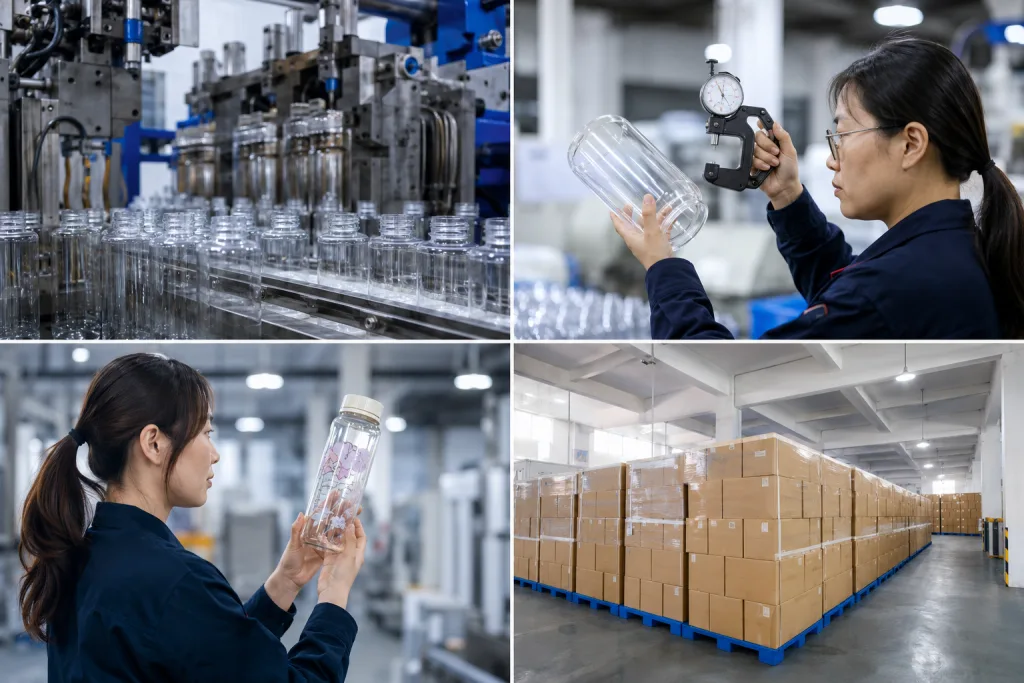
Most PETG bottles for export from Zhejiang and wider China run wall thickness around 0.7-1.0mm. That range is normal. If you push for a more rigid hand feel, resin weight climbs fast and so does unit cost. On a 700ml bottle, an extra 20-30g of resin can add USD 0.06-0.12 per unit depending on PETG market price and scrap rate. We check wall section with a caliper after blow molding, and once you start chasing a thicker feel, the math doesn't work unless retail price can absorb it.
If you are talking to a canteen supplier or canteen vendor about a custom canteen program, ask them to separate the base bottle from the accessories. That is where cost visibility gets better. A canteen customizable project often looks cheap until you see the lid BOM. In practice, the lid can be 25%-40% of total unit cost on a custom drinkware order. QC pulled the sample on one 8,000 pcs order last month, and the straw lid assembly alone had 6 parts before packing. We've seen this go sideways when the bottle body looks on target but the accessory set is doing all the damage.
MOQ Tiers Change the Math
MOQ is not just factory preference. It decides whether your unit cost makes sense. At BottleForge Industrial in Hangzhou, Zhejiang, standard PETG bottle shapes usually start at 1,000 pcs per SKU on existing molds. We run the line for the best pricing at 3,000 pcs, then the math gets better again at 5,000 and 10,000 pcs. A canteen factory quoting 500 pcs can still ship, but you usually pay for it in setup loss, color purge scrap, and hand-packing time. On our floor, one color change on a PETG body can burn 18-25 kg of material before the sample is clean enough for mass production.
Typical tier movement looks like this for a 650-750ml PETG bottle with standard lid:
- 1,000 pcs: USD 2.10-2.80 FOB
- 3,000 pcs: USD 1.65-2.25 FOB
- 5,000 pcs: USD 1.45-2.05 FOB
- 10,000 pcs: USD 1.30-1.90 FOB
These are not fixed numbers, but they are honest planning ranges we quote against. The spread comes from print coverage, lid construction, and carton pack-out details like 24 pcs vs 36 pcs per master carton. For canteen promo jobs, mixed colors are where buyers usually push back. The buyer wants 4 body colors under one PO, but each color can mean separate production loss or a fresh decoration setup. We have seen this go sideways. Some canteen manufacturers accept color assortment within 3,000 pcs total, but usually only when each color holds at 500-1,000 pcs and QC pulled the sample before the full run.
Fully new tooling is a different discussion. A new PETG body mold can cost roughly USD 2,500-6,000 for a straightforward bottle, and more if the geometry is unusual. Lid molds can run another USD 3,000-8,000 because of moving parts, silicone sealing interfaces, and thread accuracy; thread pitch tolerance is often checked down to 0.1 mm on the first trial. If you need a custom growler or customizable growler with larger volume and handle structure, tooling goes up again. For most buyers, a customized canteen based on an existing bottle platform is the safer first order. This is the wrong question to ask if annual volume is only 8,000 pcs. New tooling starts to make sense when annual volume is above 30,000-50,000 pcs.
Low MOQ works for demand testing. It is rarely the cheapest way to build a stable program.
The Cost Drivers Buyers Miss
Most quote gaps start outside the base bottle. Decoration is usually first. One-color silk screen might add only USD 0.05-0.10 per unit, but two-color print may reach USD 0.10-0.18, and full-wrap heat transfer can land at USD 0.18-0.35. A shrink sleeve with high coverage may add USD 0.20-0.40, and the line runs slower because sleeve alignment has to stay within about 1.5 mm or QC pulled the sample. If your custom canteen artwork uses metallic effects or fine registration, setup takes longer and output drops; we have seen one line run 3,200 pcs/hour on a simple logo and 2,100 pcs/hour on a tight wrap job. This is the wrong question to ask if you only compare bottle-to-bottle price.
Packaging is the second hidden driver. Export-safe bulk packing in polybag and master carton is cheap. Retail packing is where buyers get surprised. A white box may add USD 0.10-0.18, while a color box with insert is often USD 0.22-0.45, and that is before carton drop testing or FNSKU work starts. On e-commerce orders, the buyer flagged barcode position more than once, and we had to shift it 12 mm to clear the sealing edge. If you are supplying Amazon or major retail, suffocation warning bag text, barcode placement, FNSKU labeling, and drop-tested cartons add labor and board cost fast. A canteen distributor serving e-commerce should budget this on day one, or the math does not work.
Third is compliance. PETG bottles shipping to Europe and North America may need REACH screening, California Proposition 65 review for components, and food-contact declarations. That sounds routine until one colorway uses a different masterbatch and the lab asks to split the submission into separate component sets. If the bottle is marketed for children, ASTM-related packaging or physical safety expectations may also affect design decisions, including cap fit and small-part risk on lids under the 31.7 mm test cylinder check. Lab testing can cost anywhere from USD 250 for a focused check to over USD 1,000 if the scope is broad across multiple components and colorways. We have seen this go sideways when the PO says one lid color and the carton mark shows another.
Fourth is quality control. Serious canteen suppliers in China should understand AQL levels, not just “we inspect before shipment.” A common plan is AQL 2.5 for major defects and 4.0 for minor defects, and on our side QC uses a vacuum leak tester plus a 1.2 m drop check for packed samples on some programs. Leak testing on 100% of units may add a few cents, but it is cheaper than a return program in Germany or the US. The buyer pushback is usually on unit cost, then the same buyer asks why random leaks showed up after landing. If you are working with canteen distributors or building a distributor canteen range, ask for defined inspection criteria in writing before deposit. We ship cleaner when the standard is written down.
How Long Production Really Takes
Lead time is where first-time buyers get burned. They count factory days and miss the approval chain, and then the ship date moves 12 days without anyone touching the molding machine. For a repeat PETG bottle with an existing mold and standard packaging, we usually run 25-35 days after deposit and artwork approval. For a first order, 35-55 days is the honest range. In peak season from August to November, add 7-15 days buffer. Last October, the buyer flagged a carton mark typo on the PO, and that alone cost 3 days.
A practical timeline looks like this:
- Day 1-3: quote confirmation, artwork files, pantone check, PI issue
- Day 4-10: pre-production sample or digital mockup approval
- Day 11-18: material purchasing, color matching, packaging proof
- Day 19-32: bottle blowing/injection, lid production, decoration
- Day 33-38: assembly, leak test, packing
- Day 39-42: final inspection, booking, export docs
If tooling is new, sample development adds another 15-25 days, and mold correction adds 7-14 more. A custom growler or customized growler with multiple components often needs two sample rounds, sometimes three, before sealing performance is stable. That is normal. QC pulled the sample on one 64oz build last month and found a 0.3 mm thread mismatch at the neck, so we had to cut steel again. Do not get impressed when a canteen manufacturer promises a completely new structure in 20 days. We have seen this go sideways.
Factory capacity matters. A supplier with 300,000-500,000 units per month and in-house decoration control can recover faster if one line slips, because we can shift printing and assembly without waiting on an outside shop. Smaller canteen vendors can still be good partners, but their schedules break easier. This is the wrong question to ask: “What is your lead time?” Ask what is done inside the factory, what is subcontracted around Zhejiang, and how they handle a 5,000-piece reorder if the leak test station finds rejects.
FOB, Freight, and Landed Cost
A clean FOB quote helps, but FOB is not what you pay. You pay landed cost. For PETG, freight math starts with bottle geometry. Air freight follows volume weight, and ocean freight follows carton count and container loading. Tall bottles with wide lids waste cube fast. On our line, a 700ml bottle packed 50 pcs per carton may land around 72 x 46 x 42 cm, and a lid profile change of 6-8 mm can cut 40HQ loading by 5%-10%.
For ocean freight, pack-out often matters more than a small factory price gap. We have seen this go sideways. Buyers who know the category ask for carton size, GW/NW, and 40HQ quantity before they compare quotes. QC pulled the sample once on a wide-mouth bottle where the cap shoulder looked fine, but the master carton lost stack efficiency. If one canteen factory is USD 0.06 cheaper but loads 8% fewer units per container, the math does not work.
For rough planning, a PETG bottle program shipping from Zhejiang, China to North America or Europe can add:
- Sea freight and origin charges: often USD 0.12-0.40 per unit depending on order volume and market conditions
- Duty and import fees: market specific, check current HS treatment carefully
- Domestic warehousing and fulfillment prep: USD 0.08-0.30 per unit for relabeling, sorting, or FBA prep
If you buy as a canteen distributor, canteen vendor, or distributor growler program owner, ask for two packaging versions early: one retail pack and one bulk pack built for freight. We run both quotes at sample stage because late changes cost time. A 5,000 pcs MOQ in gift boxes can work, then the buyer flagged the cube and switched to bulk after the first freight estimate. Many customized drinkware SKUs make sense for wholesale only after the gift-box assumption is removed. The same bottle can serve both channels if packaging is treated as a modular cost, not a fixed one.
What to Lock Before You Place
Before you release deposit, lock the details that usually turn into claims. Start with the specification sheet. It needs the PETG body called out with each lid material by part, capacity tolerance, unit weight tolerance, color standard, logo size in mm, and packing method. If a canteen customized order includes a strap, bumper, tea infuser, or metal trim, list each part on its own line. We have seen POs marked “same as sample,” then the line runs a PP lid instead of AS because one note was missing. That is where trouble starts.
Next, confirm the quality plan. For custom drinkware, write down the leak test standard, odor check method, visual standard, drop-test method if needed, and AQL level for final inspection. State whether inspection is in-line, pre-shipment, or both. QC pulled the sample on one 5,000-piece order because the lid torque was drifting after the third cavity warmed up. A serious canteen supplier will put this into the order file without pushing back. Zhejiang factories that already ship to EU and US buyers usually run a standard QC checklist and adjust it to the project.
Then lock the commercial terms. This is the wrong question to skip. Spell out mold ownership, sample charges, deposit ratio, balance trigger, and spare parts policy. Standard terms are often 30% deposit and 70% against inspection or copy B/L for export orders, while some canteen vendors ask full payment on small trial runs under 1,000 pcs. For packaging-heavy projects, ask who pays if carton board or print proof is redone after approval. The buyer flagged this on one order because the PO said “24 pcs/ctn” and the approved artwork showed “20 pcs/ctn.” You do not want that fight at booking stage.
Questions worth asking your canteen manufacturer
- What is the MOQ by color and by lid type?
- How many days for pre-production sample and mass production?
- Which parts are made in-house and which are subcontracted?
- What compliance documents can you provide for EU and North America?
- What is the loading quantity per 20GP and 40HQ?
This is where buying discipline saves money. If you source a custom canteen, customizable canteen, customized growler, or a wider customizable drinkware range, the cheapest quote means little if the numbers change after testing, packing, and shipment booking. We have seen this go sideways: one supplier quoted low, then added cost after a 1.2 mm carton upgrade and a retest request. The math does not work if the landed cost moves at the end.
Get a PETG cost sheet you can use
Send your target size, lid style, quantity, and packaging plan. We will quote realistic MOQ, FOB pricing, and lead time from Zhejiang, China.
Frequently asked questions
What is a realistic MOQ for petg drinkware custom if I need multiple colors?
For existing molds, a realistic starting point is 1,000 pcs per SKU, but mixed-color programs usually work better at 3,000 pcs total with at least 500-1,000 pcs per color. Below that, color change loss and print setup make the quote unstable. If you need four body colors plus one shared lid, many China factories can combine them under one PO, but they will still control minimum quantity by color. For a canteen promotional order, ask whether the MOQ applies to bottle body, lid color, or finished SKU, because those are not always the same. If you also need retail boxes with language variations, carton MOQs may create a second minimum of 1,000-2,000 boxes per design.
How much should I budget for a first custom canteen order from China?
For a first order using an existing PETG bottle mold, budget FOB China at roughly USD 1.45-2.80 per unit for 3,000-5,000 pcs, depending on capacity, lid, decoration, and packaging. Then add sample cost, usually USD 50-150 for a logo sample, plus possible printing plate charges of USD 30-80 per color. If compliance testing is needed, add USD 250-1,000 depending on scope. Freight, duty, and local handling can add another USD 0.20-0.70 per unit in many cases. If you need new tooling for a canteen customizable design, mold cost can start around USD 2,500 and go well above USD 10,000 once lid mechanisms and multiple cavities are involved.
How long does a customized drinkware order usually take from approval to shipment?
If the mold already exists and artwork is straightforward, repeat orders usually ship in 25-35 days after deposit and final approval. First orders are slower because sampling, packaging proofing, and compliance review take time. A practical range is 35-55 days. If you need a fully custom growler, customizable growler, or a new lid structure, add 15-25 days for development sample work and another 7-14 days if tooling needs correction. Peak season in Zhejiang and other manufacturing regions in China can stretch lead time by 1-2 weeks. The safest approach is to ask for a dated critical path: sample signoff, material arrival, production start, inspection date, and ex-factory date.
Is PETG a good material for a distributor drinkware or retail bottle program?
Usually yes, if your target is lightweight, clear, impact-resistant drinkware at a moderate price point. PETG is commonly used for 500-1,000ml bottles where you want better clarity than many commodity plastics and less breakage risk than glass. It is not the right answer for high-heat use, but for cold and room-temperature applications it is practical. For a canteen distributor or distributor growler program, the real decision is less about the resin alone and more about the total build: wall thickness around 0.7-1.0mm, reliable silicone seal, consistent thread fit, and a QA plan with 100% leak test. Material choice matters, but assembly discipline matters just as much.
What documents should I ask from canteen suppliers before placing the order?
Ask for a formal quotation, product specification sheet, packing details, and a proforma invoice with Incoterm clearly stated, usually FOB Ningbo or FOB Shanghai for Zhejiang shipments. On compliance, request material declarations and any available test reports relevant to your market, such as REACH or food-contact documentation. On factory control, ask whether they have ISO-based procedures, BSCI audit status if social compliance matters to your brand, and their final inspection standard, ideally with AQL levels listed. You should also request carton dimensions, gross weight, and loading quantity for 20GP and 40HQ. If the order is for Amazon or retail, confirm barcode, FNSKU, and labeling responsibility before deposit.