Key Takeaways
- For PETG bottles, stock mold projects usually start at 3,000-5,000 pcs per SKU, while new mold programs often need 10,000+ pcs and 25-35 days for tooling
- Typical FOB pricing for a 700ml PETG bottle with one-color silkscreen and basic polybag runs about USD 1.10-1.90 at 5,000 pcs, depending on lid structure and packaging
- Ask for REACH, LFGB or FDA contact compliance, plus AQL 2.5 final inspection and drop-test standards before paying the 70% balance
- A factory in Zhejiang with 300,000-500,000 units/month capacity and 30-45 day lead time is usually safer for repeat B2B orders than a trading-only source
You are not buying a bottle. You are buying 5 decisions that decide whether the order runs clean: material safety, decoration risk, tooling cost, packaging accuracy, and whether the factory can repeat the same result at 3,000 units and again at 30,000. On our line, QC pulled the sample after a 1.2 meter drop test and a leak check, because a nice desk sample still fails in transit, on a retail shelf, or during a compliance test if the basics were never locked down.
Most buyers who come to Zhejiang start with the wrong question. They ask for the lowest FOB price, and we've seen this go sideways fast. The better question is which trade-offs you accept: stock mold or a new mold with a 45-day tool lead time, single-color print or wrap label with tighter registration control, 3,000 units or 30,000, retail shelf pack or a simple promotional giveaway carton. Last month a buyer flagged a PO typo on carton count, 24 pcs vs 36 pcs, and that single line changed the packing math. Once these decisions are clear, custom drinkware sourcing gets easier and the math works.
Start with four buying decisions
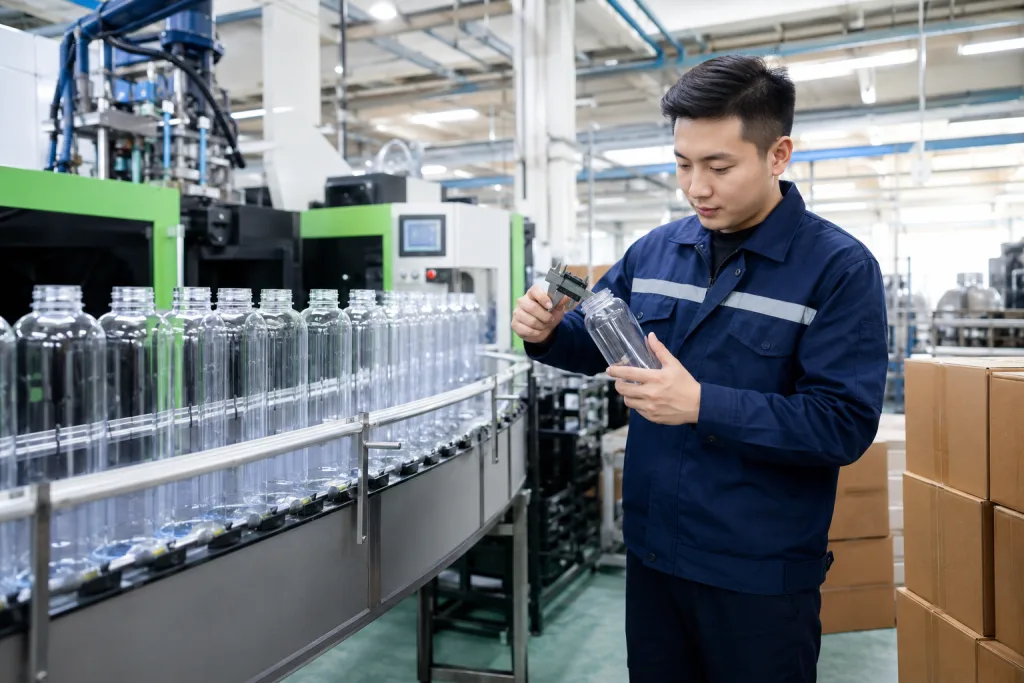
If you are selecting a petg drink bottle manufacturer, cut the job into four buying decisions. That gets the quote cleaner, the sample cycle shorter, and the line moving faster. On our side, we usually check neck finish with a digital caliper at 0.1 mm before we even talk decoration, because small spec drift turns into big trouble later.
- Decision 1: Stock mold or custom mold. A stock shape is the faster, safer route. We ship stock projects in 30-35 days in normal season, and the buyer avoids mold risk. A custom silhouette gives you a stronger shelf look, but you may spend USD 2,500-8,000 on tooling and wait 45-60 days before mass production. We have seen this go sideways when a buyer approves a 3D drawing, then flags the shoulder radius after T1 sample.
- Decision 2: Promotional or retail grade. A canteen promotional giveaway can run with simpler packaging, wider color tolerance, and lighter decoration coverage. Retail shelves in Europe and North America usually need tighter scratch control, correct barcode position within a few mm, stronger carton drop performance, and better cap-thread consistency. This is the wrong question to blur. QC pulled the sample on one order last year because the cap torque spread was too wide for a retail chain, even though the bottle looked fine.
- Decision 3: Price point or claim set. If you need recycled positioning, food-contact testing, dishwasher guidance, and stronger print durability, factory cost moves up fast. The math does not work if the target price stays at basic event-bottle level. If your goal is a clean logo bottle for a 5,000-piece event order, simplify the spec and run a standard print test on the line first.
- Decision 4: One-off buy or repeat program. A serious canteen distributor or distributor drinkware buyer should plan past the first PO. You need color repeatability, spare-parts consistency, and packaging specs that we can rerun 6 months later in China without starting over. We keep approved master samples and carton marks on file because one typo on a PO - cap color listed as "mat blue" instead of "mint blue" - is enough to create a claim later.
This is where 7 out of 10 buyers lose money. They mix retail expectations with giveaway budgets. Or they ask for a custom canteen look from a stock bottle, then reject it because it does not look exclusive enough. Be honest about the job this item needs to do in your line. A practical canteen supplier should push back and define the end use before quoting.
At BottleForge Industrial in Hangzhou, Zhejiang, we usually tell buyers to lock the sales channel first, then the bottle architecture. Most RFQs come in the other way around, and that is why revisions pile up. We run sample review from cap fit downward, and that sequence has saved buyers 12 days vs 18 days on redesign loops more than once.
Know when PETG is the right material
PETG sits between cheap clear plastics and higher-cost materials. It gives you better clarity, better drop resistance, and cleaner bottle shaping on the line than a lot of brittle options we see in low-end promo orders. We run this material often for branded customizable drinkware, especially 5,000 to 20,000 pcs programs. Still, this is the wrong question to ask if you want one material for every use case.
Use PETG when the brief is simple: clear bottle, lighter carry weight, and daily use for gyms, schools, promotions, or office programs. For a 600-750ml PETG bottle, wall thickness usually runs 0.8-1.2mm depending on the body shape, grip panel, and base diameter. We have seen thin sample bottles at 0.75mm look good on the table, then deform in master cartons after export stacking at 18kg. For repeat orders, ask your canteen manufacturer for the real wall range, bottle weight tolerance in grams, and cap torque spec checked with a torque meter.
PETG is a weaker fit if your sales copy pushes a high-heat claim. It is also not the first pick when buyers want the premium feel of stainless steel or glass and the buyer flagged it on shelf comparison. If your brand also sells a custom growler or insulated line, position PETG honestly as a lightweight everyday bottle. Not a thermal bottle. We have seen this go sideways when a PO says "hot water use" by mistake and the factory has to stop for clarification.
Questions worth asking the factory
- What resin grade is used, and can the supplier provide food-contact declarations?
- Can the bottle pass common migration requirements for your market, such as REACH-related checks or FDA/LFGB requests through a third-party lab?
- What is the bottle weight in grams, and what variance is acceptable batch to batch?
- Are color masterbatch and decoration inks suitable for the destination market?
A capable canteen factory in Zhejiang should answer these points with documents, dates, and test scope, not vague sales lines. QC pulled the sample and the paperwork should match the cap, bottle, and ink set actually used in production. If a canteen vendor only says "food safe, no problem," that does not work for Europe or North America. Ask for the exact lab report scope and report date. Serious canteen manufacturers keep these files ready because buyers ask for them every week, and AQL 2.5 inspection is not the place to find out something is missing.
Compare factory capability, not just quotations
A low quotation from a canteen supplier tells you almost nothing if that source cannot hold decoration color, assembly fit, or final inspection on the line. Ask first what they actually run. We have seen trading companies piece together bottles, lids, and packing from 4 workshops, then miss a 1.5 mm logo position shift at final check. You need to know whether you are buying from a real canteen manufacturer, a hybrid source, or a trader.
Ask for hard metrics. Real ones. Monthly output for bottles in the same material family should be stated in numbers, not sales talk. A credible Zhejiang producer might tell you 300,000 to 500,000 units per month, MOQ 3,000 pcs for stock molds, and 30-45 days lead time after sample approval and deposit. That helps. “Big factory, fast delivery” does not. The buyer flagged this exact line to us last year, and he was right to do it.
Then check process coverage. For PETG, the useful question is which stations they control themselves: blow molding or bottle forming, injection-molded lids, silkscreen, heat transfer, UV print, assembly, leak testing, and carton packing. If your order includes a canteen custom cap, carry loop, straw, or sleeve, ask what stays inside and what goes outside. Every outsourced step adds risk. This is the wrong question to ask only at price stage; by then, the math usually does not work.
You do not need the biggest factory in China. You need a factory whose normal order size looks like your order, not one that treats your 5,000 pcs as a distraction.
For social and quality systems, ask what is current on paper and what is running on the floor. BSCI, ISO 9001, and basic traceability discipline matter more than a stack of expired certificates. If you are a canteen distributor supplying chain retail, ask about carton barcode control, pallet standard, and whether FNSKU or customer-specific carton marks can be applied without mix-up. QC pulled the sample on one run and found 2 master cartons with the old PO suffix still printed. Small error, big headache.
This is also where a buyer looking for customized drinkware or a customizable canteen should ask for the factory org chart, or at least the project owner’s name and job scope. One export coordinator who understands approvals, pre-production samples, and AQL release can save 12 days versus 18 days of back-and-forth. We ship smoother when one person owns the file. We have seen this go sideways because a PO typo changed “smoke grey” to “smok grey,” and nobody caught it before mass print.
Price drivers buyers usually miss
Compare two PETG bottle quotes line by line. A unit price at USD 1.15 versus USD 1.48 usually means the specs changed somewhere you did not catch, and we see this on POs every month. Last week the buyer flagged a 0.6mm wall change after QC pulled the sample.
The big cost drivers are easy to spot: bottle weight in grams, cap structure, seal type, print method, packaging style, and line scrap. The missed costs sit underneath. A frosted finish can drop yield by 3-5 points on the line. Metallic ink often slows screen printing from about 2,800 pcs to 2,200 pcs per shift. A molded logo on the lid can need a new insert even if the bottle body stays on a stock mold, and that insert is usually cut on CNC first, then hand-polished. Individual color boxes add real money too, usually USD 0.18-0.45 depending on box size, inner support, and print coverage. This is the wrong question to ask if you only compare bottle body price.
Here is a realistic FOB range from Zhejiang for stock-mold PETG programs:
- 600-750ml clear bottle, PP lid, one-color silkscreen, polybag, master carton: USD 1.10-1.90 at 5,000 pcs
- Same bottle with two-color print, hangtag, and color box: USD 1.45-2.30
- Bottle with straw lid or carry handle assembly: add USD 0.20-0.60
- New custom mold amortization: often USD 0.15-0.50 per unit in early runs if spread over 10,000-20,000 pcs
If you are buying as a distributor canteen program or through canteen vendors, ask the factory to break out unit price, tooling, sample charge, packaging, and test fees on one sheet. We ship cleaner quotes that way. If not, the low quote often comes back later through revised carton specs, a paid sample revision, or a carton drop test fee the buyer did not budget. We have seen this go sideways over one PO typo on carton size.
The same rule applies when you source a customized canteen, customizable growler, or distributor growler program alongside bottles. Standardize the quote template across all suppliers. A 12-line template is enough. It makes cost comparison faster, and it shows whether the extra money sits in packaging, tooling, or slower decoration on the line.
Compliance and quality gates before shipment
Most B2B trouble starts before the line runs. It starts with a vague PO. For PETG bottles, spell out the acceptance standard before production: compliance documents, approved artwork, critical dimensions, leak standard, and final inspection level. We have seen a 0.8mm logo shift turn into a full reprint claim, and this is the wrong question to ask after molding starts.
For Europe and North America, buyers usually ask for food-contact declarations and REACH-related substance control, then FDA or LFGB testing if the channel requires it, through SGS, Intertek, or TUV. If the bottle goes to kids or school channels, check whether ASTM-related items apply to the lid accessory or retail box. The buyer often assumes the canteen vendor already knows the channel rule set. We do not assume that. Last season one PO even said "school chanel," and QC pulled the sample against the wrong packaging file until the buyer flagged it.
On quality control, AQL 2.5 is a common final inspection level for major and minor defects, while some branded retail launches move to AQL 1.5. Critical defects should stay at zero tolerance: leakage, broken threads, sharp edges, wrong barcode, wrong logo color, or compliance mismatch. Ask for a pre-production sample signed to Pantone references, then a production sample from the first mass run. We run thread checks with a go/no-go gauge, and the math does not work if you wait until finished packing to argue about seal performance.
What to include in the QC checklist
- Leak test method and hold time
- Cap torque range and opening feel
- Print adhesion test method
- Carton drop test standard, often 76cm for export cartons
- Bottle weight and major dimension tolerances
- Inner pack quantity and carton gross weight limit
A disciplined canteen factory in China should send packing photos and carton measurements before balance payment. If the goods ship to Amazon FBA or a large distributor, confirm barcode placement and carton labels before the first carton is sealed. We ship cartons after checking outer box size on a tape measure, and a 3cm label offset has already caused pallet relabel work at destination. These details look boring. They decide whether the shipment is usable or expensive.
Build the order plan around lead time
Lead time is not one number. It is a chain. For a stock-mold PETG bottle from Zhejiang, a realistic schedule is 3-7 days for artwork proof, 5-10 days for pre-production sample, and 25-35 days for mass production after approval and deposit. On our side, QC pulled the sample and the screen print position was off by 1.5 mm, so the clock restarted for one day. Add a week if your project has a new lid color, two decoration passes, or retail box revisions. Add more time if third-party testing must be completed before shipment. We have seen this go sideways.
If you are launching a canteen customized seasonal line, build backward from your warehouse need date, not the ship date. This is the right question to ask. Ocean freight to Europe or North America still moves around, and the math does not work if you plan from vessel departure only. A tight plan might require production completion 55-75 days before your sales deadline, depending on route and customs handling. Last month, one buyer flagged a PO typo on carton marks, and that alone cost 3 days before loading.
For repeat orders, ask your canteen manufacturers to reserve raw material and key color masterbatch after the first shipment if your forecast supports it. We run this with a 500 kg PETG lot and locked masterbatch code on the first order. That can cut reorder lead time by 5-10 days. It also reduces the chance that your “same” translucent blue looks slightly different in the next lot, which is a common complaint once bottles from two shipments sit side by side.
Serious canteen suppliers and canteen distributors usually perform better when forecasts are shared quarterly, even if they are rough. We ship smoother when the buyer gives a 90-day view, even with only 3 SKU estimates. If your program includes matching customized growler, bottle, and tumbler items, align artwork approvals and carton standards across all SKUs. On the line, the outer carton stamp and barcode placement are checked against one master sheet. It sounds administrative, but it stops you from paying expedited sampling fees three times.
The best sourcing rhythm is simple: approve one clear spec, run one stable shipment, then scale. Short and boring works. We normally tell buyers to prove the first 5,000-piece customizable canteen run, check the drop test and color delta, then open the larger custom drinkware line through China for annual replenishment. That sequence saves money and avoids preventable rework.
Need a clear quote for PETG bottle sourcing?
Send your target size, quantity, decoration, and market. We will quote MOQ, FOB price, lead time, and compliance options without vague factory language.
Frequently asked questions
What MOQ should I expect from a petg drink bottle manufacturer?
For stock molds, most real factories in China will quote MOQ at 3,000-5,000 pcs per size and colorway. If you want mixed lid colors, retail boxes, or multiple prints, the practical MOQ may move upward because of setup waste and packaging minimums. For a new bottle mold, expect 10,000 pcs or more to make the tooling cost sensible. If you are a distributor testing a market, ask whether one bottle body can be paired with 2 lid options under the same order. That often gives you a canteen customizable program without paying for a new mold on the first run.
How do I tell if a supplier is a real factory or just a trader?
Ask for factory address, business license scope, production photos by process, and a video showing bottle forming, lid assembly, printing, and packing in one workflow. Then ask for hard numbers: units per month, normal MOQ, and current lead time. A factory answer sounds specific, such as 400,000 units/month, 5,000 pcs MOQ, 35 days lead time. A trading answer is usually vague. You should also ask which processes are outsourced. Many acceptable suppliers use outside carton or mold partners, but if bottle body, lid, print, and assembly are all outsourced, your timing and QC risk go up quickly.
What compliance documents should I request for PETG custom drinkware?
At minimum, request food-contact declarations for the bottle resin, lid material, silicone seal, and decoration inks if they may contact the mouth area. For Europe, ask about REACH-related controls and any LFGB test reports available for similar constructions. For North America, FDA-related food-contact support is common. If you sell to stricter retail channels, use a third-party lab such as SGS or Intertek and define the test scope before production. Also request carton and packaging details if your market has labeling rules. Compliance should match the final assembled bottle, not just one raw material datasheet from months ago.
What is a realistic price for a customized canteen or PETG bottle order?
For a 600-750ml PETG bottle using a stock mold, one-color silkscreen, standard PP lid, and export carton packing, a normal FOB China range is about USD 1.10-1.90 at 5,000 pcs. Better lid structures, handle parts, color boxes, or multi-color decoration can push the project to USD 1.45-2.30 or higher. Tooling for a custom shape usually adds USD 2,500-8,000 depending on complexity. Always compare total landed cost, not only unit price. A slightly higher FOB from Zhejiang can still be cheaper if carton utilization, defect rate, and lead time are better.
What quality checks matter most before I release the balance payment?
Focus on five checks: leakage, print durability, dimension tolerance, carton accuracy, and barcode correctness. Ask for an AQL 2.5 final inspection or tighter if the program is premium retail. Critical defects should be zero: leaking bottles, cracked necks, wrong artwork, wrong labels, and carton quantity errors. Good factories will provide inspection photos, carton measurements, gross weight, and random sample videos before shipment. If your order is 10,000 pcs or more, third-party pre-shipment inspection is money well spent. Spending USD 250-400 on inspection is cheaper than receiving a container with one avoidable defect repeated 2,000 times.