Key Takeaways
- For pc water bottles wholesale, the practical MOQ is usually 3,000 to 5,000 units per color, with 25 to 35 day lead time after sample approval.
- A 600 ml PC bottle typically runs about USD 1.10 to 1.95 FOB China depending on mold, lid type, decoration, and carton pack-out.
- Use PC when you need high clarity and impact resistance; avoid it for boiling-fill applications above 90 C or premium gift positioning.
- Inspection should be agreed at AQL 2.5 major and 4.0 minor, with leak test, odor check, drop test, and barcode scan included.
You can buy a cheap clear bottle almost anywhere in China. Easy part. The hard part is checking whether that bottle survives a 1.2 meter drop test, passes REACH and LFGB where needed, takes a clean logo on the screen-print line, and still lands at the right FOB cost after lids, inner boxes, master cartons, and inspection are counted.
If you are sourcing pc water bottles wholesale for retail, promotion, gym chains, or campus programs, you need a straight comparison, not catalog fluff. We run into this every week. A solid Zhejiang factory should tell you where PC fits, where it does not, and when Tritan, stainless, or glass will cut claims later; this is the wrong question to soften. The buyer flagged this before on a 5,000-piece PO with the lid spec typed wrong, and we have seen that go sideways fast. That is how bulk drinkware should be bought.
Where PC Wins And Loses
PC, or polycarbonate, still earns its slot in wholesale drinkware if the brief is clear bottle, decent abuse resistance, and a low sell-in price. We run this material for buyers who need volume, not hype. Over the last 12 months, 7 out of 20 new bottle inquiries still stayed on PC after sampling because the math worked for sports clubs, event packs, value retail, and institutional orders. A well-made PC bottle is still a sensible buy. This is the wrong question to ask: "Is PC trendy?" Ask where it will be used. On the line, we watch wall thickness around 0.8-1.0 mm because thin bodies save cents fast and then crack fast too.
What you get from PC is simple. Strong drop performance, clear appearance, stable molding on threaded necks, and a lower FOB than insulated stainless. A typical 600 ml single-wall PC bottle with PP lid and silicone seal can land around USD 1.10 to 1.45 FOB Ningbo at 5,000 units. Add a carry loop, color masterbatch, or two-position printing and you are usually in the USD 1.50 to 1.95 range. We ship this spec every month, and neck consistency is one reason buyers stay with it; the cap torque window is easier to hold when the mold is running clean. QC pulled the sample last week and checked the thread with a plug gauge after one buyer flagged cross-threading on a previous PO.
Buyers get into trouble when they assume clear plastic works everywhere. It does not. PC fits cold fill and ambient drinks. If your market expects 300 dishwasher cycles, occasional hot beverage misuse, or a strong sustainability pitch at retail, pause and reset the material choice. We've seen this go sideways. In those cases, wholesale canteen or wholesale growler programs usually sell better in stainless, even if the opening quote is higher. For kids' items, compliance review is tighter and the buyer flagged odor retention more than once. For premium gifting, stainless or glass gives your sales team fewer objections. One inspection finding we see with rushed PC projects is haze after repeated wash tests, and that argument burns more time than the small savings are worth.
- Good fit: school programs, gym retail, promotion, travel hydration, entry-price bulk canteen orders
- Borderline fit: mid-market lifestyle retail with heavy dishwasher exposure
- Poor fit: hot-fill use, beer growler wholesale bulk, alcohol flask wholesale, premium gift sets
Buy PC because it matches the use case, not because the sample feels nice in your hand for 30 seconds.
Head To Head Spec Table
If you are comparing materials, the spec table matters more than marketing copy. We see buyers in Europe and North America stack PC against Tritan, 18/8 stainless steel, and soda-lime or borosilicate glass on the same sheet, then circle weight, drop risk, and landed cost. On our side, QC usually checks wall thickness with a digital caliper at 2.0 to 2.8 mm before we even talk packaging. The right choice comes down to channel, claims risk, and target shelf price. This is the right question.
Typical sourcing comparison
- PC bottle, 600 ml: 85 to 110 g body weight, wall thickness 2.0 to 2.8 mm, FOB China USD 1.10 to 1.95, MOQ 3,000 to 5,000 pcs, lead time 25 to 35 days, cold beverage focus
- Tritan bottle, 600 ml: 95 to 120 g, wall thickness 2.0 to 3.0 mm, FOB USD 1.55 to 2.40, MOQ 3,000 pcs, lead time 30 to 40 days, stronger retail acceptance in Europe
- Single-wall stainless canteen, 600 ml: body 0.4 mm to 0.5 mm 18/8, FOB USD 2.10 to 3.60, MOQ 2,000 to 3,000 pcs, lead time 35 to 45 days, better for wholesale canteen and canteen bulk programs
- Insulated tumbler or growler: inner 0.4 mm and outer 0.5 mm, FOB USD 3.80 to 8.50+, MOQ 1,000 to 2,000 pcs, lead time 40 to 55 days, suitable for beer tumbler wholesale bulk and beer growler wholesale
- Glass bottle, 550 ml: FOB USD 1.40 to 2.60, MOQ 3,000 pcs, lead time 30 to 40 days, stronger taste-neutral story but higher breakage risk
For large drinkware wholesale tenders, start with failure tolerance. We have had buyers ask for the cheapest bottle first, then the buyer flagged a 3% breakage assumption later, and the math doesn't work. PC usually beats glass on breakage claims and beats stainless on entry price. Tritan still wins on buyer perception in parts of Europe, while insulated steel wins on temperature retention by a wide margin. Factories in Zhejiang that run both plastic and steel lines are easier to work with because they will tell you to switch materials before tooling goes the wrong way.
If your brief includes bulk growler, growler wholesale, or beer growler in bulk, skip PC early. Once capacity goes above 1 liter, plus carbonation-related consumer expectations, we have seen this go sideways unless you move to stainless. On the line, a 1.2 L concept in PC often looks fine in sampling and then gets pushback at the sealing test. If your brief is best wholesale drink bottle for student retail under a tight budget, PC is still one of the cleaner answers to quote and ship.
Use Case Fit By Channel
Most sourcing problems start with a channel mismatch. Buyers ask for one bottle to cover retail, promo, and ecommerce, and we usually push back because this is the wrong question to ask. On the line, the same 700 ml PC bottle that works for a 20,000-unit giveaway can fail on a retail shelf over a 1 mm logo shift or haze mark.
Promotional and event distribution: PC fits this channel because the cost stays under control and breakage risk is lower than glass. If you need 10,000 to 30,000 units for a campaign, a simple 700 ml PC body with one-color silk screen is the standard build we ship every month. Standard export cartons of 48 or 60 pcs keep packing cost down, and the bottle usually takes rough handling better; last month a buyer flagged dented cartons, but QC pulled the sample and the bottles inside were still fine.
Retail shelf programs: PC can fit value retail, but the spec has to be tighter and the paperwork has to be clean. Your customer may ask for REACH, California Proposition 65 screening, and migration test reports depending on market, and retail buyers will read those files line by line. If you are selling into Europe, ask how the factory controls color on transparent bodies; we check masterbatch lots against an approved sample under a light box, because shelf rejects are often cosmetic and we have seen this go sideways fast.
Amazon FBA or DTC: PC is workable if the bottle passes drop testing and the unit pack protects the lid and print. FNSKU labeling, suffocation warning, and outer carton barcode placement should be locked before mass production, not after 5,000 pcs are packed. A bottle can survive container transit and still fail small-parcel delivery if the cap cracks under compression; we run carton stack tests at 5 layers, and that catches problems early.
Hospitality and beverage-related lines: For beer tumbler bulk, beer tumbler in bulk, or wholesale growler projects, PC is usually the wrong branch of the tree. Temperature retention matters. Condensation control matters more. Hand feel matters too, and the math does not work if the buyer expects a premium bar program from a lightweight PC wall. The same logic applies to alcohol flask bulk or alcohol flask wholesale bulk orders. Those products are generally stainless steel categories, not PC, and most buyers asking for 304 stainless also want welded seam finish checked before packing.
Buyers sometimes try to force every related keyword into one supplier search: canteen wholesale, drinkware bulk, growler bulk, alcohol flask in bulk. We get that request a lot from new sourcing teams, and once we even saw a PO typo mixing PC bottle and steel growler specs on the same line item. In real purchasing, the best China factory for PC bottles may not be the best one for steel flasks or insulated growlers. If your Zhejiang supplier can make 1.2 million units per month across categories, that helps, but category depth matters more than a wide catalog.
Compliance And Quality Checks
For pc water bottles wholesale, compliance is where cheap quotes get expensive fast. We have seen a low quote jump 11% after failed testing and a reprint. The bottle body, lid resin, colorant, silicone ring, paint, and print ink all need to match the target market, and this is the wrong question to ask if you only ask, "Is it food grade?" Ask for the exact material declaration for each part, down to the silicone ring Shore hardness if the line uses two seal options. Serious buyers usually ask for REACH screening for EU programs, California Proposition 65 review for US retail, and product testing against the food-contact standard used in the destination market.
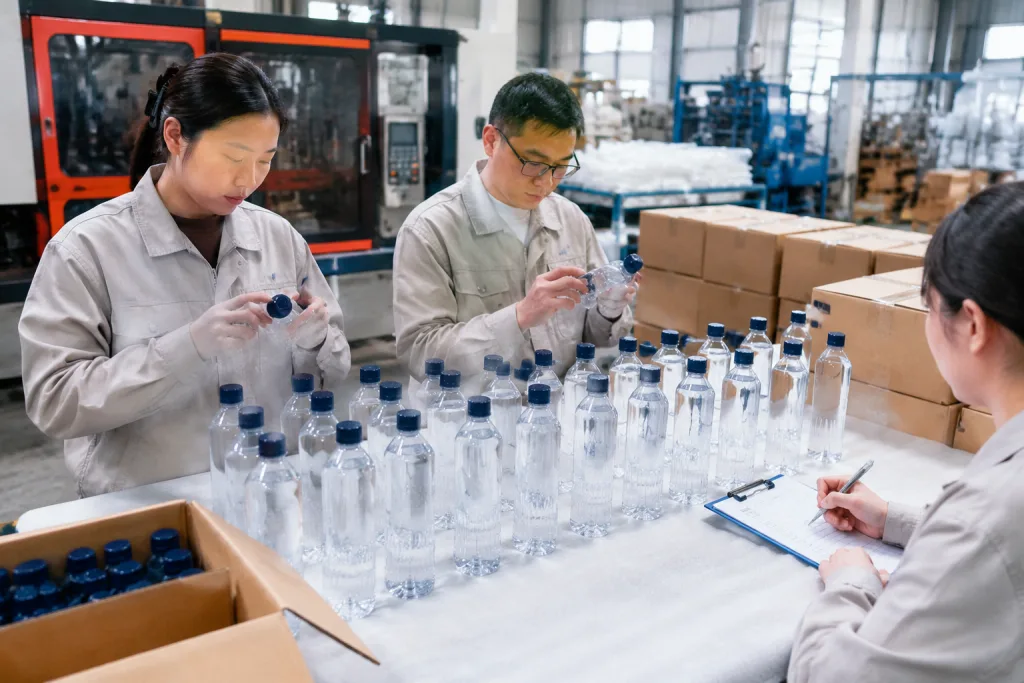
At production level, a sensible quality plan beats a wall full of certificates. ISO 9001 helps. BSCI matters if your customer asks for social compliance. Neither replaces in-process control on the line. We normally suggest these checkpoints before you release balance payment, because QC pulled the sample too late on one 20,000 pc order and the buyer flagged lid color drift after packing had started:
- Incoming material check: resin batch record, color match against approved chip, seal ring hardness checked with a Shore A durometer
- In-line control: neck thread gauge check every 2 hours, print adhesion cross-hatch test with 3M tape, leak test by vacuum or inverted hold
- Final inspection: AQL 2.5 major, 4.0 minor, carton drop test, assembly fit, odor check, barcode scan
- Performance tests: 24-hour leak test, 1.2 meter drop test with water fill, dishwasher trial if claimed, strap pull test if handle is included
For custom logo jobs, ask what defect standard applies to print registration and pinholes. If you do not define it, the factory may treat a small logo shift as passable, and we have seen this go sideways at pre-shipment. Put it in writing. Print position tolerance within plus or minus 2 mm, Pantone match target, and no obvious scratches visible at 30 cm distance. On our side, we run a first-off sample check with a steel ruler and light box before mass print starts.
Buyers miss master carton strength all the time. For 700 ml PC bottles packed 48 pcs per carton, look for five-layer export cartons and gross weight under about 14 kg if possible. The math does not work if the carton saves RMB 2 but splits at the bottom seam after a 1.2 meter drop. We ship enough of these to know the bottle is cheap and failed transport packaging is not.
Cost Drivers Buyers Miss
The unit price on the quotation is only half the story. We see buyers compare FOB bottle price only, then pay for it later. For pc water bottles wholesale, the cost drivers buyers miss are mold amortization, decoration, lid structure, packing format, and claim risk. This is the wrong question to ask. Ask landed cost per sellable unit. On the line, QC pulled a sample last month where the bottle passed visual check but the seal lip was off by 0.4 mm, and that one detail turns into returns.
A standard existing mold is still the cheapest path. If you want a new silhouette, an integrated carry handle, or a custom mouth opening, expect a mold charge from roughly USD 2,500 to 8,000 depending on complexity and cavity count. That can still make sense if your annual volume is above 50,000 units. Below that, the math doesn't work in most cases. We have seen buyers push for a fresh shape at 10,000 units MOQ, then walk back after they see sampling, mold charge, and 18 days of extra development time.
Decoration changes the economics fast. One-color silk screen may add only USD 0.05 to 0.08 per unit. Heat transfer or wrap print can add USD 0.12 to 0.25. Laser engraving is irrelevant on PC, so if your brand style depends on durable etched marks, move to steel. We run screen print fixtures by position, and a full-wrap job usually needs tighter alignment control than buyers expect. Individual polybag, egg-crate divider, color box, or PDQ display pack can add more than the logo itself. The buyer flagged this on a PO once because "color bx" was typed instead of "color box," and the packing cost moved by USD 0.09 per unit.
Here is a practical way to compare quotes from China:
- Base bottle FOB: body, lid, seal, standard carton
- Decoration adder: per color, per position, or full-wrap
- Packing adder: polybag, white box, color box, insert card
- Testing and inspection: third-party lab, pre-shipment inspection, carton drop verification
- Claim reserve: realistic allowance for leakage, print rub, transit damage
If one supplier is USD 0.11 cheaper but needs a 45-day lead time and has a 3 percent leak failure on spot inspection, that quote is not cheaper. We ship this category every month, and 30 days vs 45 days changes replenishment planning more than buyers admit. A reliable Zhejiang factory with 30-day lead time and stable assembly is usually the better total-cost answer. Freight also matters, but for this category, quality failures erase freight savings fast. We have seen this go sideways after a drop test finding on a 5-ply carton that should have been 7-ply.
How To Place The Right Order
The best purchase orders are boring. That is the point. They leave no room for guessing on the line. If this is your first China order for wholesale drinkware, write the PO like a spec sheet, not a sales note. We have seen a PO marked "smoke gray" turn into 2 shades in one run because no Pantone code was listed, and the buyer flagged it at carton drop.
Start with the fixed data: capacity, net weight tolerance, material specification, color code, lid structure, gasket material, logo method, unit pack, export carton dimensions, and barcode requirements. Then write the performance target in plain numbers. For example: 650 ml capacity plus or minus 3 percent, body in PC clear smoke color, PP screw lid with food-grade silicone ring, one-color silk screen logo, leak-proof under inverted 24-hour hold, pass 1.2 meter drop test with water fill, and comply with approved sample standard. QC pulled the sample and checked fill volume with a graduated cylinder, not by eye. This is the wrong question to ask: "Can you make it like last time?" Put the number on paper.
Lead time should tie to approval points, or the math does not work. A common format is 7 to 10 days for pre-production sample, then 25 to 35 days for bulk after sample sign-off and deposit. If your order lands before Chinese New Year or peak summer bottle season, add 5 to 7 days buffer. We run into this every year. Buyers in North America often miss how fast July and August vessel space gets tight, and a plan that looked fine on Monday becomes 12 days vs 18 days once booking rolls.
Payment terms for new suppliers are still commonly 30 percent deposit and 70 percent balance before shipment. That is standard in Zhejiang. For larger repeat orders, some factories in Zhejiang will discuss better terms after a clean trading history, usually after 3 orders or 6 months with no claim. Before paying balance, ask for final inspection report, packaging photos, quantity summary, and shipping marks approval. On one job, the PO showed "24 pcs/ctn" but the shipping mark file said "24 pc/cton." Small typo, real customs risk.
Finally, keep your category boundaries clear. If you are also buying canteen bulk, wholesale drinkware, beer tumbler wholesale, or alcohol flask wholesale in the same project, do not assume one sample approval standard covers all of them. PC bottle tolerance, stainless vacuum retention, and flask weld finishing are different technical conversations. We ship all three types, and they do not run on the same line or get checked with the same fixture. A PC bottle mouth might be held to +/- 0.3 mm, while a flask seam issue shows up under polish inspection. We have seen this go sideways when one approval sheet tries to cover 4 SKUs.
Get a practical quote for your next bottle program
Send your target volume, capacity, market, and logo method. We will recommend whether PC, Tritan, or stainless fits your cost and compliance needs.
Frequently asked questions
What MOQ should I expect for pc water bottles wholesale?
For a standard existing model, most factories in China will quote 3,000 to 5,000 pieces per color. Some will say 1,000 pieces, but that often means using mixed leftover components or accepting a higher unit price. If you need custom body color, custom lid color, and printed logo, 3,000 pieces is the more realistic floor. For a fully new mold, the commercial break-even usually starts closer to 10,000 pieces, especially if you want the tooling cost diluted. In Zhejiang, a factory with regular bottle production can often handle 100,000-piece repeat orders without issue, but your first order should stay manageable. Start with one or two SKUs, confirm market feedback, then scale.
Are PC bottles still acceptable for Europe and North America?
They can be, but you need to match the product to the market and use case. Buyers are more cautious now, so you should not rely on broad claims. Ask for material declarations, food-contact test reports relevant to the destination market, and clear documentation for lid, seal, colorant, and ink. For Europe, REACH attention is standard, and some customers may also ask for LFGB-related testing depending on product positioning. For North America, retail programs may ask about California Proposition 65 screening. PC is still used for practical bulk drinkware programs where impact resistance and cost matter. It is less attractive where the brand story leans heavily on premium sustainability or high-heat use.
How much does a wholesale PC bottle usually cost?
A plain 600 to 700 ml PC bottle with PP lid typically sits around USD 1.10 to 1.45 FOB China at 5,000 pieces. Add a carry strap, dual-material lid, custom color, or multi-position print and you move into the USD 1.50 to 1.95 range. A branded color box can add another USD 0.18 to 0.45 depending on structure and print. If a quote is well below market, check what is missing: carton strength, seal ring quality, decoration durability, or inspection scope. For large drinkware wholesale tenders, the right comparison is not just bottle price. You should compare total landed cost, defect allowance, and lead time reliability.
When should I choose stainless instead of PC?
Choose stainless when temperature retention, premium feel, or category fit matters more than entry cost. That includes most wholesale growler, beer growler bulk, beer tumbler wholesale bulk, alcohol flask bulk, and alcohol flask wholesale projects. Stainless is also better when your brand wants laser marking, vacuum insulation, or a stronger outdoor positioning. A single-wall stainless canteen may cost roughly USD 2.10 to 3.60 FOB, and insulated items can run USD 3.80 to 8.50 or more, so the price jump is real. But if the end customer expects a premium hand feel or hot-cold performance, PC will feel like the wrong compromise and you will spend more fixing the mismatch later.
What quality checks should be mandatory before shipment?
At minimum, require leak testing, visual inspection, assembly fit check, carton verification, and pre-shipment inspection to an agreed AQL, usually 2.5 major and 4.0 minor. For PC bottles, add a 1.2 meter drop test with water fill, print adhesion test if decorated, odor check after packing, and barcode scan for both unit and carton labels. If the bottle has a strap or loop, ask for a pull test. If the goods are for Amazon FBA, confirm FNSKU placement and outer carton label format before packing starts. A serious factory in Zhejiang should be able to send inspection photos, packing line photos, and carton measurements before you release the 70 percent balance.