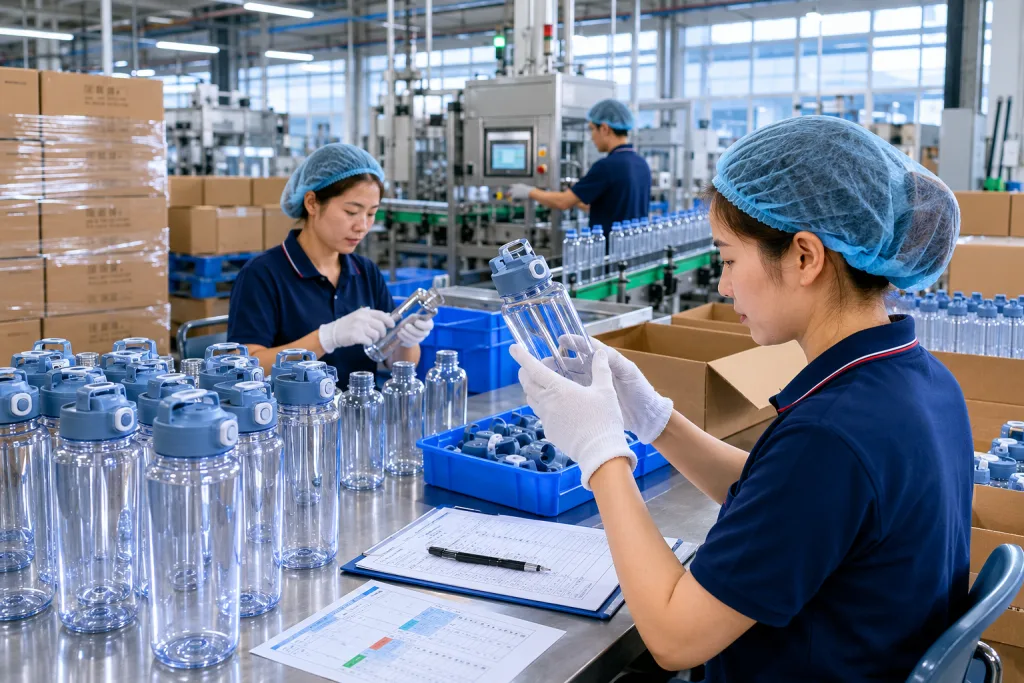
Key Takeaways
- For PC bottles, a practical starting MOQ is 3,000 units per color, with 25-35 day lead time after sample approval.
- Wall thickness below 2.2 mm often creates thread deformation and higher leak risk during hot-fill misuse or long transit.
- AQL 2.5 for major defects and 4.0 for minor defects is a reasonable baseline for custom drinkware export orders.
- Silkscreen logos can fail rub testing fast; ask for cross-hatch adhesion and 500-cycle rub test standards in writing.
You can buy a cheap sample from almost any pc water bottles supplier in China. Easy part. Trouble starts after approval, when the line runs 20,000 pcs and QC pulls the sample: color is half a shade off, the lid leaks at 0.03 MPa, the logo rubs after 50 tape pulls, the thread goes out by 0.2 mm, or the carton fails a drop test before it reaches your warehouse in Europe or North America.
If you source custom drinkware, think like a factory engineer. Buyer thinking alone is not enough. In Zhejiang, we ship clean orders and we also see claim-heavy orders, and the gap usually sits in resin grade, wall thickness, mold tolerance, print method, and inspection limits. This is the wrong question to ask if you only focus on sample price. For canteen custom programs, custom growler projects, or a simple customizable drinkware line, we’ve seen this go sideways when a PO says “frosted blue” with no Pantone callout and no wall spec like 2.8 mm. The safer move is to lock the failure points before production starts.
The Sample Passed, Bulk Failed
This is the sourcing mistake we see most with a pc water bottles supplier: the buyer approves a hand-finished sample, then expects bulk goods to match it piece for piece. They usually do not. Sample-room bottles often come from the best mold cavity, get hand-trimmed with a knife, and go to the senior print operator. The line is less forgiving. At 8,000 to 20,000 units per day, small drift in trim, color, or logo position shows up fast.
If you are buying from Zhejiang or elsewhere in China, lock that sample into a production spec sheet. Do not stop at capacity and color. This is the wrong question to ask. We have seen POs with "blue, same as sample" and nothing else, then the buyer flagged a 1.5 mm logo shift after goods were packed. You need measurable controls:
- Material: virgin PC resin grade, food-contact compliant, with REACH and LFGB or FDA declaration as needed
- Net weight: for example 148 g plus or minus 3 g for a 700 ml body
- Wall thickness: 2.2-2.8 mm on the body, not just “standard”
- Color tolerance: Pantone target with an approved delta range
- Closure torque: a defined range so caps do not back off in transit
- Logo method: silkscreen, heat transfer, or pad print, plus test standard
For canteen custom and customizable canteen orders, I recommend approving a golden sample made on production tooling, not only a 3D print or a hand-polished pre-production mockup. If your supplier cannot provide that, risk goes up. We run pre-production samples from actual molds, then QC pulled the sample for sign-off before bulk starts. That usually adds 3 to 5 days. The math works: 3 to 5 days now is better than reworking 12,000 bottles later because the cap fit was off by 0.3 mm.
What hurts buyers is not one bad bottle. It is a 5% defect rate across 12,000 units. QC may call it scattered issues under AQL 2.5, but once returns start, we have seen this go sideways fast.
Resin and Wall Thickness Problems
PC bottles fail quietly when the resin spec or wall thickness is off. Day one looks fine. Then after 18 days on the water and 6 hours in a hot container, you start seeing neck cracks, sink marks, or an oval body that will not sit flat on the table. We have seen this go sideways. A pc water bottles supplier that talks only about shape, color, and logo print is missing the part that decides whether the bottle survives shipment.
Where failures start
Most body failures come from four places on the line: mixed resin, regrind pushed too far, a thin shoulder section, or uneven mold cooling. For a 600-750 ml bottle, 2.2 mm is a practical lower limit on the main body wall if you want stable threads and decent drop resistance; we check that with an ultrasonic thickness gauge after first-off samples. Drop below that and the unit cost might improve by USD 0.03 to 0.06, but the math does not work once bottles deform or leak.
Ask your canteen manufacturer or canteen factory these direct questions:
- Is the bottle body 100% virgin PC or blended with regrind?
- What regrind percentage is allowed internally, if any?
- What is the target weight per unit and the acceptable tolerance?
- How many mold cavities are running, and are dimensions checked cavity by cavity?
In 7 out of 10 distributor drinkware programs, buyers look only at FOB price. That is the wrong question to ask. If a bottle body uses unstable resin or the shot weight drifts by 3 g, you might save USD 0.05 per piece and lose USD 1,500 to 4,000 on claims, relabeling, or customer service after the buyer flagged leaks. A serious canteen supplier should show incoming material records, lot traceability, and in-process dimension checks; on our side, QC pulled the sample every 2 hours and logs neck OD against the master sample.
If you also source custom growler or customizable growler lines, the same rule applies. Body stability starts with material control, not post-production inspection. We ship plenty of nice-looking samples, but QC cannot inspect a weak 2.0 mm body back into a reliable product.
Leaking Lids and Bad Threads
If you sell a customized canteen or customized drinkware line online, leak complaints show up in 7 days, sometimes faster. Buyers blame the gasket first. Most of the time, QC pulled the sample and found the real cause in thread geometry, cap torque drift, or a loose fit between the cap insert and bottle neck. We check this with a thread ring gauge and a torque meter on the line. A clean-looking lid proves nothing if the seal stack-up is off by 0.3 mm.
Start with the closure system. For a typical PC bottle with PP lid and silicone seal, you should define:
- Thread finish dimensions and tolerance
- Gasket material and Shore hardness, for example silicone 50-60 Shore A
- Leak test method, such as inverted 30 minutes plus side-pressure check
- Torque range, for example 8-12 kgf.cm depending on cap design
Too many canteen manufacturers skip one control point and fall back on random hand checks. That does not work for export. We run start-up inspection on the first 20 pcs, then hourly leak testing, then final random checks to AQL. For large programs, 100% air-pressure or vacuum leak testing makes sense, especially when the unit price is above USD 2.00. This is the wrong question to ask: "Does the lid feel tight?" The better question is whether the cap holds spec at 8-12 kgf.cm across the full lot.
A good canteen vendor or canteen vendors group should understand misuse risk too. End users fill the bottle with warm liquid. They leave it in a car at 45 C. PC is tough, but we have seen closure warpage and gasket compression set show up after 12 days of heat-aging when the design margin was too tight. If you are selling into schools, promotions, or distributor canteen channels, make sure the lid hinge and carry loop are cycle-tested. A basic target is 3,000 to 5,000 open-close cycles without fracture, and the buyer flagged one program last year because the hinge pin cracked at 2,200 cycles.
At our Zhejiang facility, monthly capacity across standard drinkware programs is about 600,000 units, but closure QC is still handled lot by lot. Capacity does not solve leak risk. Process discipline does. We ship by lot code, and if a PO says "blue lid" while the artwork sheet says "navy," the line stops until that mismatch is cleared. The math does not work any other way.
Decoration That Rubs Off
Logo failure is where 7 out of 10 promo bottle claims start. The artwork looked clean on the approval photo, then after a week of office use the print scuffed or peeled at the shoulder radius. That is not a small cosmetic issue. On branded custom canteen or canteen customized programs, buyers read print durability as product quality, and QC pulled the sample more than once on tape-lift after first rub.
Pick the print method for actual use, not the cheapest line on the quote sheet. On PC bodies, we run silkscreen, pad print, heat transfer, and sometimes IMD-style decoration for special projects with MOQ 5000 pcs. Each one has tradeoffs, and this is the wrong question to ask if the buyer only asks for the lowest unit cost:
- Silkscreen: low setup cost, good for simple 1-2 color logos, usually USD 0.05-0.12 per color, but abrasion resistance drops fast if flame treatment is weak or the curing temperature misses spec by 8-10C
- Pad print: works on uneven areas and recesses, fine for small marks around 15-30 mm wide, but the math doesn’t work for large wrap graphics
- Heat transfer: better for full-color art, usually USD 0.18-0.35 extra, but it needs proper bake time and adhesion control; we have seen buyer-flagged wrinkling when the film alignment drifted 2 mm on the line
Do not accept “logo won’t fall off” as a standard. Put the test criteria on the PO and artwork approval, and write them in plain language because we have seen this go sideways over one typo on a PO:
- Cross-hatch adhesion test pass
- Dry rub test, 500 cycles minimum
- Dishwasher disclaimer if the bottle is hand-wash only
- Color match against approved Pantone or physical swatch
This matters whether you are dealing with one canteen distributor, several canteen distributors, or a large distributor growler account. Decoration claims get expensive fast. The bottle still holds water, so the buyer flagged it as a quality issue while the factory argues function passed, and then the dispute turns subjective. A written pass-fail standard before production starts fixes that, and AQL 2.5 inspection is cleaner when the sample board is signed.
If you need stronger branding, laser marking on suitable components or a molded-in logo is often the better call. Upfront cost goes up. On a 20,000-piece customized growler or customizable drinkware program, it removes one common failure point, and we ship with fewer after-sales emails once the surface print is off the risk list.
Cartons Collapse Before Arrival
Sometimes the bottle is fine, and the shipment still fails. Packaging is where it breaks. We have seen a pc water bottles supplier make acceptable units, then lose the order with under-spec inner trays, weak cartons, or pallet loading that ignores container vibration on a 17-day ocean leg. On our line, QC pulled the sample after a shake test and found the divider board had already cut into the lid shoulder. North American and European buyers flag this all the time on promotional and retail-ready drinkware.
Do not treat packaging like the last box to tick. For export from China, we usually lock the outer carton spec in measurable terms, and this is the right question to ask:
- 5-ply corrugated export carton for most bottle programs
- Minimum burst strength or edge crush requirement based on packed weight
- Drop test standard, for example 6 faces, 8 corners, 12 edges from defined height
- Moisture protection if shipping in humid season from Zhejiang ports
- Barcode and shipping mark position confirmed before print
For e-commerce and FNSKU programs, the spec gets tighter. If your canteen supplier is shipping to Amazon FBA prep or a 3PL, carton dimensions, suffocation warnings, polybag thickness, and scan placement drive claims fast; the bottle itself is only half the job. Last month a buyer flagged a 6 mm label shift, and the warehouse rejected 420 cartons for scan failure. A missing label or a weak master carton can wipe out the margin. The math does not work.
Ask your canteen vendor or canteen suppliers if they run packaged drop tests and pallet stability checks, not just naked product inspection. A solid product packed badly is still a bad order. For a 10,000-unit shipment, improving packaging may add only USD 0.08 to 0.15 per set. We ship loads like this every month, and that add-on is usually cheaper than one partial transit claim after a pallet leans and the top layer crushes 18 mm on arrival.
QC Plans That Miss Real Risk
The last failure mode is procedural. The QC plan looks polished on paper, then misses the defects end users complain about in the first 30 days. AQL works only when the defect definitions match real risk. We have seen first-time buyers lift a generic checklist from a canteen factory, then the buyer flagged odor and barcode issues that were never defined at all. This is the wrong question to ask: "Do you have a QC plan?" Ask what the line is checking, at what station, and with what limit.
For custom drinkware, build your QC plan around the complaint triggers that actually cause returns and chargebacks. QC pulled the sample, not the brochure:
- Critical defects: odor contamination, sharp burrs, wrong barcode, failed leak test, missing compliance warning
- Major defects: cracked body, severe color mismatch, crooked logo, cap thread binding, unstable base
- Minor defects: small specks, light print variation, non-visible molding marks
A practical starting point is AQL 0 for critical, 2.5 for major, 4.0 for minor. That part is standard. What changes is how tight you run the visual standard. For a retail launch or branded program, we usually add in-line checks every 2 hours and keep a sealed limit sample at the packing table. For a basic canteen promo run, the buyer may accept one or two extra specks per body, but never on leak performance or safety. The math does not work if you save 3 cents on inspection and lose the order on returns.
You should also ask whether the supplier has social and system compliance that matters to your market, such as BSCI audit readiness, ISO-style quality controls, or testing support for REACH, LFGB, CPSIA, or ASTM where applicable. Compliance alone does not make a good canteen factory. Still, weak compliance usually shows up on the floor too: missing calibration stickers, no batch trace card, or a carton stamp that does not match the PO date.
Lead time needs the same treatment. For a 5,000 to 10,000 piece order with custom color and logo, we usually quote 25 to 35 days after deposit and final approval, and that assumes the Pantone match is signed off and the screen plate is ready. If a pc water bottles supplier offers 12 days for everything, ask which control step is getting cut. We have seen this go sideways with skipped curing time, one less leak-test round, or no pre-shipment sort after the line finds cap-thread binding.
The buyers who avoid trouble are not the ones chasing the lowest FOB Ningbo price. They write tighter specs. They ask blunt questions. They make canteen distributors and factories prove the process before the first container leaves China, down to sample retention, carton drop check, and whether the logo sits within a 1.5 mm tolerance.
Send your bottle spec before you place the PO
We will review your drawing, logo method, MOQ, packaging, and QC points, then flag the failure risks before mass production starts in Zhejiang, China.
Frequently asked questions
What MOQ should I expect from a pc water bottles supplier?
For a standard existing mold, the practical MOQ is usually 3,000 units per color, sometimes 2,000 if the bottle and lid are standard colors already running on the line. If you want a new Pantone match, custom insert, or gift box, 5,000 units is more realistic. For a fully new mold, development cost can run from USD 2,500 to 8,000 depending on bottle complexity, and production MOQ usually starts around 10,000 units. In Zhejiang and other China sourcing hubs, very low MOQ offers often mean higher unit cost, limited color control, or mixed production slots. Ask whether MOQ applies per SKU, per lid color, or per logo design. Those details affect your landed cost more than the headline MOQ does.
Are PC water bottles still acceptable for B2B custom programs?
They can be, if the market fit is right and the compliance paperwork is in order. PC is valued for impact resistance, clarity, and stable molding on sports and school bottles. But your customer segment matters. Some buyers in Europe prefer Tritan or stainless because of retail perception, even when the PC bottle is technically compliant. If you source from a pc water bottles supplier in China, ask for food-contact declarations, REACH screening where relevant, and clear statements about BPA status based on your target market requirements. Also confirm use instructions, because misuse drives complaints. For low-cost promotion, PC can still work well at roughly USD 1.20 to 2.40 FOB for many standard models, but only when the specification and compliance file are handled properly.
How do I reduce leak complaints before shipment?
Start by controlling the closure system, not by relying on final random inspection alone. You want defined neck dimensions, gasket spec, cap torque range, and a written leak test standard on the PO. For example, require 30 minutes inverted testing plus side placement and a sample size tied to AQL. If the order is for e-commerce or a high-complaint category, ask for 100% leak testing or at least 100% torque confirmation with hourly leak checks. Also request hinge and carry-loop cycle testing if the design includes those parts. In practice, most leak issues trace back to thread mismatch, warped lids, or inconsistent gasket seating. A supplier that can show in-line control data is usually safer than one that only sends finished product photos.
What lead time is normal for customized drinkware orders?
For an existing bottle mold with custom color and one logo position, 25 to 35 days after deposit and approval is normal. If you add custom packaging, multiple print locations, or lab testing before shipment, 35 to 45 days is more realistic. Tooling changes or new molds add development time first, usually 15 to 30 days for sample readiness depending on complexity. Be careful with very short promises. When a canteen supplier says 12 to 18 days for a fully customized order, that often means loose color control, rushed curing on the print, or reduced QC checkpoints. In Zhejiang factories serving export markets, a steady schedule usually gives you better yield than a compressed one. Fast is useful only when the process still holds.
Which inspections should I require on a first order?
For a first order, require at least three checkpoints: pre-production sample approval, in-line inspection during mass production, and pre-shipment final inspection. On the final inspection, use AQL 0 for critical, 2.5 for major, and 4.0 for minor as a workable baseline. Your checklist should include leak test, logo adhesion, color match, unit weight, thread fit, odor check, carton drop resistance, barcode accuracy, and packaging count. If you are shipping to FBA or major retail distribution, also verify carton labels, FNSKU placement, and pallet configuration. First orders are where process gaps show up, especially with a new canteen factory or canteen vendor. Spending a few hundred dollars on disciplined QC is usually cheaper than negotiating claims across an ocean.