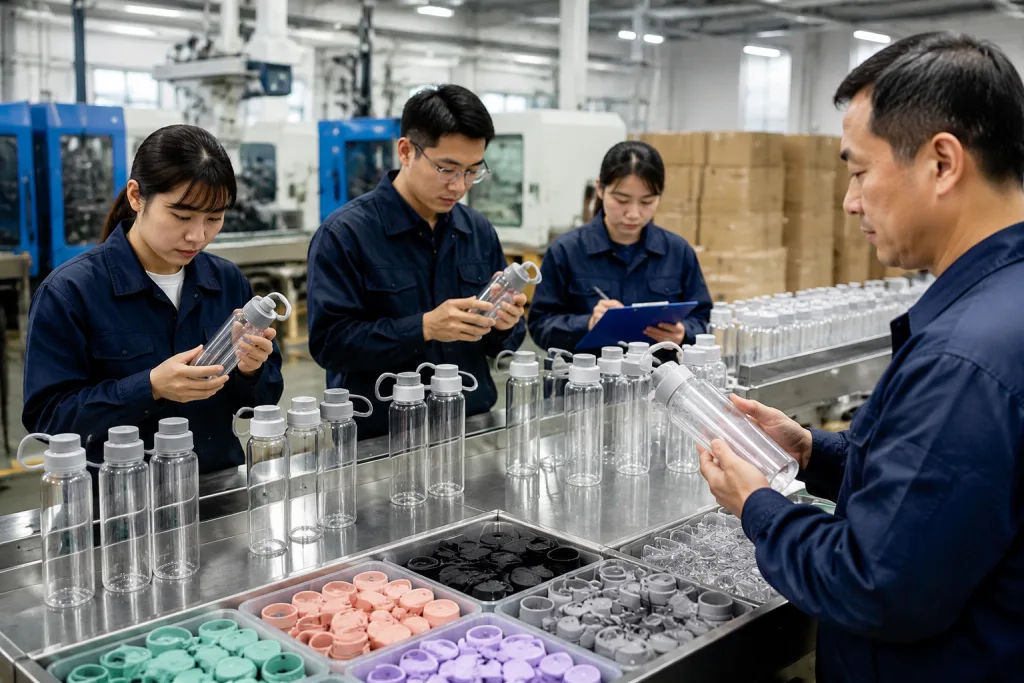
Key Takeaways
- Typical PC bottle MOQ starts at 3,000 pcs per color, while fully new molds usually need 10,000-30,000 pcs to make financial sense
- Unit pricing often moves by USD 0.12-0.38 between 3,000 pcs and 20,000 pcs depending on lid style, print method, and packaging
- Normal production lead time from Zhejiang is 20-35 days after sample approval, with new tooling adding 18-35 days
- AQL 2.5 inspection, REACH testing, and barcode or FNSKU labeling should be budgeted early, not added after the PO is approved
If you are sourcing from a pc water bottles manufacturer, the hard part is not finding a supplier. It is figuring out why one quote lands at USD 1.18 and another at USD 2.05, why one factory says 18 days and another says 45, and which numbers still hold after packaging, testing, and rework hit the sheet. We see this weekly. On our side, the line can pass a 0.3 mm logo position check in sampling, then lose margin fast if the buyer adds an extra insert card after PO approval. That is where custom drinkware projects go sideways.
Buyers in Europe and North America usually ask for the same core numbers: a clean cost breakdown, a lead time you can ship against, and firm limits on MOQ, decoration, and compliance. This is the right place to start. Whether you buy a custom canteen, a customizable growler, or promotional bottle programs from China, the commercial details matter more than catalog photos. We run into the same pushback all the time: a buyer flagged a 3,000 pcs MOQ as too high, then sent six mixed lid colors on one PO, and the math did not work. Zhejiang factories can move fast, but only if your specification is complete and the carton mark, artwork size, and cap color code are locked before the line starts.
What Really Sets Your Price
A pc water bottles manufacturer does not quote by capacity alone. We run 700 ml bottles every week, and two bottles with the same volume can still show a 40% gap once the mold structure, bottle gram weight, and print spec change. The real cost sits in resin grade, unit weight, lid build, leak-proof parts, color matching, logo process, and packing method. A custom canteen with a basic screw lid and 1-color silkscreen stays in the tight range. Change that to a carry handle, flip straw, overmold TPR grip, individual gift box, and retail barcode, and the line cost moves fast. We have seen buyers ask for "same shape, same price" after adding a spring-loaded lid. This is the wrong question to ask.
For standard East China production, including Zhejiang and nearby clusters in China, a clear PC body with PP lid and silicone seal often lands around USD 0.95-1.35 FOB at 5,000 pcs. That is for a routine setup, usually with a bottle body around 1.8 mm wall thickness and standard export carton packing. Add a more complex lid with straw or push-button lock and you can move to USD 1.35-1.95. If the bottle needs thicker walls, for example 2.2 mm instead of 1.8 mm, resin consumption alone may add USD 0.07-0.12 per unit depending on size. QC pulled the sample on one 780 ml project and the buyer flagged the weight jump from 168 g to 181 g right away, because the math did not work for their target shelf price.
- Material: food-contact PC resin cost is usually 15-25% higher than low-grade alternatives you should not accept. We check incoming lots against the supplier COA, and cheap resin is where clear bottles start going blue or brittle.
- Lid assembly: each extra molded component, spring, or gasket adds both unit cost and assembly labor. A simple 2-piece screw lid runs clean; a push-button lid can reach 6-8 parts, and assembly time on the line is a different story.
- Decoration: one-color silkscreen may add USD 0.03-0.06; wrap print, heat transfer, or laser-marked lid parts can add USD 0.10-0.30. On silkscreen jobs, we usually control logo position within about 1.5 mm, because buyers do reject shifted prints.
- Packaging: plain export carton is cheapest; color box with insert often adds USD 0.18-0.45. A lot of people miss carton drop risk here, and we have seen 350 gsm boxes fail where a 400 gsm box shipped fine.
If you are also comparing a canteen factory, canteen supplier, or custom growler source, ask each one to separate mold cost, bottle cost, decoration, and packing. We ship cleaner quotes that way. A blended quote hides the real commercial picture and makes later negotiation messy. One buyer sent us a PO with "gift bos" typed instead of "gift box," and even that small line-item mistake changed the packing discussion for 8,000 pcs.
MOQ Tiers Change The Math
MOQ is where buyers misread the offer. We hear it every week. A factory may quote MOQ 3,000 pcs, but that usually means one body color, one lid color, and one print artwork on an existing mold, with no packaging split and no second barcode on the carton. Once you break colors or add market-specific packaging, the effective MOQ moves up fast. The buyer flagged this on a PO last month after changing from 1 artwork to 3 SKUs.
For a standard pc water bottles manufacturer in Zhejiang, the structure usually looks like this. We run quotes this way on the line:
- 3,000 pcs: workable on a stock mold, usually 1 body color, 1 lid color, basic silkscreen, and plain carton packing. MOQ is fine, but options are tight.
- 5,000 pcs: better resin purchasing efficiency, more sensible logo setup, and less carton waste. This is where the math starts to work.
- 10,000 pcs: the point where FOB reductions usually become real, and color assortments get easier to manage across 2 or 3 SKUs. Our mixer batch sheets show the difference.
- 20,000 pcs and above: the strongest position for custom canteen or customized drinkware programs with mixed SKUs, especially when cartons, inserts, and lid colors all need to match a chain rollout.
Here is the practical part. If your 5,000-pc quote is USD 1.32 FOB Ningbo, the same bottle may only drop to USD 1.24 at 10,000 pcs and USD 1.16 at 20,000 pcs. So doubling volume does not cut price in half. This is the wrong question to ask. It often saves 6-12%, not 30%, because the bottle weight, print labor, and packing minutes do not drop at the same speed. QC pulled the sample and the net weight was still 168 g either way.
For buyers working with canteen distributors, canteen vendors, or distributor drinkware channels, split shipments usually solve cash-flow pressure better than forcing an unrealistic low MOQ. Example: produce 10,000 pcs to get the lower unit cost, then ship 5,000 now and 5,000 later if the factory has warehouse space. You will pay storage or staggered shipping, but the math often still beats the 3,000-pc price. We ship this way often, with 30 to 45 days storage, and the buyer pushback is usually about carton aging, not bottle quality.
New molds are different. If you need a canteen customizable body shape or a customized growler profile, the commercial MOQ should usually be 10,000 pcs minimum. Below that, tooling amortization makes the landed cost hard to defend. We have seen this go sideways when a buyer asks for a new 1.2 mm body profile at 5,000 pcs and expects stock-mold pricing. The math does not work.
Tooling, Samples, And Setup Fees
Not every custom project needs new tooling. In our factory, about 7 out of 10 branded programs start from an existing bottle and still look custom once we change resin color, lid texture, logo position, or the gift box insert. That is usually the right first move. We run this on the line every week. A new mold needs a sales reason you can defend in a buyer meeting, not a 2 mm shoulder change because the design team wants something fresher.
For existing molds, sample charges stay manageable. Expect USD 30-80 for random samples, and USD 80-200 for pre-production samples with custom color and logo. Most China factories credit part of that back against the bulk order. New logo screens or pad-print plates may cost USD 20-50 per color per position. QC pulled the sample last month on a 650 ml PC bottle because the white logo sat 1.5 mm low, and that small miss still required a new print plate.
For new tooling, the spread gets much wider. A single PC bottle body mold may run USD 3,000-8,000. A more complex program with lid tooling, handle parts, or straw components can move to USD 8,000-20,000. If you are sourcing from a canteen manufacturer or canteen manufacturers offering very low tooling charges, ask whether the mold is dedicated or shared. This is the wrong question to skip. We have seen shared tooling go sideways when another customer books the same cavity set and your reorder waits 18 days instead of 12.
Where buyers lose time
The delay is usually not steel cutting. It is approvals, and the buyer flagged this more than once after changing artwork on day 9. A typical path is 3-5 days for 3D drawing confirmation, 12-20 days for tooling, 3-7 days for first trial sample, and another 4-10 days if revisions are needed. On the factory floor, the CNC work can finish on schedule, but one Pantone switch after approval sends color matching back to the lab and print checks back to zero.
If a factory says sample lead time is 7 days, check what they are shipping. We mean a real pre-production sample with your color and print, not a digital mockup plus stock bottle.
This matters whether you buy custom drinkware, a custom growler, or a canteen promotional order. Setup fees look small next to a missed vessel cutoff. We ship plenty of rush orders, and the math does not work if a PO typo on logo size holds the sample for two extra days.
Lead Time From PO To Vessel
For standard orders on proven molds, a realistic production lead time is 20-35 days after deposit, artwork approval, and sample sign-off. That is the clean answer. On the factory floor, the messy part starts when one barcode digit is missing on the PO or the Pantone callout does not match the approved print file, and then the line waits.
A sensible timeline from Zhejiang or greater China supply chains often looks like this:
- Day 1-3: confirm PI, packaging spec, Pantone, barcode, and shipping marks. We usually catch basic misses here, like a 2 mm logo shift on the carton layout.
- Day 4-10: pre-production sample or print sample approval. QC pulled the sample, checked color against the Pantone book, and sent marked photos back the same day.
- Day 11-28: mass production for a 5,000-10,000 pc order. On a normal PC bottle run, we ship this through injection, printing, and packing once the spec is locked.
- Day 29-32: internal QC, AQL 2.5 final inspection, carton drop check. The drop test sounds small, but a weak inner divider shows up fast.
- Day 33-35: booking and container loading, depending on vessel space. If the buyer flagged a last-minute mark change, this step slips first.
If your order is 30,000 pcs across several colors, expect 30-45 days. That is normal. If you add a BSCI audit review, lab testing, or retailer-specific packaging approval, add 5-12 days, and we have seen retailer packaging signoff alone hold 7 days over a missing warning line. Peak season before August and again before November can stretch molding and printing queues by another week.
At BottleForge Industrial in Hangzhou, Zhejiang, typical output for plastic and mixed-material drinkware programs can reach 400,000 units per month across active lines, but that capacity only helps if the specification is frozen early. This is the wrong question to ask: buyers ask how fast we can run, but the real issue is how late the artwork gets locked. We have seen 15-day requests for a customized canteen launch with four lid colors, multilingual packaging, and a new insert card, and the math doesn't work. It usually shifts risk from schedule to defects, like scratch marks on lids or mixed-language cartons found at final packing.
If you are a canteen distributor, distributor canteen buyer, or one of several canteen suppliers quoting the same retail launch, ask for the vessel cutoff date first and count backward. We run planning that way. A reliable factory promise starts with the ship date, then sample approval, then line time.
Compliance And QC Affect Both
Low prices get expensive fast when compliance is vague. For PC bottles going to Europe or North America, we check the food-contact requirement by market and make sure the paperwork matches the PO, not some old test report from another item. Common buyer asks are REACH screening, LFGB-related test scope where applicable, California Proposition 65 review, and ASTM or CPSIA checks for children's programs. A kids line is different. We have seen buyers mix this up on one PO, then QC pulled the sample and flagged the straw bite area at 2.0 mm as a children's-use risk while the body was quoted as a gym bottle.
Testing cost is usually small next to the order value. A routine migration or chemical screening package may cost USD 250-600 per SKU depending on test scope and lab. That part is manageable. The problem starts when testing waits until after production and the masterbatch or logo ink fails, because then the line stops and the math doesn't work. We have seen a 5,000-piece run held for 12 days because the silver print failed adhesion after curing, and the buyer flagged the delay harder than the test fee.
QC also moves lead time. A serious canteen factory or canteen vendor should run incoming material checks, in-line leak testing, and final inspection under an agreed AQL, usually AQL 2.5 for major defects and 4.0 for minor on general drinkware. For transparent PC bodies, clarity issues, black specks, gate marks, and stress whitening should be written into the defect standard before production starts. This is the wrong question to ask late. On our floor, inspectors use a light box and 40 cm viewing distance, because one black speck near the gate can pass one team and fail the next if the standard is loose.
- Leak test: 100% for assembled lids on higher-risk designs. We run vacuum or upside-down hold tests on the line, and a soft-seal lid with 0.3 mm flash at the thread is where leaks usually show up.
- Drop test: often 3 rounds from 80-100 cm depending on packaging requirement. Buyers ask for 1.2 m sometimes, but we have seen this go sideways if the insert and bottle wall thickness were quoted only for standard retail pack.
- Carton test: export cartons commonly use 5-ply corrugate for standard sea freight. For a 24-pack shipper over 12 kg gross weight, we usually check edge crush first instead of arguing about carton grade names.
When you compare canteen manufacturers or canteen distributors handling private-label work, do not only ask for certificates. Ask who pays if the lot fails agreed inspection. That answer tells you more than a PDF logo sheet. We ship plenty of private-label orders, and this point matters: if the supplier cannot state the claim process in one line, the risk is still sitting with you.
How To Budget Landed Cost
FOB price is one layer, not the full math. New buyers miss decoration scrap, master carton cube, duty, and destination handling, then get stuck later when QC pulled the sample and the packed carton measured 58 x 38 x 42 cm instead of what they budgeted. The bottle quote can look cheap on page 1. After freight and packaging, the advantage is gone.
Take a simple example. You buy 10,000 units of a 700 ml PC bottle at USD 1.22 FOB Ningbo from a canteen supplier in China. Your packaging is a printed box at USD 0.22, one-color logo at USD 0.05, and carton barcode labeling at USD 0.01. Your ex-factory equivalent product value is already USD 1.50 before freight. Add ocean freight, destination charges, import duty, local trucking, and inspection, and your landed number may be USD 1.78-2.05 depending on season and port. We run quotes like this every week, and this is the wrong question to ask if you only compare FOB and stop there.
That range decides whether the order works. In promo and distributor business, a resale target can miss by USD 0.12 per piece and kill the program, even if the factory quote looked fine at first; we have seen the buyer flag a 1.8 kg carton weight jump after final pack-out and the margin disappeared. The same problem shows up on customizable canteen and customizable growler projects sold through wholesale channels. Margins get eaten outside the factory gate.
A practical budgeting checklist
- Tooling amortization per unit if the mold is exclusive.
- Extra 2-4% quantity buffer for print or assembly scrap on complex programs.
- Inspection cost, usually USD 250-350 per man-day for third-party QC.
- FNSKU or retailer label application, often USD 0.02-0.05 each.
- Palletization requirement for North America or Europe.
The cleanest RFQ asks every canteen supplier, canteen vendors list, or distributor growler source to quote on the same commercial basis: FOB port, carton details, net and gross weight, carton size, HS code, test status, and sample lead time. Put all suppliers on one sheet. We ship cleaner when the PO is clean, and yes, we have seen a PO typo change “Ningbo” to “Nimbo” and delay booking by 2 days. Then you can compare offers on the same numbers instead of guessing from sales language.
Get a real cost and lead-time breakdown
Send your target volume, bottle size, logo method, and packaging spec. We will quote MOQ tiers, tooling, testing, and FOB timing clearly.
Frequently asked questions
What is a normal MOQ from a pc water bottles manufacturer?
For an existing bottle mold, 3,000 pcs is a common starting MOQ in China, usually for one size, one body color, one lid color, and one artwork. If you need multiple Pantone colors, assorted lid parts, or retail gift boxes, the practical MOQ often becomes 5,000-10,000 pcs. For a fully custom canteen or customized drinkware project with new tooling, 10,000 pcs is a more realistic minimum, and 20,000 pcs gives better pricing leverage. Be careful with suppliers promising 500 pcs on custom production. That usually means stock goods with limited branding, not a true production run. Ask whether MOQ applies per SKU, per color, or per shipment. Those are not the same thing.
How long should production take after I approve the sample?
For a standard private-label order, 20-35 days after sample approval is normal. A 3,000-5,000 pc order on an existing mold can finish closer to 20-25 days if materials are ready. A 10,000-30,000 pc order with several colors and printed boxes usually needs 30-40 days. New tooling adds roughly 18-35 days before bulk production even starts. Add 5-10 more days if you require lab testing after pre-production samples, or if your retailer needs packaging approval. The real schedule risk is incomplete information: missing barcodes, changing artwork, or late Pantone confirmation. If a Zhejiang factory gives you 15 days for a custom program, ask how they are protecting print curing time, inspection, and booking space.
Is PC still acceptable for B2B bottle programs in Europe and North America?
It can be, but you need the right application and the right paperwork. PC offers strong transparency, impact resistance, and stable shape, which is why some buyers still use it for sports bottles, promo canteens, and institutional drinkware. You should specify food-contact grade resin and confirm applicable compliance documents for your market, such as REACH-related screening, Proposition 65 review where relevant, and any retailer-specific chemical restrictions. If the bottle is aimed at children, your compliance scope is usually stricter than for general adult use. Also check temperature expectations. PC is tough, but it is not the right answer for every hot-fill or premium insulated program. The material choice should follow the use case, not just the unit price.
What should I ask a canteen manufacturer to include in the quote?
Ask for a quote that separates bottle cost, decoration, packaging, tooling, sample charge, and any test fee. You also want the commercial basis, usually FOB Ningbo or FOB Shanghai, plus MOQ by color, lead time, carton size, gross and net weight, HS code, and whether the mold is exclusive. If you are buying custom drinkware for Amazon or retail, request barcode application cost, FNSKU labeling, and palletization details. For QC, ask for leak-test standard, AQL level, and who pays if the lot fails third-party inspection. Without these items, you are not comparing offers properly. You are comparing partial promises, which is how landed cost surprises show up after the PO is placed.
Can I lower cost without changing the bottle shape?
Usually yes. The easiest savings come from simplification, not redesign. Switching from a multi-part push-button lid to a standard screw cap can reduce unit cost by USD 0.18-0.40. Moving from individual color box packing to bulk or simpler kraft box can save another USD 0.12-0.30. One-color silkscreen is cheaper than full-wrap decoration, and reducing wall thickness from 2.2 mm to 1.9 mm may save resin cost if drop performance still passes. You can also improve cost by consolidating colors and pushing volume from 3,000 pcs to 10,000 pcs. What usually does not save money is asking for a completely new mold to chase a minor cosmetic change. Tooling plus delay often cancels the intended savings.