Key Takeaways
- For 650-750 ml PC bottles, a realistic MOQ is 3,000-5,000 units per color, with custom logo orders from 1,000 units on stocked molds
- Typical FOB Zhejiang, China pricing is USD 1.15-2.40 per unit for standard PC bottles, before custom mold, special lids, or premium packaging
- Wall thickness usually runs 0.8-1.5 mm; below 0.9 mm saves cents but raises denting, cracking, and leak risk in repeat-use programs
- Normal lead time is 25-35 days after sample approval; new mold development often adds 18-30 days and USD 2,500-8,000 in tooling
You can buy a cheap bottle from almost any pc water bottles factory in China. Easy part. The hard part is picking the right resin grade, wall thickness, lid structure, decoration method, and compliance package for your market. Get one wrong and the math doesn't work: landed cost climbs, return rate moves up, or the buyer asks why the approved sample passed a 1.2 m drop test but the production batch leaked at the thread after torque testing on the line.
Buyers in Europe and North America often start with a short brief: clear bottle, branded lid, low MOQ, fast lead time. Then it turns into a tradeoff on price, durability, dishwasher risk, REACH testing, and whether the bottle is actually right for gym retail, school programs, events, or a canteen distributor channel. We run into this every week in Zhejiang. Last month one buyer flagged a 0.3 mm wall reduction to hit target price, then QC pulled the sample and found panel deformation after hot-fill simulation. A good decision starts with a side-by-side spec comparison, not a sales pitch.
Start with the specification table
If you are comparing a pc water bottles factory, skip the catalog photos first. Start with a spec sheet that makes each canteen manufacturer or canteen supplier answer the same points in the same format. That is how you separate factory data you can use from a quote that looks good on page 1 and falls apart on the line. We’ve seen buyers approve shape from a PDF, then QC pulled the sample and found the body weight was 11 g light.
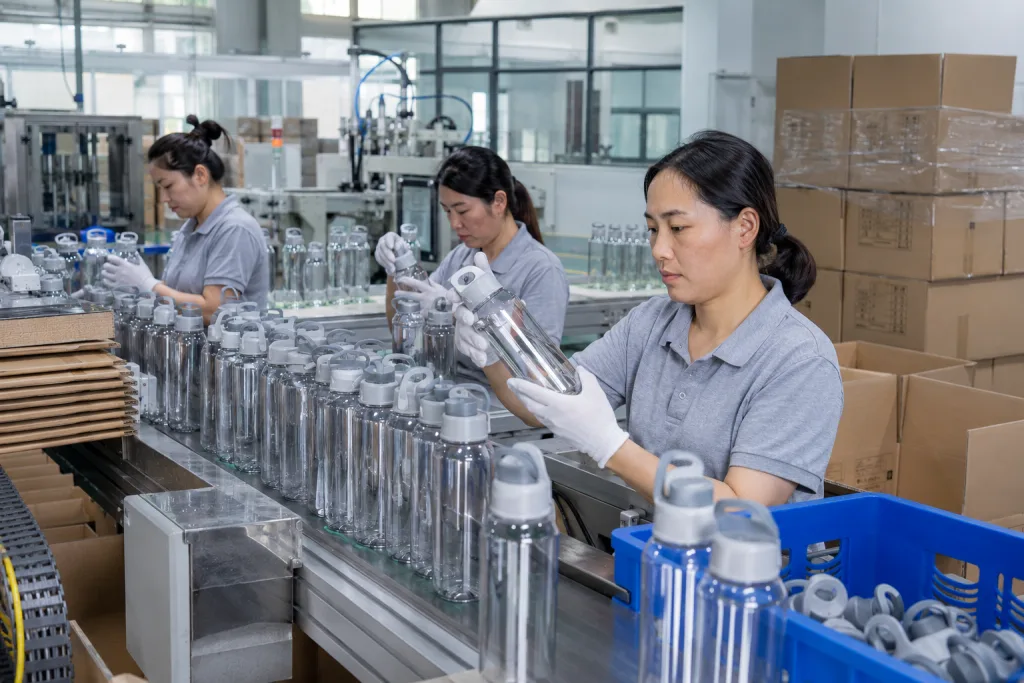
For B2B buying, the best head-to-head table should cover resin, capacity tolerance, bottle weight, wall thickness, neck finish, lid leakage standard, decoration process, carton pack, MOQ, FOB price, and compliance scope. At BottleForge Industrial in Zhejiang, China, we produce around 1.2 million units per month across multiple drinkware lines, and the buyers who move fastest are the ones who lock these items before artwork. That step saves time: 7 days on average at sampling stage, because the silk-screen jig, Pantone match, and carton drop test standard are already fixed.
- Material: virgin PC, recycled content if available, food-contact declaration
- Common sizes: 500 ml, 650 ml, 750 ml, 1,000 ml
- Wall thickness: 0.8-1.5 mm for most single-wall PC bodies
- Unit weight: about 95-180 g depending on size and grip design
- Leak test: vacuum or inverted test, often 30 minutes to 2 hours
- MOQ: 1,000 units for stocked designs, 3,000-5,000 for color-custom production
- Lead time: 7-10 days for pre-production sample, 25-35 days for mass production
A practical buyer question is not whether one factory can make a custom canteen. Most can. The better question is whether the same supplier can hold weight tolerance within plus or minus 5 g, control color variation across 5,000 pieces, and keep leak complaints below 0.3% after shipment. This is the wrong question to skip. Last quarter, one buyer flagged a 0.2 mm wall-thickness drift at the shoulder, and that small miss changed the drop-test result.
If a quote is missing wall thickness, resin grade, and test scope, treat the price as incomplete.
PC against Tritan, PETG, and steel
PC still fits some custom drinkware programs, but not all of them. Buyers mix up clear low-cost bottles all the time and treat PC, Tritan, and PETG like the same resin. They are not. On our line in Hangzhou, QC pulled a sample last month where a buyer approved PC for a retail launch, then flagged dishwasher haze after pilot use. An honest factory should say where PC works and where it will get you complaints.
PC bottles usually fit low to mid-price reusable programs, school sports, promotions, and canteen projects where clarity and drop resistance matter more than premium feel. That is the real trade-off. PC gives solid impact performance at a lower FOB than Tritan, and the mold cycle is usually a little faster on a basic 700 ml body. A 700 ml PC bottle may land around USD 1.20-1.65 FOB from Zhejiang for a basic design with one-color silkscreen.
Tritan copolyester usually costs 15-35% more, and buyers still pick it for North America retail, wellness brands, and better customizable drinkware programs because the sell-through story is cleaner and dishwasher performance holds up better. We have seen buyers push back on that premium, then come back after retailer review. PETG can come in cheaper on some shapes, especially thinner-wall promo bottles around 0.6-0.7 mm, but it is not the best pick for repeated rough handling. Stainless steel sits in another bracket: higher cost, stronger premium position, better temperature hold, and more shipping weight. This is the wrong question to ask if you only compare resin price. You need to compare claim risk and shelf position too.
Use-case fit, side by side
- Event giveaway: PC is often the best price-performance choice, especially if you need 3,000 pcs fast and keep decoration to one-color print.
- School or sports club: PC works if the lid structure stays simple and spare parts are available; we have seen push-button lids go sideways after rough bus-bag use.
- Retail shelf above USD 12.99: Tritan or steel usually sells better. The buyer sees the material callout before they read the bottle copy.
- Custom growler program: PC is usually the wrong material; stainless is safer for positioning and durability, and the math does not work once return complaints start.
- Distributor drinkware line: PC can fill the opening price point, while steel covers the margin-rich SKUs. That split ships well if MOQ is 1,000 pcs per color.
If you are a canteen distributor, canteen vendors, or distributor canteen buyer serving institutions, PC often wins on budget and lead time—12 days vs 18 days on some repeat orders we run. If you are building a customizable growler or customized growler line, skip PC and move to insulated steel. We ship both, but this one is not close.
Where PC bottles actually fit
Buyers often ask for one bottle that fits every channel. It almost never works. A pc water bottles factory should match the bottle to how people use it, not just drop a logo on a stock 750 ml body. We’ve seen the same 750 ml bottle sell through at a gym promo, then stall in a university bookstore because the shelf price missed by USD 0.40 and the carry loop looked too bulky.
For canteen custom or canteen customized projects, look at refill frequency, drop abuse, and cleaning method first. This is the right question. Institutional buyers usually want low replacement cost and a cap that staff can take apart fast at the line or in maintenance. More cap parts means more claims. On one school order, QC pulled the sample and found the spring in a push-button lid had shifted after a 1.2 m drop test. For a canteen distributor network, a plain screw cap with PP lid and silicone gasket usually beats a push-button assembly because replacement is easier, AQL 2.5 checks move faster, and the math works on after-sales.
PC is usually a good fit for:
- Sports events: 500-750 ml, light carry weight, one or two spot colors, packed 50 units per export carton
- Employee welcome kits: custom logo, color-matched lid, individual polybag, FOB target under USD 1.60
- School hydration programs: moderate budget, high volume, fast replacement cycle; we often run these with a 10,000 pcs MOQ and simple screen print
- Distributor canteen catalogs: value segment SKU where lead time matters more than gift-box packaging; standard colors ship faster
PC is usually a poor fit for:
- Dishwasher-heavy office use where cosmetic haze becomes a complaint; the buyer flagged this on a past reorder after 60 wash cycles
- Premium wellness retail where shoppers expect a stronger material story and cleaner shelf presentation
- Customized growler projects where capacity, insulation, and brand position require steel; we’ve seen this go sideways when the target was 1.9 L but the customer still wanted a light single-wall body
If your target is a customizable canteen for promotions, keep it simple: 650 ml to 750 ml, single-wall, carry loop, one-color print, standard export box. We ship this spec every month. If your target is a customized drinkware collection for retail chains, put more budget into lid feel, color consistency, and shelf-ready packaging. Last month one PO even had the lid color code typed wrong, from Pantone 549C to 594C, and the buyer caught it at pre-production. Those details matter more than cutting USD 0.06 off the bottle body.
MOQ, tooling, and decoration tradeoffs
Most first-time buyers stare at unit price and miss the order structure. That’s where the bill starts drifting. A stocked bottle from a canteen vendor or canteen supplier is usually fine at 1,000 units with a simple logo. Change the shape, add a matching straw lid, push for a custom gradient color, and pack it in a gift tube, and the practical MOQ jumps to 3,000-10,000 units fast. We see this on the line all the time. One buyer flagged a quote gap last month, and the reason was simple: the PO asked for a Pantone-matched lid and tube insert but the inquiry sheet only priced bottle printing.
Typical numbers for a pc water bottles factory in Zhejiang, China look like this:
- Stock mold + one-color silkscreen: MOQ 1,000 units, sample 5-7 days, production 20-30 days
- Stock mold + custom body/lid color: MOQ 3,000 units per color, production 25-35 days
- Heat transfer wrap: MOQ 3,000 units, adds about USD 0.12-0.25 each
- Laser mark on cap component: mostly for metal inserts, not common on pure PC bodies
- New mold development: USD 2,500-8,000, lead time 18-30 days before sampling
For customized canteen and customizable drinkware programs, decoration choice needs to match the sales channel. This is the right question. Silkscreen is still the low-cost option for 1-2 solid colors, and we run it daily with a 300 mm jig on stocked bodies. Heat transfer fits multicolor branding better, but buyers should ask about registration tolerance and abrasion test results before approving artwork. We’ve seen this go sideways. A wrap looks good on the first sample, then QC pulled the sample after rub testing and found edge lift near the bottle seam. In-mold effects look cleaner, but the math doesn’t work at low volume. A serious canteen factory or canteen manufacturers group should give you print adhesion test standards up front, not after deposit.
If you are a distributor growler or distributor drinkware buyer building a broad SKU matrix, keep one cap platform across multiple bottle sizes. That cuts spare parts, makes AQL inspection easier, and helps canteen distributors or canteen manufacturers ship replenishment faster. We ship these mixed-size programs every season. One 63 mm cap shared across 500 ml and 700 ml bodies is boring, yes, but boring sells. The wrong question is usually “Can we make every SKU different?” Standardization protects margin.
Quality control that matters in practice
Every factory says it has QC. That tells you nothing. Ask what they check, at which station, and against which acceptance standard. On PC bottles, the costly defects are easy to see on the line: lids leaking after torque, stress whitening within 3-5 mm of the neck, color drift against the signed Pantone chip, off-center printing, odor from silicone parts, and scratches from dividers that are too thin. We ship these every week, and this is the wrong question to ask: “Do you have QC?” Ask what QC pulled, when they pulled it, and why it passed.
A workable QC plan starts before molding. We run incoming resin checks, first article approval, inline inspection, and final random inspection to an agreed AQL. For most B2B bottle orders, AQL 2.5 major / 4.0 minor is a practical starting point. If your goods go into stricter retail programs, tighten it at PO stage, not after mass production starts. If you are shipping simple canteen promotional stock for events, you can loosen some cosmetic points, but do not loosen leakage standards. We have seen this go sideways when a buyer accepted scratches but then rejected 2 leaking samples at final inspection.
- Leak test: 100% inverted test during assembly, or batch testing with a defined sample size; on our line, caps usually sit inverted for 30 minutes after torque
- Drop test: commonly 3-5 drops from 80-120 cm, empty or partly filled depending on program; 1.0 m onto plywood is common for promo orders
- Print adhesion: cross-hatch or tape test after curing; QC pulled the sample with a 3M tape check after the print oven
- Odor check: especially for colored masterbatch and silicone components; this is where cheap colored resin often gets flagged
- Carton test: burst and drop condition for export handling; a 5-layer export carton usually holds up better than the low-cost option
If you work with a canteen manufacturer, canteen suppliers, or canteen vendors serving Europe, ask about REACH and food-contact declarations. For North America, confirm the relevant state or retailer compliance documents early, before artwork approval and carton marking. For children’s formats, ASTM-related requirements may come into play depending on the exact product design and market use. Ask whether the factory runs social compliance such as BSCI and whether production is under an ISO-managed system. Those papers do not guarantee quality. They do cut avoidable risk. We had one PO where the buyer flagged a carton mark typo after packing, and the rework cost more than the audit had.
The honest answer from any canteen factory should be simple: perfect bottles do not exist. What matters is whether the defect rate is controlled, documented, and corrected before container loading. If final inspection finds 6 leaking pieces in one lot, the math does not work, even if the bottles look clean in photos.
How to compare suppliers without guessing
When you request quotes from a canteen manufacturer, canteen manufacturers, or a canteen supplier base in China, send one RFQ format to every factory and score the replies side by side. If you do not, you compare different products built on different assumptions. We see this every month. One factory looks cheaper by $0.18, then QC checks the spec sheet and finds 0.9 mm walls instead of 1.2 mm, 12 g less resin, and a weaker export carton.
Score each supplier on five points: spec clarity, sample accuracy, compliance readiness, production capacity, and communication speed. Price is one line, not the decision. If the supplier cannot confirm whether the bottle is 0.9 mm or 1.2 mm thick, or whether the gasket is food-grade silicone or TPE, you do not have a usable quote. You have a placeholder. Frankly, this is the wrong question to ask first: “Who is lowest?” Ask who is quoting the same build.
For a practical buying matrix, ask every supplier for:
- FOB and EXW price at 1,000 / 3,000 / 5,000 units
- Unit weight and tolerance
- Carton quantity, carton size, and gross weight
- Sample charge and refund policy
- Tooling ownership terms
- AQL standard used at final inspection
- Lead time during peak season versus normal season
A reliable Zhejiang supplier should also tell you where delays usually happen. On our line, the molding cycle is rarely the problem. Delays usually show up at color approval, print confirmation, or packaging signoff. Last quarter, one buyer flagged a Pantone drift after mass print, and the order lost 6 days waiting for revised film. If you are buying custom canteen, customized drinkware, or canteen customizable SKUs for a launch date, freeze artwork and carton marks early. We have seen this go sideways over one PO typo in the shipping mark.
One more point: if you are a canteen distributor or canteen distributors network buyer, check replenishment logic, not just first order speed. Ask for repeat color control, lid batch records, and restock lead time such as 12 days vs 18 days. A supplier who can ship 50,000 units once but cannot repeat the exact smoke gray lid in 90 days is not a stable canteen vendor. QC pulled a sample on one repeat order here and found the gray was off by eye before the carton was sealed. Repeatability is what turns a factory into a long-term canteen supplier.
Send your bottle spec and get a usable factory quote
Share capacity, target price, market, and artwork needs. We will match the right bottle structure, MOQ, and lead time before you commit to sampling.
Frequently asked questions
What is a realistic MOQ from a pc water bottles factory?
For stocked bottle molds, 1,000 units is realistic if you accept standard packaging and simple one-color printing. Once you ask for custom body color, lid color, or upgraded decoration, MOQ usually moves to 3,000-5,000 units per color. If you want a fully new bottle mold, many factories in China will ask for 5,000-10,000 units over the first run, plus tooling cost. For institutional canteen custom programs, you can sometimes mix 2-3 logo versions within one order if the bottle color and lid parts stay the same. Ask the factory whether MOQ is set by molding, printing, or packaging. The answer changes your cost structure.
How much should I expect to pay for custom PC bottles FOB China?
A standard 650-750 ml PC bottle with PP lid and one-color silkscreen often falls around USD 1.15-1.65 FOB Zhejiang, China at 3,000-5,000 units. Larger 1,000 ml bottles, textured grips, or more complex lids can push pricing to USD 1.80-2.40. Heat transfer graphics, individual color boxes, or gift tubes usually add USD 0.12-0.60 per unit depending on format. New mold costs commonly range from USD 2,500 to USD 8,000. If a quote is much lower, check unit weight, wall thickness, leak testing, and carton specification. The cheapest offer often uses thinner walls or lighter caps that increase complaint rates after delivery.
Are PC water bottles suitable for Europe and North America?
They can be, but only if the use case and compliance package are clear. For Europe, buyers typically ask for REACH-related declarations and food-contact documentation. For North America, requirements depend on the channel, retailer, and product design. PC is usually acceptable for value-oriented reusable bottle programs when the factory can provide material declarations, test reports where required, and stable production records. If your brand position is premium wellness or dishwasher-heavy daily use, Tritan or stainless often makes more sense. Also check lid materials, color masterbatch, and print ink compliance, not just the bottle resin. A bottle passes as a system, not as one part.
What quality checks should I require before shipment?
At minimum, require an approved golden sample, material confirmation, print color approval, leak test protocol, and final inspection to an agreed AQL such as 2.5 major / 4.0 minor. For PC bottles, ask for checks on neck stress whitening, cap thread fit, logo adhesion, odor, scratch resistance in packing, and carton drop condition. If the bottle is sold into sports or school use, request a simple drop test from 80-120 cm. You should also confirm carton quantity, gross weight, and shipping marks before production finishes. A pre-shipment inspection by your own team or third party in China is money well spent when the order is above about 5,000 units.
When should I choose PC instead of steel or Tritan?
Choose PC when your priority is low FOB cost, good clarity, light weight, and a practical reusable bottle for promotions, schools, events, or institutional programs. It is especially useful for canteen promotional projects and distributor drinkware catalogs where price matters more than premium positioning. Choose Tritan when you need a cleaner premium story and stronger retail acceptance in North America or Europe. Choose stainless steel for insulated products, premium gifting, or any custom growler line. A simple rule: if your target shelf price is under roughly USD 8 equivalent, PC can work well; above that, buyers often expect a better material story or thermal performance.