Key Takeaways
- For most custom PC bottles, practical MOQ starts at 3,000-5,000 units per color, while new mold projects usually need 45-60 days
- A realistic FOB China target for a 650ml custom PC bottle is often USD 1.20-2.40 depending on lid structure, print process, and packaging
- Ask for REACH, LFGB, FDA contact compliance, and an AQL 2.5 final inspection plan before deposit, not after production starts
- Factories in Zhejiang with 500,000+ units/month capacity can still fail on consistency if wall thickness, leak testing, and torque standards are not documented
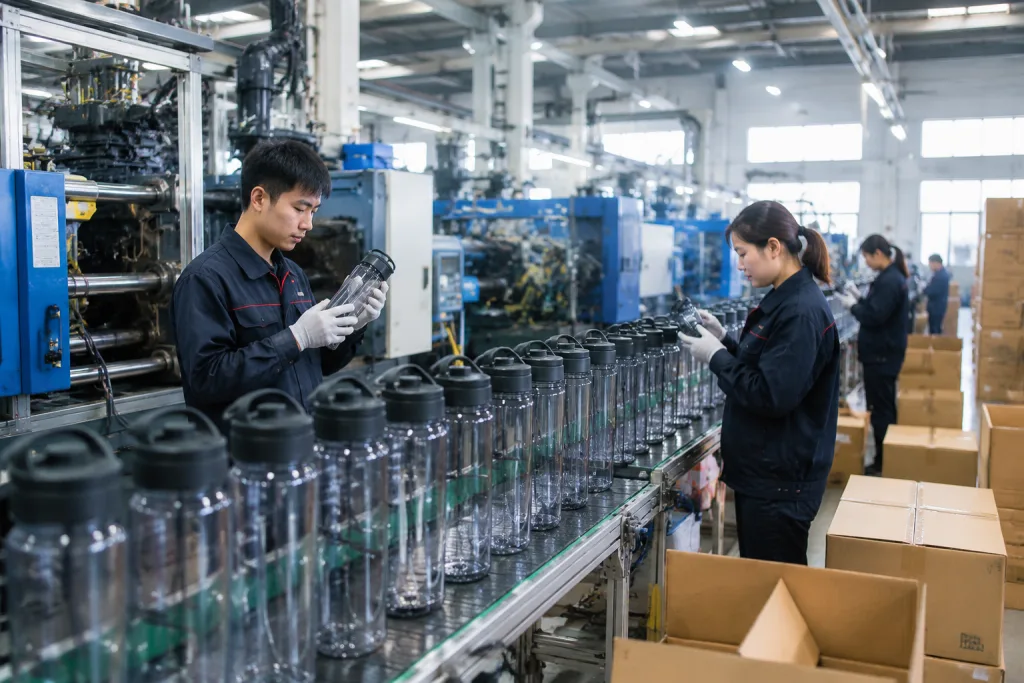
You are not buying a bottle. You are buying a supply result you can repeat for 3,000 pcs or 30,000 pcs: the right resin, stable color, clean decoration, passed tests, and cartons that ship against your launch date, not 12 days late. This is where first-time buyers get burned with a pc water bottle manufacturer. The sample looks fine under office light, then the line runs and QC pulled the sample again at 10,000 pcs because clarity shifted, the cap torque was off by 0.3 N·m, there was a light odor after sealing, or the logo failed tape test.
If you source from Zhejiang or broader China, make the hard calls early. Material fit, compliance scope, decoration method, and production model decide your cost and risk far more than the quoted unit price. We have seen a buyer argue over $0.06, then lose 18 days because the PO had the wrong lid code typed on it. A capable canteen factory should explain the trade-offs in plain language, with limits, MOQ, and test scope on the table. If they do not, the math doesn't work, and you will pay for it later.
Start with four buying decisions
If you shortlist a pc water bottle manufacturer, don’t open with the catalog. Start with four buying decisions and cut the list fast. We’ve seen buyers spend 10 days comparing 18 SKUs, then scrap the whole sheet after one compliance question from retail.
- Decision 1: Material route. Decide the resin first. PC still sells in some B2B programs for impact strength and clear walls, especially gym, campus, and price-driven promotions, but this is the wrong question to leave vague. Your market and compliance target need to be written down before sampling starts. On the line, even a 0.3 mm wall change can affect drop performance, so “just make it like Tritan” usually goes sideways.
- Decision 2: Custom level. Define how far you want to customize. Is it a basic logo bottle, a color-matched custom canteen, or a fully canteen customized project with a new lid or body mold? Stock tooling and new tooling are not the same quote. The gap can be USD 0.20 per unit, or USD 3,000-12,000 in one-time mold investment. Last quarter, a buyer flagged a cap sketch that looked minor, but the hinge angle forced a new tool insert.
- Decision 3: Channel fit. Match the bottle to the sales channel. A canteen distributor shipping into retail chains needs barcode control, carton drop performance, and replenishment planning that works after the first PO, not just at launch. A canteen promotional buyer usually pushes for low MOQ, fast decoration, and cleaner landed cost. We run both types, and the packing spec changes fast: 24 pcs per master for promo, 12 pcs with divider for retail after QC pulled corner crush in transit.
- Decision 4: Supplier model. Decide whether you need a real canteen manufacturer or a trading consolidator. A trader is fine if they add control and own the communication, but ask who owns the tooling, who runs QA, and which city actually makes the goods. We’ve had POs list Hangzhou on the header while production was outsourced 180 km away, and then no one could answer a leak issue at final inspection.
At BottleForge Industrial in Hangzhou, Zhejiang, we tell buyers to write these four points into the RFQ itself. It saves about 7 days vs the usual 12-day email loop, and it stops fake price comparisons. If one canteen supplier quotes a stock 700ml body with one-color silkscreen and another quotes a custom lid with a separate straw assembly, the lower price tells you nothing. The math doesn’t work.
You do not choose the best factory by the sample alone. You choose it by how predictable the factory is after you change one variable.
Know where PC makes sense
Polycarbonate bottles still earn their place for 2 hard reasons: clear appearance and drop resistance. Cost matters too, but the math only works if your target FOB is tight. On our line, a decent PC body will pass a 1.2 m drop test that cracks cheaper AS resin, and it gives a glass-look shelf effect without the weight or metal cost. That is why some canteen distributors and distributor drinkware buyers still keep it in their range.
PC is not the answer for every program. Buyers in Europe and North America usually ask the same 4 questions first: BPA, odor, dishwasher cycles, and how the bottle looks after 6 months of use. This is the right question to ask. Your canteen vendor should be ready to show resin grade, migration test scope, and batch controls from incoming material to packing. We have seen factories dodge basic resin disclosure or send a PO with the material code typed wrong. Move on.
Typical fit for PC bottles
- Value retail and event merchandising with tight target pricing
- Campus, gym, and club programs where the buyer flagged breakage on brittle bottles before
- Promotional bundles where target FOB must stay under USD 2.00 and MOQ usually starts around 3,000 pcs
- Programs that want transparent color effects, like smoke blue or tea tint, with lower breakage risk in transit cartons
When to consider another material
- Premium gifting: stainless usually gives better perceived value, and buyers tell us this in the first sample review
- Hot-fill or thermal programs: use insulated steel instead; a vacuum test tells the story fast
- Strict sustainability positioning: recycled-content options often matter more than low first cost, especially when the buyer asks for claim support
- Markets with retailer restrictions on PC specifications, where QC pulled the sample and stopped the project before bulk
A reliable canteen factory in Zhejiang or elsewhere in China should be comfortable saying no if PC is the wrong fit. That is a good sign. We ship more smoothly when the material choice is honest from day 1. The same goes for customizable drinkware ranges. If you need a matching family with tumbler, bottle, and customizable growler, a mixed-material program often makes better commercial sense than forcing every SKU into one resin.
If you manage a portfolio, think by channel, not by one bottle. A mass program might start with customized drinkware in PC, while the margin line moves to stainless for gift and corporate accounts. We have seen this go sideways when buyers try to make one resin cover retail, promo, and premium. Good sourcing is usually a range strategy, not a single-SKU strategy.
Audit factory capability beyond the sample
The first sample is usually hand-checked at the bench. Mass production is where a pc water bottle manufacturer gets exposed. Ask for line data, not sales talk.
- Monthly capacity: Ask for normal and peak output by line. A solid range is 400,000-800,000 units/month across bottle lines. “Large capacity” means nothing unless they can show machine count, shifts, and daily output from the line board.
- MOQ by SKU: Stock-body custom logo projects often start at 3,000 units. Custom color matching may require 5,000. New molds can start from 10,000 depending on complexity. We’ve seen this go sideways when a buyer put 3,000 on the PO but asked for a new lid color chip and insert card on the same run.
- Lead time: Typical production is 25-35 days after sample approval and deposit. During peak season in China, add 7-15 days. Ask for each step: resin booking, color mixing, printing, assembly, packing, booking vessel. If they say “about one month,” that is the wrong question to ask; you need a dated schedule.
- In-house processes: Injection, blow molding, ultrasonic welding, pad print, silkscreen, laser marking, assembly, and leak test should be mapped clearly. Ask what is in-house and what goes outside, and ask which station uses what fixture.
Then go deeper. Ask the canteen supplier or canteen vendors how they control wall thickness, neck finish tolerance, cap torque, and leak performance. For a 650ml PC bottle, you should expect wall thickness consistency tight enough to avoid visible sink or weak zones. QC pulled the sample is not enough; ask for the target range in mm, the torque spec, and the leak-test method. We run into buyer pushback here because some teams ask about “strong bottle body” without defining anything measurable.
Quality systems matter. A factory shipping to Europe and North America should know AQL 2.5 for major defects and should separate critical defects such as leakage, cracked threads, sharp flash, wrong barcode, or failed drop test. Ask for the current ISO 9001, BSCI, or retailer audit file, not last year’s scan. We have seen an inspection fail over a 1-digit barcode mismatch on the outer carton, while the bottle itself passed. Serious canteen manufacturers and canteen suppliers send the documents fast.
At our Hangzhou, Zhejiang operation, we tell buyers one simple thing: if the factory cannot show you a production control sheet, they do not control production. It is that simple. On our floor, that sheet ties resin lot, color batch, torque check, leak-test record, and packing count to the PO number. That applies whether you are buying a low-cost customizable canteen or a straw-lid item for chain retail. Without that sheet, the math doesn’t work.
Price the project the right way
The fastest way to misbuy is to compare unit prices before you split the cost build-up. On custom drinkware, especially PC bottles, we usually price from four hard drivers: resin weight, lid structure, decoration method, and packaging spec. QC pulled the sample last month and the bottle body was 28g heavier than the approved drawing; that alone changed the quote more than the buyer expected.
A plain 500-700ml stock-body bottle with a simple screw lid and one-color silkscreen may land around USD 1.20-1.60 FOB China at 5,000 units. Add a flip-top, carry strap, color-matched lid, and individual box, and you can move to USD 1.80-2.40. New-tool concepts go higher, and freight volatility is separate. We run this math every day. A strap sounds cheap until the line adds manual assembly and extra drop-test risk.
What buyers should cost separately
- Mold or tooling: often USD 3,000-12,000 depending on body, lid, and accessory complexity
- Color matching: usually included above MOQ, but confirm Pantone tolerance
- Decoration: silkscreen, heat transfer, water transfer, laser, or in-mold label all price differently
- Testing: migration, dishwasher, drop, and packaging tests may be quoted separately
- Packaging: polybag, egg-crate, PDQ, gift box, master carton strength, barcode labeling
This is where terms like canteen custom, canteen customizable, and canteen customized start wasting time. Some factories say them loosely, and we’ve seen this go sideways. The wrong question is “Are you customizable?” The better way is to lock the level on the PO: “custom logo only,” “custom color plus logo,” or “new tooling.” We once saw a PO typed as “customized lid” when the buyer only wanted a Pantone change, and the factory quoted a new mold path by mistake.
If you are a distributor canteen buyer or a distributor growler program manager, ask for volume price breaks at 5,000, 10,000, and 30,000 units. A real canteen vendor will show where resin buying improves and where cycle time drops on the line, like 22 seconds per shot instead of 26. If the price only drops 1% from 5,000 to 30,000 units, the supplier is often trading, padding, or just guessing. The math doesn’t work.
Compliance, testing, and market risk
Too many B2B orders fail here, and they fail quietly. The bottle ships. It looks fine. Then the retailer, importer, or marketplace asks for papers the factory never lined up. We have seen this go sideways over one missing LFGB report and a PO typo on the color code. For Europe and North America, build the compliance file before order placement, not after the line starts.
For a PC bottle program, discuss at least these points with the pc water bottle manufacturer:
- Food contact compliance: FDA for the US market, LFGB for Germany-sensitive channels, and REACH relevance for materials and coatings used
- Physical safety: leakage test, drop test, odor assessment, sharp-edge check, torque test
- Decoration durability: print adhesion, abrasion resistance, dishwasher statement if claimed
- Packaging compliance: labeling, carton marks, country of origin, barcode application
If you sell online, lock in fulfillment details early. Amazon FBA buyers usually need FNSKU labeling, suffocation warnings, and carton dimensions that do not trigger chargebacks. Last quarter, one buyer flagged outer cartons at 64 cm when their limit was 63.5 cm, and the math did not work after relabeling. A factory in China may know export paperwork and still miss channel execution, which means you pay after we ship.
For children’s formats or school programs, ask whether ASTM-related expectations or added retailer protocols apply. For promo projects, do not assume low-risk means light documentation. This is the wrong question to ask. Some of the fastest projects turn into the most expensive because the testing plan was skipped, and the lab slot moved from 12 days to 18 days.
Good canteen manufacturers and canteen supplier teams do not hide behind generic test reports from old SKUs. They match the file to your actual structure, lid, ink, and packing setup. QC pulled the sample and checked the lid torque at 1.8 N·m on the current mold set, not the old one. That matters just as much for a customized canteen as it does for a customized growler or custom growler line extension.
Decoration and packaging decide sell-through
Buyers spend weeks on bottle shape and resin grade, then rush the two things shoppers see first: decoration and packaging. That is the wrong question to ask. On a retail or e-commerce program, the shelf test starts with print clarity and the box face, not the bottle wall thickness. Last month the buyer flagged a logo shift of 0.8 mm on a clear PC sample before they asked about anything else.
For PC bottles, the common decoration methods are silkscreen, pad print, heat transfer, and sometimes laser marking on coated components. Silkscreen is still the cleanest cost/clarity choice for simple logos and scale marks; we run 1-2 spot colors on the line every day with lower scrap than full-wrap jobs. Heat transfer gives wider artwork coverage, but the math doesn't work on every project because wrapped graphics over a deep curve push rejects up fast. We have seen a 3% line reject jump to 8% when artwork crossed the grip panel radius.
- Silkscreen: low cost, sharp simple graphics, usually best for 1-2 spot colors; on straight-wall PC bodies, QC pulled the sample after 100-rub adhesion checks
- Heat transfer: fuller artwork, better for promotional graphics, higher setup care; if the seam lands near a curve break, the buyer will see it
- Pad print: useful on caps and small curved areas; good for logo areas under 35 mm where screen fixtures do not sit well
- Laser: more common on metal parts or coated lid inserts than clear PC bodies; on PC itself, the effect is usually weak unless there is a coating layer
Now the practical part: ask the canteen manufacturer to define acceptable print registration tolerance, adhesion test method, and carton packing layout. Put the number on paper. If the logo can drift only 0.5 mm, say 0.5 mm. If adhesion is tested by 3M tape after 24 hours, write that too. We ship better programs when approved golden samples are photographed from four angles and locked before mass production; otherwise a cap shade or scale mark position goes sideways and everyone argues over the PO.
Packaging should match your sales channel. A basic export pack works for a lot of canteen distributors, usually a master carton with dividers and a drop test at the outer-carton level. Retail-ready programs often need color boxes, PDQ trays, or bilingual inserts, and e-commerce needs stronger drop performance because parcel handling is rough. We have had Amazon-facing buyers ask for 6-side drop checks from 76 cm, not just a clean-looking box. If your project is part of a broader customizable drinkware range, standardizing insert cards and carton dimensions across SKUs saves money on plates, cartons, and pallet build. One customer cut packing changeover time by 12 days vs 18 days after they unified 4 carton sizes into 2.
The same logic applies if your line extends beyond bottles into customized growler or distributor growler items. Keep the print style, box architecture, and insert language consistent. Simple sells. A buyer should see the range and read it as one brand family, not a batch of containers bought from three factories.
How to choose the right supplier model
You do not always need the biggest factory. You need the supplier model that fits your order pattern. For B2B drinkware, we usually see 3 setups on the table: direct factory, trading company, or a hybrid partner that manages 2-5 plants under one export team.
A direct canteen factory works best if your volume is steady, your spec sheet is tight, and you plan to build a product family over 12 months or more. You see cost breakdowns faster, and the line gives engineering feedback in 24-48 hours instead of waiting a week through a middle layer. We run this way on PC bottle projects where neck finish tolerance is controlled within 0.3 mm. A trading company fits better if you need mixed categories, lower MOQs, or one team to ship bottles, tumblers, glassware, and growlers from separate plants. Buyers ask for "one cheap source for everything" all the time. Usually, that math doesn't work.
Transparency is the right question. Ask who owns the tooling, which plant runs production, who signs off final inspection, and who takes liability if goods miss agreed specs. Ask for the factory name on the carton mark, not just on the PI. QC pulled the sample on one order last year and the PO even had the plant code typed wrong. If the answer stays fuzzy, your claim process later will be worse. We've seen this go sideways.
A simple decision framework
- Choose direct factory if annual demand is 50,000+ units, customization is moderate to high, and replenishment matters
- Choose trader or hybrid if you need low-volume assortments across bottle, tumbler, glass, and growler categories
- Choose neither until documents are clear if compliance is complex or launch timing is tight
Good buyers ask one hard question: what happens if defect rate lands above target? This should be written before deposit, not argued after arrival. A mature canteen distributors or canteen vendor relationship already sets corrective action, replacement lead time, and claim evidence rules, down to photo angles, carton count, and AQL lot record.
At BottleForge Industrial in Zhejiang, China, we usually suggest a trial order with one stock-body SKU first: 3,000-5,000 units, one decoration method, standard packaging, and a documented AQL plan. We ship this kind of test run every month. One silk-screen color on a 700 ml body tells you more than ten rounds of samples, because you see print adhesion, cap fit, packing speed, and how the supplier handles a real booking window. If that run is clean, then scale into a full custom drinkware program, a customizable canteen family, or adjacent items like a customizable growler.
Get a clear factory quote before you commit
Send your target volume, bottle size, artwork, market, and compliance needs. We will reply with practical MOQ, FOB pricing, and lead time from Zhejiang, China.
Frequently asked questions
What MOQ should I expect from a pc water bottle manufacturer?
For a stock-body PC bottle with custom logo, 3,000 units is a common starting point in China. If you need a custom body color plus logo, many factories will ask for 5,000 units per color. New mold projects usually start higher, often 10,000 units depending on the body, lid, and accessory complexity. If a supplier offers 500 units on a fully customized project, check whether they are using leftover materials, digital mockups instead of production samples, or outsourcing to multiple plants. Low MOQ is possible, but you usually pay for it with higher unit cost, fewer color options, or longer lead time. For distributors and brand owners, it is often smarter to start with one proven stock mold and scale after the first repeat order.
How much does a custom PC water bottle usually cost FOB China?
A realistic FOB range for a 500-700ml custom PC bottle is about USD 1.20 to 2.40 at 5,000 units. A simple screw-lid bottle with one-color silkscreen sits near the low end. Add a flip-top lid, strap, custom Pantone color, measurement marks, and individual color box, and the price climbs quickly. If you want a completely new mold, you also need to budget one-time tooling, often USD 3,000 to 12,000. Always ask the factory to separate bottle cost, decoration cost, packaging cost, tooling, and testing. That way you can change one variable without re-quoting the entire project blindly. Buyers who request volume breaks at 5,000, 10,000, and 30,000 units usually get the clearest picture.
What compliance documents should I ask for before placing an order?
For Europe and North America, ask for food-contact compliance relevant to your market, usually FDA for the US and often LFGB-sensitive documentation for European channels. You should also review REACH relevance for materials, inks, and coatings used in your exact SKU. Beyond chemical compliance, ask for a written quality plan covering leak testing, odor checks, print adhesion, and drop performance. If the goods are for e-commerce or a chain retailer, include barcode, labeling, and packaging rules in the approval pack. Do not rely on an old generic report from another bottle. The documents should match your body, lid, ink, and package configuration. A factory that knows export business in China should be able to state what it can provide before you pay deposit.
How long does production take for customized drinkware from China?
For a stock-body custom logo PC bottle, normal production lead time is usually 25 to 35 days after deposit and final sample approval. During peak season, especially before summer and major holiday shipping windows, add 7 to 15 days. If the project needs a new mold, development plus production often takes 45 to 60 days, sometimes longer if the lid structure is complex. Sample approval also matters more than buyers think. One extra round of print positioning or color correction can add 3 to 7 days. If you are importing to Amazon or retailer distribution centers, include another few days for labeling, carton confirmation, and pre-shipment inspection. Build the timeline backward from your required in-warehouse date, not from the PO date.
Is it better to buy from a factory directly or through a trading company?
If your annual volume is above 50,000 units and you expect repeat orders, direct factory is usually better. You get clearer engineering answers, better visibility on tooling, and fewer layers between you and production. If your needs are mixed, such as a PC bottle, stainless tumbler, glass bottle, and growler in one program, a trading company or hybrid sourcing partner can be efficient. The key issue is transparency. You should know which plant makes the product, who owns the mold, who inspects the goods, and who is responsible if AQL or compliance targets fail. In Zhejiang and wider China, both factory-direct and trading models can work well. The bad model is the one where nobody clearly owns the problem after shipment.