Key Takeaways
- For pc vacuum flask bulk, 304 inner and 201 outer can save $0.18-$0.35 per unit versus full 304, but outdoor retail usually prefers 304/304 for corrosion risk control.
- Most custom thermos programs start at 1,000 pcs per SKU/color, with sample lead time of 7-10 days and mass production in 30-45 days from artwork approval.
- A 500 ml vacuum flask with 0.4 mm inner and 0.5 mm outer wall typically balances durability and cost better than thinner bodies for distributor thermos channels.
- Laser engraving is low-risk for 1-color logos, while silkscreen or heat transfer is better for promotional thermos graphics but has higher scratch and alignment risk.
You usually do not lose money on a stainless flask because of the bottle body. You lose it on the wrong spec. A 500 ml model can look fine in a showroom, then fail a carton drop test, print poorly on a textured coating, or miss a retailer shelf height by 8 mm. We have seen QC pull a sample that was only 6 mm over spec and the buyer still rejected the whole display plan. If you are buying pc vacuum flask bulk for outdoor retail or promotional campaigns, the job is to lock the use case, decoration method, compliance point, and landed cost before sampling starts drifting and the line loses 12 days.
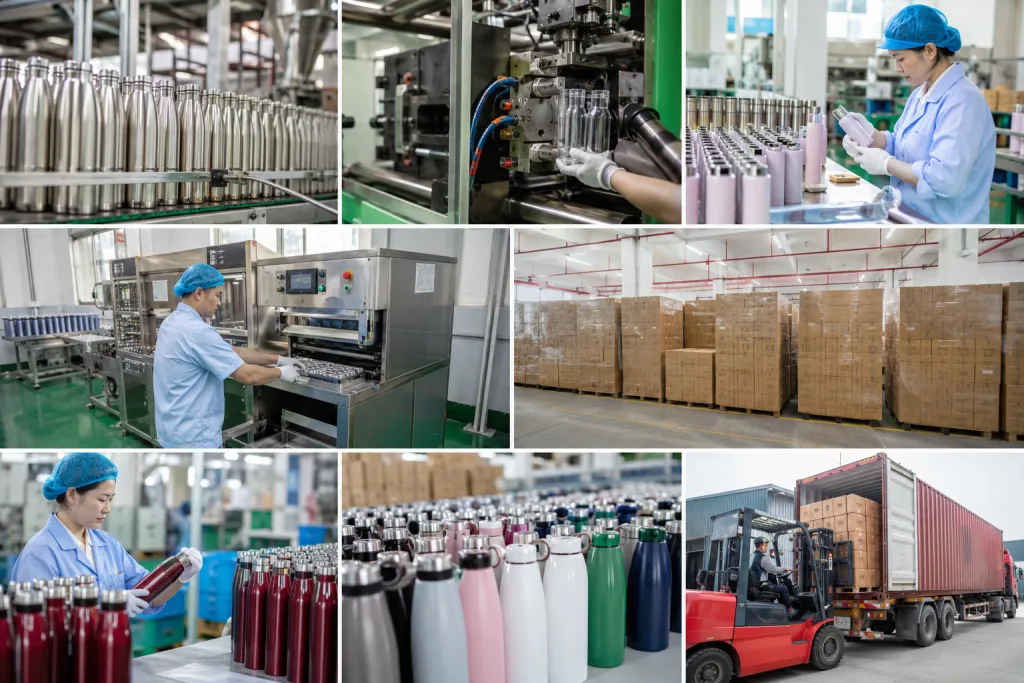
At BottleForge Industrial in Hangzhou, Zhejiang, we build stainless steel vacuum bottles for buyers across Europe and North America with MOQs starting at 1,000 pcs per color and typical lead times of 30 to 45 days. We run different tooling setups, coating lines, and lid assemblies, and not every factory is built for the same order profile. One buyer wants a clean laser mark on 304 stainless; another flags a PO typo after mass production starts. You need a head-to-head view. Vague claims do not help, and this is the wrong product category to buy on brochure language.
Start with the spec table
If you are comparing pc vacuum flask bulk offers from China, make each supplier quote the same baseline spec. If not, one factory prices 304 stainless with powder coat and a BPA-free PP lid, and another prices mixed steel grades, wet paint, and no drop-test standard. That is not apples to apples. We see this every week on the line. Last month one PO even said “304 outter,” and the buyer still expected the lower 201/304 price.
| Spec point | Promo fit | Outdoor retail fit | Typical impact |
|---|---|---|---|
| Steel grade | 304 inner / 201 outer | 304 inner / 304 outer | Cost difference usually $0.18-$0.35 |
| Capacity | 350-500 ml | 500-750 ml | Affects carton count and shelf use |
| Wall thickness | 0.35/0.45 mm | 0.4/0.5 mm | Durability vs unit cost |
| Coating | Spray paint | Powder coat | Grip and scratch resistance |
| Logo method | Silkscreen or heat transfer | Laser or silkscreen | Artwork limits and defect risk |
| Packaging | White box | Color box or PDQ | Freight and retail presentation |
For most manufacturer thermos projects, unit price comes from six cost points: steel grade, body weight, lid complexity, coating, decoration, and packaging. Capacity matters less than most buyers expect. A tall 500 ml customized thermos with a one-piece lid often lands below a short 420 ml model with a carry handle, tea strainer, and printed gift box. The math doesn't work the way buyers assume. On our side, a lid with 5 plastic parts and 2 silicone rings adds more trouble than another 80 ml of volume.
In Zhejiang, we usually ship more 500 ml and 750 ml vacuum flasks for outdoor retail, while promo buyers place heavier volume on 350 ml and 500 ml because freight per campaign is under pressure. If you need distributors thermos pricing for a broad catalog, standardize neck finish, lid threading, and carton size across several capacities. That cuts tooling changes and shortens replenishment from 18 days to 12 days on repeat runs. We run this setup with shared molds where possible, and it saves headaches. QC pulled the sample on one mixed-capacity order last season because the 63 mm neck and 58 mm lid thread were listed together. That kind of mistake slows everything.
- Good RFQ practice: quote FOB Ningbo or FOB Shanghai, not ex-works only. We get pushback on this, but local truck, port fees, and booking charges can swing the real number fast.
- Ask for net weight and gross weight: freight can erase an apparent $0.12 unit saving. A 24 pcs master carton that is 1.8 kg heavier changes the picture right away.
- Fix your AQL level early: AQL 2.5 major / 4.0 minor is common for bulk thermos orders. This is the right question to ask early, before QC finds logo offset or coating pinholes at final inspection.
304 versus 316 versus mixed steel
The first real head-to-head decision in pc vacuum flask bulk is not color or lid style. It is steel. For a standard vacuum bottle, the usual options are 304 stainless steel, 316 stainless steel, or a mixed build such as 304 inner with 201 outer. We quote all three on the line, and they are not the same product once you look at salt-spray results, forming yield, and unit cost.
304 inner / 201 outer
This is the common cost-down build for thermos bulk, especially for corporate gifting and promotional thermos orders above 3,000 pcs. The inner wall touches the drink, so 304 works well for coffee, tea, and water in normal daily use. The 201 outer shell cuts cost. On a 500ml bottle, that gap is enough to matter. If the target retail price is tight and the item is not meant for rough outdoor use, this is usually the practical pick. We have seen buyers push for 304/304 on every project, but the math doesn't work on entry-level programs.
304 inner / 304 outer
This is the safe middle choice for custom thermos programs going into outdoor retail. It gives better corrosion resistance on the outside when bottles sit in humid storage, get handled with sweaty hands, or ship into coastal markets. Last season, QC pulled the sample after a rub test and the 304 outer body held up cleaner than 201 on the same powder coat. It also makes the spec sheet simpler because the full bottle body is 304. Chain-store buyers ask for that. We ship a lot of this structure because it avoids the usual back-and-forth on material consistency.
316 inner / 304 outer
Use 316 when the product story and price point support it. It is better for more aggressive contents and long-term corrosion performance, but the price increase is real, often $0.40-$0.90 per unit depending on size and market conditions. On one 750ml quote, the buyer flagged the upcharge twice before approving the sample. For standard promotional brands, that premium usually does not turn into enough sell-through. For premium retail, it can. This is the wrong question to ask if your main target is a giveaway bottle under a fixed landed cost.
You do not buy 316 because it sounds better. You buy it because your end customer will value it enough to pay for it.
Any thermos supplier should also confirm material test documentation. For Europe, ask about REACH and LFGB-related food contact testing where applicable. For North America, ask about FDA-contact compliance assumptions and whether the lid plastics can support your retailer's test plan. We usually match the steel certs with the lid BOM before sampling, because we have seen this go sideways over one silicone part that failed odor testing. A reliable thermos factory in Zhejiang should know this without improvising.
Insulation claims versus usable performance
Every thermos supplier writes heat-retention claims. Far fewer show the test method behind them. When you compare pc vacuum flask bulk quotes, a line like keeps hot 12 hours is not enough. Ask for fill temperature, ambient temperature, fill volume, and the pass line. We have seen buyers flag a claim after one lab ran a 90% fill and another ran a full-fill test. Same bottle, different result.
A workable baseline for a 500 ml stainless vacuum flask looks like this: water filled at 95 degrees C, tested at 20 degrees C ambient, with recorded temperature at 6 and 12 hours. For a decent 304 double-wall vacuum bottle, expect about 68-75 degrees C at 6 hours and 50-58 degrees C at 12 hours. Cold retention with ice water should usually stay below 10 degrees C after 12 hours, depending on how often the lid gets opened. QC pulled the sample with a digital probe last month on the line, and the reading spread was within 2 degrees C across 8 pcs.
Head-to-head, heavier is not always better. This is the wrong question to ask. What matters is wall thickness, vacuum quality, and how the bottle survives denting after shipping. Bottles that get too light often lose temperature stability and take dents at the shoulder after a 76 cm drop test. For most custom thermos orders, these structures make commercial sense:
- Economy promo: inner 0.35 mm / outer 0.4-0.45 mm
- Mainstream retail: inner 0.4 mm / outer 0.5 mm
- Rugged outdoor: inner 0.45 mm / outer 0.5-0.6 mm
If you sell through outdoor channels, check lid heat loss too. Buyers often study the bottle body and skip the stopper seal. A push-button lid is convenient, but it adds more leak points than a screw cap. We ship both styles, and the after-sales numbers are usually cleaner on simple lids. One distributor buyer pushed back on that last year, then came back after a 1.8% complaint rate on button lids.
At our Zhejiang facility, standard leak testing is 100% before packing, with vacuum checks by batch. We run the leak test station before final carton packout, and batch vacuum checks are logged against the lot card. If you need tighter control for a high-visibility customized thermos launch, ask for extra in-line checks and a pre-shipment inspection against your approved golden sample. It adds cost, though the math does not work if a retail delivery gets rejected over 12 pcs from one failed carton sample.
Decoration methods under real use
Most buyers ask for a custom thermos. That is the wrong question. On pc vacuum flask bulk, the real issue is which decoration method still looks saleable after daily use, carton friction, and a 1.2 m drop test. The logo choice changes defect rate, packing method, and even lead time on the line.
Laser engraving
Best for simple logos, especially on powder-coated bottles where the exposed stainless mark gives a clean contrast. We run this with low setup risk, stable output, and no color registration headache. On a 500 ml body, the logo position tolerance is usually held within 1.5 mm if the jig is decent. If your brand wants a quiet retail look, this is the lowest-drama route for thermos custom work.
Silkscreen printing
Still the most common method for bulk thermos orders. The math works well at volume, especially for 1-2 spot colors, but abrasion resistance is the pushback we hear most. On smooth painted finishes it is fine for promotional use. On textured coatings, we have seen this go sideways when the wrong ink system is used or curing temperature drifts; QC pulled the sample once because the cross-hatch adhesion test failed after tape pull.
Heat transfer or water transfer
Best for multi-color graphics, gradients, and full wraparound artwork. This fits promotional thermos campaigns and seasonal retail drops, but the defect risk is higher: alignment drift, wrinkles, edge lift, and color shift show up fast if the water temperature or film tension is off. Line speed is slower—12 days vs 18 days is a normal gap against simple print jobs on the same MOQ—and QC needs tighter checkpoints.
For customizable thermos projects sold online, retail packaging matters almost as much as the bottle. If you ship to Amazon or DTC fulfillment, tell your manufacturer thermos partner up front if you need FNSKU labels, suffocation warnings, barcode windows, or drop-tested color boxes. We ship this every month, but once carton layout is locked, changes get expensive fast; one buyer flagged a barcode window that was 8 mm off and the whole insert had to be redone.
Typical decoration adders on a 500 ml bottle can range from $0.05 for basic laser to $0.18-$0.45 for multi-color transfer, depending on coverage. If a quote looks too low, ask what pass rate they assumed. Cheap decoration turns into rework fast, and the scrap math does not lie.
Use-case fit: retail or promotion
The most common sourcing mistake in pc vacuum flask bulk is using one bottle spec for two channels that buy for different reasons. Retail outdoor and promotional programs do overlap, but the math often does not work if you force one compromise model across both.
Outdoor retail fit
Retail buyers usually want stronger perceived durability, cleaner insulation claims, and shelf-ready packaging. We usually run a 500 ml or 750 ml powder-coated body with 304/304 steel, laser logo, and a simple leak-resistant screw cap as the base option. That setup holds up better in carton drop tests, and the barcode panel stays readable on a 62 mm body. Retailers watch claim rate closely. If QC pulled the sample and found scratch marks after a basic rub test, the buyer flagged it fast and repeat orders got harder.
Promotional brand fit
Promotional buyers look harder at margin, logo visibility, and color options. A 350 ml or 500 ml model with 304 inner / 201 outer, painted finish, 1-color silkscreen, and white box is usually the better value. For event orders, lead time beats premium steel storytelling every time; we ship plenty of those in 12 days where a retail spec would take 18 days. Lid complexity is the wrong place to spend money. We've seen this go sideways when a campaign bottle used a push-button lid and the buyer came back on failure rate after one drop test.
Head-to-head, these are the usual buying patterns:
- Retail outdoor: fewer SKUs, deeper buys, stricter QC, and less tolerance for scratches, dented rims, or weak carton drop performance.
- Promotional: more logo versions, shorter forecast windows, and sharper pushback on MOQ, screen charges, and setup cost.
- Distributors: a standardized bottle family, repeatable decoration zones like a 40 x 80 mm print area, and mixed customer requirements on the same PO.
If you are a thermos distributor or one of the thermos distributors building a broad catalog, choose 2 or 3 proven bottle platforms and change decoration and pack-out around them. That is faster to quote and easier for the line to control than sourcing a different bottle for every brief. In China, the manufacturers thermos side works best when volume stays on repeatable structures; one-off complexity usually creates avoidable sampling errors, and sometimes it is as small as a logo position note typed wrong on the PO.
MOQ, lead time, and buying math
Buying math decides the order. Specs matter, but for pc vacuum flask bulk, cost lives in MOQ, setup time, and how we run the line. In Zhejiang, a common MOQ for a stainless vacuum flask is 1,000 pcs per model per color. If you want a custom color, custom logo, and custom box, that number is normal. Drop below it and the math doesn't work, because pad printing plate setup, carton markup approval, and line change time still hit the order.
A new custom thermos project usually runs on this timing:
- Artwork check: 1-2 working days
- Pre-production sample: 7-10 days
- Mass production: 30-45 days after sample approval and deposit
- Peak season buffer: add 7-15 days from September to December
At BottleForge Industrial, monthly capacity for vacuum drinkware is up to 300,000 units depending on decoration mix, but scheduling is the part buyers usually miss. We ship a simple laser-logo order faster than a 4-SKU transfer-print run, even at lower volume, because the line stops for fixture changes and QC pulled the sample twice on one recent mixed-color lid set.
For budgeting, a mainstream 500 ml manufacturer thermos program FOB China usually lands around these numbers in a normal steel market. We check this against carton spec, coating type, and lid weight in grams before we quote.
- 304 inner / 201 outer, painted, 1-color logo, white box: about $2.20-$2.90
- 304/304, powder coat, laser logo, color box: about $2.90-$3.80
- 316 inner premium version with upgraded lid: about $3.60-$4.80
These are not promises. Steel prices, coating color, and packaging shift the result, and we've seen this go sideways over a 5 mm foam insert change or a buyer-side PO typo on carton quantity. If a thermos supplier quotes far below this range, check the assumptions hard. You may be looking at thinner walls, lower-grade steel outside the beverage contact surface, weaker packaging, or QC standards that will not hold at shipment.
QC checkpoints that prevent bad surprises
You do not need an oversized QC program for every thermos bulk order. You need the checkpoints that catch the failures we actually see on the line. The better thermos suppliers are not the ones saying yes to every request. They are the ones who tell you where a flask usually goes wrong, whether that is a lid thread off by 0.3 mm or a coating batch with poor adhesion.
For stainless vacuum flasks, the main risk points are leakage, coating defects, logo inconsistency, thread fit, odor from plastic parts, and packaging damage in transit. This is where buyers should focus. A usable QC plan should include:
- Incoming material check: steel grade confirmation, lid resin verification, coating batch records
- In-line checks: vacuum performance by batch, logo adhesion, color consistency, thread engagement
- Final inspection: AQL 2.5 major / 4.0 minor, leak test, carton drop review, barcode scan
If your end market is Europe, add REACH-related screening and make sure packaging components meet your customer's restricted substance requirements. We ship to EU buyers who ask for this before deposit, not after production. If your buyer requests social compliance, BSCI audit status is a standard question. If they request factory management systems, ISO 9001 is still the baseline most procurement teams expect from a serious factory thermos partner. Last month one buyer flagged a PO typo on the inner box mark, and that alone held packaging approval for 2 days.
For outdoor retail launches, I recommend a simple abuse test set on approved samples: 1 meter drop on packed product, 12-hour leak inversion, coating rub test, and dishwasher disclaimer review if the bottle is not designed for it. QC pulled the sample and ran this before mass packing on a 3,000 pcs order because the math does not work if returns start after launch. We have seen this go sideways. Too many returns come from expectation mismatch, not actual manufacturing failure.
When you compare thermos manufacturer offers, score service speed too. A supplier that answers a defect report in 24 hours with photos, root cause, and corrective action is worth more than a supplier that was $0.08 cheaper at PO stage. We have had buyers come back after choosing the lower quote, then losing 12 days on claims handling instead of 2. Across China time zones, that delay gets expensive fast.
Send your flask spec and get a usable quote
Share capacity, steel grade, logo method, packaging, and target quantity. We will flag cost drivers, MOQ issues, and lead time risks before sampling starts.
Frequently asked questions
What does pc vacuum flask bulk usually mean in MOQ and order setup?
In most stainless drinkware programs, pc vacuum flask bulk simply means ordering by pieces rather than mixed low-volume retail packs. A realistic MOQ is 1,000 pcs per model per color for a custom thermos with logo. Some stock-color programs can start at 500 pcs with laser marking, but your design flexibility is narrower. If you need custom Pantone coating, silkscreen, and gift box, assume 1,000 to 3,000 pcs. For distributor thermos buying, it is better to lock one bottle shape and vary artwork. That gives you better carton efficiency, easier replenishment, and usually a lower per-unit cost than splitting small quantities across several customized thermos designs.
Which stainless steel grade should I choose for outdoor retail?
For outdoor retail, the safest default is 304 stainless inside and outside. It gives you good corrosion resistance, a clean material story, and broad acceptance with buyers in Europe and North America. If the flask is targeted at premium outdoor use or long-term beverage contact claims, 316 inner with 304 outer can make sense, but expect a unit cost increase of roughly $0.40 to $0.90 on a 500 ml bottle. For promotional thermos campaigns, 304 inner and 201 outer is often enough and can save $0.18 to $0.35. Ask your thermos supplier to specify steel grade in writing and support food-contact testing for the lid materials as well, not only the bottle body.
How long should a 500 ml vacuum flask keep drinks hot or cold?
A commercially sound 500 ml stainless vacuum flask should retain usable heat for 6 to 12 hours, depending on test method. A practical benchmark is 95 degrees C fill temperature at 20 degrees C ambient. After 6 hours, many decent 304 bottles hold around 68 to 75 degrees C. After 12 hours, around 50 to 58 degrees C is common. For cold retention, water with ice should generally stay under 10 degrees C after 12 hours if the lid seal is well designed. Be careful with vague claims. Ask the manufacturer thermos side for the exact test standard, fill level, and pass threshold. Lid design can change real-world performance more than buyers expect.
What logo method is best for a custom stainless thermos?
It depends on your channel. For outdoor retail, laser engraving is usually the lowest-risk option. It looks premium, resists wear well, and keeps defect rates low on powder-coated bodies. For promotional brands, 1-color silkscreen is still the best value if you need strong logo visibility at scale. If your artwork has gradients or wraparound graphics, heat transfer is possible, but expect slower production and tighter QC because alignment and edge issues are more common. On a 500 ml bottle, decoration cost can range from about $0.05 for simple laser to $0.18 to $0.45 for multi-color transfer. Always approve artwork on the actual surface finish, not just a flat proof.
What quality documents should I request before placing a bulk thermos order?
Request the basics first: full specification sheet, material declaration for steel and plastics, leak-test method, and your agreed AQL standard, commonly 2.5 major and 4.0 minor. If you sell into Europe, ask for REACH-related compliance support and any food-contact test scope required by your customer. For North America, clarify lid material compliance expectations and packaging labeling requirements. If your customer asks about factory systems, ISO 9001 is a normal baseline, and BSCI is often requested for social compliance. For Amazon or retail distribution, also confirm carton markings, barcode placement, and if needed FNSKU application. These details prevent expensive relabeling or rejected inbound shipments later.