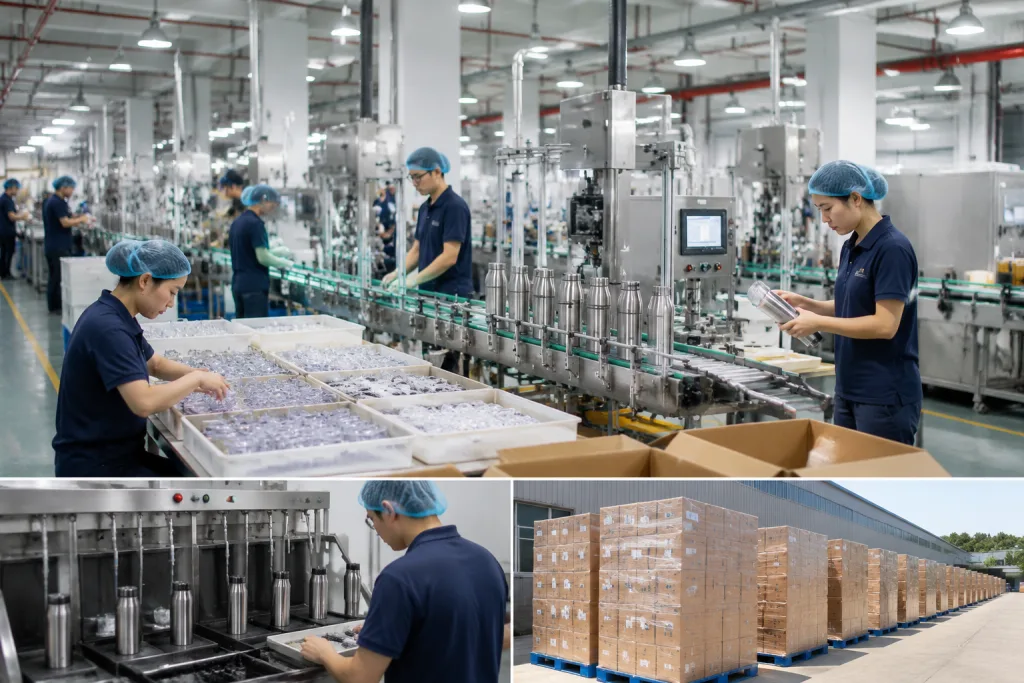
Key Takeaways
- A workable MOQ for custom stainless thermos is usually 1,000 to 3,000 pcs per color, while stocked shapes can start at 500 pcs
- Standard production lead time from Zhejiang, China is typically 25 to 35 days after sample approval and deposit
- For outdoor retail, 18/8 stainless with 0.4-0.5 mm inner and outer walls is the practical baseline for durability
- AQL 2.5, REACH testing, and 24-hour heat retention checks should be agreed before you place thermos bulk orders
If you search for a pc vacuum bottle supplier, you hit a sorting problem fast. On one page, 12 listings can lump plastic-bodied vacuum bottles, stainless steel thermos flasks, and plain trading offers under the same keyword. That is how a buyer ends up quoting the wrong shell material, the wrong lid structure, or a compliance file that does not match the sample on the bench. We have seen this go sideways after QC pulled the sample and found a 0.4 mm stainless outer where the PO assumed a different body build.
You need a cleaner comparison method. For bulk thermos programs from Zhejiang, China, price is not the main filter; this is the wrong question to ask at the start. You need to line up steel grade, insulation hours, decoration method, carton pack, and MOQ with the channel you actually run, whether that is retail shelf, promo gifting, or e-commerce. We ship orders where 1,000 pcs works, and we also run 3,000 pcs with custom color boxes, but the math does not work if the lid, print, and pack spec were never locked before sampling.
What buyers mean by supplier
The search term pc vacuum bottle supplier causes confusion in B2B. We see it every month. Some buyers mean polycarbonate. Some write PC as pieces on a rough PO. Others just want a vacuum bottle supplier and end up talking to a 304 stainless flask factory like us. If your real target is a custom thermos or customizable thermos for outdoor retail or promo programs, split the options first. This is the right first move.
- Plastic vacuum bottle: lighter weight and lower cost, but heat retention is usually weaker, often 6 hours hot instead of 12, so it fits entry-level promotions.
- Stainless steel vacuum bottle: the standard choice for custom thermos and distributor thermos programs, with common specs like 0.4 mm inner wall and tighter vacuum performance.
- Hybrid listings from traders: wide catalogs on paper, but once the buyer flagged lid torque or wall thickness, they still had to ask 2 or 3 outside workshops.
For most Europe and North America projects, stainless is the safer commercial route. The math works better over repeat orders. You get better dent resistance, steadier insulation, and cleaner compliance paperwork. A serious thermos manufacturer should tell you the steel grade, vacuum process, inner wall thickness, powder coating spec, and leak test standard on the spot. If sales needs 2 days to ask the line what steel they run, we've seen this go sideways.
At BottleForge Industrial in Hangzhou, Zhejiang, we tell buyers to filter supplier type before design. A factory thermos partner with 600,000 units/month capacity answers one way; a sourcing office that forwards questions to 3 unrelated workshops answers another way. On our floor, QC pulled the sample and checked gloss at 60° before mass production approval. That matters. If you need customized thermos with logo, retail box, barcode labels, and repeatable color control, the supplier model matters more than a 3 percent unit price gap.
A cheap quote is useless if the vendor cannot hold the same lid fit, powder coat gloss, and vacuum yield on the second and third production run.
Spec table that actually matters
Buyers still get pulled in by catalog photos. That is the wrong place to start. Put suppliers side by side in a spec table and force the basics onto one sheet, because those details decide whether a bulk thermos program holds up in outdoor retail, promotional gifting, or distributor channels. On our line, QC pulled a sample last month that looked fine in the photo set but came in 0.32 mm on the inner wall.
Core comparison points
- Body material: 18/8 stainless steel is the safer retail choice. 18/0 can cut USD 0.18 to 0.35 per unit, but it gives up corrosion resistance, and buyers flag rust spots faster than they flag a price gap.
- Wall thickness: 0.4 mm inner and 0.45-0.5 mm outer is the common build for a durable manufacturer thermos. Below 0.35 mm, dent complaints go up. We check this with a micrometer at incoming and again after forming.
- Capacity range: 350 ml, 500 ml, 750 ml, and 1,000 ml cover most custom thermos demand. In actual orders, 500 ml and 750 ml usually carry the volume, with MOQ often starting at 1,000 pcs per size.
- Heat retention: A realistic standard is 12 hours hot above 55C and 24 hours cold, tested from 95C fill at room temperature. If a supplier only says “long-lasting insulation,” ask for the test sheet.
- Lid system: screw cap, cup cap, push button, or dual-use tea filter lid. Each one changes leak risk and tooling cost. We have seen push-button lids fail at the silicone seat, not the thread.
- Decoration: silkscreen, laser engraving, UV print, and pantone-matched powder coat. The buyer usually asks for the cheapest print first, then flags color mismatch later, so get the Pantone number on the PO.
- Packing: egg-crate bulk pack for promotional thermos, or PDQ/color box for retail. Carton drop risk changes here, and the math does not work if the bottle is fine but the gift box crushes in transit.
For outdoor retail, the safer spec is usually a 500 ml or 750 ml stainless flask with 18/8 steel, copper-coated inner liner, and matte powder coating. We ship that build every month. FOB Ningbo pricing from China for that level is often around USD 3.20 to 5.80 depending on size, lid complexity, and print. For a promotional thermos order, buyers often step down to a simpler 500 ml straight bottle at USD 2.40 to 3.60 FOB with one-color print and white box. Last quarter, one buyer pushed for the outdoor spec at the promo price, and it went nowhere.
If a suppliers thermos quotation does not state steel grade, wall thickness, and test method, you are not comparing the same bottle. You are comparing photos. We have seen this go sideways over one missing line item, even a PO typo that changed 18/8 to 201 steel.
Use-case fit by sales channel
Not every thermos custom project should run on the same bottle. We see first-time buyers miss the mark on spec and cost in the first RFQ. A customizable thermos built for an outdoor chain is usually wrong for a giveaway campaign, and a distributors thermos SKU that works in wholesale cartons can look too plain on an ecommerce listing. This is where orders drift fast: wrong lid, wrong finish, wrong margin.
- Outdoor retail: durability comes first, then grip and carry comfort. The common run is 500 ml to 1 L, 18/8 steel, powder coat, laser logo, MOQ 1,000 pcs. We usually check powder adhesion with a cross-hatch cutter before mass production. Expect FOB USD 3.80 to 6.50.
- Promotional brands: unit cost, logo visibility, and delivery speed drive the job. Straight-wall 350 ml or 500 ml models with silkscreen logo and white box usually land better than complex shapes. MOQ can start at 500 to 1,000 pcs from a stock mold. Buyers still ask for gift boxes at this level, but the math doesn't work on a tight promo budget.
- Distributor thermos business: repeatability and carton efficiency matter most. You want stable tooling, spare lids, and standardized master carton counts such as 24 pcs or 36 pcs. On the line, even a 3 mm carton height change can affect pallet loading and freight cost.
- Online private label: review risk is the real issue. Leak rate, coating scratch resistance, and barcode application matter more than saving USD 0.20. QC pulled the sample last month because the FNSKU label was 2 mm off-center and covered the care mark.
For thermos distributor and thermos distributors channels, simple SKUs usually sell better. A catalog with 8 reliable shapes usually makes more money than 40 unstable shapes. New buyers from China sourcing often stack too many versions into the first PO: tea infuser, carry loop, cup lid, rubber boot, strainer, gift box. We've seen this go sideways. MOQ friction starts, tooling lead time stretches, and one typo on the PO can hold approval for 2 days.
A better launch is one proven manufacturer thermos body in two capacities and three colors. Then watch sell-through and add parts after that. A Zhejiang production line can scale a stable design faster than it can fix a complicated one once the welding jig is set. This is the wrong question to ask at first order stage: "How many features can we add?" The better question is how fast we can ship 1 clean SKU without returns.
MOQ, tooling, and price truth
The fastest way to get a bad quote is to ask 10 factories for a custom thermos price before you lock the commercial assumptions. This is the wrong question to ask. MOQ, print method, and pack-out move the cost fast; last month one buyer flagged a price gap of USD 0.62, and it came from a gift box insert plus a 2-color logo on the lid, not the bottle body.
For stock molds from a thermos factory in Zhejiang, normal MOQ is 500 to 1,000 pcs per size if you accept existing colors, and 1,000 to 3,000 pcs per color for custom coating. A fully customized thermos with new lid or base tooling can require 3,000 to 5,000 pcs, plus mold charges from roughly USD 2,000 to 8,000 depending on the part complexity. On the floor, we usually check the new lid drawing against a 0.3 mm seal tolerance before we quote, because we've seen this go sideways on first-fit samples.
Typical FOB China cost drivers
- Material upgrade: 18/8 instead of 18/0 can add USD 0.15 to 0.40.
- Copper lining: adds roughly USD 0.08 to 0.20 and improves thermal performance.
- Powder coat: adds USD 0.18 to 0.45 versus plain spray finish.
- Laser engraving: often USD 0.05 to 0.12, while multi-color print can run higher.
- Retail gift box: often USD 0.25 to 0.80 depending on insert and finish.
If you are buying thermos bulk for promotions, start by cutting decoration or packaging. Do not cut the steel grade first. Cheap steel saves a few cents, then QC pulled the sample and found odor complaints after hot-water testing, rust spots near the thread, or dented arrivals from weak carton spec. The math doesn't work.
Lead time needs a straight answer. Standard repeat orders can run in 20 to 30 days. New artwork with custom carton and approvals is more often 25 to 35 days. New tooling can push the first run to 45 to 60 days. Any thermos vendors promising 12 days on a custom coated, logo-printed stainless flask should be asked what process they are skipping; we run coating cure, logo confirmation, and drop-test packing checks on the line, and those steps still take the time they take.
Compliance and QC before deposit
You do not need a thermos supplier carrying every certificate on file. You need the documents that match your market and a QC routine we can actually check on the line. For Europe and North America, ask for a compliance pack tied to the exact SKU, lid set, and coating code, not a random PDF pulled from another 500 ml bottle. We have seen buyers approve the wrong file because the PO listed matte black and the test report was for navy.
- Material safety: REACH where applicable, LFGB or food-contact migration test if required by your market, and clear declaration of stainless grade.
- Factory systems: ISO 9001 is useful. BSCI matters if your brand has social compliance requirements.
- Product tests: leak test, salt spray for coating where relevant, drop test for packaged unit, and insulation retention records.
- Inspection standard: define AQL, commonly AQL 2.5 for major defects and 4.0 for minor defects.
For a manufacturers thermos order, QC trouble usually shows up in five spots: color deviation, logo position, thread fit, vacuum loss, and dirty interiors. This is where orders drift. On one run, QC pulled the sample and found the logo sitting 3 mm low on 800 units because the jig was reset after lunch. Lock the standard before deposit: approved golden sample photos, pantone confirmation, packaging dieline sign-off, and a written defect list. If a supplier says they will fix it later, that answer is not good enough.
We usually tell buyers sourcing from China to require 100 percent leak testing and vacuum inspection during production, then a pre-shipment inspection on finished packed goods. We run leak test benches every shift, and the line should record vacuum retention by batch, not by guesswork. If your order ships FBA or goes into high-review ecommerce channels, add carton drop testing and barcode scan checks. The buyer flagged missing scans on an Amazon label job last year, and the relabel bill erased the savings. That is basic discipline. The math does not work without it.
The easiest way to lose margin on a thermos bulk order is not at the quote stage. It happens after arrival, when 2 percent leakage turns into returns, relabeling, and angry retail buyers.
How to shortlist the right factory
Once you lock the spec, the real screening starts. The right thermos supplier is not the one with the lowest FOB price on page one. It is the one that gives you fewer surprises in sampling, on the line, and on the repeat PO. We have seen buyers save $0.18 per bottle, then lose 12 days because the carton drop test failed at the packing table. The math doesn't work.
Ask each thermos manufacturer the same six questions. Put the answers in one sheet and compare them side by side.
- What is your MOQ by model, color, and logo method?
- What are your standard lead times for sample, first order, and repeat order?
- What is your monthly capacity on stainless vacuum bottles?
- Can you provide REACH, ISO 9001, and recent inspection records?
- Do you do in-house coating and laser, or subcontract them?
- What defect rate do you usually hold on final inspection?
A solid factory thermos source in Zhejiang or elsewhere in China should answer these points straight. If the sales team stays vague, or one person says 20 days and another says 45 days for the same item, expect trouble. QC pulled a sample last month where the cap thread felt fine dry but slipped with wet gloves after a cold-water test. For outdoor retail, check hand feel, wet grip, base stability, and cap use with gloves. For promo programs, check logo readability, carton marks, and whether the white box survives courier handling. We have even seen a PO typo on carton text pass unchecked and show up in all 3,000 pcs.
At BottleForge Industrial, our usual MOQ starts at 1,000 pcs for custom color stainless models, with sample lead time around 7 to 10 days and production around 25 to 35 days. That is normal for Zhejiang. It is just an honest schedule. We run coating and assembly against a real line plan, not a sales promise, and the buyer is better off hearing 30 days up front than chasing a 22-day promise that slips to 34. A thermos vendor who manages timing well usually ships more consistent goods.
The last filter is repeatability. One good pre-production sample proves little. A useful supplier shows they can make the same customized thermos again six months later, with the same gloss, weight, and lid torque. We check lid torque with a meter, and a 2 mm shift in the silicone seal stack can change the feel fast. This is the right question to ask. That is what turns a one-off order into a supply line you can run.
Get a workable stainless thermos quote
Send your target capacity, logo method, packaging, and MOQ. We will reply with a realistic spec comparison, FOB pricing, and lead time from Zhejiang, China.
Frequently asked questions
Does a pc vacuum bottle supplier usually mean stainless or plastic?
You need to confirm that directly, because the term is used loosely in export listings. Some suppliers mean polycarbonate vacuum bottle, some mean vacuum bottle supplier by piece count, and some simply use the keyword to catch search traffic. If you need a stainless custom thermos, specify 18/8 or SUS304 interior and exterior, double-wall vacuum, and target capacity such as 500 ml or 750 ml. Ask the supplier to state wall thickness, for example 0.4 mm inner and 0.5 mm outer, plus heat retention data after 12 hours. If they reply with only photos and a unit price, the quote is not usable yet. A proper China supplier should provide a full spec sheet within 24 to 48 hours.
What MOQ should I expect for a customized thermos order?
For an existing stainless mold, 500 to 1,000 pcs is a realistic MOQ if you use standard colors and simple logo decoration. Once you ask for pantone-matched powder coating, custom retail packaging, or mixed accessories, MOQ usually moves to 1,000 to 3,000 pcs per color. A new lid or body tool often pushes MOQ to 3,000 to 5,000 pcs, and mold cost can range from USD 2,000 to 8,000. If a supplier offers 100 pcs on a fully custom bottle, look closely at what is actually custom. Often it means only a stock item with one-color print. For promotional thermos jobs, that can still work. For retail, it usually does not.
How do I compare prices from different thermos suppliers fairly?
Lock the same assumptions before collecting quotes. You need the same capacity, steel grade, wall thickness, finish, logo process, packaging, inspection level, and trade term. A 500 ml bottle quoted at USD 2.60 FOB China may use thinner steel, no copper lining, and a plain white box. Another at USD 3.40 may include 18/8 steel, powder coat, laser logo, and 24-piece export cartons. Those are different products. Ask every thermos supplier to quote with the same baseline: for example 500 ml, SUS304 double wall, 0.4/0.45 mm, matte powder coat, one-position laser logo, white box, MOQ 1,000 pcs, FOB Ningbo. Then the number means something.
What compliance documents matter for Europe and North America?
For stainless drinkware, you should at least ask for material declaration, food-contact test documents relevant to your market, and factory system records such as ISO 9001. For Europe, REACH-related documentation is commonly requested, and some buyers also ask for LFGB style food-contact testing depending on category and retailer requirements. For North America, retailer-specific standards may add packaging, labeling, or chemical restrictions. If you sell kids-focused ranges, ASTM-related requirements may matter more broadly across the program. Beyond certificates, insist on process control: 100 percent leak test, vacuum check, and final inspection to AQL 2.5 for major defects. Paperwork without process discipline does not protect your shipment.
How long does a bulk thermos order usually take from sampling to shipment?
For a stock stainless model with custom logo, sample time is usually 5 to 10 days, assuming artwork is ready. Mass production is commonly 25 to 35 days after sample approval and deposit. If you need a new mold, expect 15 to 25 days for tooling and testing before mass production, so the first order can stretch to 45 to 60 days. Add a few extra days if you require retail color boxes, barcode application, or third-party inspection booking. Sea transit from China to Europe or North America is separate, so do not confuse factory lead time with landed timeline. For seasonal outdoor retail programs, most buyers should start 90 to 120 days before the shelf date.