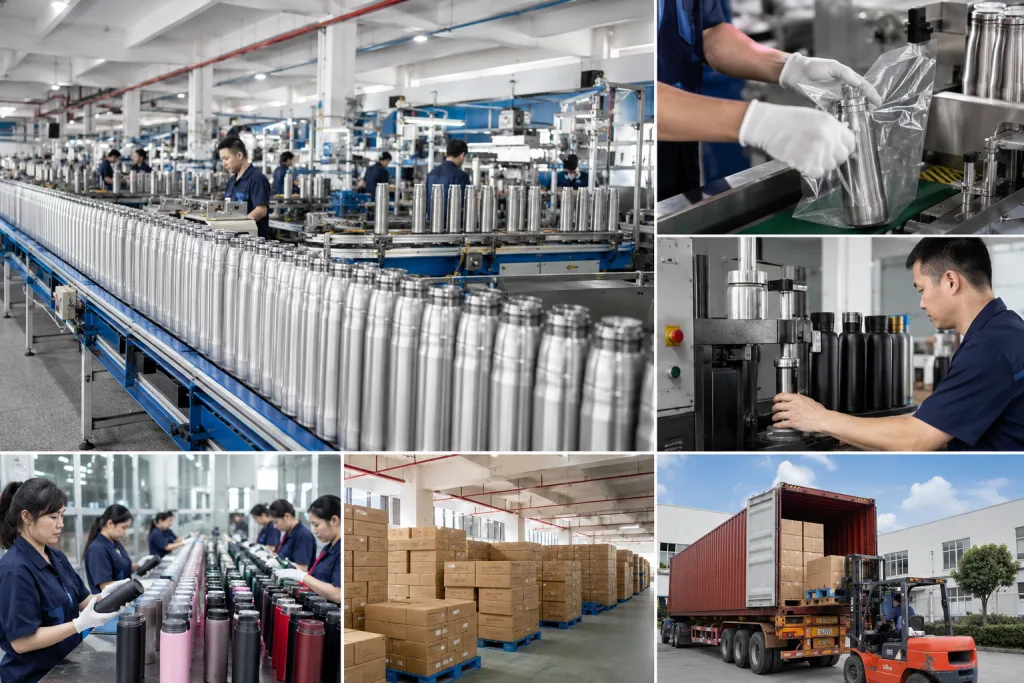
Key Takeaways
- A usable RFQ for a custom thermos should lock 12-15 specs before quoting, including capacity, 18/8 or 18/10 steel, wall thickness, coating, logo method, and carton packout.
- For most stainless vacuum bottles, sample lead time is 7-12 days and bulk lead time is 25-40 days after sample approval and deposit.
- A realistic MOQ is often 500-1,000 pcs per color for stock molds, while new mold development can push MOQ to 3,000 pcs or add USD 1,500-4,000 in tooling.
- Use AQL 2.5 for major defects and AQL 4.0 for minor defects, and put vacuum retention, leak test, and barcode placement directly on the PO.
You may be sourcing a pc vacuum bottle manufacturer and still end up comparing five factories that look the same on paper. That starts with a loose RFQ. One supplier quotes USD 2.95, another quotes USD 4.10, and neither is wrong. They are pricing different steel grades, lid structures, print methods, and inspection exposure. We see this on the line every week: one buyer asks for a "matte black bottle," but the PO does not state 304 stainless, spray code, logo size in mm, or drop-test standard.
If you buy for an outdoor retailer or a promotional brand, the quotation sheet is not the hard part. Bulk production is. From Hangzhou, Zhejiang, we see the same failure pattern each month: weak PO details lead to delays, color mismatch, dent claims, and crushed export cartons. QC pulled the sample on one order last month and found the approved navy lid was 1.5 shades off the master chip, but the PO only said "blue." A clear step-by-step buying process fixes most of this before your bulk thermos order starts. This is the wrong question to ask: "Who is cheapest?" Ask who can ship your spec without arguments at final inspection.
Start with a usable RFQ
If you ask a pc vacuum bottle manufacturer for a price with only a photo and capacity, you will get a number, but it is usually just a rough guess. A usable RFQ for a stainless bottle needs enough detail for the factory to cost steel, lid components, labor, decoration, and packout without filling gaps on their own. On our side, we run the BOM line by line, check tube weight against the drawing, and match it to the packing spec before we quote. In Zhejiang and across China, the fastest reply is often the sales team that typed first, not the factory that understood the job.
For outdoor retail, the RFQ usually needs clear performance language, such as heat retention target, leak test standard, and dent tolerance after transit. For promotional thermos projects, decoration and carton setup usually drive the quote harder because the unit sells as a campaign item, not a shelf SKU. We have seen buyers flag a quote gap over a simple carton count change from 24 pcs to 36 pcs. Separate fixed items from options. That is the wrong question to skip.
PO line items to define before quotation
- Body material: 304 stainless inside/outside, or 316 interior if you need higher corrosion resistance for tea or electrolyte use.
- Capacity and tolerance: 500 ml, 750 ml, or 1,000 ml, typically within plus or minus 3%.
- Construction: double-wall vacuum, copper coating yes or no.
- Wall thickness: common body thickness is 0.4 mm outer and 0.4 mm inner; premium units may go 0.5 mm.
- Lid style: PP screw lid, stainless cap, handle lid, or flip lid with silicone seal.
- Finish: powder coat, spray paint, brushed, polished, or base color for further printing.
- Logo method: silkscreen, heat transfer, laser engraving, or UV print.
- Packaging: white box, color box, PDQ, master carton quantity, drop-test standard.
- Compliance: REACH, LFGB, FDA contact compliance, BPA-free declaration, ASTM F963 if the product is for children.
A serious factory thermos quote should also show FOB Ningbo or FOB Shanghai, sample charge, mold charge if any, and lead time. We usually add MOQ, sample lead time, and one packing note because this is where POs get messy; last month QC pulled the sample and found the logo position matched the art file, but the PO typo showed the wrong lid code. If the supplier thermos quotation skips those basics, trouble comes later.
Compare quotes the right way
Once the quotations come back, do not grab the lowest number first. Check what is inside it. One pc vacuum bottle manufacturer quoting USD 3.20 FOB might be using a 201 stainless outer wall, 0.35 mm body thickness, one-color silk print, and 50 pcs per carton. Another quotes USD 3.85 with full 304 inside and outside, powder coating from the line, and a stronger individual box after a 1.2 m drop check. Those are different offers. We have seen buyers compare them side by side, then the buyer flagged weight and finish after sampling. The math does not work.
Ask each thermos supplier to rebuild the quote in the same format. This is the right question to ask. We run a simple table with base bottle price, lid upgrade, decoration cost, packaging cost, test cost, and tooling cost split out, because a distributor order of 3,000 pcs and a branded retail launch at 10,000 pcs fail in different places. Last month QC pulled the sample and found the PO said “mat surface” while the approved sample was powder coat. That one typo cost 4 days.
A clean quotation is a cost breakdown, not one total line. If a manufacturer thermos quote cannot show where the money goes, you will lose control when the lid, print size, or carton spec changes later.
What to check line by line
- MOQ per SKU and per color: stock molds often start at 500 pcs per color, but a custom lid, a new handle tool, or an uncommon Pantone can push MOQ to 1,000 pcs. We ship this every week, and the buyer usually pushes back on slow colors first.
- Vacuum retention claim: for example, 12 hours hot above 55 degrees C and 24 hours cold below 10 degrees C, tested from 95 degrees C fill temperature. Ask which test method they run and how many samples; on our bench, 5 pcs is normal.
- Decoration position and size: a 35 x 60 mm print area is different from full-wrap transfer. On the line, fixture position matters, and a 2 mm shift is enough for QC to reject logo placement.
- Tolerance on color: powder coating can vary from Pantone reference more than offset printing on boxes. Ask for the delta standard up front, because we have seen this go sideways when the cap looks darker than the body under store lighting.
- Carton details: export carton board, burst strength, carton size, gross weight under 15 kg if needed for warehouse handling. We still see quotes with 16.8 kg master cartons, then the warehouse refuses them.
This is also where you ask whether the factory is BSCI-audited, ISO 9001-managed, and willing to work to your AQL. Paperwork blocks shipments fast. For promotional brands and thermos distributors, retailer files sometimes stop a container before any production defect does; last season one buyer missed a factory code on the packing list, and the booking slipped 6 days.
Lock the sample before approval
The sample stage is where a custom thermos order either gets locked down or starts burning money. Plan to pay for samples. Typical charges from a China thermos factory run USD 50 to USD 150 for stock items with simple laser marking, and USD 100 to USD 300 for printed, color-matched, custom-packaged samples. New tooling or custom lid development is separate. On our line, a laser-marked stock sample is often packed within 2 days, but a color-matched unit still waits for paint mix approval against the Pantone chip under the light box.
If the project matters, ask for three sample types. First, a reference sample from an existing mold, so you confirm shape, hand feel, and base diameter. Second, a pre-production sample with your exact finish and logo; this is the one QC pulled after spray, print, and final assembly. Third, a packaging sample with the real inner box and barcode layout. This gets missed all the time. We have seen buyers approve the bottle and skip the box, then the buyer flagged a barcode panel that was 4 mm off and the FNSKU label covered the product title.
PO line items to freeze at sample stage
- Approved sample date and version code
- Pantone reference for body and lid parts
- Logo artwork file type and print size
- Leak test standard: inverted 30 minutes with no leakage
- Vacuum test protocol: sample quantity, start temperature, measurement time points
- Packaging artwork approval and barcode placement
If you are buying thermos custom units for outdoor retail, check drop resistance and carry-loop strength at sample stage. Do not wait for mass production. We usually hang a 1 kg pull test weight on the loop and check the joint after cycling. If you are buying promotional thermos units, look harder at coating consistency and print adhesion than thermal retention, because end users judge the finish first. This is the wrong question to ask: “Does the sample look fine?” A solid vendor will ask you to sign off with photos, dimensions, and a marked-up approval sheet, because we have seen a casual email approval go sideways after a PO typo changed the logo size from 35 mm to 53 mm.
Write the bulk PO properly
Once the sample is approved, the bulk purchase order needs more than a model name. This is where buyers lose margin. A thin PO leaves the factory to guess, and on the line, guessing usually means the fastest workable option, not your exact requirement. We would rather get a two-page PO than a one-line order for 5,000 pcs followed by 10 correction emails. Last month a buyer typed the wrong cap color code on the PO, and QC only caught it when the first 12 pcs came off the print line.
Your bulk PO should be clear enough that the planner, purchasing team, print line, packing line, and QC inspector all read the same thing and make the same product. For stock-mold custom thermos orders, our practical MOQ is often 500 pcs per color and 1,000 pcs per design, with production capacity above 300,000 units per month. Bulk lead time is usually 25 to 35 days after 30% deposit and artwork confirmation, extending to 40 days in peak season. If your PO says "assorted colors" without a split, the math doesn't work, because purchasing has to book paint, lids, and cartons by count, not by guess.
Core PO lines for a bulk thermos order
- SKU code and product name: 750 ml double-wall stainless vacuum bottle
- Quantity by color and packaging type
- Unit price and Incoterm: FOB Ningbo, EXW Hangzhou, or DDP terms if agreed
- Deposit and balance terms: standard 30/70 against inspection or copy B/L
- Approved sample reference
- AQL requirement: Major 2.5, Minor 4.0, Critical 0
- Carton marks, FNSKU, suffocation warning, country of origin label
- Delivery window and late-shipment handling
- Spare parts or overrun allowance: for example plus or minus 3%
Call it manufacturer thermos, supplier thermos, or distributors thermos business, the rule stays the same: if a detail changes unit cost, warehouse receiving, or claim risk, put it on the PO. This is the wrong question to ask, but we still hear it: "Can we confirm carton marks after production starts?" We have seen this go sideways. Once outer cartons are on the floor and the label file changes, rework is slow, messy, and charged by labor.
Control production and inspection
Good sourcing does not stop after the deposit hits. You need eyes on raw material, decoration, assembly, and packing. These bottles look simple. They are not. On the line, defects show up fast: weld shadow on the mouth after polishing, powder coat adhesion failing the 3M tape test, a 0.8 mm base dent from transfer, weak vacuum, leaking lids, or the buyer flagging a carton label that says 500PCS instead of 5,000PCS on the PO copy.
For a custom thermos order in China, we usually run three control points as the minimum: pre-production confirmation, in-line photo updates, and final random inspection. If the order is above 10,000 pcs or split across 3 colors to 5 colors, add a mid-line inspection when 20% to 30% of goods are finished. That is where QC pulled the sample and caught logo drift or coating mismatch before 800 cartons were sealed. This is the wrong question to ask if you only want the cheapest inspection; the real question is where defects become expensive to fix.
Inspection points that matter
- Material verification: stainless grade declaration, food-contact parts list, silicone seal specification, and tube wall check with a micrometer before mass production starts
- Vacuum performance: test sample bottles from each lot, usually 5 pcs per lot, and record the result by lot code
- Leakage: 100% basic leak check on assembly line if possible, with upside-down hold time set on the SOP
- Cosmetics: scratches, pits, logo offset, print rub resistance, and color difference against the signed sample under the light box
- Function: lid thread fit, handle pull test, base stability, and cap torque checked with a torque meter
- Packaging: barcode scan, carton count, carton drop condition, plus outer carton mark check at packing station 2
AQL is useful only when defect definitions are written in plain language. A pinhead paint point on the base may be minor. A dent on the visible sidewall is usually major. No vacuum is major. A leaking lid is major. Missing country-of-origin mark may become critical if your importer or marketplace rejects the shipment. We have seen this go sideways when QC photos looked acceptable, then the final inspector classified 12 pcs out of 200 as major because the standard was never agreed. The manufacturers thermos business runs smoother when QC language is locked before production, not argued over after inspection photos arrive.
Plan shipment and landed cost
The last step is where buyers get caught. We see it often. They lock freight at a good rate, then the order stalls because the master carton is 6 mm over the warehouse limit, pallet height lands at 1.78 m instead of 1.70 m, or the FNSKU label sits on top of the product barcode and the buyer flagged it. A thermos bulk order can look perfect on the sample table and still fail at inbound. For outdoor retail, master carton strength matters because cartons get dropped, restacked, and moved through 3PL handling. We run carton drop checks on the line for this reason. For promotional thermos orders, the delivery date usually matters more than saving the last USD 0.05 on freight. The math doesn't work if you miss the campaign window.
Ask your pc vacuum bottle manufacturer for packed carton size, gross weight, and loading quantity per 20GP and 40HQ before you place the order. Get it early. A 500 ml bottle packed 24 pcs per carton ships differently from a 40 pcs carton setup, especially if one carton is 13.5 kg and the other pushes past a warehouse's 15 kg handling cap. Not every importer accepts the same carton weight, and we've seen this go sideways after the PO was signed. Ocean freight is usually the right call above 3 CBM. Air works for urgent launch quantities or replacement stock, especially when you need 12 days vs 18 days.
Final PO and shipping checks
- HS code confirmation
- Carton dimension and weight approval
- Pallet spec: euro pallet, no pallet, or fumigated wood if required
- Document set: commercial invoice, packing list, B/L, test reports, COO if needed
- Booking timeline: cargo ready date, ETD, and destination delivery window
For supplier thermos projects heading to Amazon or similar channels, label mapping needs to be checked before bulk packing. QC pulled the sample on one order last month and found the outer carton mark matched SKU-B, while the inner sticker matched SKU-D because of a PO typo. For traditional thermos distributors, mixed-SKU container planning often matters more, especially when 4 SKUs share one 40HQ and each carton count has to match the warehouse ASN. Either way, you need your landed cost per unit: product, packaging, testing, freight, duty, and local handling. This is the right number to watch. The FOB bottle price alone is the wrong question to ask.
Know when custom is worth it
Not every order needs a full custom thermos program. If you are testing a new outdoor SKU, start with a stock mold, then change the Pantone color and logo. We run this setup every week. You can often reach market with 500 to 1,000 pcs per color, unit pricing around USD 2.80 to USD 5.50 FOB depending on size and finish, and no mold charge. On the line, we usually check logo position with a simple fixture before mass print, because a 1.5 mm shift is enough for the buyer to flag it. This is how a lot of Zhejiang factories handle first orders for importers who want speed.
Full thermos customized development makes sense when you need a proprietary lid, a different body silhouette, or retail packaging that has to earn a higher shelf price. The cost picture changes fast. Tooling can add USD 1,500 to USD 4,000, development may take 20 to 35 days before sample approval, and MOQ may rise to 3,000 pcs or more. We have seen buyers push for a new lid at 2,000 pcs, and the math doesn't work. One new injection mold plus leak-test setup is already enough to move the project. QC pulled the sample last month on a lid fit issue at 0.3 mm, so this part is not theory.
If your annual volume is below 10,000 pcs, custom decoration on a proven bottle shape is usually smarter than reinventing the bottle.
This is where an honest thermos manufacturer should give you a blunt answer. A custom body mold is not automatically better. This is the wrong question to ask. A reliable stock platform with the right coating, logo method, and packaging often gives better sell-through and fewer claims. For a distributor thermos line, repeatability matters more than novelty, and we ship repeat POs faster when the thread and stopper are already proven. For a promotional brand, delivery and print accuracy usually matter more than a unique thread profile; we have even seen a PO typo on carton mark artwork delay approval by 2 days. The right sourcing decision is the one you can reorder without drama six months later from China.
Send your thermos RFQ with the real specs
Share capacity, steel grade, logo method, packaging, target price, and delivery date. We will review it like a factory in Zhejiang, not a trading spreadsheet.
Frequently asked questions
What does a pc vacuum bottle manufacturer usually mean in sourcing terms?
Most buyers using the phrase pc vacuum bottle manufacturer are really looking for a stainless vacuum bottle factory that can handle product customization, decoration, and bulk export. The "pc" part often appears in search terms, but for food-contact vacuum bottles the main structure is usually 304 or 316 stainless steel, with PP or Tritan lid components and silicone seals. You should confirm exactly which parts are plastic and ask for a bill of materials. A usable supplier answer includes steel grade, lid resin, MOQ, sample cost, and lead time. For stock-mold projects from China, expect MOQ around 500 to 1,000 pcs per color, sample lead time of 7 to 12 days, and production in roughly 25 to 35 days after deposit and approval.
How much should I budget for a custom stainless thermos order?
For a stock-shape double-wall bottle, you can usually budget USD 2.80 to USD 5.50 FOB China for 500 ml to 1,000 ml sizes, depending on steel thickness, coating, lid complexity, and logo method. Basic laser marking is cheaper than multicolor heat transfer. A white box is cheaper than a printed retail box by roughly USD 0.18 to USD 0.60 per unit. Testing, if needed, may add USD 250 to USD 800 per project depending on scope. Samples often run USD 50 to USD 150 for simple versions and USD 100 to USD 300 for finished pre-production samples. If you need a new lid or body mold, add USD 1,500 to USD 4,000 in tooling and expect higher MOQ, often 3,000 pcs or more.
What MOQ is realistic for bulk thermos and promotional runs?
For stock molds, 500 pcs per color is a practical entry point at many Zhejiang factories, though 1,000 pcs per color usually gives cleaner pricing and easier production scheduling. If you want mixed colors under one SKU, ask whether the MOQ applies per color, per logo, or per packaging version. Promotional thermos runs sometimes work at 300 pcs for laser logo on an existing color, but you will pay more per unit and have fewer finish options. Printed logos, Pantone-matched coatings, and custom boxes tend to push MOQ back to 500 or 1,000 pcs. For fully customized thermos development with new tooling, 3,000 to 5,000 pcs is more realistic. Low MOQ is possible; low MOQ with efficient pricing is the harder part.
Which quality checks matter most before shipment?
Start with function, then cosmetics. The essentials are vacuum retention, lid leakage, coating adhesion, logo placement, base stability, and carton accuracy. Put AQL on the PO, typically Critical 0, Major 2.5, Minor 4.0. Ask the factory or third-party inspector to sample from packed cartons, not just loose bottles, because packaging errors are common. For vacuum testing, define the method clearly, such as 95 degrees C fill and temperature check after 6 and 12 hours. For leakage, an inverted 30-minute test is a practical minimum. If the order goes to retail or Amazon, confirm barcode readability, country-of-origin marking, and FNSKU placement. In China, many shipment problems are not product failures but labeling and packout mistakes that were never written into QC criteria.
How do I choose between a stock mold and a fully customized thermos?
Use a stock mold when speed, lower MOQ, and repeatable production matter more than owning a unique silhouette. That suits many outdoor accessories launches and most promotional thermos jobs. With a stock platform, you can still customize color, logo, finish, strap, and packaging, and usually move from sample approval to bulk in 25 to 35 days. Choose full customization when your sales channel rewards differentiation enough to cover tooling cost, longer development, and higher MOQ. A new project may need 20 to 35 development days, USD 1,500 to USD 4,000 in tooling, and MOQ above 3,000 pcs. If your annual demand is under 10,000 pcs, a proven stock bottle with strong decoration usually gives better commercial results.