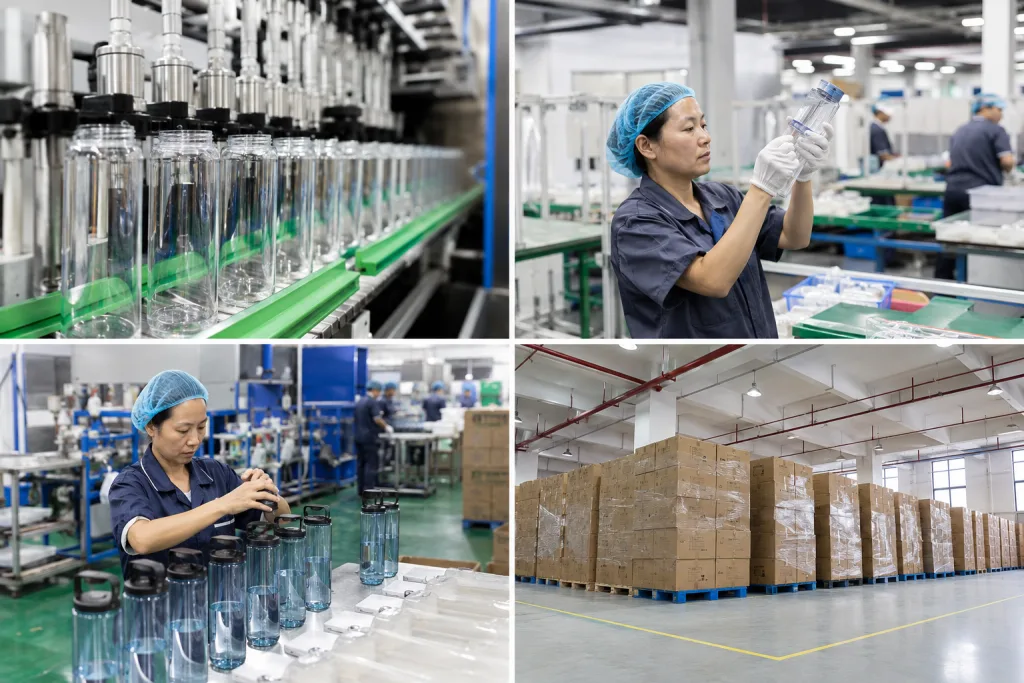
Key Takeaways
- For most Tritan bottles, a practical MOQ is 3,000 to 5,000 pcs per color, with 25 to 35 days lead time after sample approval.
- A 0.6 to 0.8 mm wall section is common for lightweight sports bottles, but heavier 0.8 to 1.2 mm walls reduce denting and thread distortion.
- AQL 2.5 for major defects and 4.0 for minor defects is a realistic inspection standard for custom drinkware mass production.
- Tooling for a new body mold often runs USD 3,500 to 9,000, while screen printing usually adds only USD 0.05 to 0.18 per unit.
You can get a decent-looking Tritan bottle sample from almost any supplier in China. Easy part. The hard part is knowing if the quote hides poor resin lot control, a 0.3 mm wall section that runs too thin on the shoulder, a lid that seeps after 200 cap cycles, weak logo adhesion after dishwasher testing, or a production setup that looks fine at 500 samples and breaks down at 20,000 retail units. We have seen QC pull the sample and catch all of this in one afternoon.
If you are buying from a pc tritan bottle manufacturer for a brand, distributor drinkware program, or canteen promotional order, read the spec sheet like a shop-floor document, not a sales brochure. In Zhejiang, we see buyers lock onto shape and color first, then the buyer flags neck tolerance at 0.15 mm, asks why the 24-drop carton test failed on one corner, or finds the REACH file missing one page because of a typo on the PO. This is the wrong question to ask at sample stage. Mold cavities, cap fit, and shipping carton strength decide whether we ship on day 12 or miss and slide to day 18.
Start With Resin, Not Shape
When you ask a pc tritan bottle manufacturer for a quote, start with resin. Not shape. We get POs every month that say “PC bottle” when the buyer actually wants Tritan copolyester, and the line treats those as two different jobs. That mix-up changes your compliance file, odor level after hot-water testing at 80C, dishwasher performance, and where the product can sit at retail. This is the wrong question to ask first: logo size means nothing if the resin spec is wrong.
For branded custom drinkware, ask for the exact resin designation, the food-contact declaration, and whether the factory runs virgin material only. A serious canteen manufacturer or canteen supplier in Zhejiang should give you the grade, lot traceability, and regrind policy in one email, not after six follow-ups. We run into this all the time. QC pulled the sample once and found a 1.5 mm haze band near the shoulder because the material source was not what the buyer thought it was. If the answer is vague, expect the same problem later on lid fit, color consistency, and complaint handling.
- Virgin Tritan resin: better optical clarity, lower odor risk, and a cleaner compliance file for Europe and North America. On clear bottles, the buyer usually checks this first under a light box.
- Mixed or unclear material source: lower price, but more color drift and more arguments when end customers report taste issues. We have seen delta shift after one production run, and the buyer flagged it fast.
- Standard documentation: REACH, LFGB where relevant, FDA declaration, and migration test reports tied to the material. If the report is not linked to the resin lot, the math doesn't work.
For a canteen custom or customizable drinkware project, resin cost is not a side line item. On a 700 ml bottle, material choice can swing the ex-works unit price by USD 0.12 to 0.35 depending on weight and grade. On a 10,000-piece MOQ, that is USD 1,200 to 3,500. Buyers feel that fast. If you are a canteen distributor, canteen vendor, or distributor growler program manager, lock the resin grade before approving renderings. BottleForge Industrial in Hangzhou, Zhejiang typically tells buyers this early because changing resin after mold sampling adds scrap, pushes sampling from 12 days to 18 days, and we have seen this go sideways.
Wall Thickness Tells You Durability
The spec sheet line buyers skip first is usually wall thickness. New buyers squeeze the bottle and call it done. We do not. On the line, we check section thickness, gate position, cooling time, and shrinkage, and QC pulled the sample last month with a wall meter because the shoulder was drifting 0.12 mm. For a pc tritan bottle manufacturer, this is where styling hits the mold limit. We have seen this go sideways.
A lightweight 500 to 750 ml Tritan sports bottle may run at 0.6 to 0.8 mm wall thickness. That is common for gym programs and giveaway orders where freight is tight and the target FOB is under pressure. If you want a more premium custom canteen, customizable canteen, or customized drinkware item, 0.8 to 1.0 mm is the safer window, and we run that range often on 2-cavity molds for cleaner thread stability. Move into large-format bodies, integrated handles, or wide-mouth customizable growler concepts, and 1.0 to 1.2 mm does a better job controlling panel flex and thread distortion at the neck finish.
Why this matters to you
- Thin walls cut resin cost and shipping weight, but the risk of ovality after molding goes up. The buyer flagged this on a 750 ml bottle once when the neck went out by 0.4 mm.
- Uneven wall distribution creates sink marks near grip zones and weak spots near base transitions. We usually catch this around the heel radius during first-article inspection.
- Thicker walls improve hand feel and perceived quality, but cycle time shifts from 12 days vs 18 days on total molding output planning, and the unit cost climbs. This is the wrong question to ask if you only focus on piece price.
If your canteen factory quotes a bottle that is USD 0.18 cheaper than another Zhejiang or China supplier, check the weight first. A 700 ml body at 95 g and the same shape at 118 g are not the same product just because the drawing looks similar. The math does not work. We have seen retail complaint rates jump from under 0.8% to above 3% when buyers pushed wall thickness too low for threaded neck designs, and one PO even had the bottle weight typed wrong by 20 g. That gets expensive after we ship and goods land in Germany, Canada, or the US.
Good sourcing is boring on purpose: ask for finished bottle weight tolerance, typical wall range, and a filled drop-test standard before you approve the first sample.
Neck Finish, Lid, And Leak Risk
The bottle body gets the attention. The lid gets the complaints. A canteen manufacturer can show you a clean-looking bottle and still ship trouble if the neck finish, cap thread, or seal geometry drifts out of spec. We check this on the line with a thread gauge and torque driver. Leak resistance is a system issue, not just a cap issue.
Ask for neck dimensions with tolerance, thread start design, gasket material, and torque guidance in writing. On Tritan bottles, we usually see 3 failure points: cross-threading at the first turn, silicone rings sitting 0.5 mm proud and not compressing enough, and hinge fatigue on flip lids after drop testing. For custom growler and customized growler concepts, the risk is higher. Larger mouths and carry handles put more load on the closure during transit, and we have seen this go sideways on a 1.8L sample run.
- Silicone seal: ask for Shore hardness, usually around 50 to 70A depending on design.
- Lid material: PP is common; ABS may be used for cosmetic parts; stainless inserts add cost and weight.
- Leak test: specify 100% vacuum or inverted water test in production if the program is retail-critical.
- Cycle life: hinge or button lids should be tested for 3,000 to 5,000 open-close cycles.
For canteen customized or canteen customizable programs sold through e-commerce, be stricter than you would for event giveaways. The math is simple. A 1% leak claim rate can wipe out margin after reverse logistics and marketplace penalties. If you are an Amazon or big-box buyer, put carton orientation and cap torque verification into the PO notes; one buyer flagged a PO typo on torque spec, 12 lb-in instead of 21 lb-in, and QC pulled the sample before mass packing. Around 8 out of 10 canteen suppliers in China can hit the target, but this is the wrong question to ask. Ask whether they lock the standard before sampling. At our Hangzhou facility, we run leak verification in final inspection for lid-heavy SKUs because reopening sealed cartons for recheck adds about 12 days vs 18 days if a full repack is needed after a claim.
Decoration Methods Change Unit Economics
Most buyers ask for a logo first. That is the wrong question to ask. The real question is which decoration method matches your order volume, artwork file, and how the bottle will be used, because the wrong print choice can turn a clean custom drinkware job into a returns issue fast; we have seen QC pulled the sample and found rubbing after 30 hand wipes with a dry cloth.
For a Tritan bottle, the common options are silkscreen, heat transfer, digital printing, in-mold label on selected structures, and laser on certain lid components. We run silkscreen every week for canteen promo orders because the setup is simple and the cycle time on the line stays tight. Expect roughly USD 0.05 to 0.12 per color per position at volume, with setup fees depending on artwork. Heat transfer gives finer color detail, but it often lands at USD 0.12 to 0.30 per unit and adds one more handling step. Full-wrap digital can look sharp on the first sample. The catch is adhesion. We check it with a cross-cut blade and 3M tape, because brochure photos do not tell you what happens after cartons rub in transit.
If your customer is a canteen distributor, canteen distributors group, or distributor canteen importer serving schools, gyms, or outdoor retail, scratch resistance matters more than how bright the sample looks under showroom lights. The buyer flagged this on one school order after seeing white scuff marks on 6 bottles from a drop test bin. Ask for:
- Cross-hatch adhesion test standard
- Dishwasher or hand-wash durability statement
- Pantone matching tolerance
- Artwork position tolerance, usually plus or minus 1.5 to 3.0 mm
A custom canteen for a trade show can accept more cosmetic variation than a premium customized canteen sold online at USD 14.99 retail. Be honest about the use case. We ship both types, and the math does not work if you spec retail-grade decoration on a low-price giveaway bottle with a 3,000-piece MOQ. Good canteen vendors and canteen suppliers in Zhejiang will usually push back before production, because each extra print step hits yield and slows packing. On high-volume jobs, even a 2% print rejection rate becomes expensive. On a 50,000-piece run, that can mean 1,000 extra units to remake, repack, and reinspect.
Compliance Files Must Match The SKU
Any factory can send a clean PDF with test logos on it. That does not prove the file matches the bottle you are buying. Buyers who do this every season check the exact SKU, resin grade, decoration method, and sales market. We have seen a PO say “same as last order” while the lid changed from PP to Tritan, and QC pulled the sample on day 3 because the file no longer matched.
For Tritan bottles shipping to Europe and North America, the basic file usually covers food-contact declaration, REACH SVHC statement, and relevant migration testing. Some programs also need LFGB, California Proposition 65 review, or ASTM/CPSIA checks for kids' items. If the bottle sits in a kids range, the bar moves fast. A line that runs adult gym bottles is often missing the paperwork depth for children's products, even if the molding and printing look fine. We had one buyer flag a missing age-grade reference after artwork approval; the math does not work if you catch that after deposit.
What to verify before deposit
- Test report date within the last 12 to 24 months
- Report naming the same material and decoration used on your order
- Factory name or authorized supplier linkage
- BSCI, ISO 9001, or social audit status if your retailer requires it
This is where first-time buyers lose 12 days vs 18 days. They accept “similar item” paperwork at quotation stage, then their customer asks for matching SKU data before shipment. A 30-day production plan turns into 45 days because the lab has to rerun testing on the actual build, sometimes down to the 2 mm silicone gasket and the exact screen-print ink. For a pc tritan bottle manufacturer handling export business properly, this should be routine. Our view from Zhejiang is simple: do not release bulk without a document matrix listing bottle body resin, lid resin, gasket, decoration process, and target market. This is the wrong question to ask late. The check needs to happen before the line starts, whether you are buying customizable drinkware for a distributor program or a customized growler private-label launch.
MOQ, Capacity, And Lead Time Reality
Most buyers ask for the “best MOQ” first. That is the wrong question to ask. MOQ is a production number, not a sales slogan. We run it off machine setup hours, color change scrap, carton MOQ, and whether the line uses a stock mold or a new tool. On one 750ml Tritan bottle, a simple color switch can burn 18 to 25 kg of resin before the first stable piece drops.
For a stock Tritan bottle with one-color logo, a realistic MOQ from a canteen manufacturer in China is often 3,000 pcs per size per color. Some factories will quote 1,000 pcs, but the unit cost may jump by 12% to 25%. Buyers push back on that every week. The math does not work at low volume once you count bottle blowing, silk screen setup, and printed box minimums. For a new custom canteen mold, the commercial MOQ often starts at 5,000 pcs because the supplier needs enough volume to stabilize output and recover sampling effort. A new body mold can cost USD 3,500 to 9,000; a lid mold may add USD 2,000 to 6,000 depending on complexity. On the factory floor, mold tuning usually means checking neck finish within 0.15 mm before we sign off the sample.
- Sample lead time: 7 to 12 days for stock sample with logo, 15 to 25 days for molded prototype depending on tooling route.
- Mass production: usually 25 to 35 days after deposit and approval.
- Peak season: add 7 to 15 days from August to November.
Capacity claims need checking. If a canteen factory says it can ship anything fast, ask for actual monthly output, actual running lines, and the last 2 shipment months. A real number might be 400,000 to 600,000 plastic bottles per month on standard programs, not “unlimited.” We have seen this go sideways when a distributor booked 5 colors for 6 countries and the buyer flagged carton delays after PO issue. Split shipments, color priority, and carton sourcing need planning early. In Hangzhou, Zhejiang, we usually tell buyers to reserve production slots at least 30 days ahead if they need delivery before the fourth quarter rush. QC pulled the sample on one August order and found the master carton burst at 17.8 kg, so we changed board grade before mass production.
Inspection, Packaging, And Shipment Damage
Buyers skip the last lines on the spec sheet, then pay for them later. We see this on the line all the time. Inspection standard, pack-out method, and carton spec decide whether 5,000 bottles land sellable or land as a claim file with corner crush photos and wet cartons.
For export custom drinkware, AQL 2.5 for major defects and 4.0 for minor defects is common. Define the major defects early and write them into the PO: leak, wrong logo, crack, missing seal, wrong barcode, failed drop test. Cosmetic marks on the inner base might be minor if they sit below the fill line and QC pulled the sample from a cavity with no sharp edge. A cap that leaks is major. Full stop. If you leave this vague, your canteen vendor and your third-party inspector will score the same shipment two different ways, and we have seen that go sideways.
Packaging changes cost and claim risk fast. A bare bottle in a polybag works for a lot of canteen promotional projects, usually from 3,000 pcs up. Retail programs are tighter: white box, color box, insert card, barcode label, and export carton drop performance. For Amazon or DTC orders, FNSKU location and carton overhang limits need to be in the pack-out file before mass production. Last-minute relabeling by hand gun adds hours, and the math doesn't work.
- Outer carton burst strength: ask for the spec, not just “strong carton” language.
- Drop test: 1.0 to 1.2 m carton drop is a practical baseline for many bottle programs.
- Barcode scan rate: check before sealing master cartons.
- Spare parts: consider 0.5% to 1.0% extra lids for large distributor orders.
A disciplined pc tritan bottle manufacturer should be comfortable with pre-production sample signoff, inline inspection, and final random inspection before balance payment. This is the baseline. We run pre-production checks with a go/no-go gauge on thread fit, then final random inspection before the balance clears. If your canteen vendor pushes back on a clear QC plan, this is the wrong question to argue about. The buyer flagged one leaking flip lid on a 2,400-piece order last month, and that single defect opened 18 cartons for recheck.
Send your bottle spec for a factory-level review
Share your target size, MOQ, logo method, and market. We will review the spec line by line and flag cost, compliance, and production risks.
Frequently asked questions
What is a normal MOQ for a pc tritan bottle manufacturer?
For a stock bottle shape with standard lid and one-color logo, 3,000 pcs per color is a practical starting point in China. Some canteen suppliers will offer 1,000 pcs, but the FOB unit price usually rises by USD 0.15 to 0.40 because setup loss and packaging costs are spread over fewer pieces. For a fully custom body or lid, expect 5,000 pcs minimum and separate tooling charges. If you are buying for a canteen distributor program with several colors, ask whether the MOQ can be combined by shape with a minimum of 1,000 pcs per color. That is often more realistic than forcing one low-volume SKU and then being disappointed by both price and lead time.
How do I know whether Tritan documentation is real and relevant?
Ask for reports that match the actual SKU structure: body resin, lid material, gasket material, and decoration process. A good canteen factory should provide a declaration plus third-party test reports dated within the last 12 to 24 months. Check whether the report identifies the supplier or authorized factory, not just a generic trading company name. For Europe, REACH and food-contact evidence are common starting points; for kids' products, the file often needs more scrutiny. If the factory sends a report for an undecorated bottle but your order includes a heat-transfer wrap, the paperwork is incomplete. That gap can delay shipment by 7 to 14 days if you need retesting before cargo leaves Zhejiang or another China port.
Is Tritan better than standard PC for custom drinkware?
For most branded B2B programs, yes, Tritan is easier to sell and usually easier to document for modern retail expectations. Buyers use the term pc tritan bottle manufacturer because search language is messy, but you should still confirm the actual resin. Tritan generally gives you strong clarity, good odor performance, and a cleaner market story for custom drinkware, custom canteen, and customizable growler products. Standard polycarbonate may be cheaper in some cases, but price savings are often modest once you include compliance and retail positioning. On a mid-size bottle, the difference might be USD 0.10 to 0.25 per unit, while a single compliance or consumer perception issue can cost much more. For Europe and North America, most serious programs now lean toward Tritan.
What lead time should I expect for a customized canteen order?
For a stock shape with logo printing, plan on 7 to 12 days for pre-production sample approval and 25 to 35 days for bulk production after deposit. New tooling adds time. A new body mold can take 20 to 30 days, then you still need trial sampling and corrections before mass production. During peak season in China, especially from August through November, add another 7 to 15 days for scheduling. If your order includes color box packaging, barcode labeling, or retailer-specific tests, build those steps into the calendar early. Many delays do not come from molding; they come from artwork confirmation, packaging proofreading, or waiting for compliance documents that should have been checked before the PO.
What quality standard should I put in my purchase order?
Use a defined inspection standard, not general wording like “good quality.” AQL 2.5 for major defects and 4.0 for minor defects is a common baseline for custom drinkware shipments. Then list the defect definitions clearly. Major defects typically include leaks, cracks, wrong artwork, missing seals, failed function, or wrong barcode. Minor defects may include small cosmetic marks that do not affect use. You should also specify leak test method, logo adhesion requirement, carton drop expectation, and packaging count per master carton. If you are a canteen distributor or distributor growler buyer shipping into retail, add barcode scan verification and pack-out photos to the approval flow. Clear QC language protects both you and the canteen manufacturer.