Key Takeaways
- For pc thermos bulk, a workable MOQ is usually 500 to 1,000 units per color, while fully new lid tooling often starts at 3,000 units.
- A 500ml double-wall stainless custom thermos typically lands at FOB China USD 3.20 to 6.80 depending on steel grade, coating, and packaging.
- Mass production lead time is usually 25 to 40 days after sample approval and deposit, with pre-production samples adding 5 to 10 days.
- AQL 2.5 inspection, REACH checks, and carton drop testing cost less than a bad shipment and usually add only 2 to 4 days.
You search for pc thermos bulk, and half the listings are plastic tumblers, loose pricing, or retail copy that tells you nothing about a real stainless thermos program. If you run an outdoor retail line or a promo order, you need hard numbers: MOQ, tooling, decoration limits, testing scope, and the actual timing for each step. On our side, the line will not release a sample before the spec sheet, Pantone callout, and logo size in mm are clear.
This is where sourcing goes sideways. A China quote can look cheap on page one, then climb after logo setup, packaging revisions, failed REACH checks, or a lid mold that misses schedule. From Zhejiang, we see buyers lose 12 to 18 days because the specification sheet was not locked early; last month one PO even carried the wrong lid code, and QC pulled the sample before mass run. Understand how cost and lead time are built, or the math does not work.
What buyers usually mean by pc thermos bulk
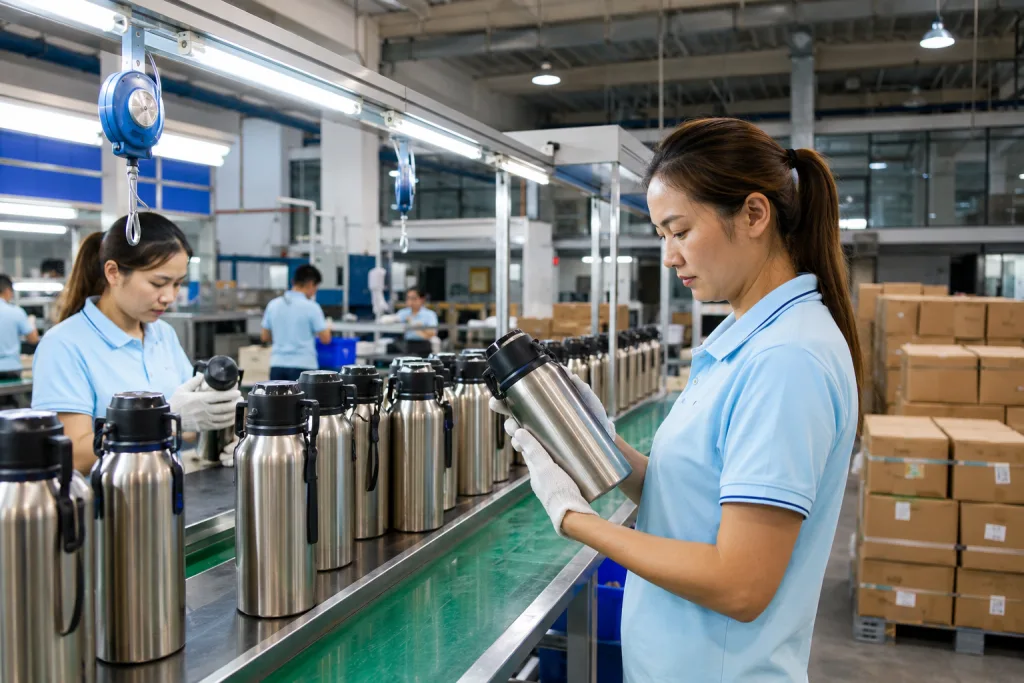
Let’s clear up the keyword first. In B2B sourcing, pc thermos bulk usually means a stainless steel vacuum bottle ordered in volume, not a polycarbonate body. We see this on RFQs every week. Outdoor retailers and promotional brands usually sell bulk thermos programs with 18/8 stainless inner and outer walls, vacuum insulation, and a PP or Tritan lid. If you ask for a true PC body for hot drinks, factories in China often push back. We’ve seen this go sideways at sample stage: heat resistance is weaker, odor hangs in the bottle, and the shelf feel does not match a premium stainless item.
If you need a custom thermos or customizable thermos, write the spec as a stainless thermos unless you clearly want a transparent plastic part. This saves one round of quoting. A practical base spec for a factory thermos order looks like this:
- Capacity: 500ml or 750ml
- Body material: SS304 inside and outside, 0.4mm to 0.5mm wall thickness
- Insulation: vacuum, copper coating optional
- Lid: PP, Tritan, or stainless/PP hybrid
- Finish: powder coat, spray paint, or brushed
- Logo: 1-color silkscreen, laser engraving, or heat transfer
That wording helps a thermos manufacturer or thermos supplier quote with fewer gaps. At our Zhejiang factory, standard stainless thermos capacity is around 600,000 units per month across bottle lines, but the real lead time still depends on the lid and coating line. A 500ml straight body with a common PP screw lid might run in 12 days; a new lid mold or textured powder coat can push it to 18 days. If you send only a reference photo and ask for a thermos bulk price, the quote range will be too wide to plan against. We run into this with buyers who send one JPG and no wall thickness, no finish, no logo size.
You do not control cost by asking for the lowest price first. You control cost by fixing the product definition first.
Where the unit price really moves
The biggest mistake in a thermos custom project is treating logo printing as the main cost driver. It isn't. The money usually sits in steel grade, lid construction, finish yield on the line, and packaging spec. On a 500ml manufacturer thermos with a standard screw lid, FOB China can move from USD 3.20 to USD 6.80 with the same body shape, same base mold, and no change to bottle diameter.
Core cost drivers
- Steel specification: SS201 outer with SS304 inner can save USD 0.18 to 0.35 per unit versus full SS304. We still see outdoor buyers reject that combo after salt-spray review for corrosion risk and brand positioning.
- Wall thickness: 0.35mm body stock is cheaper, but it dents faster in transit. QC pulled samples with panel dents after drop testing on export cartons. 0.5mm feels more solid in hand and cuts claim risk.
- Lid construction: A simple PP screw cap may cost USD 0.35 to 0.55. A leak-proof carry lid with multiple silicone parts can reach USD 0.80 to 1.30. The line slows down too, because each gasket has to sit clean in its groove.
- Surface finish: Brushed steel is straightforward. Powder coating adds roughly USD 0.25 to 0.60 depending on color and reject rate. Matte black is usually stable; metallic colors are where QC starts watching for dust points and color drift. Rubberized finishes cost more and slow output.
- Decoration: Silkscreen is often USD 0.05 to 0.12 per color. Laser engraving is usually USD 0.08 to 0.20. Full-wrap heat transfer can be USD 0.25 to 0.45. On one PO, the buyer flagged a 1.5mm logo offset that looked minor on paper and obvious on the bottle.
- Packaging: Plain white box may be USD 0.18 to 0.35. Full-color retail box with insert can reach USD 0.45 to 0.95. This is the wrong place to get fancy on promo orders; the math doesn't work once carton size starts pushing freight.
For promotional thermos programs, keep the lid simple and the packaging flat. That's where margin disappears. If you are a thermos distributor selling into outdoor retail, spend on coating adhesion and leak-proof tolerance instead of oversized cartons with extra insert layers. We ship plenty of projects out of Zhejiang where the buyer asks for a premium feature, then pulls back after seeing the MOQ, the added assembly time, or an AQL 2.5 inspection note. The better factories in China will tell you straight when a feature adds cost but does not help sell-through. We've seen that go sideways enough times.
MOQ tiers that change your quote
MOQ is not one number. New buyers get tripped up here all the time. One thermos vendor says 500 pieces, another says 3,000, and both quotes are valid because the break point sits on the factory setup: existing mold or new mold, stock paint or Pantone match, simple logo or full retail pack. On our line, even a 1.2 mm color-card deviation can trigger a recheck before mass coating.
For a standard customized thermos body on an existing mold, normal MOQ in China is 500 to 1,000 units per size per color. If the customizable thermos program adds a custom lid, custom pantone coating, barcode labels, and a retail gift box, the practical MOQ usually moves to 2,000 units. If you need a fully new lid mold, the commercial starting point is often 3,000 to 5,000 units, plus tooling. We have seen buyers ask for 800 pieces with a new lid and gift box; the math doesn't work once the CNC mold cost and trial runs hit the quote.
- 500 units: standard shape, standard lid, 1 logo position, neutral carton or plain box
- 1,000 units: better pricing break, more stable color batch after one full powder run, can justify custom box print
- 2,000 to 3,000 units: stronger FOB pricing, easier mixed carton planning, more decoration options like wrap print or laser marking
- 5,000+ units: best position for semi-exclusive colors, dedicated mold work, and annual program pricing
For distributor thermos and distributors thermos programs, ask one thing first: is MOQ counted per SKU, per color, or per shipment? This is the right question. A supplier may offer 1,000 units total but still require 250 units per colorway so the powder coating booth runs cleanly and the purge loss stays under control. At BottleForge Industrial in Hangzhou, Zhejiang, our normal MOQ for an existing stainless thermos is 500 units, while new mold development usually starts around 3,000 units with 18 to 25 days for tooling samples. Last month, QC pulled the sample because a PO had “mat black” typed instead of “matte black,” and the buyer flagged the finish before approval.
Low MOQ has a price. A 500-unit order can cost 12% to 22% more per piece than a 3,000-unit order because setup, coating purge, inspection, and packaging labor are spread over fewer units. We ship plenty of 500-piece orders, so small runs are possible, but buyers should price them with clear eyes. If your sales forecast supports it, buying the right volume first is usually cheaper than coming back 12 days later for a top-up run with another setup charge.
How long each stage actually takes
Lead time on thermos customized projects usually gets hit in approvals, not on the line. We see this every month: the bottle body is ready, but artwork sits 3 days in a brand manager inbox, or a carton size changes after the dieline was signed. QC pulled the sample, production was waiting, and the delay still landed on the factory. That is the wrong question to ask.
A realistic timeline for thermos manufacturers in China looks like this:
- Quotation and feasibility: 1 to 3 days if the spec sheet is complete, with bottle size, material, logo method, and MOQ clear
- Artwork check and pantone confirmation: 1 to 2 days, assuming the AI file opens cleanly and the Pantone code is not mistyped on the PO
- Pre-production sample: 5 to 10 days for existing mold items, including logo setup and one sample pass from the spray line
- New lid or component tooling: 18 to 25 days for first trial samples, then we usually need one fit check on the thread and silicone ring
- Mass production: 25 to 40 days after sample approval and deposit, depending on quantity, print method, and whether the line runs one color or several
- Inspection and booking: 2 to 5 days, including AQL pull, carton drop check, and vessel booking
If you need a thermos promotional order for an event date, count back from ship date, not factory finish date. FOB Ningbo or Shanghai still needs booking, customs papers, and vessel space, and we have seen bookings slip 4 days even after goods were packed on pallets. From August to November, add 5 to 7 buffer days. Factories in Zhejiang with in-house coating and assembly usually hold timing better than shops sending out 2 or 3 process steps, because every handoff adds one more place for the buyer to get stuck on a carton mark or barcode position.
One more point: mixed orders slow down. A single-SKU thermos supplier order may run in 28 days. A four-SKU program with two lid types, three box designs, and Amazon FNSKU labeling can easily run 38 to 45 days. We ship these every season, and the math doesn't work any other way. Last month one buyer flagged a 2 mm carton height change after approval, and that alone cost 2 days because the master carton stacking test had to be redone.
If your target delivery is fixed, lock decoration and packaging first. Shape changes are manageable; late packaging changes are where schedules start to slip.
Testing, compliance, and claim prevention
Buy a cheap supplier thermos once if you want. Claims will wipe out the margin on the second order. Outdoor retailers and promotional brands in Europe and North America should lock compliance before deposit, not after packing. We have seen cartons already sealed, then the buyer asks for REACH paperwork and LFGB confirmation. That goes sideways fast. For stainless thermos, the usual file covers REACH for EU market contact materials, LFGB if your channel asks for it, and relevant CPSIA or California Proposition 65 attention for US programs based on the actual materials and exposure profile.
For product reliability, ask your thermos factory for these baseline checks:
- Leak test: 100% inline or at least final assembly sampling
- Vacuum retention test: sample basis per lot
- Coating adhesion: cross-hatch test
- Salt spray if outdoor use positioning matters
- Carton drop test: especially for e-commerce and Amazon routes
- Incoming material verification for steel and plastics
Inspection standard matters too. AQL 2.5 for major defects and 4.0 for minor defects is a common commercial level for thermos distributors and private label retail. “Good quality” is the wrong spec. QC pulled the sample, the buyer flagged a crooked logo, and then everyone argues. If you write “AQL 2.5/4.0, no functional leakage, logo position tolerance within 2mm,” the line, the factory QC team, and the third-party inspector all check against the same target. We usually add one more line on the PO: vacuum hold result and lid fit must match the approved sample.
From a cost view, third-party inspection in China is cheap insurance. A pre-shipment inspection may cost USD 250 to 350 per man-day in Zhejiang. The math does not work if you skip it and then replace 1,200 leaking units in a promotional rollout. We ship enough Amazon orders to know carton details are not small details. One missing FNSKU sticker or a carton mark typo on a 68 cm master carton can stop receiving and trigger chargebacks fast.
Best buying setups by sales channel
The right custom thermos setup depends on your sales channel. Outdoor retail and promotional orders can look close on a spec sheet, but the margin math is different. We have seen buyers mix the two and then get stuck on cost after the first sample review.
For outdoor retailers
You need a stronger product story and lower return risk. We usually run SS304 inside and outside, 0.5mm body stock if the target price can carry it, powder coat, and a gasket that seals clean after repeated open-close testing on the line. A solid thermos manufacturer should give heat-retention data such as 12 hours hot and 24 hours cold under internal test protocol, not just say “good insulation.” Retail buyers look at shelf impact, but they also flag coating chips, dent marks, and complaint rates. Spend the extra USD 0.30 where the customer can see it and where QC can measure it.
For promotional brands
You need landed cost under control and a factory that ships on the promised date. Use existing molds, standard lid sets, 500ml or 750ml capacities, 1-color silkscreen, and compact packaging that keeps carton weight in check. A promotional thermos for a campaign usually wins because it ships on time, not because it carries five decoration options. For this channel, a 500 to 1,000 unit MOQ with approved standard colors works well. We had one buyer push for custom pantone on 600 pcs, and the math did not work.
If you are building a manufacturers thermos sourcing base or comparing suppliers thermos options, ask each factory the same five questions: monthly capacity, MOQ by SKU, sample days, mass lead time, and inspection standard. This is the right comparison point. Last month a PO even came in with the sample date typed wrong by 10 days, and that alone would have broken the ship window if nobody caught it. The best thermos suppliers in China answer with numbers, not slogans.
Use the same logic when you compare FOB quotes. A USD 3.90 quote with AQL, REACH paperwork, and stable lead time can beat USD 3.55 from a factory with vague tolerances and outsourced assembly. QC pulled the sample on one such project and found lid-thread variance of 0.4mm between batches. That is where orders go sideways. You are not buying a line item; you are buying the odds of a clean shipment.
Get a firm pc thermos bulk quote
Send your capacity, target MOQ, logo method, and delivery date. We will reply with FOB pricing, sample timing, and production lead time from Zhejiang, China.
Frequently asked questions
What is a realistic FOB price for pc thermos bulk orders?
For a standard 500ml stainless vacuum bottle, FOB China usually falls between USD 3.20 and USD 6.80 per unit. At the low end, you are typically looking at an existing mold, basic screw lid, 1-color silkscreen, and plain box at 1,000 to 3,000 units. A better outdoor retail specification with SS304 inside and outside, powder coat, laser logo, and custom printed box often lands around USD 4.60 to USD 5.80. If you add a complex carry lid, metallic finish, or gift packaging, the number climbs fast. For 750ml sizes, add roughly USD 0.35 to USD 0.80. Always ask whether the quote includes logo setup, carton marks, spare gaskets, and export carton upgrades.
Can I order 300 units for a customized thermos project?
You can sometimes buy 300 units, but it usually means you are paying a penalty on unit cost or using leftover factory capacity. Most stainless thermos factories in Zhejiang or other parts of China quote 500 units as the practical MOQ for existing models and 1,000 units as the cleaner commercial level. At 300 units, coating loss, setup labor, and packaging print minimums are spread over too few pieces, so your unit price may be 15% to 30% higher than a 1,000-unit order. If you need a low-volume launch, keep the bottle shape, lid, and carton standard, then customize only the logo. That is the most realistic way to control cost without compromising delivery.
How long does a custom thermos order take from approval to shipment?
If you use an existing mold, a normal schedule is 5 to 10 days for the pre-production sample and 25 to 40 days for mass production after sample approval and deposit. Inspection and export booking usually add another 2 to 5 days. So a practical total is 32 to 55 days from confirmed artwork to FOB shipment. If your project needs a new lid mold, add about 18 to 25 days for tooling and trial samples. During peak season in China, especially from late summer into Q4, add a 5 to 7 day buffer. Mixed-SKU orders, custom gift boxes, and Amazon labeling also stretch lead time because assembly and carton control become more complex.
What tests should I require for a thermos bulk order going to Europe or the US?
At minimum, ask for material compliance aligned with your market, plus performance and packaging checks. For Europe, REACH is the common baseline, and some buyers also request LFGB depending on channel requirements. For the US, you may need attention to CPSIA or Proposition 65 depending on materials and sales channel. On the product side, require leak testing, vacuum retention checks, coating adhesion testing, and carton drop tests. For higher-risk retail or e-commerce orders, specify AQL 2.5 for major defects and AQL 4.0 for minor defects. A third-party pre-shipment inspection in China usually costs about USD 250 to 350 per man-day, which is small compared with the cost of returned or rejected stock.
Should I source from a trading company or a thermos factory directly?
Direct factory sourcing works well when you have clear specifications, forecasted volume, and someone on your side who can manage approvals. A thermos factory usually gives you better control on MOQ, lead time, and technical detail, especially for stainless wall thickness, insulation process, and coating quality. A trading company can still be useful if your order is small, mixed across categories, or you need one party to manage several factories in China. The important point is transparency. Ask who owns production, where the goods are made, and whether the supplier can support audit and inspection access. For a repeat stainless thermos program above 1,000 units per SKU, direct factory communication is usually the cleaner setup.