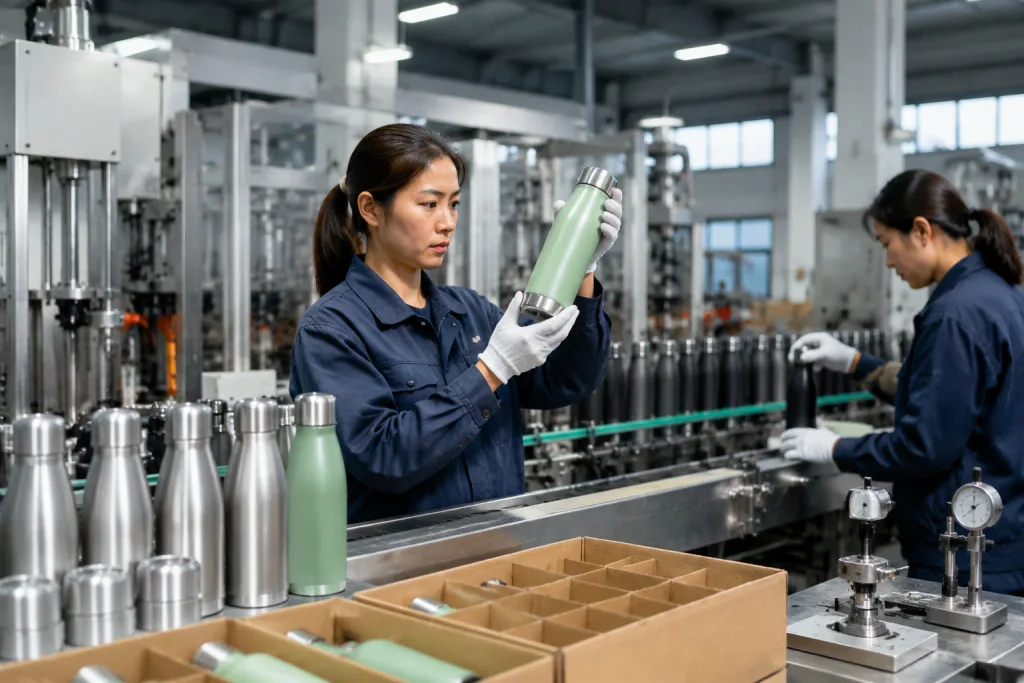
Key Takeaways
- Set vacuum retention, leak, coating, and drop-test limits in writing before mass production; AQL 2.5/4.0 is common for finished drinkware lots above 3,000 pcs.
- A realistic MOQ for stainless custom thermos orders is often 1,000 pcs per color, with sample lead time 7-12 days and bulk lead time 25-40 days from artwork approval.
- 304 stainless inside with 201 or 304 outside changes price by about USD 0.18-0.45 per unit on common 500 ml models, but corrosion risk and brand claims also change.
- Do not approve only by looks; ask for heat retention data at 6 and 12 hours, 100% leak test, coating adhesion, carton drop test, and REACH/LFGB or FDA supporting files.
You usually do not lose money on a stainless thermos because the concept was bad. You lose it after the sample passes, then mass production shows the weak points: coating chips after drop test, vacuum loss at the weld, lid leaks at 0.03 MPa, logos fading before 200 dishwasher cycles, cartons crushing under stack load, or a compliance file missing one page when customs asks for it. We have seen a PO held over one missing signature. That is where most pc thermos bottle custom projects fail.
Buying from Zhejiang, China is not just buying a shape or a color. You are buying a process window on the line: tube thickness tolerance, vacuum hold time, spray curing temperature, and carton compression strength. For outdoor retailers and promotional brands, the job is simple and hard at the same time: lock down each failure mode before PO release. A capable thermos manufacturer in China can run 300,000 units/month, and we run lines at that level, but this is the wrong question to ask. Speed does not fix a weak specification. A tighter spec does.
Where stainless thermos projects actually fail
Buyers new to thermos custom work usually start with the easy calls first: color chip, logo position, capacity, gift box. Fair enough. That is not where projects fail. The costly issues show up later, after your bulk thermos order lands in a warehouse in Europe or North America and QC pulled the sample from 1 carton out of 12.
Most defects on a custom thermos are not dramatic. They stack up. A 0.3 mm dent rate that looked acceptable at pre-shipment turns into a returns problem once an outdoor retail account wants shelf-perfect product under store lighting. Lid torque that swings too much creates leak complaints from end users; on our line, we usually see pushback once opening force moves past 1.8 N·m. A matte powder coat starts rubbing at the shoulder because the bottle profile leaves too much contact in transit, and the buyer flagged it after a drop test with inner trays that were 2 mm too loose. A promotional buyer may live with more cosmetic variation than a specialty retailer. Neither wants callbacks.
From a factory thermos perspective in Zhejiang, China, the main failure modes usually sit in six buckets. We have seen all six go sideways.
- Material mismatch: 201 used where 304 was expected, or the wrong PP/silicone grade approved off a sample board. This sounds basic, but we still see PO typos and old BOM versions slip into production.
- Vacuum inconsistency: some bottles lose insulation performance because welding or vacuuming parameters drift on the line. If the vacuum hold data is weak, 12-hour heat retention in sample review becomes a complaint batch later.
- Lid leakage: gasket hardness, thread tolerance, and cap structure are out of sync. QC pulled the sample, squeezed it at angle, and found seepage on units that passed static testing.
- Surface defects: paint adhesion, color variance, scratches, logo wear. We run cross-hatch adhesion checks, and this is where soft-touch coatings often get buyer pushback.
- Packaging failure: insert design and carton strength do not match the shipping route. A 5-ply carton may pass for local delivery and fail on a long ocean-plus-truck move; the math doesn't work if the packed weight is already 18 kg.
- Paperwork gaps: test reports, declarations, barcode labeling, country-of-origin details are incomplete. One missing label line can hold a shipment longer than a minor cosmetic issue.
Treat your customized thermos project as a technical spec, not a graphic exercise. This is the right question to ask early. An experienced thermos supplier should guide material grade, torque range, packaging drop standard, and inspection points before mass production starts.
Material shortcuts cost more later
The first place projects fail is material selection. Buyers push for a lower FOB and say all stainless looks the same after powder coat. It doesn’t. On a mainstream manufacturer thermos program, we run 18/8 stainless, also called SUS304, on the inner wall, with either 304 or 201 outside. On entry-level thermos bulk orders, some factories quote 201 outer shell to cut cost. On a 500 ml bottle, that usually trims roughly USD 0.18 to 0.45 per unit, depending on steel price swings and whether the shell is 0.40 mm or 0.50 mm.
The saving is real. The trade-off is real too. If you sell the bottle as premium outdoor gear, 304 inside and outside is easier to defend on the product page and in corrosion testing after a 48-hour salt spray check. If the item is a short-cycle promotional thermos campaign, 304 inner plus 201 outer can work. What matters is simple: your PO must state the grade clearly. We have seen this go sideways when a buyer wrote only “SS body” and the line built to the cheaper outside steel.
What to specify
- Inner wall: SUS304, thickness 0.35-0.45 mm on common vacuum bottles.
- Outer wall: SUS201 or SUS304, thickness 0.40-0.50 mm.
- Lid contact parts: food-grade PP, Tritan, or stainless; silicone gasket with hardness range stated.
- No BPA claim only if supporting raw material declaration exists.
- Compliance set by market: FDA or LFGB, plus REACH where relevant.
For pc thermos bottle custom, another mistake shows up all the time. Buyers write “PC” meaning the project type or bottle family, while the factory sales rep may read it as polycarbonate. This is the wrong question to leave open. If you want a stainless vacuum bottle with a plastic lid part, write that exactly. Do not let a thermos vendor guess. QC pulled a sample last year where the PO said “PC lid,” the buyer meant product category, and the supplier used a polycarbonate visual part that was never approved.
Good purchasing language is boring on purpose: material grade, thickness, finish, and contact-part resin should all appear on the approved spec sheet.
If your suppliers thermos quotation does not separate body material, lid material, and surface finish, the price is too vague to compare. We ship against spec sheets every day, and one missing line like “outer wall SUS304” can erase the whole gap between two quotes.
Vacuum loss is the silent return driver
Insulation failure drives returns because customers do not see it until day 3 or day 30. The bottle may look clean, paint passes tape test, logo position is fine, and it is still a bad customizable thermos. On the line, vacuum performance comes down to weld quality at the bottom bead, copper plating or reflective treatment where used, evacuation time, and how stable the post-vacuum sealing step is. QC pulled the sample once on a glossy black bottle that looked perfect, then the retention result missed by 6°C. That is the defect buyers hate.
Do not accept generic wording like “keeps hot 12 hours.” This is the wrong question to ask. Ask your thermos factory for the exact test method, fill volume, room temperature, and pass line. A practical standard for a 500 ml double-wall stainless bottle is filling with 95 degree C water and checking retained temperature after 6 hours and 12 hours in a controlled environment. We have seen factories test at 20°C and others at 25°C; that 5°C gap changes the result enough to start arguments later. Put the condition in writing. For cold retention, ask for an ice-water or chilled-water method, with the start temperature recorded on the report.
For retail and distributor thermos programs, set the minimum pass threshold on the approved sample, then confirm it on production samples from the actual line, not a hand-built engineering sample from the lab bench. We have seen this go sideways. The engineering sample passes, mass production drops, and the buyer flagged it only after first shipment. Also require a 100% vacuum check during production. Most solid thermos manufacturers in China run a fast screening method on every bottle, then do a deeper retention test by batch with samples pulled from packed stock, not loose workshop pieces.
- 100% leak and vacuum screening during assembly, often with a negative-pressure tester before packing.
- Retention test by lot: at least 5-10 pcs per 3,000 pcs.
- Record bottle ID, line, date, and operator for traceability; one wrong shift record can waste 2 hours in root-cause checks.
- Reject criteria defined before production, not after; do not renegotiate the pass line once the goods are made.
If your order is headed to Amazon or another direct-to-consumer channel, even a 1% insulation failure rate hurts. On a 10,000-piece thermos customized run, that is 100 bad reviews waiting to happen and 100 replacement emails your team has to answer. The math does not work. A serious supplier thermos partner will show process controls, batch records, and actual test sheets—not just a sales slide with one nice sentence.
Lids leak for predictable reasons
Leak complaints are usually predictable. We see the same four causes on the line: thread mismatch, weak gasket compression, unstable lid molding, or a lid design that confuses the user. QC pulled a sample last month where the silicone ring was 0.6 mm under spec, and the bottle failed after two side-lay checks. This applies to a premium outdoor thermos customizable range and a low-cost thermos promotional event order.
A common buyer mistake is approving a lid after one desk test. That test means little. You need repeat results across a run, not one bottle from the top of the carton. Ask your thermos supplier for the closure torque range and gasket spec in writing. If the cap is too loose, it leaks. If it is too tight, users cross-thread it or complain the opening force is too high. On standard screw-cap stainless bottles, a controlled torque window might be around 8-14 kgf.cm, but it depends on cap diameter and thread design. We usually check torque with a cap torque tester, and the buyer flagged one batch before because the PO said matte black lid while the approved sample used a different thread start.
Leak tests worth specifying
- 100% inverted leak test after filling and capping.
- Random side-lay test for 30 minutes.
- Hot water leak test to account for seal expansion.
- Thread engagement check using approved gauge or master sample.
Flip lids and push-button lids need tighter control than plain screw caps. More parts, more risk. Springs, lock parts, pins, and spouts all add failure points, and we have seen this go sideways after drop tests from 80 cm. If your market is rugged outdoor retail, simpler lids usually hold up better. Fancy lids bring more warranty claims; the math doesn't work on a low-margin program. If your customer is a promotional brand chasing low unit cost and clean logo area, a standard screw lid is usually the safer choice for thermos distributor and thermos distributors channels.
Discuss replacement gasket supply at quotation stage, not after the first complaint. A spare-parts plan for 2,000 or 3,000 pieces is cheap insurance, and one small PE bag with 2 extra rings per 24 bottles can protect a large account. Good manufacturers thermos support includes this detail. Buyers often skip it, then come back six months later asking for 500 loose gaskets by air.
Decoration fails before steel does
The stainless body usually is not what fails first. The finish does. Buyers often call it a steel issue, but on the line we usually find coating adhesion, print wear, or artwork placement drift. For customized thermos orders, the decoration process has to match actual use, not a nice-looking mockup. Silk screen, heat transfer, laser engraving, digital print, and powder coating do not wear the same way, and they do not run on the same fixtures.
For outdoor retail, powder coating plus laser marking is the safer route. We ship that combo again and again because it handles carton friction and store handling better than glossy spray paint with surface print. On a 500 ml bottle, the buyer flagged edge wear after a 24-hour carton shake test on glossy stock, while the powder-coated sample stayed clean except at the thread start. For event-driven distributors thermos business, silk screen on a painted body can still work if the target price is tight. Just set the right abrasion standard. This is the wrong question to ask: “What is the cheapest logo method?” Ask how the logo should look after 3 months of use.
Ask your thermos manufacturers for these controls:
- Color tolerance against approved Pantone target.
- Cross-hatch adhesion test for coating.
- Alcohol rub or abrasion test for printed logo.
- Dishwasher disclaimer if product is hand-wash only.
- Visual standard defining acceptable dents, pinholes, and hanging marks.
On a typical 500 ml bottle from a Zhejiang plant, powder coating can add around USD 0.25 to 0.60 over basic spray paint, depending on finish and color coverage. Laser engraving may add USD 0.05 to 0.12 per position, while screen printing changes with color count. The math does not work if you save USD 0.18 on decoration and then lose the account over peeling logos on a branded custom thermos line. We have seen QC pull samples with 2 mm edge chipping around the logo window after tape test, and that small defect turns into a full claim fast.
Pay attention to bottle geometry too. Narrow waists and heavy shoulder curves look sharp in renderings, then start causing scuffs at the guide rail and tighter packing clearance in production. A shoulder step of just 3 to 5 mm can change how bottles touch in the carton. We have seen this go sideways. One PO even had the finish note typed as “soft touch” while the approved sample was standard matte powder, and the shape already had enough risk without adding a scratch-prone coating. A practical thermos manufacturer should push back when design style and process stability are working against each other.
Packaging and transit damage start at design
You can make a solid bottle and still get a bad shipment. We see transit damage start with packaging specs that are too loose, especially on split orders: retail, distributor stock, and e-commerce fulfillment in the same PO. A good thermos supplier should ask the shipping route first, not last. Ocean pallet loads, parcel delivery, and Amazon FBA prep need different carton plans. We run all three, and the line packs them differently from the insert stage.
For export from China to Europe or North America, the basics are simple. The bottle must not move inside the box, the export carton has to match the load, barcodes have to scan, and sealed masters should pass drop test after final packing. If your order uses a gift box, watch the outer carton closely. Retail boxes crush fast. Last month QC pulled the sample and found 8 mm headspace inside the gift box, enough for the bottle to dent the lid ring during a corner drop.
- Use 5-ply export cartons as a minimum for most bottle programs; upgrade if gross weight is high.
- Set carton gross weight around 12-15 kg where possible for safer handling.
- Require drop testing on sealed master cartons after final packing.
- For Amazon or 3PL channels, specify FNSKU, suffocation warning, and carton mark format before printing.
A lot of thermos suppliers quote a clean FOB price, then cut the insert or downgrade carton board to hold margin. That is where claims start. Approve the full packaging spec: dimensions in mm, board grade, print file, packing qty per carton, and insert material. We have seen buyers approve the bottle sample but skip the carton die-line, then the buyer flagged scuffed corners after arrival. If a factory in Zhejiang says the lead time is 30 days, ask one direct question: does that include packaging material lead time, or do they order boxes after bottle approval? We have seen this go sideways. That answer often means 7 days, sometimes 10.
Typical MOQ for custom packaging on stainless bottles is 1,000 pcs, though some factory thermos programs can start lower with plain white boxes. If you want the color box, bottle, and insert all custom, plan 25-40 days bulk lead time from final approval, not from the first inquiry. This is the wrong question to ask: “Can you do it fast?” Ask instead which item is on the long pole. On our side, it is often the color box proof or a revised PO with one barcode digit wrong.
QC paperwork is part of the product
The last thing that breaks a shipment is often the paperwork. Buyers park documents as admin and chase them later. That is the wrong question to ask. In a compliant pc thermos bottle custom program, the file set sits inside the product package. If one page is missing or the PO shows the old lid code, goods get held, relabeled, or rejected by retail even if the bottle body passed leak test at 0.03 MPa.
For stainless drinkware, the document list changes by market and sales channel. The normal pack usually covers material declarations, migration or contact-safety reports, REACH statements, LFGB or FDA-related testing where requested, and social or factory audit references such as BSCI or ISO 9001. For kids' items, add ASTM-related review where applicable. For chain retail, vendor manuals are often tougher than local law; we have seen buyers flag a missing inner bag warning line even after lab reports were clean.
QC execution should also be defined. We run it like this:
- Incoming material check on steel, plastic resin, paint, and gaskets.
- In-process checks on welding, vacuuming, polishing, coating, and assembly.
- Final inspection by AQL, commonly 2.5 for major and 4.0 for minor defects.
- Pre-shipment report with photos, quantity summary, and test records.
If you use a third-party inspection firm, tell the thermos factory before mass production. If you wait until cartons are taped, the math doesn't work. You pay re-opening cost, the line loses time, and arguments start over who owns the defect. Good thermos vendor management means your golden sample, carton marks, barcode file, and inspection checklist match before production starts; QC pulled the sample from line 2 last month because the master carton print showed 24 pcs while the PO said 20.
The right supplier in China will not promise zero defects. That claim is not serious. You want controlled risk: clear tolerances, traceable records, and a team that tells you where the design can fail before you place a 5,000-piece or 20,000-piece order. We have seen this go sideways on simple parts, like a silicone gasket that came in 0.4 mm thinner and cut heat retention by hours.
Send your thermos spec before you place the PO
We will review material grade, lid structure, decoration, MOQ, and QC checkpoints for your stainless thermos project from Zhejiang, China.
Frequently asked questions
What MOQ should I expect for pc thermos bottle custom stainless orders?
For a standard 500 ml stainless vacuum bottle, a realistic MOQ is 1,000 pcs per model per color if you want custom body color and logo. If you also need a custom color box, the practical MOQ usually stays at 1,000 pcs because packaging suppliers in China set their own minimums. Some thermos factory programs can do 500 pcs with existing stock colors and one-color logo, but unit price rises and finish options narrow. For a fully customized thermos with new mold parts, MOQ can move to 3,000-5,000 pcs. Ask your supplier thermos partner to split MOQ by bottle, lid, and packaging so you can see where the real limit sits.
How much does a custom stainless thermos usually cost FOB China?
For a common double-wall 500 ml stainless bottle, FOB China pricing often starts around USD 2.60-3.80 for a basic screw-lid model at 3,000 pcs, depending on steel grade, finish, and packaging. A better outdoor-spec bottle with 304 inside and outside, powder coating, and laser logo may land around USD 3.50-5.20. Flip lids, gift boxes, rubber paint, and complex print push the price higher. If a thermos manufacturer gives you a quote without body material, wall thickness, logo process, and packing details, do not compare it directly. Two bottles that look similar in photos can differ by USD 0.80 or more once real specs are locked.
What lead time is normal for a customized thermos order from Zhejiang, China?
For existing bottle molds, sample lead time is usually 7-12 days after artwork and color confirmation. Bulk production is commonly 25-40 days after sample approval and deposit, assuming custom packaging is included. During peak season, especially before Q4 promotional demand, 35-45 days is safer. If your order needs a new lid mold or unusual finish, add 15-25 days for tool making and validation. A factory in Zhejiang with 300,000 units/month capacity can still miss delivery if packaging files arrive late, so ask whether bottle production and carton printing run in parallel. That one detail often decides whether your shipment leaves on time.
Which tests matter most before I approve thermos bulk production?
The core tests are insulation retention, 100% leak testing, coating adhesion, logo abrasion, and packaged carton drop tests. For insulation, ask for a defined method such as 95 degree C fill water with checks at 6 and 12 hours. For leakage, require inverted and side-lay tests, not just a quick cap closure check. For coating, use cross-hatch adhesion and rub resistance. For compliance, ask for food-contact supporting files such as FDA or LFGB-related reports, plus REACH statements where relevant. At final inspection, AQL 2.5 major and 4.0 minor is common for finished drinkware. A reliable thermos supplier should show batch records, not just verbal assurances.
Is 201 outside and 304 inside acceptable for promotional thermos orders?
Yes, it can be acceptable if the use case, price point, and claim language are aligned. Many promotional thermos and distributor thermos programs use SUS304 for the inner wall and SUS201 for the outer wall to reduce FOB cost by roughly USD 0.18-0.45 per unit on standard sizes. That structure is common and functional when the bottle is not marketed as a premium technical outdoor product. The problem starts when the PO simply says stainless steel and the buyer assumes full 304. If you choose 201 outside, write it clearly on the spec sheet, confirm finish durability, and avoid broad marketing claims that suggest a higher-grade stainless construction than you are actually buying.