Key Takeaways
- For stainless pc thermos bottle bulk projects, MOQ usually starts at 1,000 pcs per SKU and 3,000 pcs for a new mold or custom color split
- A realistic sample cycle is 7-10 days for logo samples and 20-30 days for mass production after deposit and sample approval
- FOB China pricing for a 500ml double-wall 304 stainless custom thermos often lands around USD 2.80-4.60 depending on cap, coating, and print
- Define AQL 2.5, leak test standard, carton spec, and spare parts on the PO before bulk starts, or you will pay later
You search for pc thermos bottle bulk, but most export orders with volume are no longer placed in PC plastic. European and North American buyers usually switch to stainless because compliance is cleaner, the bottle holds up better in a 1.2 m drop test, and return claims drop. If you run an outdoor retail line or a promo program, the key job is not chasing the lowest unit price. It is fixing the full bottle spec before a PO typo or missing cap detail turns into a rework bill.
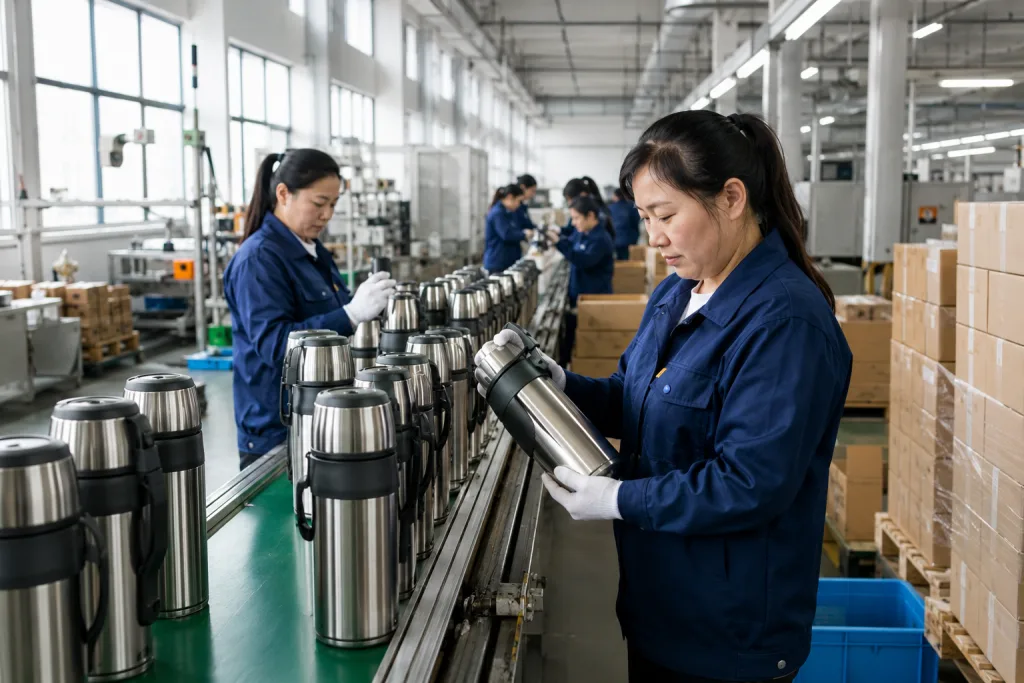
At BottleForge Industrial in Hangzhou, Zhejiang, China, we see this every month. A buyer asks for a customizable thermos, gets 3 prices that don't line up, then finds out the cap, coating, logo method, and carton drop standard were never defined. QC pulled the sample, and the mismatch was obvious at once: powder coat on one quote, spray paint on another. Our factory thermos program runs 600,000 units per month, with MOQ from 1,000 pcs, but the easy orders are the ones locked down early. This is the wrong question to ask: "What's your cheapest bottle?" The better question is, "What exact spec are we shipping?"
Start with the right RFQ
If you send five thermos factories a one-line RFQ that only says pc thermos bottle bulk, you will get five different offers back. We see this every month. One sales rep quotes plastic, another quotes stainless, and one factory prices a 500ml promo bottle while another builds a 750ml outdoor flask. That is not bad faith. The input is incomplete. A usable RFQ should read like the first PO draft, with enough detail that the line and the costing sheet point to the same bottle.
Your RFQ should list at least these PO line items:
- Body material: 18/8 stainless steel inner, 18/8 or 18/0 outer
- Capacity: 350ml, 500ml, 750ml, or 1L actual brimful and usable fill volume
- Vacuum structure: double-wall copper-coated or standard vacuum
- Wall thickness: common range 0.4mm inner / 0.5mm outer
- Cap type: screw lid, flip lid, carry loop, tea filter, or cup lid
- Surface: powder coat, spray paint, base stainless, electroplating, or soft-touch
- Logo method: silk screen, laser engraving, heat transfer, UV print
- Packing: polybag, white box, color box, PDQ tray, master carton count
- Compliance: REACH, LFGB, FDA contact safety, Prop 65 if needed
- Incoterm: FOB Ningbo, FOB Shanghai, or EXW Zhejiang, China
For outdoor retail, add the performance target. hot 12 hours, cold 24 hours is a normal sales claim, but this is the wrong question to ask unless the test method is also fixed. Ask for fill temperature, ambient temperature, and the temperature drop point. We have seen one buyer compare 95°C fill water against another factory's 88°C test and treat both results as equal. They are not. On our side, QC pulled the sample and checks the vacuum lot with a digital thermometer before final packing.
If your team still uses the term PC because an older bottle line used polycarbonate, say it plainly. The buyer flagged this exact point on one PO last season: the header said PC, the artwork said stainless, and the cap drawing showed a plastic sports bottle. A good manufacturer thermos partner in China should push back and confirm whether you now want stainless. That one question saves 12 days of back-and-forth instead of 18 days of wrong samples and revised quotations.
You do not need a long RFQ. You need an RFQ that removes assumptions.
Compare quotes without fooling yourself
Once quotes come in, do not line up unit price only. Check the quoted construction. A custom thermos at USD 2.95 and one at USD 3.85 often looks the same on paper, but one uses a 2.5mm lid gasket, a thicker powder coat, or a 5-layer export carton instead of 3-layer. That is where claims start. We have seen buyers save USD 0.18 per piece, then lose it fast when QC pulled the sample and found carton crush on the drop test.
What to normalize across suppliers thermos quotes
- Same capacity tolerance, usually plus or minus 3%
- Same steel grade, preferably SUS304 inner for drinking contact
- Same lid material, such as PP new material with silicone seal
- Same coating spec and pantone matching tolerance
- Same packing count, for example 24 pcs per carton
- Same test scope: leak, vacuum retention, drop, dishwasher if claimed
For a standard 500ml stainless bottle, FOB Zhejiang or Ningbo price ranges are usually:
- Basic uncoated screw-cap thermos bulk: USD 2.80-3.20
- Powder-coated custom thermos with one-color print: USD 3.20-3.90
- Premium customizable thermos with carry lid and gift box: USD 4.00-5.60
Watch the tooling and setup lines. This is where quotes get dressed up. We regularly see 4 missing items: screen charge, engraving fixture, barcode label, and FNSKU application. One buyer sent a PO with “FNSK” typed instead of FNSKU, and the line stopped for half a day while both sides confirmed the label request. Ask for these charges at RFQ stage if you ship to retail or Amazon prep. Outdoor brands should also ask if the cap mold already exists or needs to be cut new. A custom lid mold can cost USD 3,000-12,000 depending on structure, and it adds 25-40 days. If the supplier avoids that question, the math does not work.
In Zhejiang, China, experienced thermos factory teams usually answer RFQs with a specification sheet and section drawing. Ours normally shows wall structure, mouth diameter in mm, carton count, and test items on one page. If your supplier thermos quote is one line with no details, you are not comparing serious offers. You are comparing guesses.
Lock the sample before the PO
Sample approval is where customized thermos orders either stay under control or start burning money. We’ve seen buyers ask for 6 sample rounds, then still miss a 2mm logo shift. The right setup is simpler: one engineering sample and one pre-production sample, both checked against clear points.
Typical timeline for a manufacturer thermos sample flow:
- Existing shape, no new mold: 3-5 days for stock sample
- Logo sample with print or laser: 7-10 days
- New color development: 7-12 days
- New lid or structural modification: 15-25 days
Your sample approval checklist should sit on the PO or, at minimum, in the purchase email record. This part gets skipped too often, and the math doesn’t work once bulk starts on the line. Include:
- Final Pantone number and finish texture
- Logo size in mm and placement tolerance, usually plus or minus 2mm
- Weight tolerance, often plus or minus 5%
- Leak test: upside-down 30 minutes, no visible leakage
- Vacuum test: declare target result and test method
- Packaging artwork approval and barcode placement
If you source a distributor thermos line for multiple clients, build one master approval form and run it on every order. That cuts repeat mistakes fast. Last quarter, QC pulled the sample on one mixed order because the carton mark matched the old PO typo, not the approved artwork. A customizable thermos project with three logo positions and two lid options still ships clean if the approved sample has photo records, key dimensions, and signed carton marks.
For outdoor retailers, ask for abuse checks beyond a showroom sample. We run cap-thread cycling at 3,000-5,000 open-close cycles on practical projects, and buyers often flag loop strength after the first drop test. If there is a carry loop, ask for handle pull force in kg. For promotional brands, ask for adhesion on printed logos and powder coat cross-hatch results. Pretty samples are easy. Durable bulk thermos is the hard part.
Write the purchase order like engineering
A clean PO protects you once bulk starts. Most disputes we see between thermos suppliers and overseas buyers come from missing line items, not bad intent. Write the PO so a new production planner can run it on the line without asking 12 follow-up questions. We have seen one typo on a PO change a lid from screw cap to flip lid, and that mistake cost 18 days.
Minimum PO fields we recommend for custom thermos orders:
- Item code and photo reference
- Capacity and dimensions
- Material spec: body, lid, seal ring, filter if any
- Color by Pantone or approved sample code
- Decoration method and artwork revision number
- Packaging method and carton dimensions limit
- Order quantity by color or artwork split
- Unit price and trade term
- Lead time: for example 30 days after deposit and artwork approval
- Inspection level: AQL 2.5 major / 4.0 minor or your standard
- Required reports: REACH, LFGB, FDA, BSCI, ISO 9001 if requested
- Penalty or remedy terms for critical defects and missed date
If the order is for promotional use, put the event date and latest ship date on the PO. Don’t leave it in email. We ship plenty of event orders where a 7-day slip kills the value of the goods. If the order is for retail shelves, add shipping mark format, carton gross weight limit, and pallet rules with numbers. In North America, many importers want master cartons below 15kg to cut warehouse handling claims. For FBA, add FNSKU label location in mm from the carton edge and suffocation warning requirements if polybags are used. QC pulled a sample last month with the right label content but wrong placement, and the buyer flagged it.
Our factory thermos orders from Zhejiang typically run with 30% deposit and 70% balance against inspection and copy documents for repeat customers. New buyers often ask for third-party inspection before balance payment. That is reasonable. This is not the wrong place to be strict. We run that process every week, and decent thermos vendors should accept a defined release point instead of arguing after bulk is packed.
The PO should answer three factory questions before production starts: what exactly to make, how to check it, and how to pack it.
Control production before cartons close
Mass production is where a 0.5 mm spec miss turns into a container claim. You do not need to stand in a factory in China every day. You do need checkpoints. We usually run three: one pre-production confirmation, one in-line review for decoration and coating, and one final inspection against agreed AQL before the cartons are taped shut.
Common control points for stainless custom thermos production:
- Raw material confirmation: steel grade certificates and incoming lid resin
- Semi-finished body check: neck thread fit, weld appearance, weight
- Vacuum performance sample test from the line
- Powder coat color and adhesion check
- Logo position and print rub test
- 100% leak testing before packing
- Carton drop test, commonly 1 corner, 3 edges, 6 faces depending on spec
For an order of 10,000 pcs thermos custom bottles, a practical final inspection level might be ISO 2859 based AQL 2.5 for major defects and 4.0 for minor defects. Define critical defects as zero acceptance: leakage, sharp edge on drinking area, missing logo if branded, wrong barcode, or mold contamination inside the bottle. QC pulled the sample from packing last month and found 2 cartons with a barcode typo from the PO revision. This is the wrong question to ask: “Is inspection arranged?” The better question is which defects stop shipment on the spot.
Lead time for a standard distributors thermos project is usually 25-35 days after sample approval and deposit. In peak season from August to November in Zhejiang, add 5-10 days unless capacity is reserved. We have seen coating lines back up 6 days just waiting for one custom Pantone batch. If a supplier promises 15 days for a new color, custom box, and 20,000 pcs, ask how. Sometimes the answer is honest overtime. Sometimes the math does not work.
Ask for production photos from the actual line, not only showroom shots. We ship these records with date codes because warehouse claims show up late. A reliable thermos manufacturer should be able to show neck forming, vacuuming, coating, logo printing, and packed cartons with date code. If the buyer flagged dented rims or loose lids later, those line photos and packing shots help trace whether the issue started before loading or after the container left.
Plan freight, claims, and repeat orders
The last stage is not glamorous, but this is where margin lives or dies. We’ve seen buyers push for USD 0.03 off the bottle, then lose more on one bad carton drop test, 200 missing spare lids, or claim terms nobody wrote down. Treat freight and after-sales as part of sourcing from day one, not office cleanup after the PO is placed.
Before shipment, confirm these line items:
- Final carton size and CBM
- Gross weight per carton
- Pallet or floor-load requirement
- Barcode scan pass rate
- Spare parts ratio, such as 0.5%-1% extra lids or seals
- Shipping marks and destination labels
- Document list: invoice, packing list, BL, test reports, origin if needed
For a 40HQ, changing from a wide 750ml bottle to a slimmer 650ml bottle can materially improve loading efficiency. We run this check at carton level, not by guesswork. A bottle body that drops 8-10 mm in diameter often gives a better loading count, and the freight math beats a USD 0.05 unit saving fast when ocean rates move up. Ask your thermos supplier for estimated loading quantity before final confirmation. Serious manufacturers thermos teams can provide carton-level load plans, and the line should confirm whether the packout is floor-load or palletized before booking.
Claims should be predefined. This is not legal wording for later; it is working procedure for the shipment in front of you. A fair export standard is photo evidence plus sample return for analysis, with a response window such as 5 working days. QC pulled the sample, cuts the failed part, and checks whether the problem came from welding, powder coating, or a bad lid fit. If the issue is confirmed as manufacturing-related, remedy can be credit on the next PO, replacement parts, or a negotiated refund percentage. We’ve seen this go sideways when the buyer flagged “leakage” but the real issue was a PO typo and the wrong stopper went into 1,200 pcs. This is especially important for thermos distributor programs where one failed shipment affects multiple downstream accounts.
If a project is successful, convert it into a repeatable code. Keep one approved BOM, one packaging spec, one inspection checklist, and one booking profile. Add the real factory details: carton size, gross weight, drop test standard, lid torque range, and even the ship mark layout file. Simple records save orders. That is how your first custom thermos order becomes a stable bulk thermos program instead of a fresh negotiation every season.
Send your thermos RFQ and get a real quote
Share capacity, lid, finish, logo, and target quantity. We will reply with a workable stainless spec, MOQ, FOB price, and lead time.
Frequently asked questions
What does pc thermos bottle bulk usually mean in real sourcing terms?
Most buyers use pc thermos bottle bulk as a search term, but for Europe and North America the actual purchase often shifts to stainless vacuum bottles. PC usually refers to polycarbonate, which is less common now for premium insulated drinkware. In practical sourcing terms, you should state the exact material: SUS304 inner, SUS304 or SUS201 outer, PP lid, silicone gasket. For bulk, MOQ is commonly 1,000 pcs per size and color, though some China factories in Zhejiang can mix 2 colors within 3,000 pcs total. If you really need plastic components, specify whether they contact drinking water and what compliance reports you require.
How much should I budget for a custom stainless thermos order?
For a typical 500ml double-wall stainless custom thermos, FOB China pricing is often USD 2.80-4.60 depending on steel grade, lid complexity, powder coating, logo method, and packing. A plain white box keeps cost down. A custom color box, insert, and barcode labeling can add USD 0.25-0.80 per unit. New tooling is separate: simple cap modifications may be a few hundred dollars, while a full new lid mold can run USD 3,000-12,000. Sample fees are usually refundable against bulk at agreed quantities. For a first order, also budget third-party inspection at roughly USD 250-400 per man-day.
What tests should I require before approving bulk thermos production?
At minimum, require 100% leak testing, vacuum retention checks, logo adhesion or rub testing, and carton drop verification. For compliance, ask for the reports that fit your market: REACH and LFGB for many EU programs, FDA-contact style testing for the US, and Prop 65 screening where needed. A practical factory checklist includes upside-down leak test for 30 minutes, hot retention verification against the agreed claim, coating adhesion by cross-hatch, and visual inspection to AQL 2.5 major / 4.0 minor. If the thermos has a handle or loop, add pull-force testing. If it will be used outdoors, ask for scratch and abrasion checks on the coating.
How long does a custom thermos project usually take from RFQ to shipment?
If you use an existing bottle shape and lid, a straightforward schedule is 2-3 days for quotation, 7-10 days for a logo sample, and 25-35 days for mass production after deposit and final approval. So a clean repeat-style project can ship in about 40-50 days. If you need a new cap mold, custom base, or multiple box rounds, add 20-40 days. Peak season in China, especially from late summer into Q4, can add another 5-10 days unless capacity is reserved. If your event date is fixed, put the latest ex-factory date directly on the PO and confirm it before deposit.
Can I mix colors, logos, or lid styles in one bulk order?
Yes, but every split affects MOQ, setup time, and defect risk. A common rule is 1,000 pcs per color per SKU for efficient production, though some thermos suppliers allow mixed colors within 3,000 pcs total if the decoration and packaging stay the same. Mixed logos are easier for laser engraving than for silk screen because screen changes cost time and money. Mixed lid styles on one bottle body are possible when the neck finish is shared, but you should expect separate carton marks and possibly separate inner packs. Put every split on the PO by exact quantity, otherwise the factory may optimize the run in a way that does not match your sales plan.