Key Takeaways
- Lock the full specification before sampling; changing lid, finish, or print position after approval can add 7-12 days.
- For most custom drinkware orders, practical MOQ starts at 1,000-3,000 units per SKU, with unit FOB pricing often around USD 2.80-6.50 depending on size and decoration.
- Set inspection terms early; AQL 2.5/4.0 with 1.0 critical defects is a common baseline for thermal bottles shipped to Europe and North America.
- A realistic production window in Zhejiang, China is 25-35 days after sample approval and deposit, not counting peak-season booking delays.
You are not buying a bottle. You are buying a repeatable result: the right capacity, correct decoration, stable insulation, clean packaging, on-time delivery, and no ugly surprises when the goods land in Europe or North America. We have seen first orders fail on small things the sample never showed: a weak lid hinge after a 1 m drop test, color drift against the Pantone chip, a barcode typo on the PO, or a factory that said yes before checking tooling and compliance.
A practical way to source from a pc thermal bottle supplier in China is to walk one order through from brief to shipment. Lock the spec first. Then pin down MOQ, artwork limits, AQL, and what your Zhejiang factory will inspect before loading. QC pulled the sample, but that is not the same as checking 3,000 pcs on the line. If you also buy custom canteen, customized drinkware, or a customizable growler range, the same logic applies. This is the right question to ask early.
The order starts with one brief
Say you are a procurement manager building a mid-range hydration line for retail and promo sales. You need a 600 ml bottle with a clean shelf look, a lid that survives travel, and a cost that still fits beside your other custom drinkware SKUs. You contact a pc thermal bottle supplier in Zhejiang and ask for pricing. If your RFQ says only “thermal bottle with logo,” the quote is almost useless; our costing clerk will still need to ask 8 or 10 questions before the line can price it.
A usable brief should cover the details that change tooling, yield, freight, and defect risk. Small items move the price. A 0.3 mm change on wall thickness or a 12 kg carton limit can push us toward a different body mold.
- Body capacity: 500 ml, 600 ml, 750 ml
- Material structure: double-wall insulated body, food-contact parts, whether PC is used in the lid, straw, or transparent component
- Finish: spray paint, powder coat, metallic, rubber finish
- Decoration: 1-color silkscreen, laser engraving, heat transfer, wrap print
- Packaging: polybag, white box, color box, PDQ
- Market: EU, US, Canada, Amazon FBA, distributor channel
- Compliance need: REACH, LFGB, FDA, CPSIA if youth-oriented
The same discipline applies whether you source a custom canteen, customized canteen, customizable canteen, or a custom growler. Buyers often bundle 4 or 5 product families into one seasonal program, but the pricing logic does not change: define the exact product before asking for price. We have seen this go sideways when a PO says “PC lid” but the approved sample used PP; QC pulled the sample, and the buyer flagged it two days before packing.
At BottleForge Industrial in Hangzhou, Zhejiang, we usually see buyers save one full revision cycle by confirming target retail price, decoration method with artwork size, and carton-drop expectations before the RFQ goes out. Those points often decide whether we run a standard model or adjust one from a canteen factory or canteen manufacturer with existing tooling. Asking for the cheapest quote first is the wrong question; the math does not work if the bottle passes price review but fails a 76 cm carton drop test.
Quoting without hidden surprises
Once your brief is complete, make the quote comparable line by line. A serious pc thermal bottle supplier should split cost into bottle body, lid, decoration, packing, and FOB charges instead of sending one vague number. We have seen buyers compare 3 offers from different canteen suppliers in China, then find one factory quoted a 0.35 mm thinner body and a lighter white box. The headline price means little.
For a normal 600 ml insulated bottle with a standard screw lid, single-color print, and white box, you might see something like this on FOB Ningbo terms:
- 1,000 units: around USD 4.80-5.60
- 3,000 units: around USD 3.70-4.40
- 5,000 units: around USD 3.20-3.90
Adders should also be stated clearly. QC pulled one sample last month where the laser mark area on the PO was typed as 25 mm, but the artwork file showed 35 mm, and that changed the setup.
- Powder coating: +USD 0.18-0.35
- Laser engraving: +USD 0.08-0.20
- Color box: +USD 0.20-0.60
- Leakproof test insert or care card: +USD 0.03-0.10
If you are buying for a canteen distributor, distributor drinkware program, or canteen promotional campaign, ask for price breaks by decoration method and master carton quantity. This is where buyers usually push back. They care less about 5 cents on unit price than whether 24 or 36 units per carton fits the warehouse flow, pallet count, and local delivery run. We ship programs where that carton count matters more than the unit cost math.
Ask direct questions:
- Is this price based on existing mold?
- What is the exact MOQ by color and by logo?
- What wall thickness or body weight is included?
- What test reports are current, and what must be renewed?
- How many units per month can the factory actually produce?
A Zhejiang supplier with 300,000 units monthly capacity should answer on the spot. If not, you are probably speaking with a trader who has not checked slot availability with the actual canteen manufacturer or canteen factory. We have seen this go sideways when the line was already full for 18 days and the buyer was still being told 12 days.
Sampling is where real issues appear
The sample stage tells you more than any polished pitch. In this buyer case, we run approval in three steps: stock sample, logo sample, then sealed PPS sample. It takes a few extra days up front, but that cost is small next to reworking 3,000 bottles after the line has started.
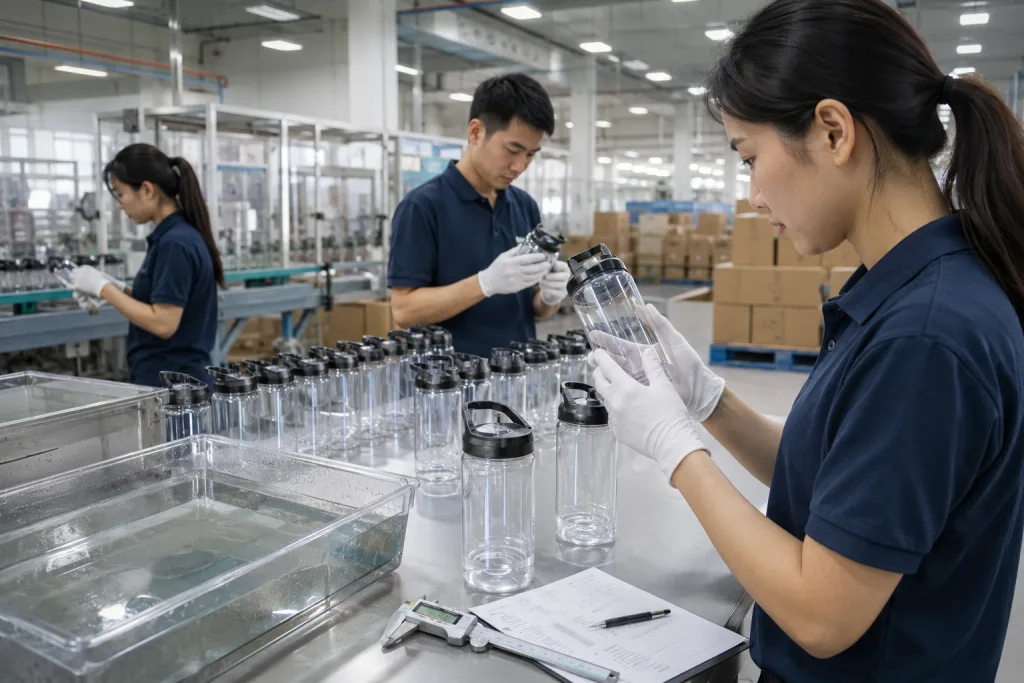
Step 1: Stock sample. Check the basics first. Hand feel, lid action, mouth diameter, base diameter, gross weight, and whether the silhouette fits your channel. We usually put a caliper on the mouth and base, then weigh the bottle to the gram. A sports-channel buyer often asks for a slimmer customizable drinkware profile that fits a side pocket. A corporate gifting buyer usually pushes for a wider shoulder and heavier body because the lighter unit feels cheap in hand.
Step 2: Logo sample. Now the print starts to expose problems. Check print position, Pantone tolerance, and whether the surface finish hurts readability. On textured powder coat, thin lines often break, and QC pulled samples before where a 0.3 mm stroke dropped out. On metallic paint, white ink may need a double pass. Buyers flag this late all the time, and then ask why the sample looked weaker than the artwork.
Step 3: PPS sample. This is the production reference. Sign off on color, artwork size, packaging, barcode placement, and accessory count. We also check the shipper mark, inner tray fit, and simple PO mistakes; one barcode digit off or a typo in the color name can hold a shipment for days. This is the wrong question to rush, because the PPS sample is what QC and production will both work from.
Typical sample timing in China looks like this:
- Stock sample: 2-4 days
- Logo sample: 5-7 days
- PPS sample: 7-10 days
If you also source custom growler, customizable growler, or customized growler items, keep the same sealed-sample rule. Bigger bodies and special caps raise leak risk and carton damage risk fast; we have seen a cap pass bench testing, then fail after a 1.2 m drop test in transit packaging. The same applies to custom canteen lines sold through canteen distributors or distributor canteen accounts.
A nice-looking sample is not approval. Approval means the supplier, the buyer, and QC all hold the same reference unit and the same written tolerances.
That written tolerance list should cover capacity variance, logo placement tolerance such as +/-2 mm, acceptable color shift, and carton spec. Keep it plain. We have seen this go sideways when one side approved by photo and the other side approved by a sealed unit with different foam thickness. Good China sourcing gets boring here, and that is exactly the point: fewer assumptions, fewer arguments later.
Production control before mass run
After PPS approval, the order moves into material prep and line booking. Buyers often go quiet here. That is the wrong move. Your pc thermal bottle supplier should spell out what gets checked before full assembly starts, down to the lid mold number, seal spec, and which line we run.
For a 3,000-unit order, a practical control plan looks like this:
- Incoming check: stainless body, PC lid parts, seals, paint, cartons, labels
- First article approval: 3-5 assembled units signed by production and QC
- In-process checks: print adhesion, lid torque, vacuum hold, cosmetic defects
- Final random inspection: based on AQL standard before balance payment
Ask for the defect classification in writing. For thermal bottles, a reasonable baseline is:
- Critical: 0.0 or AQL 1.0, including sharp edges, odor, missing food-contact parts, severe leakage
- Major: AQL 2.5, including failed vacuum, wrong logo, deep dent, unstable base
- Minor: AQL 4.0, including light scuff, small paint dot, slight carton mark
Cosmetic standard should match the sales channel. If your customer is a canteen distributor, canteen vendors network, or a distributor growler account with strict retail presentation standards, tighten the visible-face standard and define it by zone, such as front 120 mm logo area and lid top surface. We have seen buyers flag a 2 mm paint nib on the front panel while accepting the same issue on the bottle bottom. If the goods are for canteen promotional use at events, a slightly looser minor standard can protect timing and cost. The math does not work if you hold gift-box cosmetic rules on event stock.
Zhejiang factories shipping to the EU and US should also control documents the same way they control parts. Purchase order, approved artwork, carton mark file, barcode list, and test plan must match line for line. QC pulled a sample once where the bottle was correct but the outer mark carried an old PO suffix, and the buyer held the shipment. One wrong FNSKU or shipping mark can cost more than a small cosmetic defect rate.
Lead time for this stage is usually 25-35 days after deposit and final approval. In peak season from August to November, add 5-10 days unless your canteen supplier has already reserved capacity. On our side, that usually comes down to carton arrival, screen-print slot, and whether the vacuum test rack is already full.
Compliance, packaging, and shipment details
Most B2B trouble starts after production, not at quotation stage. Goods are finished, then the retailer rejects the label, Amazon flags the carton setup, or the importer asks for a test report the supplier never planned to issue. We have seen this go sideways over a 2 mm font-height miss on a country-of-origin mark.
For a pc thermal bottle supplier shipping to Europe and North America, check four points early:
- Material compliance: REACH for EU, FDA/LFGB food-contact expectations as needed
- Factory audit status: BSCI, Sedex, or customer-specific social audit if required
- Packaging compliance: labeling, country of origin, suffocation warning if applicable
- Transit performance: carton drop, inner protection, pallet rule if needed
Take a big-box program as an example. The outer carton may need a gross weight cap such as 15 kg, and QC will check it on a floor scale before sealing. For Amazon FBA, carton labels, FNSKU application, and exact carton dimensions need sign-off before packing starts. Repacking in China is a headache. Repacking after arrival burns money fast. One buyer flagged a PO because the carton size was typed as 42 cm instead of 24 cm.
The same discipline applies if the range includes custom canteen, customized canteen, or custom growler items under one PO. Do not assume one carton style fits the full line. Taller bodies need different dividers in a lot of cases, especially for a customizable growler with a handle or wide cap. We run drop checks on mixed-case packs because the math does not work if one insert has too much headspace.
A dependable canteen supplier or canteen vendor should send a packaging layout for approval. That file should show unit pack, inner pack if any, master carton size, units per carton, net weight, gross weight, and carton mark. If your supplier says “standard export carton” and nothing else, push back. This is the wrong question to skip. Standard means nothing until the numbers are on the sheet and the line is packing against that version.
What a smart buyer checks before payment
The goods are finished. Now you decide whether to release the balance. Smart buyers do this with records, not pressure. On our line, QC pulled the sample after final wipe-down and checked it against the sealed golden sample before anyone talked about booking.
For this order, your checklist before shipment is simple:
- Inspection result: third-party or factory final inspection passed to agreed AQL
- Performance result: leak test and insulation test records available
- Packaging result: barcode, carton mark, and quantity match PO
- Document result: invoice, packing list, booking details, and compliance files complete
If you buy from multiple canteen manufacturers, canteen suppliers, or canteen distributors across categories, use one approval sheet for all of them. This is the right question to ask. Keep the format tight: product spec, packaging spec, inspection result, and shipment release signature. We have seen buyers miss a 2 mm logo shift because each factory used a different form. One sheet makes factory-to-factory comparison easier over time on defect rate, delay rate, and claim response.
One practical benchmark: if a supplier ships 10 containers per month but cannot provide a basic CAPA response within 48 hours when a defect appears, the math does not work. Volume only makes that weakness louder. Last month one buyer flagged a lid crack issue and asked for a full reply the same day; the factory sent photos, lot numbers, and corrective action in 36 hours. A reliable Zhejiang partner does not need to be perfect. It needs to be measurable, reachable, and consistent.
Buyers usually return to the same pc thermal bottle supplier for one reason: repeat orders run cleaner. Not cheaper. Artwork files are archived correctly. Reorder MOQ may drop to 500-1,000 units for repeat colors. Spare parts remain available. Claims are settled with photo evidence instead of argument. We ship smoother when the PO typo from the first order is already fixed, the carton mark is confirmed, and the line knows the packing standard. That is the difference between buying a one-off bottle and building a real custom drinkware supply line.
Send your bottle spec and get a workable quote
Share capacity, lid style, logo method, packaging, and target market. We will review MOQ, compliance, lead time, and QC points before sampling starts.
Frequently asked questions
What should I ask a pc thermal bottle supplier before requesting samples?
Start with the points that change cost and risk: capacity, material structure, lid type, finish, logo method, packaging, compliance market, and MOQ. Ask whether the quote is based on existing tooling, and whether PC is used in the lid, straw, or other food-contact parts. For B2B orders, also ask monthly capacity, standard lead time, and whether the supplier exports regularly to Europe or North America. A useful first reply from China should include MOQ by SKU and color, sample time of about 5-10 days for logo samples, and mass production timing around 25-35 days. If the supplier cannot answer these basics clearly, sampling usually becomes a slow and expensive guessing exercise.
What is a realistic MOQ for custom drinkware and custom canteen orders?
For most standard insulated bottles, a practical MOQ is 1,000 units per model with one body color and one logo. Some factories in Zhejiang can do 500 units for repeat orders or stock colors, but that usually means fewer finish options and a higher unit cost. If you want a custom canteen, customized drinkware set, or customizable growler with special packaging, MOQ often moves to 2,000-3,000 units because of box printing, setup waste, and line changeover. Decoration also matters. Laser engraving can be economical at lower quantities, while full-wrap print often needs higher volume. Always ask for MOQ by model, color, and logo, not just one headline MOQ.
How do I control quality when buying from a canteen manufacturer in China?
Set the QC terms before production starts. Use an approved PPS sample, then agree defect categories and AQL levels in writing. For drinkware, many buyers use critical 0 or AQL 1.0, major 2.5, and minor 4.0. Require incoming checks for lids, seals, and packaging, plus in-line checks for print adhesion and assembly. Before shipment, use a final random inspection when at least 80% of goods are packed. Ask for leak testing, vacuum or insulation records, and barcode verification if the goods go to retail or Amazon. The point is not to inspect quality into a bad product. The point is to make sure the canteen factory and buyer are using the same measurable standard from the start.
What compliance documents matter for EU and US drinkware imports?
That depends on the product design and sales channel, but most buyers should at least review food-contact compliance and material declarations relevant to their market. For Europe, REACH is commonly requested, and some buyers also ask for LFGB-related food-contact testing depending on the product. For the US, FDA-related food-contact expectations are common. If the item targets children, ASTM or CPSIA-related requirements may apply. Social compliance can matter too, especially for retail programs, so BSCI or Sedex audit status may be requested. Ask the supplier which reports are current, which product version they cover, and whether testing is tied to the exact lid, seal, coating, and packaging used on your PO.
How long does a full B2B order take from inquiry to shipment?
For a standard project, allow about 5-7 days for quoting and technical confirmation, 5-10 days for logo or PPS samples, and 25-35 days for bulk production after deposit and approval. Booking and port handling can add another 3-7 days depending on season and loading port. If you are ordering during the August-November peak, add 5-10 days unless the factory reserved production space in advance. A mixed order with custom canteen, distributor growler, and customized drinkware SKUs may take longer because packaging approval and line scheduling are more complex. The shortest lead times usually happen on repeat orders with frozen artwork, repeat colors, and no carton redesign.