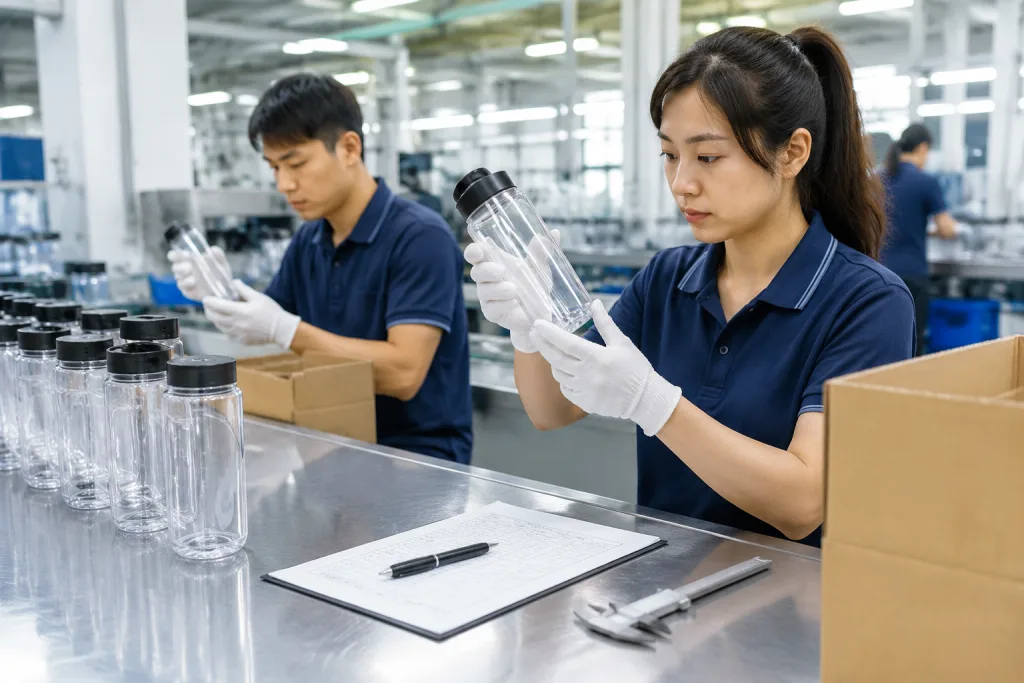
Key Takeaways
- Set a written golden sample and carton spec before deposit; changing logo position after production starts can add 7-12 days
- Typical MOQ for a custom PC thermal bottle is 1,000-3,000 units per color, with FOB pricing often around USD 2.80-6.50 depending on size and decoration
- Use AQL 2.5 for major defects and AQL 4.0 for minor defects on final inspection, with leak, drop, and coating adhesion tests written into the PO
- For Europe and North America, confirm REACH, LFGB or FDA contact compliance, plus ASTM or CPSIA where kids' use is relevant
You are not buying a bottle. You are buying a finished SKU that has to survive freight, pass compliance, hold temperature, print cleanly, and hit the target cost. We have seen first POs fail on basic points with a pc thermal bottle manufacturer: the drawing was approved, the pre-production sample looked fine, then mass production moved 2 mm on logo position, the lid torque went loose, or the export carton softened after a drop test.
The better way is to run the order like a controlled project from day one. If you source from Zhejiang, China, or another China base, you need a clear specification sheet, a workable MOQ, and QC checkpoints tied to where you sell. This is the wrong question to ask if the first discussion is only unit price. A factory running 300,000 units per month can still ship the wrong bottle when the approval standard is vague; we ship against signed specs, carton marks, and a golden sample that QC pulled from the line.
Start with the order brief
Here’s the real case. You’re buying for a brand, promo importer, or canteen distributor and lining up a 5,000-piece launch order. You found a pc thermal bottle manufacturer in Zhejiang, China with pricing that works, but the quote sheet still reads like a placeholder: 500ml, double wall, logo available. That won’t support a serious PO. Last month, a buyer sent us that exact level of detail, then flagged the sample because the mouth came in at 44mm instead of the 50mm cap they had in mind.
Your first job is to turn the product idea into a production brief the factory can run without guessing. This is the wrong question to skip. At minimum, specify:
- Body material and grade, such as stainless steel 304 inside and 201 or 304 outside, or if the project really uses PC components, define where PC is used and confirm food-contact compliance.
- Capacity tolerance, for example 500ml plus or minus 3%.
- Vacuum performance target, such as 6 hours hot above 55C and 8 hours cold below 10C from a standard fill test.
- Wall construction, mouth diameter, bottle height, net weight, and coating finish.
- Lid structure, gasket material, carry handle requirement, and leak-proof standard.
- Decoration method: silkscreen, laser, heat transfer, powder coating, or UV print.
- Retail pack, master carton size, drop standard, pallet requirement, and shipping mark format.
This is also where related terms need to be fixed. We see buyers use custom canteen, canteen customizable, customizable growler, and customized drinkware as if they mean the same thing. On the line, they do not. A canteen factory needs one locked configuration, one drawing, one BOM. If you are also sourcing a custom growler or sports SKU in the same program, split every item by drawing number and BOM version. We’ve seen this go sideways over one PO typo: lid A written against bottle body B.
The expensive mistake is not a high unit price. It is allowing the supplier to fill in missing details for you.
For a first order, ask the canteen supplier to quote three exact scenarios, not one broad range: plain bottle, one-color logo bottle, and full retail-pack bottle. That gives you a clean cost ladder before you negotiate. We usually quote those three against the same MOQ and carton spec, so you can see the real add-on cost instead of a mixed number that hides packing or print charges.
Lock the specification before sampling
Once the target cost looks workable, sampling starts. We see 7 out of 10 delays come from approving the look first, then arguing over lid fit, thread feel, or print position after the sample is on the buyer's desk. Reverse that order. Approving the shell first is the wrong question to ask. Your sample approval should lock construction and fit before artwork release, with the caliper reading, torque feel, and logo film checked on the same bench.
A practical sample path with a pc thermal bottle manufacturer normally looks like this, based on a 14-day sample window we run on the line:
- Day 1-3: artwork check, logo size confirmation in mm, Pantone reference under a D65 light box, and packaging dieline review against the carton knife line.
- Day 4-10: pre-production sample or existing mold sample with new decoration, then lid assembly checked with the actual straw, gasket, and carry loop.
- Day 11-14: revisions on color, lid, or print placement after QC pulls the sample and marks the change points on the approval sheet.
If the bottle includes PC in the lid, straw module, or transparent outer part, ask for resin identification and migration test basis before approval. Do it before the PO. Buyers in Europe ask about REACH. Buyers in North America ask for FDA-contact materials, California Proposition 65 risk review, and retail packaging labeling. If the design is for children, ASTM and CPSIA move up the checklist. We have seen this go sideways when the resin code was clear on the material bag but missing from the signed sample file.
Before sample sign-off, request a signed spec sheet with measurable points. Do not accept comments like normal quality or as discussed. Those words create arguments at final inspection. Replace them with numbers from tools the factory actually uses, such as a 0.01mm digital caliper, 3M tape, and a 30-minute leak test fixture:
- Logo centered within plus or minus 1.5mm.
- Coating passes 3M tape adhesion test with no peeling.
- Thread engagement smooth, no cross-threading in 10 consecutive openings.
- Leak test: inverted for 30 minutes, no visible leakage.
- Vacuum spot check on 5 pieces per batch.
This level of detail matters whether you are buying canteen custom, customized canteen, or customizable drinkware for retail, corporate gifts, or a distributor drinkware program. A canteen vendor with good intentions will still follow the easiest interpretation unless you define the standard. In Zhejiang, where one assembly line can switch from a 5000-piece gift order to a 30000-piece retail order in the same week, the gap between a smooth run and a painful run is documentation, not capability. QC pulled the sample for a reason.
Price the order like a buyer
The sample is close. Now price it like a buyer, not like every bottle should land at one flat number. A pc thermal bottle manufacturer prices off steel weight, lid structure, spray line time, print method, and how tightly the cartons pack. If you send 10 suppliers a loose spec, you will get 10 prices that do not match up. We see this every week, and the wrong question is "what is your best price?" The right one is "what spec did you price?"
For a standard 500ml vacuum bottle project, typical B2B pricing from China might look like this under FOB Ningbo or FOB Shanghai terms:
- Plain stock color bottle: USD 2.80-3.60 at 3,000 units.
- Powder-coated bottle with one-color silkscreen: USD 3.30-4.40 at 3,000 units.
- Premium lid, gift box, barcode labeling, and stronger carton: USD 4.40-6.50 at 3,000 units.
MOQ often starts at 1,000 units for existing shapes, but practical MOQ is usually 2,000-3,000 units if you want custom color, custom packaging, and stable print yield. On the line, 1,000 units sounds easy until you split two lid colors and one logo size, then the math doesn't work. Some factories quote 500 units to catch the inquiry and add margin back through setup charges later. Ask straight about mold fee, print plate fee, carton revision fee, and the extra cost for mixed colors in one PO. We have even seen a PO typo on carton marks trigger a full outer carton reprint.
Split unit price from failure cost. Saving USD 0.12 on the bottle means nothing if the master carton bursts in transit and 4% of units arrive dented. QC pulled the sample on one order last season because the gross weight was over 18 kg and the side compression was weak. That is why experienced canteen distributors and distributor canteen buyers ask for carton gross weight, board grade, and loading quantity early.
Questions worth asking before you pay deposit
- What is the exact MOQ by color and by logo?
- What is the mass production lead time after sample approval: 25, 35, or 45 days?
- What is the surcharge for individual polybag, egg-crate divider, or gift box?
- Can the supplier support FNSKU labels, suffocation warning, or multilingual carton marks?
If you are a canteen vendor, canteen distributors group, or distributor growler buyer building a line extension, ask for a family quote across bottle, tumbler, and growler formats. We usually run this as one sheet with shared packaging assumptions, and buyers spot cost gaps faster that way. It also gives you more leverage than pushing one SKU on its own.
Run production with checkpoints
After deposit, the order should move through clear gates, not disappear for 30 days. A capable pc thermal bottle manufacturer will confirm artwork, issue a pre-production sample, book raw material, then run body forming, welding, vacuuming, coating, assembly, packing, and final inspection. On our line, the laser weld check usually happens before vacuum hold, and that detail matters. Your PO should tie approval and release to each stage.
A practical checkpoint schedule for a 30- to 40-day order:
- Day 3: approved artwork and packaging files frozen.
- Day 7: pre-production sample photos and key dimensions confirmed.
- Day 12-18: in-line production photos covering body forming, coating, and print.
- Day 20-28: packaging confirmation and carton drop check.
- Day 28-35: final random inspection before balance payment.
Use the checkpoints to catch drift early. We have seen powder-coat color shift by one Pantone step, silver dust trapped under print, lids swapped from a backup sub-supplier, and retail boxes jam after a 2 mm inner tray revision. QC pulled the sample on one order because the logo sat 1.5 mm low after screen setup. These are normal factory issues, whether you are buying custom drinkware, custom canteen, canteen promotional stock, or a customized growler. The real question is simple: do you catch them before shipment, or after 3,000 pcs land at your warehouse?
For first orders, ask the canteen factory for lot traceability by production date and line. Ask for the actual line code if they have one. If the factory claims BSCI, ISO 9001, or social audit coverage, request the current scope and site name. Do not assume one group certificate covers every workshop; we have seen buyers find out too late that the coating shop sat outside the audited address. If the order matters commercially, appoint a third-party inspection company in China for DUPRO or final random inspection.
In Zhejiang and other manufacturing regions in China, factories are used to direct buyers who ask for measurable controls. They are less responsive to vague comments like make it nicer. This is the wrong question to ask. We ship cleaner orders when every update points back to the signed sample, approved artwork, and carton standard, down to the master carton mark and the PO typo the buyer flagged on day 6.
Inspect for defects that really matter
Final inspection is not a photo exercise. It is the last gate before we ship, and it needs to confirm the bottles match the approved sample in function, finish, and packing. On our line, QC pulled the sample and checked 50cm appearance, lid fit, and carton marks against the signed approval. For a pc thermal bottle manufacturer, a proper final random inspection should cover appearance, quantity, labeling, performance, and packing integrity.
AQL is the baseline, not the whole answer. For most general custom drinkware orders, AQL 2.5 for major defects and AQL 4.0 for minor defects is workable. Critical defects should be zero acceptance. This is the wrong question to ask if a buyer only asks for "good quality" and skips a written defect list. Define the defect list before inspection starts, and put it on the brief the inspector carries on the floor:
- Critical: sharp edge, wrong material claim, serious leak, mold contamination, missing safety warning where required.
- Major: wrong logo, obvious coating peel, dent, unstable base, failed vacuum, failed drop test carton.
- Minor: small print pinhole, slight color variation within agreed limit, light surface mark not visible at 50cm.
Functional tests should be written into the inspection brief. No verbal promises. We run these checks with actual tools, not guesswork, and the line knows the sample size before cartons are opened:
- Leak test on sampled pieces.
- Vacuum heat retention spot test.
- Barcode scan test for retail labels.
- Carton drop test, often 1 corner, 3 edges, 6 faces depending on pack style.
- Assembly torque and lid fit check.
If you are supplying a canteen distributor network or building a distributor drinkware program, packaging consistency matters almost as much as bottle quality. Outer cartons should show PO number, item code, quantity, gross and net weight, carton size, and country-of-origin marking exactly as instructed. We have seen this go sideways over one PO typo and one FNSKU label placed 8mm off spec, then the buyer flagged the whole pallet. For Amazon-oriented shipments, confirm FNSKU placement and overlabel rules in advance.
The point of inspection is not to reject factories for show. It is risk control. A factory shipping 200,000 to 300,000 units per month can still produce one bad lot, and the math does not work if you discover it after arrival. Your system has to catch it. Last month, one inspection finding was a vacuum failure cluster in 7 pieces from the same 3-hour production window.
Plan the second order before shipping
The first shipment does not end the buying cycle. It gives you the data for PO2. Once inspection passes, check what happened on the line against the quote and ship plan. Did sampling take 10 days or 18? Did QC pull the sample and find the print yield held lot to lot? Did the carton cube match the booking plan, or did the outer carton come in 8 mm wider than the file? This is the point where you decide if a supplier is only usable or worth building with.
For repeat custom programs, use a small supplier scorecard with five checks: on-time delivery, defect rate, response speed, documentation accuracy, and cost stability. Keep it blunt. A canteen manufacturer that is USD 0.08 cheaper but ships 12 days late is not cheaper once you count storage reshuffle, missed promo dates, and split delivery. We have seen buyers argue hard on unit price while ignoring a packing list typo on the PO revision. That is the wrong question to ask. This gets harder when you run multiple SKUs like customizable canteen, customized growler, or canteen customized seasonal gift sets.
Ask the supplier to hold one sealed golden sample, one approved carton, and one print reference per SKU. Put a label on each master carton and date it. For stable demand, discuss raw material reservation or safety stock of standard lids and seals; we usually count this in sets and review MOQ before locking it. That can cut repeat lead time from 35-40 days down to 20-25 days on replenishment orders. If your annual volume is meaningful, negotiate price tiers at 5,000, 10,000, and 20,000 units instead of reopening every detail on each order.
Good buyers also write down what cannot change without approval: stainless grade, seal material, vacuum process, print method, carton board, and accessory source. Be specific. If the gasket is food-grade silicone at one shore hardness, say so. This matters with any canteen supplier, canteen vendors, or canteen manufacturers in China because substitutions usually show up when the line is under schedule pressure, not because anyone sent a clean change notice. The buyer flagged this on one order after QC found a softer seal during drop test comparison.
By the time the goods leave China, you should already know whether the supplier can support a broader line: custom drinkware, custom growler, canteen promotional programs, or retail-ready insulated bottles for Europe and North America. That call should come from facts, not sales talk. We ship the first order, then we check if the math works on lead time, claims risk, and document control. That is the real output of a disciplined first order.
Send your bottle spec and get a workable factory quote
Share capacity, material, logo method, target price, and packing requirement. We will review MOQ, lead time, and QC points before you place the order.
Frequently asked questions
What should I ask a pc thermal bottle manufacturer before placing a first order?
Ask for exact MOQ by color, unit price by decoration method, production lead time, compliance documents, and inspection standard. You also need material details by component, not just by bottle body. A useful first-order checklist includes: 304 or 316 contact surface confirmation, lid material disclosure, REACH or FDA basis, leak test standard, carton spec, and AQL plan. For a normal custom drinkware order from China, expect MOQ around 1,000-3,000 units and lead time around 25-40 days after sample approval. If the supplier cannot provide a signed spec sheet, approved artwork layout, and packaging dimensions before deposit, the risk is too high for a serious B2B order.
Is PC a good material for thermal bottles?
Usually, thermal performance comes from double-wall stainless steel vacuum construction, not from PC. In many projects, PC appears in the lid, straw, cap window, or accessory parts rather than the insulated body itself. That is why you should ask the factory exactly where PC is used. If PC is in contact with liquid, confirm food-contact compliance and migration testing relevant to your market. For Europe, buyers often ask for REACH and, depending on product type, LFGB-related support. For North America, FDA-contact compliance and Proposition 65 review are common. If your brief says pc thermal bottle manufacturer, make sure the supplier is not using the term loosely for a stainless bottle with only a plastic lid component.
How do I compare quotes from different canteen suppliers fairly?
Standardize the RFQ first. Give every canteen supplier the same drawing, capacity, material callout, decoration requirement, packing method, and Incoterm. Then request a cost breakdown covering bottle, lid, logo, retail box, master carton, and any setup charges. A quote of USD 3.10 and a quote of USD 3.45 are meaningless if one includes powder coating, barcode labels, and a 5-ply export carton while the other does not. Ask each supplier for carton size, gross weight, loading quantity, MOQ, and lead time. Once those variables are aligned, price differences of 5% to 12% are normal across China. Larger gaps usually mean a hidden downgrade, a misunderstanding, or unrealistic quoting.
What QC tests matter most for customized drinkware orders?
For insulated bottles, focus on leak performance, vacuum retention, finish durability, and packaging strength. A solid QC plan includes inverted leak test for 30 minutes, spot-check heat retention against your agreed benchmark, print adhesion by tape test, and carton drop testing based on your pack style. Appearance inspection should also cover dents, coating defects, logo position tolerance, and base stability. Use AQL 2.5 for major and 4.0 for minor defects unless your retail channel needs tighter control. For first orders in China, add a pre-shipment inspection by a third party. That extra USD 250-400 is often cheaper than reworking even 3% of a 5,000-piece shipment.
Can a canteen factory support both promotional and retail programs?
Yes, but you should verify the operating model instead of assuming it. A factory that handles canteen promotional orders may be strong on fast logo application and mixed artwork, while a retail-ready supplier needs tighter color control, packaging consistency, barcode management, and transit-tested cartons. Ask what percentage of production goes to promo versus retail, whether they can apply FNSKU labels, and whether they hold social audit or ISO records for your customers. For a capable Zhejiang supplier, monthly output of 150,000-300,000 units is common, but capacity alone does not prove retail discipline. Review actual carton labels, shelf-ready packaging samples, and inspection reports before you commit a larger distributor growler or distributor drinkware program.