Key Takeaways
- A realistic MOQ for pc thermal bottle bulk is usually 1,000-3,000 units per color, with 25-35 day production after sample approval
- PC can suit tough transparent bottles, but BPA-free Tritan or PP may be better for EU and North American retail programs
- Logo cost can range from USD 0.08 for one-color silkscreen to USD 0.45 for wrapped heat-transfer artwork
- Use AQL 2.5/4.0 inspection and request REACH, LFGB, or FDA food-contact reports before mass production
Buying pc thermal bottle bulk looks simple until you line up samples from 4 factories and find different PC grades, loose lid threads, insulation claims with no test curve, soft 5-layer cartons, and missing FDA or LFGB reports. We see this on the sample table. A 0.3 mm gap on the flip lid can become a leakage complaint after sea freight, so you are not just buying a bottle; you are buying a repeatable spec that can survive loading, shelf handling, and the first angry customer email.
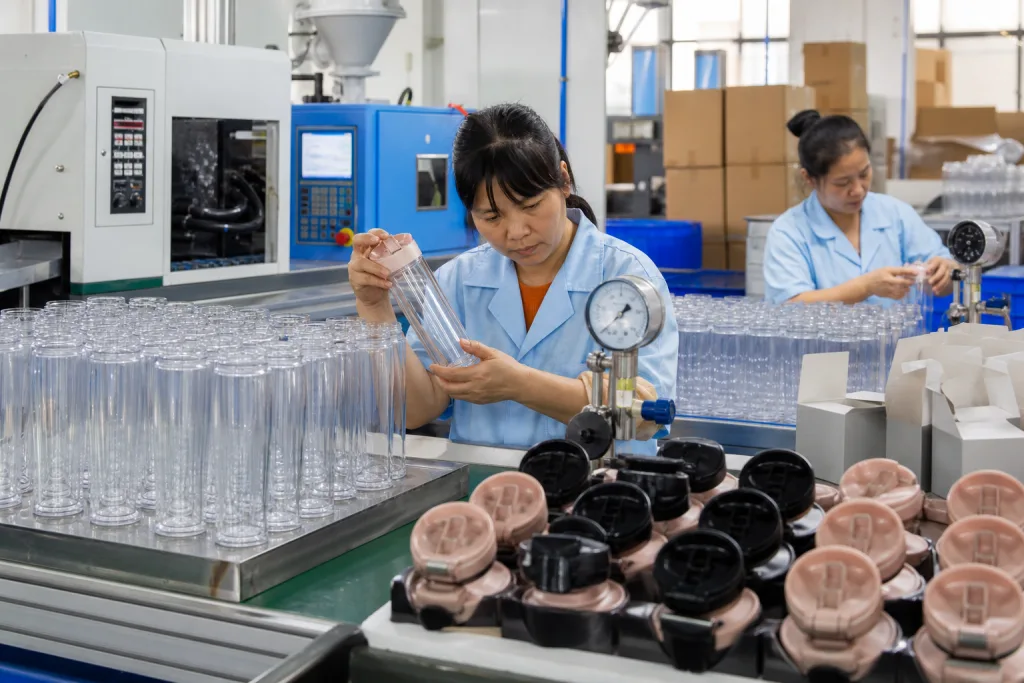
From Zhejiang, China, we watch procurement teams lose 7 to 10 days when they start with Pantone color and logo position before locking the hard parts. Wrong order. The line needs material choice, capacity and structure, compliance level, decoration method, and order economics fixed before we run the pre-production sample; last month QC pulled a 650 ml bottle because the PO said clear PC but the approved sample was smoky grey. Get those decisions right, and bulk drinkware sourcing becomes less emotional and easier to price.
Start With The Material Decision
The first decision is whether you need PC at all, or whether pc thermal bottle bulk is just the keyword your buyer used for clear plastic insulated bottles. Polycarbonate is tough, clear, and impact resistant. We have run 1.0 mm and 1.2 mm PC bodies on the same blow-molding line for sports bottles and office canteens. The issue is not only the material. It is buyer perception. Traditional PC still triggers BPA questions in Europe and North America, even when the resin supplier gives a food-grade statement.
If your sales channel includes supermarkets, school programs, Amazon, or a national distributor, ask for the exact resin name and food-contact report before anyone talks price. QC pulled one sample last year where the PO said “PC BPA free,” but the resin code on the carton did not match the test report. That order stopped for 3 days. For 7 out of 10 clear-bottle projects we quote, copolyester such as Tritan is easier to sell because the BPA-free message is clean. PP costs less and weighs less, but it looks cloudy beside Tritan. Stainless steel works better for vacuum insulation, but the math moves into another cost class.
For a double-wall plastic thermal bottle, do not expect 304 stainless vacuum flask performance. Wrong question. A PC or copolyester double-wall bottle can reduce condensation and keep water cooler for 2-4 hours in normal indoor use, based on a 23 C office test with 5 C water filled to the shoulder. It is not a 12-hour hot coffee product. If a supplier in China claims 12 hours hot for a plastic PC bottle without a vacuum stainless liner, ask for the test method and temperature curve. We have seen this go sideways when the buyer only checked the catalog claim.
A practical spec sheet should state resin, food-contact standard, wall thickness, cap material, gasket material, temperature range, dishwasher position, and whether the bottle is intended for carbonated liquid. Put the wall thickness in mm, not just “thick body.” Our line usually checks the mouth ID with a digital caliper before cap fitting, because a 0.3 mm drift can cause leaking after the gasket relaxes. The carbonated-liquid point matters if your catalog also includes beer tumbler bulk, beer growler bulk, or bulk growler items, because pressure resistance is a separate engineering job.
Choose Capacity Before Styling
Capacity decides tooling, carton size, freight cost, and what the buyer can sell it for. For pc thermal bottle bulk, we usually run 500 ml, 650 ml, 750 ml, and 1,000 ml molds. 500 ml works for office gifting and school orders; one EU buyer last month asked for a 24 pcs inner carton because their shelf depth was only 420 mm. 750 ml is the cleaner choice for sports and outdoor retail. 1,000 ml is different. It starts acting like a canteen, so QC checks the handle pull and lid seal harder, not just the bottle look.
Some procurement teams ask for one shape to cover drinkware wholesale, canteen wholesale, and growler wholesale programs. We have seen this go sideways. A daily-use PC thermal bottle needs one-hand drinking and a clean retail silhouette. A wholesale canteen needs a stronger carry handle and wider mouth; our line usually checks handle fit with a simple 5 kg hanging test before pilot packing. A wholesale growler or beer growler wholesale bulk item brings pressure concerns, larger capacity, and labeling rules if the buyer hints at alcohol use.
Use dimensions, not just milliliters. A bottle at 76 mm wide will fit many car cup holders; 86 mm often fails, and the buyer flags it after the first retail sample round. Mouth opening matters too: 45-55 mm is comfortable for ice cubes and cleaning, while narrow mouths reduce spillage but bring more complaints from users who cannot wash the bottle properly. For private label programs, we usually suggest keeping the cap diameter and thread structure consistent across 500 ml and 750 ml sizes. It cuts spare-part risk, and QC can use the same thread gauge during inspection.
If you are building a wider drinkware bulk range, split the family by function: PC thermal bottle for daily hydration, stainless travel tumbler for coffee, bulk canteen for outdoor or worksite use, bulk growler for beer or beverage service, and alcohol flask wholesale for compact gifting. Shared colors and packaging can connect the range. The wrong question is whether one bottle can cover every channel; the math does not work once carton CBM, MOQ, and spare lids are counted on the PO.
Set Compliance Before Negotiating Price
Negotiating price before compliance is the wrong first move. A USD 1.28 bottle and a USD 1.62 bottle can look the same in a supplier photo, but the cheaper one may be missing a current REACH report, FDA food-contact test, or factory audit. We have seen buyers push for a 6-cent cut, then lose 12 days waiting for a new resin test because the old file did not match the order. For North America, ask for FDA food-contact documentation and, when relevant, California Proposition 65 screening. For Europe, check LFGB, REACH SVHC, and packaging waste requirements. For children’s products, ASTM and CPSIA questions belong on the table before the PI is signed.
Factory documents must match the actual material you are buying. If the report says PP and your bottle is PC, it does not protect the shipment. If the report is older than 2 years, ask whether the resin supplier and color masterbatch are still the same; on our line, QC records the resin lot number from each 25 kg bag before injection. Color matters. Pigments and additives can change the test result, so bright neon bottles and smoky transparent colors need extra attention. We had one buyer flag a smoky grey PC bottle after the report named clear PC only, and they were right to push back.
For factory control, BSCI, ISO 9001, and Sedex are useful signals, but they do not replace product testing. In Zhejiang, China, a mid-sized drinkware factory may produce 300,000-600,000 plastic and stainless units per month, but the order still needs incoming material checks, leak testing, drop testing, and carton compression checks. Volume is not control. We run 1.2 m drop tests on loaded samples and use a pressure gauge on leak-test fixtures before packing approval. If QC pulled the sample and found cap seepage after 30 seconds, the certificate on the wall will not save the order.
Put the required reports in your purchase order, not only in email. State whether testing must be done before production, during production, or from final goods. For larger wholesale drinkware orders, we usually recommend pre-production material confirmation plus final random inspection under AQL 2.5 for major defects and AQL 4.0 for minor defects. One PO typo can cause trouble; we once saw “PC body” in the spec sheet and “PP body” in the PO, so the buyer had to reissue the document before we shipped. If the bottle will be sold as the best wholesale drink bottle in a premium channel, set tighter cosmetic limits for scratches, black dots, and logo registration, such as no visible black dot over 0.3 mm on the front logo area.
Price The Whole Landed Order
The unit price is only one line on the cost sheet. For pc thermal bottle bulk, a basic transparent double-wall bottle usually lands around USD 1.20-2.10 FOB Ningbo or Shanghai, depending on capacity, PC resin grade, lid structure, color, and packing method. Custom molds, locking lids, silicone sleeves, and retail boxes raise the price fast. We have seen a USD 0.12 cheaper EXW quote lose money after Yiwu-to-Ningbo trucking, export docs, 5-layer cartons replaced at the last minute, and 6% rework after QC pulled the sample for lid leakage.
Ask the supplier to break out cost by bottle, decoration, packaging, spare parts, and testing. One-color silkscreen may add USD 0.08-0.15 per unit, and the screen room should confirm the print area in mm before artwork approval. Laser engraving does not make sense on a clear PC body, but it can work on a stainless cap badge. Heat-transfer printing gives a full-wrap retail look, often USD 0.25-0.45 per unit, but we run 3M tape and abrasion checks before signing off. Individual kraft box packaging may add USD 0.18-0.35, while color box packaging can be USD 0.28-0.60 depending on paper gauge and finish.
MOQ changes the real price. A factory may accept 1,000 units in one color for a stock mold, but custom Pantone color often starts at 2,000-3,000 units because the injection line has resin mixing loss in the hopper and barrel. A new mold may need USD 3,000-8,000 tooling cost and 25-40 days before T1 samples. For repeat canteen bulk or drinkware wholesale programs, tooling can make sense. For a first seasonal test, chasing a private shape is often the wrong question to ask; use an existing mold, then spend the saved USD 1,500-2,000 on stronger cartons, drop testing, and tighter QC.
Do not compare alcohol flask bulk, beer tumbler wholesale, and pc thermal bottle bulk only by unit price. Material weight and carton cube move the landed cost more than buyers expect, and the math does not work if the retail box is oversized. A 750 ml plastic bottle may be cheap to make but expensive per cubic meter when packed in large color boxes; we have had buyers flag this only after seeing 62 x 45 x 52 cm cartons on the packing list. Ask for carton dimensions and gross weight before you confirm the margin.
Decoration Has Real Trade-Offs
Your logo method changes scratch life, MOQ, lead time, and how the bottle feels in hand. On PC and copolyester bottles, we usually quote silkscreen, pad printing, heat transfer, in-mold label for new tooling, paper insert, or embossed mold logo after checking the artwork on a 1:1 film. For most wholesale drinkware buyers, one-color silkscreen is still the fastest stable choice. It suits simple logos under 80 x 80 mm, keeps the bottle clean, and lets the line run without stopping every few hundred pieces for ink adjustment.
Heat transfer makes sense when the buyer needs a full-color mascot, gradient art, wrap design, or stronger retail shelf impact. The price is setup cost and more rejects on curved walls; QC usually sees lifting at the seam or tiny bubbles near the shoulder first. If your sales team asks for a matte full-wrap effect on a curved PC bottle, ask for 20 printed samples and rub them with wet cloth, dry cloth, and 3M tape before approval. We have seen this go sideways. A pretty render is not a production standard.
For drinkware bulk projects, brand owners often undercount packaging cost. A good bottle in a 0.03 mm thin polybag still looks cheap when the distributor opens the carton. A 350 gsm color box with a die-cut hang tab may fit retail, while a plain white box with barcode is enough for distributor stock. If you sell through Amazon FBA, ask for FNSKU labeling, carton drop test, and master carton weight below 15 kg when possible. Warehouse teams push back on oversized mixed cartons because one wrong SKU label can hold 600 pieces in receiving.
If your range includes beer tumbler wholesale bulk, beer growler in bulk, or alcohol flask wholesale bulk, keep the compliance wording separate on packaging. Do not print claims such as leakproof for carbonated drinks unless the product was tested for that use; this is the wrong question to ask after the PO is signed. For pc thermal bottles, safer claims are BPA-free if supported, double-wall, condensation reducing, food-contact safe, and suitable for cold drinks up to the tested temperature. QC pulled a sample last month where the carton said hot and cold, but the test report only covered cold fill.
Use Sampling To Remove Guesswork
A sample is not a souvenir. It is a decision tool. For pc thermal bottle bulk, ask for 2-3 stock samples first and check hand feel, lid travel, gasket fit, plastic odor, transparency, and scratch level under a QC lamp. Then approve a pre-production sample with your exact color, logo, packaging, barcode, and carton marks. We have seen a buyer approve from a nice rendering, then reject the shipment because the logo sat 2 mm too low on the curved body. That is the wrong shortcut unless the order is small and the risk is low.
Run a basic buyer-side test before paying the deposit. Fill the bottle with dyed water, invert it for 4 hours, shake it 30 times, and leave it on white paper. Drop a filled bottle from 80 cm onto plywood on the base, side, and lid. Put ice water inside and check for condensation after 30 minutes. Wash the cap 10 times and check whether the gasket falls out; QC pulled one sample last month where the silicone ring lifted after the sixth wash. Simple test. Big saving. These checks do not replace lab testing, but they catch obvious problems before 3,000 units ship.
Lead time should be written in stages. A normal stock-mold order from Zhejiang is usually 5-7 days for logo sample, 25-35 days for mass production after approval, and 7-14 days for final inspection, booking, and vessel departure depending on season. Before Chinese New Year, add 15-25 days of buffer. During peak summer promotional season, cap and carton suppliers can choke the line; we have had cartons arrive 4 days late because the buyer changed one PO typo in the color box barcode.
For inspection, define defects clearly: leaking, lid not locking, visible black dots over 0.5 mm, logo shift over 1.5 mm, wrong barcode, crushed color box, odor, and carton moisture. AQL works only when the defect list matches what inspectors can judge at the table with a caliper, barcode scanner, and tape test. For a first order from a new China supplier, third-party inspection is not optional at 5,000 units and above. The math does not work compared with relabeling or refunding a failed wholesale drinkware shipment.
Match Supplier Type To The Order
The right supplier depends on the order mix. A trading company makes sense when one shipment combines pc thermal bottle bulk, canteen wholesale, growler bulk, beer tumbler in bulk, and alcohol flask in bulk across PC, stainless, and Tritan. One merchandiser can chase carton marks, color boxes, HS codes, and export paperwork. That helps. The weak point is process control: if the trader has no engineer who can read a caliper result at 0.20 mm tolerance, they are just forwarding messages.
A direct factory is stronger when the order is focused, repeatable, and tied to stable tooling. If you plan to reorder 10,000 units per quarter in the same mold, factory contact saves time on resin batch control, cap thread adjustment, mold polishing, and 8D corrective action. Ask how many injection machines they run, whether bottle blowing and cap injection are in-house, and how many leak-test stations are on the line. We run cap torque checks with a digital torque meter; if a supplier cannot explain that step, the line will struggle when leakage starts.
For brand owners, the question is not simply canteen bulk versus wholesale canteen or beer growler wholesale versus wholesale growler. Ask whether the supplier can protect your specification for 2-3 years. Will they keep the same mold? Can they hold 3,000 spare caps? Can they provide replacement gaskets? Can they support a second color at 1,000 units without changing resin supplier? We have seen this go sideways when a buyer approved smoky gray in March, then QC pulled the sample in July and found the new resin supplier made it 6% darker.
When you send an RFQ, include capacity, material preference, target market, compliance requirement, quantity by color, decoration method, packaging, barcode needs, port terms, and inspection standard. A serious Zhejiang supplier can quote from that; a photo plus the words drinkware wholesale usually gets a guess. Clear inputs get you a cleaner price, fewer sample rounds, and goods that match what your sales team promised. Last month we caught one PO typo: 500 ml on the item line, 550 ml on the carton label. Fix it before sampling.
Send Your Bottle Spec For A Factory Quote
Share capacity, material, quantity, logo, and target market. We will check feasibility, MOQ, lead time, and compliance before quoting.
Frequently asked questions
What is a realistic MOQ for pc thermal bottle bulk?
For an existing mold, a realistic MOQ is 1,000 units per color if you accept standard transparent or stock colors. Custom Pantone color usually starts at 2,000-3,000 units because the resin and masterbatch need a minimum mixing quantity. If you need a new lid, silicone sleeve, or exclusive bottle shape, the project may require 5,000-10,000 units to make tooling worthwhile. For mixed drinkware bulk orders, some suppliers can combine PC bottles, travel tumblers, and canteen wholesale items in one shipment, but each SKU still has its own production MOQ.
Is PC safe for wholesale drinkware in Europe and North America?
PC can be food-contact safe when the resin and additives meet the required standard, but buyer acceptance is the issue. Many European and North American retailers prefer BPA-free claims, and traditional polycarbonate is often questioned because of BPA history. If your channel is retail, school, healthcare, or Amazon, ask for current FDA, LFGB, or REACH documentation and confirm the exact resin grade. If you need a clean BPA-free marketing position, Tritan or another copolyester may be easier than PC, even if the unit price is USD 0.15-0.35 higher.
How long does production take after sample approval?
For a stock mold pc thermal bottle bulk order, plan on 25-35 days for mass production after the signed sample and deposit are confirmed. Logo sampling usually takes 5-7 days. Final inspection, export booking, and loading can add another 7-14 days depending on the port schedule. Before Chinese New Year, add 15-25 days because resin suppliers, carton factories, and printing workshops close at different times. For new tooling, add 25-40 days before the first T1 samples are ready.
Can the same supplier handle bulk growler and beer tumbler orders?
Sometimes, but do not assume it. PC thermal bottles are usually injection or blow-molded plastic products. Beer tumbler wholesale bulk is often stainless steel, and beer growler wholesale bulk may require pressure-related design decisions, different caps, and different compliance language. A broad drinkware factory or strong trading partner can coordinate these categories, but you should ask which processes are in-house and which are subcontracted. For a mixed program, request separate samples, separate test reports, and separate AQL defect lists for each product type.
What should I include in an RFQ to get an accurate quote?
Send capacity, material requirement, target market, order quantity by color, logo size and color count, packaging type, barcode or FNSKU needs, compliance standards, delivery term, and inspection requirement. For example: 750 ml BPA-free clear PC or Tritan double-wall bottle, 3,000 units in two colors, one-color silkscreen logo, individual color box, FDA and REACH required, FOB Ningbo, AQL 2.5/4.0 inspection. That level of detail prevents vague pricing and makes it easier to compare wholesale drinkware suppliers on the same basis.