Key Takeaways
- Set MOQ around 3,000 units per color for custom PC sport bottles unless using ready molds
- Confirm PC material grade, wall thickness, lid seal, and carton drop test before deposit
- Use AQL 2.5 for major defects and AQL 4.0 for minor cosmetic issues
- Plan 25-35 days production plus 7-10 days for sampling and artwork approval
You are not just buying a bottle. You are buying a repeatable SKU that has to survive 12 to 18 kg export cartons, container freight, retail shelves, dishwasher claims, logo checks, and a buyer who will reject the lot for one wrong cap color. We have seen this go sideways over a 2 mm shade difference on a flip lid. PC sport bottle wholesale orders get messy after the first quotation because the quote rarely shows the weak points.
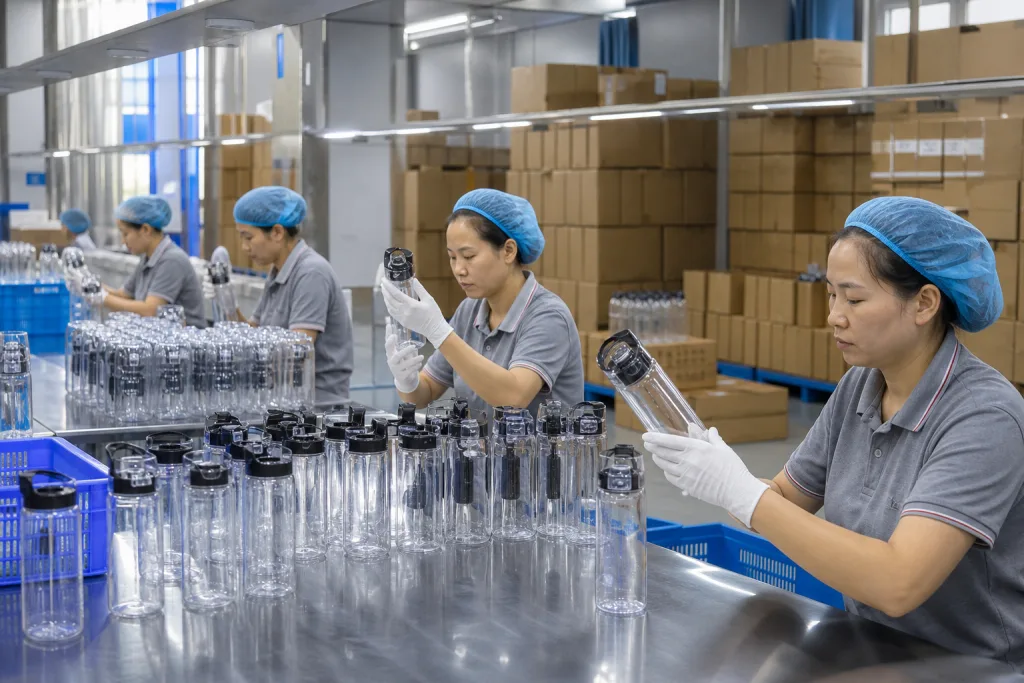
From our factory base in Zhejiang, China, we start with the drawing on the table: bottle height, mouth diameter, PC material grade, lid structure, print position, packing method, and AQL inspection rules. A normal custom PC sports bottle run is 3,000 to 10,000 units, with 25 to 35 days production after sample approval. QC pulled the sample before mass production last month because the silicone ring sat loose by 0.4 mm. Below is how we specify and check one order from sample to carton closing.
Start With The Actual Use Case
Say you are buying a 750 ml PC sport bottle for a gym chain, a weekend outdoor event, or a private-label hydration line. The wrong first question is, “What is your cheapest pc sport bottle wholesale price?” We see this go sideways. Last month a buyer sent one photo and asked for 20,000 pcs, no lid spec, no print size, no carton limit; our quoting clerk had to mark three blanks on the RFQ before the line could even check mold fit.
For PC, most buyers want clear material, drop resistance, and less weight than glass. Decide first: budget bulk drinkware, mid-range retail shelf item, or giveaway bottle for a campaign. That choice changes wall thickness, cap structure, printing, and packaging. A 1.8 mm wall can work for lower-cost drinkware bulk programs. For repeat-use retail orders, we usually push 2.2 mm because returns eat margin fast; QC pulled a 1.8 mm sample after a 1.2 m drop test and the base corner showed whitening.
Capacity changes the tooling call. A 500 ml bottle packs tight and works for school or office programs. A 750 ml size is the normal sport bottle middle ground. A 1,000 ml bottle looks better in catalog photos, but it needs stronger ribs and a carry loop that does not tear at 8 kg pull force. Do not force your bulk canteen, bulk growler, or wholesale drinkware items into one lid style just to make the page look tidy. The math does not work. A sports bottle cap gets judged on one-hand drinking and leakage after 30 minutes upside down. A canteen wholesale item gets judged on grip and body strength. A wholesale growler or beer growler wholesale product has a different sealing job and a stricter food-contact expectation.
Before you ask a China factory for a quote, send a one-page brief with capacity, target retail price, sales channel, logo size, cap function, color count, expected first order quantity, and compliance market. Simple sheet. Good quotes come from boring details. If the PO later says “Pantone 299C” but the artwork file says “Panton 299,” the buyer flagged it, and we lost 2 days before sample printing could start.
Build The Spec Before Pricing
A workable quotation needs more than a reference photo. For pc sport bottle wholesale, send a spec with resin type, capacity tolerance, bottle weight, wall thickness, lid material, gasket material, printing area, packaging, and test requirements. We usually ask for target weight in grams and wall thickness at the shoulder in mm, because that is where the line will cut cost first. No spec, no control. If these points are missing, most factories quote the lightest bottle that still looks acceptable in a photo.
For PC bottles, confirm whether the resin is virgin PC or mixed recycled content. If you sell into Europe, ask for REACH documentation and food-contact declarations before sampling, not after the deposit. For the United States, confirm FDA food-contact suitability and, when children may use the bottle, review ASTM and CPSIA relevance with your compliance adviser. We have had buyers flag PC kids bottles at artwork approval because of BPA wording, so be careful with claims. If your market needs BPA-free positioning, price Tritan, PP, or stainless as separate items. China factories can run all of them, but the mold flow, resin cost, and test risk are different. The math does not work if you compare them as one product.
Set the cap requirements clearly. Leakage on sport bottles usually starts at the silicone gasket, flip nozzle, or thread fit. Specify a food-grade silicone gasket, 100 percent leak test for assembled caps, and a torque check during production. On our line, QC uses a torque meter and a 30-minute inverted water test before packing starts. Cheap lids look good on the sample table. A low-cost lid can save USD 0.06 per unit and create USD 3.00 per unit in replacement costs later.
Decoration needs the same discipline. One-color silkscreen is usually the cleanest choice for a logo up to 60 x 80 mm. Full-wrap artwork may require heat transfer or in-mold labeling depending on the bottle curve and draft angle. QC pulled samples before where the logo passed on the flat panel but lifted near the radius after tape testing. Laser engraving is not the normal method for transparent PC, while it works better for stainless items such as beer tumbler wholesale bulk, alcohol flask wholesale, or metal canteen bulk programs. If your wider line includes alcohol flask bulk, beer tumbler bulk, and growler wholesale products, do not copy their decoration standards onto PC without adhesion testing first.
Quote The Order Like A Buyer
After the spec sheet is locked, price comparison gets cleaner. For a standard 750 ml PC sport bottle on our existing mold, we usually quote MOQ at 3,000 units per color from Zhejiang, China. Custom body mold is a different job: MOQ often moves to 10,000 units, and tooling runs from USD 1,200 to USD 4,500 depending on cavity count and cap structure. The mold room will ask for wall thickness in mm before they price it. No spec, no real quote.
A plain stock-color bottle may sit around USD 0.85 to USD 1.35 FOB Ningbo or Shanghai at 5,000 units. One-color printing adds about USD 0.05 to USD 0.12. Better retail packaging adds USD 0.08 to USD 0.20, and labels cost more if the buyer needs individual barcode stickers, FNSKU labels, or special inserts. Last month a buyer flagged a PO because the barcode size was typed as 30 x 20 mm, while their Amazon file needed 50 x 30 mm. Resin price, RMB exchange rate, and inspection level all move the quote, but asking for one universal drinkware wholesale price is the wrong question to ask.
Split unit price from order cost. A low bottle price with soft cartons can fail during sea freight, and then the math doesn't work. For export cartons, ask for 5-ply K=A or similar strength where needed, carton gross weight under 15 kg if workers will handle cartons by hand, and a 76 cm drop test for packed cartons. QC pulled one sample carton for us last season and the corner split after the second drop. For Amazon or marketplace orders, confirm carton dimensions before mass production because 2 cm over the limit can create fees nobody budgeted for.
If your purchase order mixes wholesale canteen, beer growler in bulk, alcohol flask in bulk, and pc sport bottle wholesale items, ask the factory to quote each SKU separately, then quote consolidated loading. We run plastic bottles on one line, but stainless steel bulk growler and beer growler bulk production need different welding, polishing, and leak-test control. We have seen this go sideways when a buyer pushed one supplier to pack four categories together without shared AQL 2.5 inspection rules. Consolidation saves freight only when the factory or trading partner controls QC across every category. The best wholesale drink bottle is not the cheapest row in Excel; it is the SKU you can reorder without fixing the same artwork, cap fit, and carton problem again.
Sampling Should Catch Production Risk
Sampling is where the sales photo meets the line. For a custom pc sport bottle wholesale order, we ask for three stages when the calendar has room: a stock sample from current inventory, a pre-production sample using the booked PC resin and target color, then a decorated approval sample with the real logo process. The middle sample costs about 7 days; skipping it can turn into 18 days of rework if the cap thread is 0.3 mm tight or the color masterbatch shifts after the first injection run.
On the stock sample, check hand feel and cap operation first. Then run the small stuff: thread smoothness, odor after 24 hours sealed, transparency against white paper, and bottle weight on a 0.1 g scale. Measure capacity with water to the intended fill line, not to the absolute brim. A bottle sold as 750 ml should hold 750 ml in normal use, not only when the meniscus is sitting at the lip. Ask the supplier to confirm tolerance, for example 750 ml +/- 3 percent, and have QC record the result on the sample tag.
For color, use Pantone references for printed logos and resin colors, then check the actual bottle under D65 daylight and the factory LED bench. Transparent smoke gray or amber can look clean in our sample room and too dark on an Amazon listing. Ask for daylight photos and a 10-second video of the bottle filled with water. E-commerce buyers flag this fast; we have seen a buyer reject 2,000 pcs because the blue looked one shade greener beside their product page image.
The decorated sample needs adhesion testing. For silkscreen on PC, we run a 3M tape pull test after curing, then a damp-cloth rub test for 50 strokes. If the bottle is marketed for gym use, test sunscreen and hand lotion contact because some inks soften after two hours. For a broader drinkware bulk range, apply the same sampling discipline to beer tumbler wholesale, wholesale growler, and canteen bulk orders, but do not assume the defects match. Stainless may show polishing scratches; PC may show flow marks, black dots, or logo distortion around curved surfaces. QC pulled one curved-bottle sample last month because the logo stretched 2 mm near the shoulder.
Do not approve mass production from a cropped photo. That is the wrong question to ask. Ask for a physical sample or, at minimum, a full video showing the bottle, cap, gasket, logo, packaging, and carton mark, with the PO number visible so nobody mixes your sample with another buyer's 24-carton trial order.
Set QC Rules Before Deposit
Write the QC rules before you send the deposit. After the line starts, arguments get expensive. For a PC sport bottle order, we run AQL inspection with defect classes printed on the PO and confirmed on the PI. A common setting is AQL 2.5 for major defects and AQL 4.0 for minor defects. Critical defects need zero tolerance: contamination, sharp plastic flash near the mouth, unsafe odor, or severe leakage. QC should know the standard before the first carton is taped.
Major defects should cover leaking caps, cracked bodies, missing gaskets, wrong capacity, logo position off by more than 3 mm, incorrect color, barcode errors, and cartons with wrong shipping marks. Minor defects can cover small flow marks, light scratches inside the agreed viewing distance, tiny printing specks, or slight color variation against the approved sample. Set the viewing rule in writing, such as 40 cm under normal light for 5 seconds. Otherwise the buyer flags a scratch in a WhatsApp photo, and the factory says it passed. We have seen that go sideways.
For a new order, ask for an inline check at 20 to 30 percent completion. Final random inspection should happen when 100 percent of goods are produced and at least 80 percent packed. The inspector should run leakage tests, cap cycle checks, capacity checks with a measuring cylinder, logo adhesion tests with 3M tape, carton drop tests, and quantity verification against the packing list. If the factory reports 200,000 units/month capacity but your order is only 5,000 units, the math does not protect you. Small orders can get pushed to the corner of the line.
For compliance, keep documents sorted by market and SKU. Europe may require REACH and food-contact documentation. North America may require FDA-related food-contact statements and retailer-specific chemical restrictions. If your purchase order also covers alcohol flask wholesale bulk, beer tumbler in bulk, or beer growler wholesale bulk, confirm whether alcohol contact or carbonation pressure changes the applicable test plan. A sports water bottle and a beer growler are not tested the same way; QC pulled one growler sample at 0.6 MPa once, and the cap thread was the weak point.
Packing And Shipping Decide Margin
Packing is not decoration; it is landed cost. For pc sport bottle wholesale orders, we usually run one bottle in a polybag or tissue wrap, then 24 or 48 pieces per master carton. Retail packing means a color box, belly band, hangtag, or kraft sleeve, and each one changes labor time, carton CBM, drop-test result, and freight. On one 750 ml PC bottle job, the line needed 9 extra seconds per piece after the buyer added a hangtag with cotton string. The math changed.
If you sell through distributors, plain bulk packing often passes. If you sell through retail or marketplace channels, plan for barcode labels, FNSKU stickers, warning text, recycling marks, and country-of-origin labels. Confirm whether the bottle or packaging must state Made in China. Zhejiang factories handle these export details every week, but send exact label files and placement drawings. Do not send a screenshot from WhatsApp. QC pulled a sample last month because the FNSKU was 3 mm too close to the carton edge and the scanner missed it.
For sea freight, ask for carton dimensions and gross weight before final payment. Calculate cubic meters, not just unit price. A bottle quoted at USD 0.96 can land higher than a USD 1.05 bottle if the cheaper design wastes carton space. We have seen 24 pcs per carton at 0.082 CBM lose against 48 pcs at 0.118 CBM. This goes sideways when buyers mix wholesale drinkware, growler bulk, beer tumbler wholesale, and sports bottles in one shipment without checking carton efficiency.
FOB terms are common for drinkware wholesale orders from China, usually FOB Ningbo or FOB Shanghai for Zhejiang production. EXW looks cheaper on the PI, but it pushes local trucking, export handling, and customs coordination onto your side. For a new importer, FOB is cleaner. For urgent launches, air freight works, but a 750 ml empty bottle is bulky. Air can turn a USD 1.10 item into a bad commercial decision unless the order is small, promotional, or locked to a fixed event date. We once saw air cost beat product cost by 2.4 times on 36 cartons. Wrong question to ask: "Can we ship by air?" Better question: "Does the margin survive air?"
Before shipment, ask for packing photos, carton marks, pallet photos if palletized, and the final inspection report. These are basic controls, not special favors. Check the carton mark against the PO line by line; one typo in the SKU or color code can hold the goods at the buyer's warehouse for 12 days instead of the usual 2-day receiving window.
Reorder Planning Starts Immediately
A good first order should make the second order easier. After shipment, keep the approved sample, Pantone references, artwork files, carton marks, inspection report, and any defect photos in one folder. We usually tape the signed PP sample label to the bottle neck and record cap torque in N.cm before mass production. Six months later, these files stop the factory from guessing. People change. Written standards protect you when the merchandiser leaves or the buyer sends a PO with the old logo file by mistake.
Track actual market feedback, not just sell-through. If customers complain about leaking after three weeks, check the gasket hardness, thread depth, and cap hinge against the retained sample; QC can pull 20 pcs from stock and run an upside-down water test for 30 minutes. If returns mention scratches, review packing and surface hardness. A single polybag is often the problem. If distributors ask for a larger size, compare whether a 1,000 ml PC bottle or a stainless bulk canteen makes more sense. Sometimes another plastic SKU is the wrong question to ask. For outdoor, camping, or beverage accounts, you may need canteen wholesale, wholesale growler, or beer growler wholesale options alongside PC sports bottles.
Reorder timing matters. If your first order takes 10 days for sampling, 30 days for production, 5 days for inspection and loading, and 30 to 40 days on the water to Europe or North America, your practical replenishment window is 75 to 90 days. Do not wait until inventory is down to 300 pcs if weekly sales are 500 pcs. The math does not work. For seasonal colors or event logos, approve artwork early and hold resin color standards with the supplier; we keep the color chip and the injection trial part together because a 1 mm wall change can make the same tint look darker.
For brand owners building a full range, keep material positioning clear. PC sport bottles, beer tumbler in bulk, alcohol flask wholesale, beer growler bulk, and bulk drinkware gift sets can sit in one catalog, but they should not carry the same loose sales copy. Specify temperature use, dishwasher guidance, alcohol suitability, and food-contact compliance by product. We have seen this go sideways when a buyer copied a PC bottle claim onto a flask page and the retailer flagged it during compliance review. Set the rules product by product. That is how one China sourcing order becomes a stable wholesale drinkware program instead of a one-time purchase with avoidable problems.
Send your PC bottle spec for a firm factory quote
Share capacity, quantity, logo method, market, and packing needs. We will return MOQ, FOB pricing, sample timing, and QC notes.
Frequently asked questions
What is a realistic MOQ for pc sport bottle wholesale orders?
For an existing mold, expect 3,000 units per color as a practical MOQ from many Zhejiang factories. Some suppliers accept 1,000 units for stock colors with simple logo printing, but the unit price is usually higher and color control is limited. For a custom body, custom lid, or private mold, plan 10,000 units or more because tooling setup, resin changeover, and injection molding efficiency matter. If your order combines pc sport bottles with wholesale canteen, beer tumbler wholesale bulk, or other bulk drinkware, ask whether the MOQ applies per SKU, per color, or per shipment.
Is PC still acceptable for sports bottles in Europe and North America?
PC can be used in some drinkware applications, but you need to handle compliance and positioning carefully. Many buyers prefer BPA-free materials for consumer sports bottles, especially for kids or school channels. If you choose PC, request food-contact documentation, REACH-related declarations for Europe, and FDA food-contact suitability statements for the United States. Do not make BPA-free claims unless the resin and lab documents support them. If your customer requires BPA-free as a hard rule, consider Tritan, PP, or stainless steel instead. The quote may rise by USD 0.15 to USD 0.60 per unit, but it can reduce retailer compliance friction.
How long does a custom logo PC bottle order take?
A normal schedule is 7 to 10 days for sample preparation after artwork confirmation, then 25 to 35 days for mass production after sample approval and deposit. Add 3 to 5 days for final inspection, correction, and loading. Sea freight to Europe or North America often adds 30 to 40 days depending on port and season. If you need a custom mold, add 20 to 35 days for tooling and trial samples. For event orders, lock artwork and packaging at least 90 days before the required delivery date.
What QC tests should I require before shipment?
Use AQL 2.5 for major defects and AQL 4.0 for minor defects unless your retailer specifies stricter rules. The inspection should include leak testing, cap open-close cycle checks, gasket presence, capacity measurement, logo adhesion with tape pull, barcode scan, carton drop test, and quantity verification. For transparent PC, also check black dots, flow marks, scratches, and color consistency against the approved sample. Critical defects such as sharp flash on the mouth, strong chemical odor, contamination, or cracked bodies should be zero tolerance. Final inspection should occur when all goods are produced and at least 80 percent packed.
Can one supplier handle PC bottles, growlers, canteens, and flasks together?
Sometimes, but verify the factory capability by category. A plastic injection factory may be strong for pc sport bottle wholesale and drinkware bulk programs but may outsource stainless steel bulk growler, alcohol flask wholesale, or beer growler wholesale products. Outsourcing is not automatically a problem, but you need to know who controls material, polishing, welding, coating, and inspection. Ask for production photos, audit documents such as BSCI or ISO 9001 if available, and separate samples for each SKU. Mixed-category orders are convenient only when QC ownership is clear.