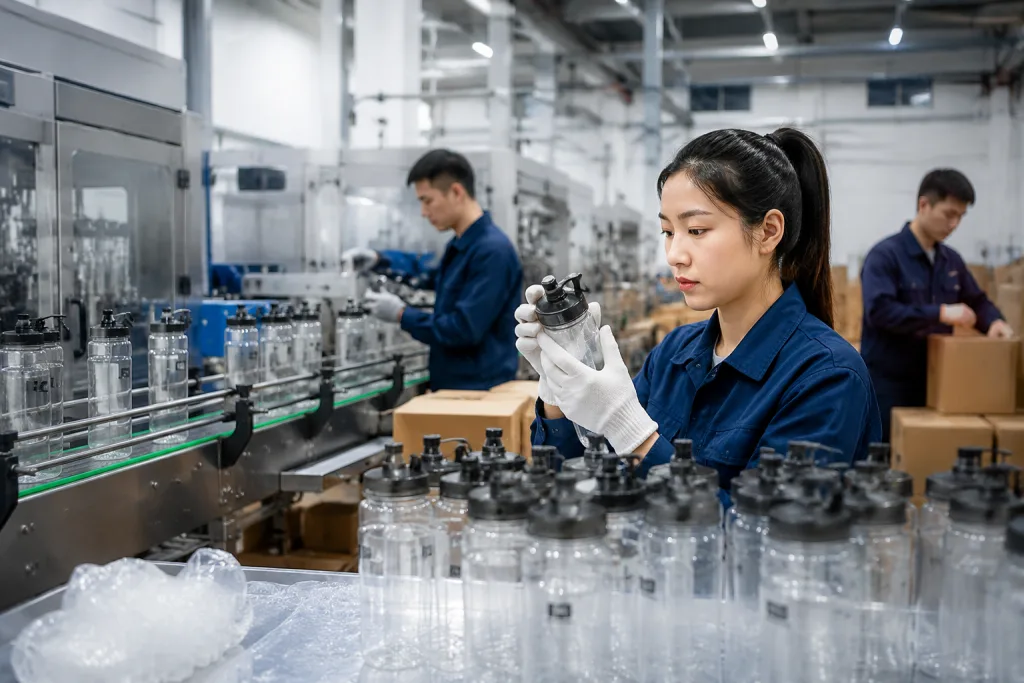
Key Takeaways
- For pc sport bottle custom, changing wall thickness from 2.2 mm to 2.8 mm can raise unit cost by 6% to 12% but cut crack complaints in transit.
- Most standard-color PC sport bottles start at MOQ 3,000 pcs per SKU; new lid tooling usually adds USD 2,500 to 6,000 and 18 to 25 days.
- Silkscreen is usually USD 0.08 to 0.18 cheaper than wrap printing per unit at 5,000 pcs, but logo coverage and dishwasher resistance differ.
- AQL 2.5 for major defects and 4.0 for minor defects should be written into the PO, not discussed after production in China starts.
You can approve a bottle that looks good in the render and still land the wrong SKU for your market. We see this on the line all the time. A pc sport bottle custom project gets sold on color and logo, while the real commercial call sits in the spec sheet: resin grade, 0.8 mm vs 1.2 mm wall, lid leak rate, decoration method, carton count, and test standard. For retail, promo, or a distributor program, those lines decide margin and complaint rate. This is the wrong question to ask: not “Can you match this color?” but “What spec are we running?”
At BottleForge Industrial in Zhejiang, China, new buyers often ask for a custom canteen or customized drinkware sample first, then the buyer flags the price after packaging and compliance are added. We’ve seen POs with the carton mark typo carried through 3 rounds. Better to review the spec line by line before sampling, with MOQ, packing, and test scope locked first. QC pulled the sample too late on jobs like that. You cut rework, keep MOQ realistic, and turn a vague 35-day plan into a schedule we can actually ship against.
Start with resin, not color
The first line on a pc sport bottle custom spec should be the body material and grade, not Pantone. Start with resin. For PC sport bottles, spell out virgin polycarbonate resin, food-contact compliance, clarity target, and whether recycled content is allowed. A lot of buyers send us a PO that just says “PC bottle,” sometimes with only a 0.6 mm wall note and a logo file, then expect every canteen manufacturer to quote the same bottle. They won’t.
Virgin PC gives good impact strength, high transparency, and stable molding, but resin source still changes the result on the line. Melt flow shifts filling behavior, clarity shifts shelf appeal, and color pickup is not the same from one supplier to the next. If the bottle is for gym retail or campus programs, haze is a problem; QC pulled the sample more than once because a clear body looked gray under a 6500K light box. For a canteen promotional campaign, buyers usually push price first. In that case, a lower optical standard may be fine if the compliance file is clean. This is the wrong question to ask: “Can you match the Pantone?” Ask first what resin you are buying.
Ask your canteen supplier to confirm:
- Food-contact status: REACH, LFGB where needed, and California Proposition 65 screening if you sell in North America.
- Resin source: virgin only, with batch traceability.
- Odor standard: no abnormal smell after 24-hour water hold test.
- Temperature range: typical use, not “boiling water safe” unless validated.
In Zhejiang, China, serious factories keep incoming resin records by lot, and we run that against each molding date and machine number. That matters later if a buyer flagged odor, stress cracking, or brittleness after shipment. We’ve seen this go sideways from one mixed lot. For most B2B orders, decide early if the project is low-cost custom drinkware or a retail-grade customized canteen program. The math doesn’t work if you try to hit both with one spec: you end up above promo pricing and below retail expectation.
Your logo can be changed in one day. The resin choice can affect every bottle you ship for the next 12 months.
Wall thickness decides strength and freight
The next spec is body weight, which comes from wall thickness. Buyers look at 650 ml or 750 ml first, but that is the wrong question to ask. Two bottles with the same volume can perform differently in transit. Typical PC sport bottle wall thickness runs around 2.2 mm to 2.8 mm depending on shape, grip panels, and thread design. A lighter bottle might save USD 0.05 to 0.12 per unit, but on parcel routes in Europe or North America, we’ve seen thin-wall bottles crack at the shoulder radius and base ring after carton drop tests from 76 cm.
For a canteen custom project, ask for three numbers: bottle net weight, average wall thickness, and minimum wall thickness at the thinnest point. Some canteen manufacturers quote average thickness only. That hides the weak area. If the bottle has finger grooves or a sculpted waist, minimum wall can be 15% to 20% lower than the average. QC pulled the sample on one project and found 2.4 mm average, but only 1.9 mm at the groove. That is where field failures start, and we’ve seen this go sideways after the buyer flagged random cracks in the first 3,000 pcs.
What this changes for you
- Durability: thicker walls improve drop performance. On our line, a 145 g bottle usually survives abuse better than a 118 g version with the same mold height.
- Freight: heavier bottles raise sea and air cost, especially on FBA replenishment. The math doesn’t work if you add 27 g per unit and then ship 50,000 pcs by air.
- Perceived value: a 145 g bottle feels noticeably more premium than a 118 g bottle in hand. Buyers notice this fast at sample review.
- Molding cycle: heavier parts may extend cycle time by several seconds, which can affect lead time at peak season. On injection molding, even 4 to 6 seconds matters when the line is full.
A practical range for most customized drinkware programs is 130 g to 170 g for a 700 ml PC body, depending on shape. If your canteen factory proposes something far below that, ask why. At BottleForge Industrial in Zhejiang, China, our rule is simple: if the sample looks good but the weight is too light for the sales channel, we say so before tooling approval. We ship plenty of retail programs, and a pretty sample means nothing if returns start after the first drop.
Lid system is the complaint center
On the drawing, the lid looks minor. On the claim sheet, it is usually complaint item No. 1. For a pc sport bottle custom order, lock down the lid structure, cap material, seal material, thread finish, pull spout or flip top, carry loop strength, and leak standard. Write “sport lid” on the PO and 6 factories will quote 6 different builds. We’ve seen this go sideways after first sample, usually when QC checks the thread pitch gauge and finds the cap finish does not match the approved bottle neck.
Common builds are PC or PP caps with silicone seals. If you want a one-hand flip lid, ask for hinge life data and spring test results, not just a nice rendering. This is the wrong question to ask: “Does it work?” Ask how many cycles it passed on the line. For school or promo screw-top canteen customizable programs, simple lids usually cut defects and cost. A complicated lid may add only USD 0.18 to 0.40 in quotation, but after-sales claims can wipe that out fast. Last year one buyer flagged weak spring-back on a flip cap after 800 openings.
Specify functional tests in plain language:
- Leak test: no leakage after inversion for 30 minutes and after 10 shake cycles.
- Handle or loop test: hold 5 kg static load for 1 hour.
- Thread engagement: cap closes smoothly within specified torque range.
- Life cycle: flip top opens and closes 3,000 to 5,000 cycles without failure for retail programs.
If your buyer is a canteen distributor, canteen distributors, or a distributor canteen wholesaler supplying institutions, simple lids are usually the better business choice. Replacement rate matters more than shelf theatrics. We ship plenty of institutional orders at 10,000 pcs MOQ where buyers reject fancy lids after the first drop test. If the end customer wants a custom growler or customizable growler style look with a larger handle and heavier cap, price the extra resin weight and stronger carton spec up front. The math doesn’t work if you add 28 g plastic to the lid and still pack in the same 24-unit master carton.
Put spare seal approval into the project file. Do it early. If a canteen supplier changes silicone hardness from 50 shore A to 60 shore A without formal notice, leak performance can shift at once. QC pulled a sample like this before: same lid drawing, same color, different seal feel, and failed inversion at 20 minutes. That small factory-floor change in China causes the big headache later.
Decoration must match the sales channel
Decoration is where quotes jump, and buyers usually cause it by overspecing the print. For pc sport bottle custom, we usually run silkscreen, heat transfer, wrap print, in-mold effect on some molds, laser marking on a lid ring or metal insert, and sticker labeling for short runs under 1,000 pcs. The right choice comes down to order volume, artwork coverage, and end use. We’ve seen this go sideways when a buyer approves a 360° graphic on a bottle with a 6 mm grip rib and then asks why registration is off.
Silkscreen is still the workhorse for canteen customized and customized canteen orders. It suits 1 to 2 spot colors and usually moves fastest for MOQ 3,000 to 10,000 pcs because the line setup is simple and QC can clear the first-off sample in minutes. Typical add-on cost is around USD 0.06 to 0.15 per color per position. Full-wrap transfer or wrap printing has stronger shelf impact at retail, but it can add USD 0.18 to 0.35 depending on coverage and setup. If the bottle is for outdoor use, ask for adhesion and rub testing with alcohol wipe or 3M tape pull, not just a clean preproduction sample. That sample can lie.
Decoration questions that affect margin
- Is the artwork placed on a flat panel or a curved grip zone?
- Do you need Pantone matching within Delta E tolerance?
- Will the product be hand-washed only, or do you expect repeated detergent exposure?
- Do you need individual barcode, FNSKU, or retail sticker application?
For a custom drinkware or customizable drinkware program sold through e-commerce, barcode placement and pack-out execution matter as much as the print. We ship plenty of Amazon orders where the buyer flagged a 2 mm label offset faster than a slight ink shade shift. For a canteen promotional order, exact Pantone often matters more than wash durability because the usage window is short. For a customized growler or distributor growler request with large graphics, ask the canteen factory for the print-safe panel size on that mold. This is the right question to ask. Buyers send wrap files every month that cannot register cleanly on the selected bottle body.
If you are comparing canteen suppliers, compare decoration yield too. QC pulled one batch last season with a 7% print rejection rate from scuffing at the curing rack. A lower bottle price with a 7% print rejection rate is not cheaper in the real world.
Packaging is where profits disappear
Packaging is where margin leaks. It drives breakage rate, carton fill, warehouse labor, and Amazon chargebacks. In 7 out of 10 custom canteen and customized drinkware POs we see, the team spends days on bottle color and lid tooling, then copies packaging from an old PO with the wrong carton mark or even a typo in the item code. That is how freight goes up, or protection falls short.
Standard export packing for a PC sport bottle may be one polybag, egg-crate divider or partition, then master carton. That is the baseline, not the spec. You still need to lock carton size, gross weight cap, drop test level, barcode position, and whether inner boxes are needed. QC pulled the sample last month on a 24 pcs/carton pack because the outer barcode sat across the carton seam and the buyer flagged it. If your end market is club retail or large distributor drinkware business, plain bulk pack is often enough. If the order is for branded retail, color box cost can run from USD 0.22 to 0.65 depending on board grade, print coverage, and insert structure.
Key packaging specs to lock down:
- Master carton gross weight: keep under 15 kg if manual handling rules apply.
- Carton drop: usually 76 cm for export cartons, more for e-commerce packaging validation.
- Barcode control: outer carton, inner pack, and item labels where needed.
- Container loading: units per carton and cartons per 40HQ to estimate freight correctly.
A bottle that nests poorly can lose 8% to 15% in container utilization versus a more efficient shape. The math does not work if you save USD 0.03 on unit price and lose 180 to 320 sets per 40HQ because the shoulder diameter is 3 mm too wide for tight packing. We run capacity planning from Zhejiang, China with monthly output around 600,000 units across multiple drinkware lines, and buyers who fix packaging early usually land a better delivered cost than buyers who only push FOB price. We ship both ways. We have seen this go sideways.
Compliance and QC need written limits
The spec sheet is not complete until compliance and QC are written as limits you can measure. This is where serious B2B buyers pull away from casual importers. If your PO says only “food safe” and “good quality,” you are setting up an argument after goods are packed. We’ve seen this go sideways. A reliable canteen supplier or canteen factory should accept clear standards on paper, down to print position tolerance in mm and seal performance after line testing.
For Europe, REACH screening and LFGB-related food-contact testing may be relevant depending on channel and buyer policy. For North America, you may need Proposition 65 review and retailer-specific protocols. For children’s use, ASTM or CPSIA-related requirements can enter the picture depending on category and market. Do not assume one report covers all versions; a lid colorant change can trigger new testing needs. QC pulled the sample on one blue lid run because the pigment lot changed, and the buyer flagged it before mass production. Good catch.
Your QC plan should state:
- AQL standard: commonly AQL 2.5 major, 4.0 minor, 0 critical.
- Inspection stage: preproduction sample, inline, and final random inspection.
- Functional checks: leak, odor, print adhesion, drop, and assembly fit.
- Appearance limits: acceptable scratch length, flow marks, color variance, and black specks.
If you are working with canteen manufacturers in China, ask who owns the master sample and who signs off on color and print placement. This is the right question to ask. It avoids the standard dispute where the sales sample, approved sample, and production sample are all slightly different. We run into this on logo position more than buyers expect; 2 mm off-center on a 1-color silk print is enough for a claim. Tie every approval to a dated specification sheet and photo set, and make sure the PO does not carry a typo on item code or lid color.
For larger programs, especially with canteen distributors or canteen distributor networks, add a corrective action loop. If final inspection fails on leakage above the agreed threshold, the factory should rework or sort before shipment, not ask you to “accept a little.” The math doesn’t work once 5,000 pcs hit your warehouse with a cap issue. On our line, failed units go back through 100% air-pressure leak check before we ship. This is standard commercial discipline, not mistrust.
MOQ, tooling, and lead time reality
Here are the numbers that decide the project. For a typical pc sport bottle custom order from a Zhejiang canteen manufacturer, MOQ usually starts at 3,000 pcs per color per size if we run an existing bottle mold and standard lid colors. Once you ask for a custom body color, special finish, custom color box, and a unique lid color at that same volume, the math doesn't work. You will get a higher unit price or a higher MOQ. On the line, even a lid color change means a material swap, purge loss, and a fresh first-piece check.
New bottle tooling usually runs from USD 4,000 to 12,000, based on structure and parting-line complexity. New lid tooling is often USD 2,500 to 6,000. For a fresh mold, sampling normally needs 15 to 25 days after drawing approval; our mold shop will not cut steel until the 2D file and Pantone note are signed off. Mass production is commonly 30 to 45 days after sample confirmation and deposit, assuming artwork, packaging, and testing requirements are settled. In peak season in China, especially before major holiday shutdowns, add 7 to 15 days. We've seen this go sideways over small things—a PO typo on carton marks or a logo file sent in low-resolution JPG instead of AI.
Ask your canteen vendors or canteen suppliers these practical questions before placing the PO:
- What is the MOQ by bottle color, lid color, and print variation?
- Can artwork changes share the same MOQ if body and lid stay unchanged?
- What is the lead time for repeat orders with no spec changes?
- Is the price FOB Ningbo or FOB Shanghai, and what carton count is quoted?
If you are a canteen distributor, canteen supplier, or distributor growler buyer building a product line, standardize components early. Reusing one lid across two bottle bodies cuts spare-part inventory and reduces future MOQ pressure; one buyer did this on a 63mm neck finish and avoided carrying 2 extra lid SKUs. This is the right question to ask. The buyers who ship cleanly are not the ones asking for every option. They know which changes move sell-through, and which ones only slow sourcing and add cost. QC pulled a sample last month where the bottle body was fine, but the custom box insert was 3 mm off and held the whole lot for rework.
Send your spec sheet for a practical quote review
Share target price, MOQ, market, and artwork. We will mark the specs that raise cost, risk, or lead time before you commit.
Frequently asked questions
What MOQ should I expect for a pc sport bottle custom order?
For an existing mold, the practical MOQ is usually 3,000 pcs per SKU, often defined by one body color, one lid color, and one print layout. Some factories in China will quote 2,000 pcs, but that usually means fewer color options or a higher unit price. If you need a custom Pantone body, custom color box, and multiple logo versions, MOQ can move to 5,000 pcs or more. For repeat orders with the same spec, MOQ may stay the same but lead time is shorter. If you are buying as a canteen distributor or for a canteen promotional program, ask whether mixed artwork can run under one master body and lid combination. That can save real money.
How much does new tooling cost for a custom canteen bottle?
A new PC bottle body mold typically costs about USD 4,000 to 12,000, depending on bottle size, grip details, and mold cavities. A new lid mold is often USD 2,500 to 6,000. If the design needs a flip-top mechanism, handle insert, or unusual thread geometry, costs can go higher. Prototype and first-off samples usually take 15 to 25 days after 3D drawing approval. Before you approve tooling, make sure the factory confirms ownership terms, maintenance responsibility, and whether the mold is dedicated or shared. Many buyers focus only on the mold invoice, but the more important question is whether the tool is designed for stable production at your target volume.
Is PC still acceptable for Europe and North America?
PC can be acceptable, but you should not rely on assumptions. You need market-specific compliance review based on the final product, including body resin, lid materials, colorants, seals, and decoration. For Europe, buyers often ask for REACH-related screening and food-contact documentation. For North America, retailer policies may also require Proposition 65 review or additional declarations. If the bottle is intended for children, the requirements can be stricter. Ask your canteen manufacturer for test history on similar SKUs, but remember that a test report is only valid for the tested construction. Changing seal material or ink can create a new compliance situation.
Which print method is best for customized drinkware bottles?
For most B2B orders, silkscreen is the best starting point because it is economical, fast, and stable for 1 to 2 spot colors. At volumes around 5,000 pcs, silkscreen can save roughly USD 0.08 to 0.18 per unit versus fuller coverage methods. If your product is retail-focused and you need strong shelf impact, wrap print or transfer can be worth the added cost of about USD 0.18 to 0.35 per unit. The decision should follow the sales channel. Promotional use usually prioritizes budget and brand color. Retail use prioritizes appearance and consistency. Always ask for print adhesion testing, especially if the bottle will be washed frequently.
How do I compare canteen suppliers beyond unit price?
Use a comparison sheet with at least eight lines: resin grade, bottle net weight, minimum wall thickness, lid structure, seal material, decoration method, packaging spec, and QC standard. Then add commercial terms such as MOQ, tooling cost, lead time, and FOB port. A supplier that is USD 0.07 cheaper can still be worse value if the carton count is inefficient or the leak rate is higher. Ask for AQL terms, production capacity, and repeat-order timing. A factory with 600,000 units per month and a 35-day repeat lead time may be safer for a long program than a smaller vendor with a lower opening quote but unstable scheduling.