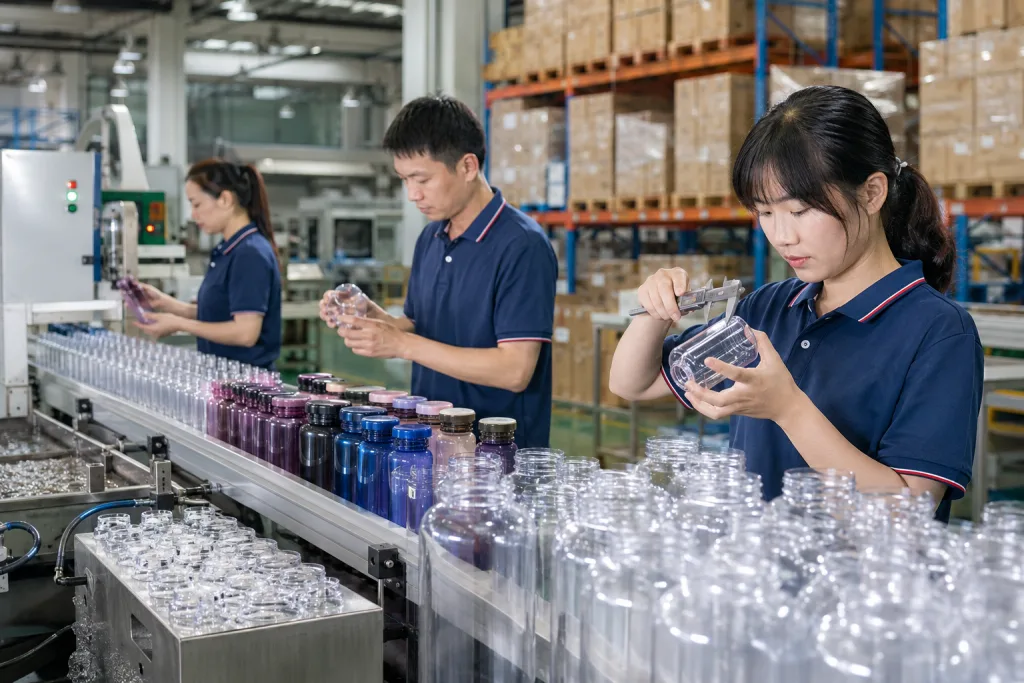
Key Takeaways
- A workable starting MOQ for custom pc polypropylene bottle wholesale is usually 3,000-5,000 units per color, with 25-35 day lead time after sample approval.
- For routine inspections, use AQL 2.5 for major defects and 4.0 for minor defects, with 100% leak testing before packing.
- A 650 ml PP bottle with standard print and single-color lid often lands around USD 1.10-1.85 FOB China at 5,000 units, depending on resin grade and decoration.
- If you need EU and North America coverage, ask for REACH, LFGB or food-contact declarations, and ASTM or CPSIA checks for kids-oriented programs before deposit.
You are not buying a bottle. You are buying a repeatable production result: correct resin, stable color, leak-free lids, compliant paperwork, and cartons that hold up from Zhejiang, China to your warehouse. First orders fail here all the time. We’ve seen 3,000 bottles land with odor complaints, a 0.5 mm neck mismatch, or a logo that failed after one dishwasher cycle because the print bake time on the line was off by 20 seconds.
For pc polypropylene bottle wholesale, the job is to lock the specification before tooling, samples, and mass production start. If you also source bulk canteen, bulk drinkware, wholesale growler, or beer tumbler wholesale bulk for the same catalog, the same rule applies: details beat assumptions. This is the wrong question to ask: “What is your best price?” Ask what resin grade, neck tolerance, logo test standard, and carton drop spec are written on the sheet. At BottleForge Industrial in Hangzhou, Zhejiang, we build around 600,000 units per month, and the clean orders usually start with a disciplined spec sheet. QC pulled the sample, matched the lid with a go/no-go gauge, and the order ran smoothly after that.
Start with the actual use case
Start with a real buying brief. You are a brand owner in Germany or Canada getting a spring hydration line ready. You need one 650 ml bottle for retail, one 1,000 ml wholesale canteen for gyms, and a matching drinkware wholesale line later. Sales wants a clean silhouette, a carry-loop lid, and four translucent colors. The warehouse team set a hard carton limit under 14 kg, which usually means we check gross weight on a floor scale before the first packing drop test. Compliance wants food-contact paperwork accepted in the EU and North America. Margin says the FOB China bottle must stay under USD 1.50 at 5,000 pieces.
It sounds easy. It is not. This brief already decides half the engineering work on the line. First question: do you mean PC, PP, or a mixed-material program? Buyers use “pc polypropylene bottle wholesale” loosely on POs, and we have seen this go sideways when the PO says PC but the approved cap drawing calls for PP. They are different materials. PC is rigid and clear, but it gets more scrutiny in compliance reviews. PP is lighter, handles stress cracking better, and we run it often for lids, caps, straws, and some bottle bodies. If your market wants cleaner compliance and lower cost, buyers in Europe often shift the body to PP, Tritan-type copolyester, glass, or stainless, then keep PP closures. This is the right question to ask early, not after mold steel is cut.
Your first job is to write the performance brief, not just the shape brief.
- Capacity tolerance: for example 650 ml +/- 3%
- Target weight: body 92-105 g, lid 28-35 g
- Drop requirement: 3 drops from 1.0 m when empty
- Leak test: no leakage after 30 minutes inverted
- Temperature use: 0-80 C for PP body, note limits clearly
- Dishwasher claim: top rack only or hand wash only
- Odor standard: no abnormal smell after 24 hours sealed
If you also plan canteen bulk, bulk growler, or alcohol flask wholesale bulk in the same sourcing cycle, split the briefs. One sheet per use case. QC pulled the sample on a shared program last year, and the growler cap passed water leak but failed torque hold after carbonation pressure. A beer growler wholesale bulk program needs different controls than a sports bottle. Carbonation retention matters. Neck finish matters. Closure torque and liner choice matter more. Do not force one generic bottle brief across the whole catalog; the math does not work.
Write the specification before asking price
Most price mistakes start with a loose RFQ. We see this every week. One photo can produce three different quotes from three factories in Zhejiang because the lid structure, resin grade, and wall thickness were never written down. On our side, the line needs one sheet that purchasing, tooling, and QC can read the same way; otherwise QC pulled the sample at 1.6 mm while the buyer expected 2.0 mm.
What your RFQ should include
- Material by part: bottle body, lid, loop, gasket, straw, sleeve
- Capacity and brimful capacity
- Dimensions: height, diameter, neck finish, thread style
- Wall thickness target: for example PP body 1.8-2.3 mm
- Weight tolerance: +/- 3 g on body, +/- 2 g on lid
- Color reference: Pantone code or approved chip
- Decoration method: silk screen, heat transfer, IMD, laser, embossed
- Packaging: polybag or egg-crate, inner box, master carton size
- Carton drop standard: 1 corner, 3 edges, 6 faces from 76 cm
- Compliance request: REACH, LFGB declaration, BPA statement where relevant
Here is a live-style example. A 650 ml PP bottle with PP screw lid, silicone gasket, one-color silk screen logo, and standard export carton might quote like this from Zhejiang, China. This assumes a normal 55 x 38 x 42 cm master carton and no special insert, because the math changes fast once the buyer asks for retail packing.
- 5,000 units: USD 1.38-1.72 FOB Ningbo
- 10,000 units: USD 1.20-1.55 FOB Ningbo
- 20,000 units: USD 1.10-1.42 FOB Ningbo
Add USD 80-150 per color for silk screen setup, or USD 250-600 for a more complex heat transfer layout. That part is straightforward. What moves the quote fast is recycled content, custom mold changes, or special soft-touch coating; we’ve seen a lid revision of 0.8 mm at the thread add new tooling cost and push sampling back 7 days. Buyers often ask for price first and spec later. This is the wrong question to ask.
Use the same discipline on related programs. A wholesale growler in stainless steel should be written by steel grade, vacuum structure, neck diameter, and passivation status; if passivation is skipped, QC usually catches rust-tone marks after salt test. A beer tumbler in bulk needs gauge, electropolish level, and lid fit, not just a capacity number. An alcohol flask in bulk is driven by weld quality, cap tether, and food-grade inner finish. We ship cleaner orders when the PO is this clear. Last month a buyer flagged a typo on neck size—38 mm on the drawing, 43 mm on the PO—and that one line would have caused vague pricing and a bad sample.
You should not approve a quotation until every component has a named material, weight, and test requirement.
Sampling is where risk gets cheaper
After the quotation is aligned, run sampling in three layers. Skip one, and you usually pay for it later on the line.
Layer 1: stock sample. This shows whether the factory already has a close base model. You’re checking hand feel, lid action, and basic build quality. We usually check thread engagement by hand for 3 full turns, sniff for resin odor right after opening the polybag, and confirm the base sits flat within 1.0 mm wobble on a glass table.
Layer 2: pre-production sample. This is built with your actual color, logo, packaging, and any mold change. For an order of 5,000-10,000 units, this sample is the physical contract. Approve it against a written checklist. Not memory. We’ve seen this go sideways because a buyer signed off by phone, then later flagged a 2 mm logo shift that was already on the sample.
Layer 3: sealed golden sample. Keep one with your team, one with the China factory, and one with the inspection team. This avoids the old argument about “mass production follows approved sample” when QC pulled the sample from one carton and the buyer was looking at a different one with a revised lid insert.
For pc polypropylene bottle wholesale, check these points on the pre-production sample:
- Capacity at brimful and fill line
- Net weight per component
- Logo adhesion after 20 rub cycles with dry cloth and 20 with wet cloth
- Leak test after torque application, for example 12-16 lbf·in on screw cap
- Color shift under daylight and cool white light
- Odor after 24 hours closed at room temperature
- Fit between bottle and accessory parts sourced from different tools
If you also buy canteen wholesale or drinkware bulk assortments, ask for a sample board showing all colorways together. This is the right question to ask early. Buyers often approve navy, sage, and smoke gray one by one, then find on shelf that the set does not read as one family. We ship a taped color board for this check, and it saves arguments later. That is not a factory defect; it is a sampling control miss.
Typical sample timing from Hangzhou or wider Zhejiang is 3-7 days for stock samples and 7-15 days for custom pre-production samples. New mold or a major tool change can add 20-30 days. If a factory promises a complex custom sample in 48 hours, the math usually doesn’t work. Either they skipped proper logo setup, or they sent a lookalike from old tooling.
Control production before cartons close
Mass production is where a 1 mm miss turns into a chargeback. Check before cartons close. The right control plan is simple: incoming material check, in-process check, then final random inspection. On our line, QC pulls the first molded bottle and cuts it at the gate area to confirm fill and wall build before full run.
Incoming checks
Ask the factory to confirm resin grade, color masterbatch, silicone hardness, and packaging material before the machines start. If your spec says PP body with food-contact declaration, the resin lot on the hopper tag must match the paperwork. We’ve seen this go sideways when a sub-supplier is late and purchasing swaps lots to save 12 hours. Buyer pushback is often “PP is PP,” but this is the wrong question to ask; lot traceability matters more than the sales name on the PO.
In-process checks
For bottles, the common risks are wall thickness drift, short shots, flash on the parting line, logo offset, and cap torque moving out of range. A factory that has its act together records dimensions and weight every 2 hours per machine, not once per shift. We use a digital scale and torque tester at the line, and QC logs the cavity number if one mold cavity starts to run light. For example:
- Body weight target 98 g, control range 96.5-99.5 g
- Wall thickness target 2.0 mm, minimum critical point 1.6 mm
- Logo position tolerance +/- 1.5 mm
- Cap torque 12-16 lbf·in
- Leak test 100% by air pressure or inverted water hold
Final inspection should use an agreed AQL. For wholesale drinkware orders, AQL 2.5 major and 4.0 minor is a workable standard. Critical defects stay at zero tolerance. QC pulled the sample from one lot last month and found a sharp flash under the neck ring; the carton count was fine, but the lot still failed. Examples:
- Critical: sharp edge, wrong material, missing food-contact part, severe leakage
- Major: logo wrong color, cracked lid, unstable base, obvious contamination
- Minor: slight print dot, small color flow mark, carton scuff without product damage
If your shipment includes beer growler in bulk, beer tumbler wholesale, or alcohol flask wholesale in the same container, use separate checklists by SKU. Procurement teams often roll everything into one “drinkware QC” sheet. The math doesn’t work. A growler handle check and a flask cap-thread check are not the same job. We once saw a mixed-container PO with the lid color code typed wrong on one SKU, and the generic checklist never caught it.
At BottleForge Industrial, we normally run 100% leak tests and random carton drop checks per lot. We ship standard custom orders in 25-35 days after sample approval and deposit. For peak-season canteen bulk programs, give yourself 40 days, not 25, unless the factory already reserved line capacity. If not, you end up squeezing molding, printing, and packing into the same week, and that’s where inspection findings start stacking up.
Compliance, labeling, and shipment details
Good bottles still get stuck at the port if the paperwork is sloppy. For Europe and North America, the required file set changes by product type, age grading, and sales channel, so sort that out before you place the PO. We have seen a plain PP bottle clear with a food-contact declaration and migration report, then a kids bottle on the next line get held for CPSIA review because the buyer changed the age claim on the card insert. One typo on the PO can start the mess.
You do not need every test. You need the correct ones for the market, and this is the right question to ask before sampling gets approved. Ask your supplier in China for:
- Material declaration by component
- Food-contact test report or declaration aligned with destination market
- REACH SVHC statement when selling into Europe
- BSCI or social audit status if your customer requires it
- ISO 9001 certificate if claimed
- AQL inspection report before balance payment
Handle labeling early. On the factory side, we usually lock carton marks with the artwork file before mass production, not after the cartons are printed. For retail distribution, carton marks should show item code, quantity, gross and net weight, carton size, and country of origin. For online orders, unit packs often need FNSKU labels or a suffocation warning. Put all of that into the artwork PDF. Do not bury it in an email 18 days later after the line has started.
Freight planning matters. Bottle orders often cube out before they weigh out, and the math does not work if carton size is an afterthought. A typical 650 ml plastic bottle in a standard export carton might pack 48 units per carton, around 60 x 40 x 50 cm, with gross weight near 9.5-11.5 kg depending on packaging. That number drives pallet pattern, container loading, and warehouse handling. If you are mixing bulk drinkware, wholesale canteen, and growler wholesale items in one Zhejiang shipment, ask for a load plan before production ends. We run these checks with carton dimensions in mm, and one oversized carton can wreck container efficiency fast.
FOB Ningbo or FOB Shanghai are normal terms. If this is your first import from China, ask for both FOB and DDP so you can compare landed cost, not just piece price. We have seen buyers save $0.06 per bottle on FOB, then lose it on relabeling, claim settlements, and poor container fill. QC pulled the sample, freight was the real problem.
What the finished order should look like
Before you release the balance payment, the order file should read like a controlled production job, not a loose purchase. Say the PO covers 8,000 units of a 650 ml PP bottle and 2,000 units of a canteen bulk variant. At this stage, we want the line standard locked, the golden sample signed, and the carton mark checked for the usual typo on the PO. The approved commercial result should look like this:
- SKU A: 650 ml PP bottle, smoke and sage, 4,000 each
- Body weight 98 g +/- 3 g, lid weight 31 g +/- 2 g
- One-color silk screen, adhesion passed internal rub test
- Leak test 100% passed before packing
- Carton pack 48 units, gross weight 10.2 kg average
- Inspection result: pass at AQL 2.5/4.0
- Lead time 31 days from deposit and art approval
- FOB Ningbo unit price USD 1.34 for main SKU, USD 1.48 for larger canteen
This is what a manageable first order looks like. Clean file. Clear limits. No debate on whether the cap should be glossy or matte because the approved sample already settled it. We have seen this go sideways after mass production starts, and then QC pulled the sample only to find the lid texture was never written into the spec.
The same workflow works for wholesale growler, beer tumbler in bulk, alcohol flask bulk, and broader drinkware bulk programs. The product changes. The control points change. On growler wholesale orders, we watch sealing and pressure behavior harder, often with a 30-minute upside-down hold test on the bench. Beer growler in bulk usually brings buyer pushback on carry handle strength and neck accuracy, especially if the cap thread fit is tight by 0.3 mm. Alcohol flask wholesale bulk puts more focus on weld appearance, cap fit, and flavor neutrality. The purchasing logic stays the same: define use, freeze spec, approve sample, inspect to AQL, and ship against a documented pack plan.
If you are sourcing from Zhejiang or elsewhere in China for the first time, do not chase 2 cents by leaving the spec open. This is the wrong question to ask. The expensive mistake is not a higher quoted price; it is receiving 5,000 units that match a loose PO on paper and still fail in your market. We ship plenty of repeat orders, and the math does not work when one unclear detail forces rework on 5,000 lids or 104 cartons. Good wholesale drinkware sourcing is not about bargaining harder. It is about making the order hard to misunderstand.
Send your bottle spec for a fast factory review
Share capacity, material, logo method, target price, and market. We will flag risk points, MOQ, and realistic lead time before you place the PO.
Frequently asked questions
What MOQ should I expect for pc polypropylene bottle wholesale?
For a custom color and logo program, a realistic MOQ is 3,000-5,000 units per SKU, often split by 1-2 colors. If you use an existing mold and standard lid, some factories in China can accept 2,000 units, but unit price will be higher by roughly USD 0.08-0.20. New mold development usually needs a larger commitment or tooling charge. If you are building a broader wholesale drinkware range, combine related SKUs carefully. Mixing canteen wholesale, drinkware bulk, and beer tumbler wholesale into one PO helps freight utilization, but each item still needs its own MOQ and inspection standard.
How do I choose between PC and PP for a bottle order?
Start with your market and compliance comfort level. PP is common for closures and can also be used for bottle bodies when you want lower cost, good toughness, and simpler food-contact positioning. PC can be rigid and clear, but many buyers in Europe and North America prefer to avoid extra compliance questions around it. For a mainstream retail hydration bottle, PP body wall thickness might run 1.8-2.3 mm with unit weights around 85-110 g depending on size. If clarity is a priority, many buyers now compare alternatives instead of relying on PC. Ask your supplier in Zhejiang, China to quote body material options side by side with test documents.
What QC checks matter most before shipment?
The non-negotiables are leak testing, weight control, dimensions, logo quality, odor check, and carton integrity. For final random inspection, AQL 2.5 major and 4.0 minor is a practical standard for many wholesale drinkware orders, with zero tolerance on critical defects. Ask for 100% leak testing before packing, not just sample leak testing. For a screw-cap bottle, also control torque, usually around 12-16 lbf·in depending on design. If your order includes wholesale growler or alcohol flask bulk items, add checks for seam finish, liner fit, and thread accuracy. A generic pass/fail report is not enough; you want measured data and defect photos.
What is a normal lead time from China for a custom bottle order?
If you use an existing mold and standard packaging, 25-35 days after deposit, artwork approval, and sample sign-off is typical. Custom color matching, special print, or carton inserts can push that to 35-40 days. New tooling or major mold changes often add 20-30 days before production lead time starts. During peak season, especially before summer programs or holiday retail resets, give Zhejiang factories more room. If a supplier promises 10-15 day delivery for a fully custom 5,000-piece order, check whether they are skipping sample control, subcontracting, or counting from the wrong milestone.
Can I combine bottles with growlers, tumblers, or flasks in one shipment?
Yes, and many procurement teams do it to improve container economics, but only if the packaging plan is controlled. A shipment that mixes canteen bulk, beer growler wholesale bulk, beer tumbler in bulk, and alcohol flask wholesale should have separate carton specs, inner pack counts, and pallet patterns by SKU. Bottles often cube out faster, while stainless items add weight. Ask for a container loading plan before production finishes. Also keep QC reports separate by product family. A pass result on one bulk drinkware SKU does not tell you anything about closure fit on a growler bulk line or weld quality on a flask order.