Key Takeaways
- Separate PC and PP clearly in the RFQ; mixing them can cause 20-40 day delays and wrong compliance paperwork
- Set leak, drop, odor, and dishwasher criteria before sampling; 0.65 mm walls and 48-hour leak tests are common baselines
- For custom drinkware, artwork approval should include Pantone, logo position tolerance of ±1.5 mm, and adhesion testing by tape test
- Use AQL 2.5/4.0 with pre-shipment checks, because a 10,000-unit order can hide 250+ cosmetic defects if standards stay vague
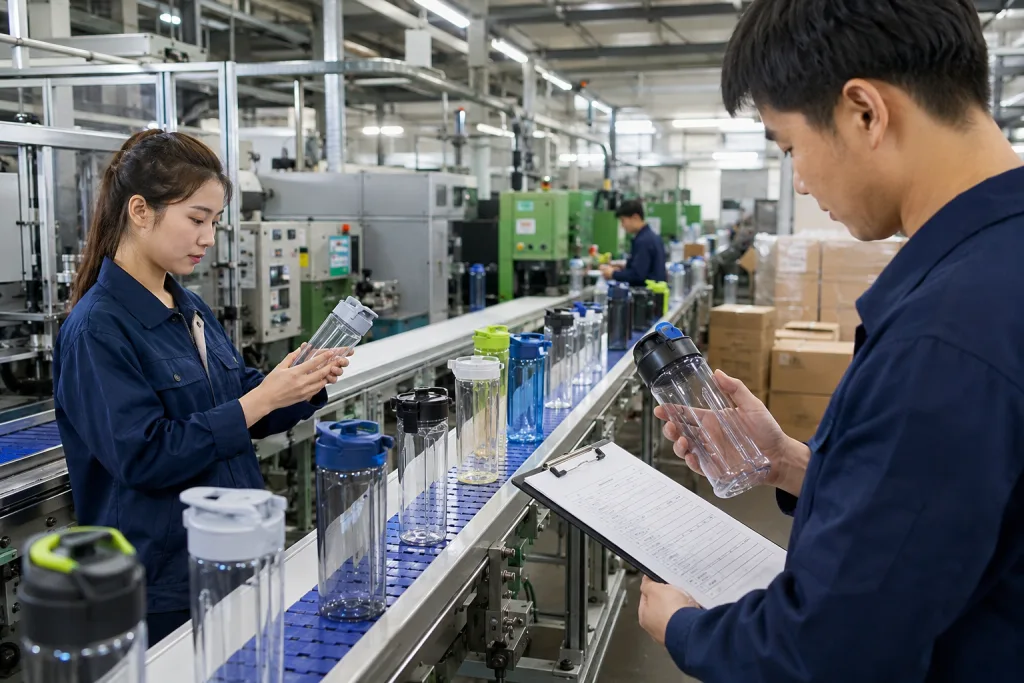
You usually do not lose money on a bottle because the quote was 3 cents too high. You lose it after the sample passes, then mass production shows stress marks at the gate, warped lids, leaking seals, bad logo registration, or a material declaration that does not match the PO. QC pulled samples like this more than once. A buyer guide should start there, with failure points, not trend talk.
If you are sourcing from a pc polypropylene bottle supplier in China, especially for custom drinkware programs in Europe or North America, you need a spec sheet that blocks common factory shortcuts before tooling and printing begin. On the line, this means calling out resin grade, seal fit, logo position tolerance in mm, and approval points before the first mold trial. In Zhejiang, where many canteen factory and canteen manufacturer projects are produced at scale, the difference between a smooth launch and a claims-heavy shipment is usually decided in the first 10 days. That early window matters. We have seen this go sideways when the buyer flagged a lid leak on day 12 instead of day 3.
Material confusion starts the problems
The first production failure usually does not happen on the line. It starts in the email thread. Buyers ask for a pc polypropylene bottle supplier when they actually need a polycarbonate bottle, a polypropylene bottle, or a split build with one resin for the body and another for the lid. That wording is where projects drift. PC and PP are not interchangeable. They run differently in the mold, polish to a different surface, pick up color in a different way, and need different compliance paperwork. We have seen a PO marked "PP clear bottle" get kicked back at sampling because the buyer expected PC-like transparency after the first gloss check.
If the supplier fills in the blanks, the risk is yours. A PP body is lighter, usually has better chemical resistance, and is common on sports bottles and kids drinkware. A PC body is clearer and stiffer, but the paperwork needs tighter control. This is the wrong question to ask if you only say "plastic bottle." In Europe and North America, ask for the exact resin grade, color masterbatch code, and declaration for REACH, LFGB where relevant, and FDA-contact compliance where applicable. QC pulled samples last month because the masterbatch code on the approval sheet did not match the drum label.
For a canteen custom or customized drinkware program, your RFQ should state:
- Body material: PP, PC, Tritan, or stainless steel, not “plastic”
- Lid material: often PP with silicone gasket
- Wall target: for single-wall plastic bottles, often 0.65 to 0.9 mm depending on shape and drop requirement
- Capacity tolerance: typically ±3%
- Use temperature: for example 0°C to 80°C for cold-fill programs
A practical supplier in Zhejiang should push back when the wording is loose. That is a good sign. At BottleForge Industrial in Hangzhou, Zhejiang, typical MOQ starts at 3,000 units per color for stock molds, and lead time is often 25 to 35 days after sample approval. We run this way because the math does not work if material is still vague after sampling. If a canteen supplier accepts a soft material description too easily, assume the shop floor will read it loosely. On one 700 ml bottle, the line stopped over a 0.1 mm wall-gap dispute that should have been settled in the RFQ.
A bottle quote without a material grade is not a real quote. It is only a placeholder price.
Leaks come from interfaces, not promises
Most leak claims get pinned on the cap. Usually that’s the wrong diagnosis. The failure sits in the interface stack: neck finish tolerance, thread engagement, gasket hardness, vent structure, and assembly torque. On our line, QC pulled a sample last month with a neck ovality drift of 0.18 mm, and that was enough to turn a good cap into a return problem. A canteen manufacturer can show you a leak-proof sample and still ship a leaking batch if those points are not locked down.
For a custom canteen, customizable canteen, or canteen customizable private-label order, put the test standard in writing. “No leak” is not a standard. It is a sales phrase. A reliable canteen factory or canteen vendor should be comfortable showing checks such as:
- Static leak test: filled with water, inverted for 24 to 48 hours
- Pressure or squeeze test: especially for sports bottle designs
- Drop test: 3 to 5 drops from 1.0 to 1.2 meters depending on pack style and end use
- Torque range: cap application torque documented per model
- Gasket verification: silicone shore hardness and visual seating check
If you buy for a canteen distributor, distributor canteen importer, or canteen distributors handling retail returns, this point lands fast. A 2% leak rate on 20,000 units means 400 customer complaints. It also means extra warehouse labor and a chargeback call. We have seen buyers focus on saving $0.03 per unit, then lose the margin in one bad returns cycle. The math does not work.
Ask whether the supplier runs 100% inline leak inspection or only sampling. For simple screw-cap polypropylene bottles, a lot of China factories still do batch testing only, often 32 pcs per lot on the bench. For flip-top or straw-lid designs, better factories add in-line checks because the hinge, plug, and straw connection create more failure points. The buyer flagged this on one PO after a straw tube was cut 2 mm short, and the lid sealed fine in pre-production but leaked in use. If you are building canteen promotional campaigns or distributor drinkware programs, ask for a retained golden sample from mass production, not only from pre-production.
The suppliers worth keeping usually tell you where leaks happen before you ask. They will mention thread jump, gasket roll, or under-torque numbers like 0.8 N·m versus 1.1 N·m. Be careful with canteen vendors that only repeat “our quality is good.” We have seen this go sideways too often.
Decoration failure ruins otherwise usable stock
A bottle can pass leak test and drop test, then still become dead stock because the decoration fails. Buyers judge the logo first. They do not start with wall thickness or thread fit. We have seen canteen customized, customized canteen, and custom drinkware orders get held for a 1.8 mm logo shift even though the body itself was fully usable.
The failure modes are routine on the line: silkscreen shifts by 2 mm, laser marking burns too deep, heat transfer wrinkles on curved walls, color drifts from Pantone, or the print scratches off during carton packing. QC pulled the sample once and found scuffing after only 12 bottles were packed neck-to-base with no PE divider. If you are sourcing a custom growler, customizable growler, or customized growler with plastic bottles, the decoration method changes by material, but the approval discipline stays the same. This is not the place to be loose.
What to lock before production
- Artwork file type: vector AI or PDF only
- Pantone reference: not “close to blue”
- Position tolerance: usually ±1.5 mm for manual print, tighter only if process supports it
- Adhesion standard: cross-hatch or 3M tape test after curing
- Dishwasher or hand-wash claim: stated in writing
A lot of canteen manufacturers in China still run semi-manual print positioning on lower-MOQ orders, often 1,000 to 3,000 units per color. That is normal. The wrong question to ask is whether the factory has big molding capacity. Ask how the print jig is set, how often the operator checks registration, and what tolerance they will sign on the PI. If you need exact wraparound alignment on 5,000 units, expect higher setup cost and slower output. Injection can run fast; decoration is usually the choke point.
For canteen promotional business, where every cent gets checked, decide early whether the logo needs to survive 50 hand washes or just look clean at event delivery. Those are two different specs, and the math does not work if you want both at the lowest price. We usually quote two options: a cheaper print and a durable print, with a clear gap, often around USD 0.05 to 0.18 per unit depending on print coverage and method. Buyers push back on that delta all the time, then accept it after a tape test sample comes back clean.
Tooling shortcuts show up after approval
A pre-production sample can hide mold trouble because a senior technician tweaks the machine shot by shot, sometimes over 2 or 3 hours on the line. Volume production tells the truth. That is where we see parting line flash over 0.15 mm, sink near the shoulder, uneven transparency, short shots in thin handle sections, and thread variation that turns into cap fit complaints after packing.
Buyers should ask less about “Can you make this shape?” and more about whether the mold runs clean at volume. That is the right question. For a canteen manufacturer or canteen factory, ask for cycle time in seconds, cavity count, expected mold life, and whether wear areas use replaceable inserts. In Zhejiang and other China production clusters, a factory that owns or controls tooling will usually answer directly, and if they dodge the point, we have seen this go sideways.
For stock molds, ask how many runs the tool has already finished and whether the last order was 5,000 units or 50,000. A tired stock mold can still make a decent sample but drift during a 30,000-unit order. For new molds, ask for:
- Tooling lead time: often 20 to 30 days for a simple plastic bottle component
- T1 and T2 sample plan: at least one revision loop, with QC pulling the sample and marking changes on the neck and base
- Critical dimensions: neck finish, base flatness, lid engagement
- Approved sample retention: one in factory, one with you
If you work with canteen suppliers or canteen vendors on a canteen custom launch, do not approve from photos only. Ask for weight, capacity, height, diameter, and thread fit data checked with a digital caliper and gauge plug. We ship reports like this every week. A 4-gram weight drift on a light plastic bottle is often the first warning that wall thickness is moving and the process is not locked.
Cheap tooling is rarely cheap once you start sorting defects. We have seen buyers save USD 1,500 on the mold quote, then lose more than that on hand rework, delayed vessel bookings, and replacement stock because cavity balance was off and one side kept running 3 grams light. The math does not work.
Compliance gaps become border problems
Buyers often treat compliance like end-stage paperwork. That's the wrong question to ask. If the raw resin, masterbatch, silicone gasket, or printing ink was not chosen for the destination market from day one, the file at shipment stage may be missing key pages or fail the claim itself. We have seen a clean bottle order sit at customs for 12 days over one missing declaration, and marketplace teams suspend listings just as fast.
For Europe, ask early for REACH and the food-contact declarations that match the actual bottle build. For the US and Canada, ask for material safety confirmation tied to food-contact use, not a generic resin statement. If the product is for children, add CPSIA or ASTM-related checks where the category and accessories require them. A straw matters. So does a bumper, carry strap, bite valve, or lid insert. QC pulled the sample on one order because the body resin file was complete, but the straw colorant had no supporting sheet. A canteen supplier sending only the body resin paperwork is not giving you a usable file.
For customized drinkware sold through retail or e-commerce, you should also confirm:
- Country of origin marking
- Barcode placement: EAN, UPC, or FNSKU for Amazon FBA
- Wash-care wording
- Carton labeling and carton drop requirements
Experienced canteen distributors and distributor growler importers usually lock this down in the PO template because one missing mark can hold 1 whole container. The buyer flagged it on a 40HQ shipment last year because the FNSKU sat 8 mm too close to the carton seam and scanners missed it. A solid China supplier should be able to package test to your ISTA-style requirement or at least run a practical transit simulation on the line. If they cannot, passing product inspection means little when the retail boxes arrive crushed.
Ask for factory audit status as well. BSCI, ISO 9001, and social compliance records do not prove the product is good, but they do tell you which canteen manufacturers are built for repeat export work. We ship with those records ready because buyers ask for them before deposit, not after. If your purchase order is above USD 30,000, third-party pre-shipment inspection usually makes sense. The math works.
Sampling that hides mass-production risk
Experienced buyers do not trust a perfect sample on its own. Sample-room pieces are often hand-finished, packed one by one, and checked one by one under bench light. The line is not. If you want a real read on a pc polypropylene bottle supplier, make the sample process mirror factory decisions as closely as possible, down to the print setup and carton pack-out.
For a customizable drinkware or custom canteen order, ask for three stages: stock sample, pre-production sample with your logo, and a production sample pulled from the first manufacturing run. This is where problems show up. We have seen a clean pre-pro sample turn into a messy first-run piece because the screen print registration shifted 1.5 mm after the operator changed the jig. The production pull tells you whether the sample room promise survives the actual print station, assembly line, and carton table.
Use an inspection plan tied to AQL. A common setup for drinkware is AQL 2.5 for major defects and AQL 4.0 for minor defects. Write the defect standard in plain language. Major defects should cover leakage, cracked body, wrong logo, wrong color family, or missing accessory. Minor defects can cover light scuffs, small print dust points, or carton appearance issues, depending on your channel. QC pulled the sample is not enough; you need the defect list on paper, signed against the PO.
If you are buying for canteen distributor networks, canteen distributors serving promotional wholesalers, or a distributor drinkware program with repeated SKUs, insist on a written quality standard sheet. Include photos of acceptable and unacceptable defects. This is not admin fluff. It cuts inspection arguments fast. We have had buyers flag a “white bottle” that was actually natural PP with 3 percent color masterbatch variance because the PO only said “off-white.” A one-page sheet with photos avoids that kind of fight.
Lead times should also be separated clearly:
- Sampling: 5 to 10 days for stock model logo sample
- Mass production: 25 to 35 days in normal season
- Peak season buffer: add 7 to 15 days before Q4
A supplier in Zhejiang or elsewhere in China who says “15 days for everything” is usually chasing the order, not scheduling capacity. We have seen this go sideways. The better answer is less pretty and more useful: 7 days for a logo sample, 28 days for production, then add 10 days if your order lands after the Mid-Autumn rush or before Q4 carton bookings tighten.
Price traps across the supply chain
The last failure mode is cost structure. Buyers stare at unit price and miss where margin starts leaking after the PO is signed. A canteen vendor with a USD 0.08 lower bottle price may be running a 0.3 mm thinner wall, loose color matching at the hopper, short print curing on the line, or a weaker 5-layer carton. That never shows up cleanly on a quotation sheet. We have seen this go sideways.
When you compare canteen suppliers, canteen manufacturers, or canteen factory options, build a landed-cost view from day one. Put in mold amortization, print plate cost, polybag or egg-crate packing, outer carton strength, inspection, and claim exposure. For a typical single-wall PP bottle, FOB pricing might range from roughly USD 0.85 to USD 1.60 depending on size, lid complexity, decoration, and order volume. A custom growler or distributor growler format can move much higher depending on capacity and finish. This is the wrong question to ask if you only ask for the ex-factory number.
Ask every supplier the same commercial questions:
- MOQ by color and by logo: often 3,000 to 5,000 units
- Color surcharge: custom Pantone masterbatch can add cost below 10,000 units
- Packaging basis: individual box, polybag, or bulk pack
- Spare ratio: 0.3% to 1% extra pieces for breakage or QC replacement
- Incoterm: FOB Ningbo, FOB Shanghai, or EXW
If you are a canteen distributor, canteen promotional buyer, or a brand building customized drinkware lines, the cheapest line item is not always the lowest-risk buy. We ship enough repeat orders to know that. The right supplier is the one whose quote survives production reality: stable resin lot to lot, honest lead times, documented QC, and enough line discipline to hold the same result on the second and third order. QC pulled the sample once on a reorder because the logo position drifted 2 mm from the approved golden sample. That is where the cheap quote stops looking cheap.
Send your bottle spec, get a practical sourcing review
Share your drawing, target price, market, and quantity. We will review material fit, MOQ, lead time, decoration risk, and QC points before sampling.
Frequently asked questions
What should I ask a pc polypropylene bottle supplier before requesting a quote?
Ask for the exact body and lid materials, not just “plastic bottle.” You should request resin grade, capacity, wall thickness range, bottle weight, decoration method, MOQ, sample lead time, mass-production lead time, and compliance documents for your market. For Europe, ask about REACH and food-contact declarations; for North America, ask for food-contact compliance support and any child-related testing if applicable. Also ask whether the supplier is quoting stock mold or new mold, because tooling can add 20 to 30 days. A useful RFQ also states packaging style, target Incoterm such as FOB Ningbo, and your expected defect standard, for example AQL 2.5 major and 4.0 minor.
Is polypropylene or polycarbonate better for custom drinkware bottles?
It depends on your use case, not on a simple “better” ranking. Polypropylene is usually lighter, tough, and practical for sports or everyday bottles. It is commonly used for lids as well. Polycarbonate is clearer and stiffer, which some buyers prefer for appearance, but you need to be stricter about market acceptance, declarations, and exact resin specification. For many promotional or distributor programs, PP is the simpler route. If visual clarity is critical, you may compare PC with other clear materials during development. In either case, you should approve based on actual tests: 24 to 48 hour leak test, 1.0 meter drop test, odor check after hot-water rinse, and logo adhesion verification after curing.
What is a realistic MOQ for a custom canteen or customized drinkware order from China?
For stock molds, a practical MOQ is often 3,000 units per model per color, though some projects start at 1,000 to 2,000 units with limited decoration and fewer color options. For more complex lids, exact Pantone matching, or individual retail boxes, many factories prefer 5,000 units to keep costs reasonable. If you need a new mold, the MOQ may stay similar, but the tooling cost is separate. In Zhejiang, many export-oriented suppliers quote sample lead times of 5 to 10 days and bulk production of 25 to 35 days after approval and deposit. If a factory offers a very low MOQ, check whether they are using leftover materials, mixed packing rules, or less controlled decoration processes.
How do I reduce leakage and print defects on canteen promotional orders?
Write the test method into the purchase order. For leakage, specify a 24 to 48 hour inverted water test and a drop test from at least 1.0 meter with the cap fully closed. For print, specify Pantone reference, artwork position tolerance of ±1.5 mm, and tape-test adhesion after full curing. Ask for a pre-production logo sample and a production sample pulled from the first batch, not just a hand-finished sample-room piece. On larger orders, add a pre-shipment inspection using AQL 2.5/4.0. If your order is 10,000 units, even a 1% leak issue means 100 complaints, so spending a few hundred dollars on inspection is usually cheaper than handling returns and replacement freight.
How can I compare canteen manufacturers and canteen suppliers without being misled by price?
Compare them on total project risk, not only FOB price. Put the same checklist against each quote: resin grade, weight tolerance, wall thickness, gasket material, leak test method, decoration method, packaging, carton spec, MOQ, and lead time. Then ask for audit status such as BSCI or ISO 9001, plus quality records like in-house inspection points and whether they accept third-party AQL inspection. A bottle quoted at USD 0.92 is not necessarily cheaper than one at USD 1.03 if the lower quote uses thinner walls, weaker cartons, and no print adhesion control. Ask for claim handling terms too. Reliable China suppliers usually answer these questions directly, while weaker canteen vendors try to keep the quote vague.