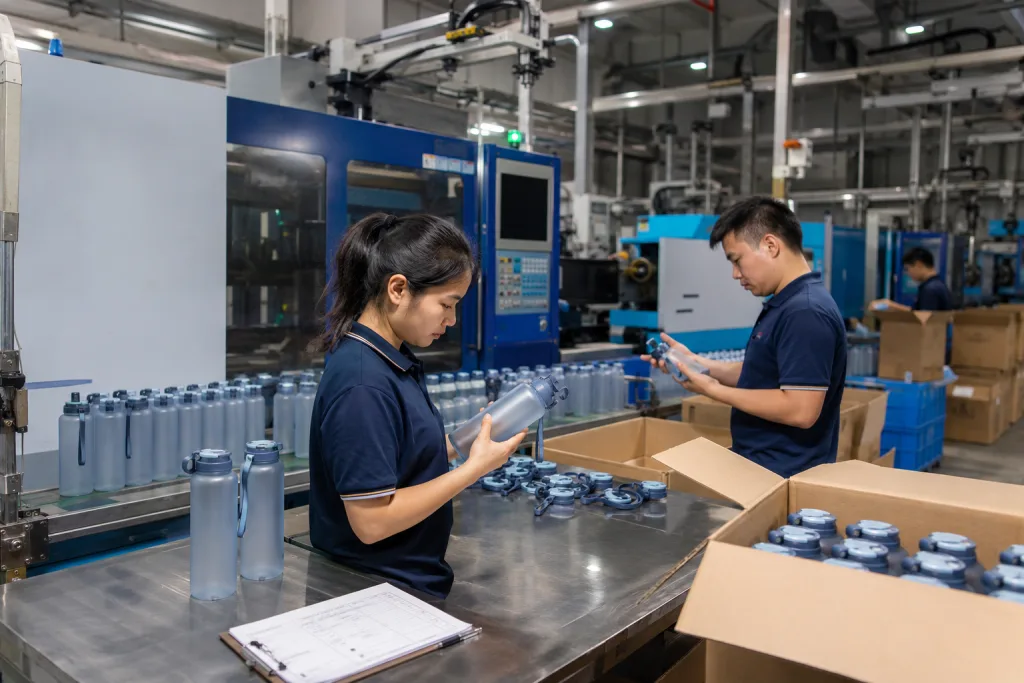
Key Takeaways
- PP usually starts at 3,000 pcs/SKU and about USD 1.10-1.90 FOB China, while PC often lands around USD 1.60-2.80 depending on mold size and lid complexity
- Lead time for repeat orders is typically 25-35 days, with new tooling adding 18-30 days and pre-production samples taking 5-7 days
- For most promotional and school programs, PP gives lower complaint risk; PC fits better where high clarity and rigid premium feel matter
- Use AQL 2.5 for major defects, REACH testing for EU, and ASTM/CPSIA checks for North America before scaling distributor drinkware orders
You are not buying a bottle. You are choosing a resin, and that choice changes carton weight, FDA/LFGB paperwork, logo scrap rate, and how many cracked-lid complaints hit your inbox after 6 months. We run PC and PP on different molds in Hangzhou; a 750 ml PC bottle can land around 145 g, while a PP version may sit near 92 g before the cap and strap. So when a buyer asks for a pc polypropylene bottle factory quote, this is the wrong first question. The better question is simple: should this order be PC, PP, or split by channel and use case?
From Zhejiang, China, we see this 3 or 4 times a week with brand owners, importer groups, and canteen distributors. The first sample looks fine. Then QC pulled the sample after 20 dishwasher cycles, or the buyer flagged odor after filling it with lemon tea overnight, or the logo lost edges because the silk screen mesh was wrong for that curved body. Marketing copy will not fix that. If you are sourcing custom drinkware, custom canteen lines, or a customized growler-style hydration SKU, get the resin, weight, MOQ, decoration method, and test standard clear before the PO is issued.
Start with the spec table
If you are comparing a canteen factory or canteen manufacturer in China, skip the catalog photos at the first call. Start with a side-by-side spec table. We run this check before quoting because one buyer once sent us 6 lifestyle images and no capacity, lid type, resin, or drop-test target. Nice pictures. No spec.
| Item | PC Bottle | PP Bottle |
|---|---|---|
| Typical FOB China price | USD 1.60-2.80 | USD 1.10-1.90 |
| MOQ per color/SKU | 3,000 pcs | 3,000 pcs |
| Visual appearance | High clarity, glossy | Translucent to opaque |
| Impact resistance | Good | Good to strong, depending on wall thickness |
| Heat tolerance | Moderate | Better for hot-fill limits, still application-specific |
| Odor retention | Moderate | Usually lower |
| Dishwasher durability | Fair to good | Good, depending on pigment and print |
| Decoration options | Silkscreen, heat transfer, pad print | Silkscreen, in-mold color, pad print |
| Best fit | Premium retail hydration | Promotional, school, gym, workwear |
The table will not answer every question, but it handles about 80% of the first sorting work. European buyers often ask for a customizable canteen with shelf clarity, barcode sticker space, and a clean retail hang tag. North American buyers often need a canteen promotional program where the landed cost beats the glossy look. The math changes fast when QC pulls the sample and the logo print adds USD 0.08 per unit.
At our Zhejiang, China operation, typical bottle body wall thickness for PP is around 0.9-1.2 mm on standard single-wall sports bottles. PC often runs about 1.0-1.4 mm depending on volume and drop-test target. Ask about monthly output early. If a supplier says yes to every color, lid, print, and packing request but cannot support 400,000 units/month, the launch calendar will expose it later; we have seen this go sideways when a PO typo changed 30,000 pcs from smoke gray to clear.
Where PC wins and where it loses
PC gets attention for one reason: appearance. On our Hangzhou line, a clear PC bottle coming off the injection blow mold reads cleaner and stiffer than PP, especially when the wall is around 2.2 mm and the cap fit is tight. For a customized drinkware line sold through retail, fitness studios, museum stores, or gift channels, that first 3-second look can decide the order before anyone checks the carton mark.
PC also works when you need:
- High clarity for infusion-style fruit visuals, printed ml scales, and straw tubes that need to show through without the milky look PP often gives
- Sharper shelf presentation for branded hydration series where the buyer wants a clean body, aligned logo, and no sink mark near the shoulder
- Rigid hand feel for a bottle positioned above low-cost promo items, especially when QC checks squeeze feel against the signed approval sample
But PC is not a magic material. We have seen this go sideways when the sales claim is stronger than the use case. PC is less forgiving once the product enters rough daily use. If end users throw bottles into delivery vans, school bags, or dishwasher cycles without care, complaints can climb from 1 case per 1,000 pcs to 6 or 8 cases per 1,000 pcs. QC pulled samples after a 50-cycle wash test last year and found surface scratching, cosmetic haze, and logo wear where the print spec was too light.
Use-case fit for PC:
- Good: retail hydration, premium event merch, and low-to-mid volume custom canteen programs with a controlled MOQ such as 1,000 to 3,000 pcs per color
- Weak: school giveaways, municipal tenders, and price-sensitive distributor canteen programs where the buyer flags every RMB 0.30 increase on the PI
For buyers new to China sourcing: if your main sales argument is “looks premium,” ask for a PC quote and a real pre-production sample. If your main sales argument is “survives rough use at USD 2 retail margin,” PC is the wrong fight.
Some buyers ask whether PC should sit next to a customizable growler or customized growler line in the same collection. Usually no. Growler buyers care about different things: 1L or 2L volume, sealing pressure, cap torque, and sometimes thermal use. We had one PO where the buyer used the same artwork code for a 650 ml PC bottle and a growler, then flagged the mismatch during carton inspection. Same silhouette does not mean same product logic.
Why PP usually wins commercial programs
PP is the shop-floor workhorse. It will not pass for glass, and that is fine. We choose it for commercial orders because the math works: lower resin cost, solid drop resistance, and fewer complaints after bottles ride around in school bags or staff lockers. On our line in Hangzhou, a 650 ml PP body usually comes off the mold with less scuff sensitivity than PC during carton packing.
If you are a canteen distributor, canteen supplier, or sourcing manager handling school, outdoor, uniform, or sports club channels, PP often gives the cleaner landed cost. The unit price gap may only be USD 0.30-0.80 versus PC, but over 20,000 pieces that difference pays for packaging upgrades, compliance testing, or freight volatility. We had one buyer flag a USD 0.42 gap on a 24,000-piece PO; after adding a stronger inner bag and one extra carton drop test, PP still won.
PP works best when your brief sounds like this
- “We need 10,000 pieces under a strict landed budget.”
- “The logo must survive repeated handling.”
- “This is a canteen customized project for teams, campuses, or field staff.”
- “We need multiple body colors and practical replenishment orders.”
PP also suits buyers building a customizable drinkware range with staggered channel pricing. One mold can cover several body colors, and the lid set can change without turning the BOM into a mess. That matters when you work with canteen vendors or canteen suppliers across several regions and need the same item again in 90 days. We run color chips against the approved Pantone card under a D65 light box before mass production, because a “close enough” blue becomes a claim fast.
The trade-off is visual impact. PP rarely looks premium enough for every brand story. If your product page depends on transparent bottle photography and a glossy finish, PP can look too plain unless the lid, grip, or Pantone control does more of the selling. This is the wrong question to ask if the buyer only says, “Can PP look like PC?” It cannot. In Zhejiang, China, about 30 factories can mold PP bottles for this category, but far fewer hold color consistency, thread fit within 0.20 mm, and print registration well enough for repeat B2B programs. QC pulled samples last month where the logo drifted 1.5 mm around the curve; that is where cheap PP goes sideways.
Match the material to the channel
The costliest sourcing mistake is pushing one material across every customer segment. Split it by channel. We see this on RFQs every month: a retail brand, a distributor drinkware program, and a corporate giveaway order are not buying the same bottle, even when the drawing looks identical at 650 ml. The wrong question is “PC or PP?” Ask where the bottle will be sold and who gets the complaint when the cap leaks.
For retail and branded ecommerce: PC makes sense when the buyer needs higher perceived value, clearer product photos, and a bottle that looks clean under a light box. Keep MOQ realistic at 3,000-5,000 pcs per SKU, and budget for better packaging. We run barcode checks with a Datalogic scanner before carton sealing because one wrong EAN on a PO can hold 42 cartons at the forwarder. A plain white box plus barcode label is enough unless the buyer needs shelf-ready color boxes.
For canteen distributors and importer groups: PP is the safer call in most orders. It handles broader use cases, reorders are simpler, and end customers argue less about micro-scratches or body clarity. QC pulled a PP sample last season after 300 open-close cycles, and the buyer only flagged cap fit, not the body finish. If you are serving canteen manufacturers or canteen vendors as a private-label buyer, PP cuts friction.
For promotional projects: choose the logo method first, then pick the material. A 55 mm single-color logo on a matte PP body can beat a more expensive clear PC bottle if the decoration stays readable after 3 months in a gym bag. We have seen this go sideways when the buyer approved a glossy PC sample, then complained that fingerprints made the logo look weak in bulk photos. That is why 7 out of 10 canteen promotional buyers we quote stay with PP even when PC looks better at the sample stage.
For field, school, and workwear channels: PP is normally the better fit. Drop rate matters. Buyers serving canteen distributors in these segments care about replacement rates, not showroom shine. On one school order, the buyer asked us to check 1.2 m drop performance on filled samples because their last supplier had cracked bases after two weeks of use.
For growler-adjacent requests: if the customer asks for a custom growler or distributor growler, pause and recheck the application. A hydration bottle factory may not be the right line for a true growler program, especially if the sealing system, wall structure, or beverage application is different. We ship PC and PP bottles; we do not pretend a standard flip-top lid is a pressure-rated growler cap. The math does not work when a beer buyer expects growler performance from a lightweight sports bottle mold.
Factory questions that actually matter
Before you qualify a pc polypropylene bottle factory, cut the soft questions. “Can you do custom?” means nothing. Every canteen manufacturer says yes, even when the line has only one aging pad printer and no fixture for oval bodies. Ask if they can run your exact SKU, cap color, logo size, carton spec, and inspection standard at repeatable quality from China.
- MOQ: Is it 3,000 pcs per color, or 3,000 mixed colors per SKU? Also ask if lid colors count as separate SKUs.
- Lead time: Is repeat production really 25-35 days after deposit and artwork approval? Get the date counted from signed sample, not from PI issue.
- Capacity: Can the plant handle 300,000-500,000 units/month in peak season? Ask how many injection machines and assembly lines are assigned to bottles.
- Decoration: What is the pass rate for silkscreen adhesion after tape test and dishwasher simulation? QC should show the 3M tape result, not just say “no problem.”
- Quality control: Do they inspect under AQL 2.5/4.0, and do they keep inspection records by PO? We want photos, defect counts, and carton marks tied to the PO number.
- Compliance: Can they support REACH, LFGB where relevant, and ASTM/CPSIA support for North America? Check whether the report covers the resin and color masterbatch you will buy.
At BottleForge Industrial in Zhejiang, we run a normal custom order flow like this: 5-7 days for pre-production sample approval, 18-30 days if tooling revision is required, and 25-35 days for repeat mass production. Those numbers hold because mold trial, logo fixture setup, and carton drop test all take shop-floor time. If a factory in China promises 12-day bulk delivery during peak season with four logo SKUs, the math does not work unless they already have material, mold time, and packing labor reserved.
Ask whether they are a real canteen factory or mostly a trading setup. This is where we have seen orders go sideways: the buyer flagged a 0.3 mm thread mismatch, and the “factory” could not explain mold cavity count, resin grade, shrinkage tolerance, thread leakage control, or carton drop performance without calling someone else. A plant that makes the bottle can talk through the torque gauge reading, leak-test pressure, and why one cavity is flashing. That saves days before a PO becomes a claim.
Decoration, testing, and complaint prevention
Most buyer complaints do not start with the bottle body. They start with decoration specs, cap leakage, or a loose quality agreement. On one 20,000 pcs customized canteen order, QC pulled the sample after the torque tester showed a cap drifting from 9 kgf.cm to 6 kgf.cm. If you are buying customized drinkware at volume, the PO needs more than color and logo placement.
Set the practical checkpoints before we open the mold trial report:
- Leak test: 100% air-pressure or vacuum leak check for assembled units where possible
- Print adhesion: cross-hatch or tape test standard agreed before mass production
- Drop test: typical 1.0-1.2 m packed drop test depending on packaging spec
- Odor test: random post-production evaluation after 24-hour sealed storage
- Carton standard: master carton weight below 12-15 kg for easier warehouse handling
For Europe, REACH screening is routine. For children’s or school programs, buyer teams often ask for extra migration checks or physical safety review based on the selling market. For North America, ASTM or CPSIA relevance depends on age grading and use case. A serious canteen supplier or canteen vendor should not guess here; we have seen one PO typo on “adult sports bottle” turn into a children’s compliance dispute after the buyer flagged the carton artwork.
Decoration choice matters as much as the resin. Large wraparound silkscreen on PP can run clean, but fine detail, gradients, or a premium shelf finish usually push the job toward heat transfer or label work. That changes unit cost, reject rate, and carton packing. Chasing the lowest FOB China price is the wrong question to ask when the print line rejects 7% of bottles and the saving was only USD 0.08 per piece.
If you plan Amazon FBA or distributor relabeling, add barcode placement, polybag warnings if required, and FNSKU confirmation to the artwork approval stage. Do it before production. We ship cartons with a 35 mm barcode quiet zone when FBA is involved, because fixing labels after sealing 600 master cartons makes no sense.
How to quote the project correctly
A clean RFQ gets cleaner pricing. For accurate numbers from canteen manufacturers or canteen suppliers in China, send the items our quotation desk usually has to chase by WeChat at 9 p.m. One missing lid drawing can move the mold insert cost by USD 180-350.
- Capacity: 500 ml, 700 ml, 1,000 ml
- Material preference: PC or PP, or ask for both
- Body color: Pantone code or transparent/translucent target
- Lid structure: flip-top, screw cap, carry loop, straw lid
- Logo method: 1-color silkscreen, 2-color print, heat transfer, laser if applicable
- Packaging: egg crate, white box, color box, PDQ, or bulk pack
- Compliance market: EU, UK, US, Canada
- Order quantity: trial 3,000 pcs or scale 20,000+ pcs
This is enough for a first quote we can stand behind. Short RFQs create fake cheap prices. The supplier fills the gaps with assumptions, then you compare a PP body with bulk pack against a PC body with color box and wonder why the gap is 12%. We see this most often when a buyer asks for a canteen custom sample, then adds a straw lid, upgraded print, and retail packaging after the quote. The FOB price moved because the BOM changed. QC pulled one sample last month where the PO said “transparent blue” but the approved chip was Pantone 2925 C; that mistake cost 3 days on the line.
If you are building a broader line with customizable growler, custom canteen, and bottle SKUs together, separate them by tooling family and use case. Do not bundle everything into one spreadsheet tab. A factory that runs sports bottles well may struggle with growler-type vessels, especially wall thickness control around the shoulder at 2.8 mm. The wrong question is “Can you make all of these?” Most suppliers will say yes. Ask which SKUs share molds, which need new tooling, and which ones they have shipped above 20,000 pcs without lid leakage claims.
For most B2B buyers, the practical move is simple: quote PC and PP side by side, choose by sales channel, and lock the quality agreement before deposit. We usually attach the artwork file, AQL 2.5 inspection points, carton drop test requirement, and final packing photo to the PI. Do that before money moves. That is how you buy from Zhejiang, China without paying tuition on your own PO.
Get a real bottle quote, not a vague catalog reply
Send your target quantity, material choice, logo method, and market. We will quote PC and PP options with MOQ, lead time, and compliance notes.
Frequently asked questions
Should I choose PC or PP for a custom promotional bottle order?
For most promotional orders, PP is the safer choice. If your target is 3,000 to 20,000 pieces and the program is price-sensitive, PP usually saves USD 0.30-0.80 per unit FOB China versus PC. It also tends to handle rough daily use better, which matters for schools, events, and field teams. Choose PC only if visual clarity and premium feel are central to the sale. If the logo is large and simple, a PP bottle with good silkscreen adhesion often performs better over time than a clearer PC body with weaker print durability. Ask your factory for both material quotes using the same lid and packaging so you can compare true landed cost.
What MOQ should I expect from a pc polypropylene bottle factory in China?
A normal MOQ is 3,000 pieces per SKU, often per color for fully custom production. Some factories in China will allow mixed colors within 3,000 pieces if the same mold, lid, and print layout are used, but decoration setup still affects cost. For stock bodies with custom logo only, MOQ can sometimes drop to 1,000-2,000 pieces. New mold development is different and may require 5,000 pieces or more to make pricing work. If you are a canteen distributor or distributor drinkware buyer, ask whether MOQ is based on bottle body color, lid color, or full finished SKU. That detail changes your project economics more than most first-time buyers expect.
How long does custom bottle production usually take?
For repeat production, 25-35 days after deposit and artwork approval is a realistic working range. Pre-production samples usually take 5-7 days if existing molds are used. If you need a new mold or tooling revision, add 18-30 days depending on complexity and mold queue. During peak season, especially before summer programs and holiday gifting, some Zhejiang factories stretch beyond 40 days. Do not just ask for the headline lead time. Ask for sample timing, mass production timing, packaging lead time, and inspection booking window separately. If the order includes color boxes, barcodes, or FNSKU labeling, those details should be approved before production starts, not after the goods are made.
What tests and documents should I request before placing a larger PO?
For EU programs, start with REACH-related material compliance and any market-specific food contact requirements relevant to the product use. For North America, review ASTM or CPSIA relevance, especially if the bottle is intended for children or school channels. On the production side, ask for a quality plan using AQL 2.5 for major defects and 4.0 for minor defects, plus leak testing, print adhesion testing, and carton drop testing. If social compliance matters to your customers, request current audit documents such as BSCI where applicable. For a 10,000-piece or larger order, spending a few hundred dollars on third-party inspection in China is usually cheaper than dealing with one container of preventable complaints.
Can one supplier handle custom canteen, drinkware, and growler products together?
Sometimes, but you should not assume it. Many factories are strong in sports bottles and standard custom drinkware but weaker in true growler-style products, especially if sealing performance, larger capacities, or different wall structures are involved. A supplier may quote a customized growler because the silhouette looks similar, but production capability is another issue. Ask what percentage of their monthly output comes from each category, whether they own the molds, and how they test leakage on larger-volume items. If a factory makes 400,000 standard bottles per month but only a few thousand growler-type units through subcontracting, you should treat that as a separate sourcing decision rather than one consolidated vendor program.