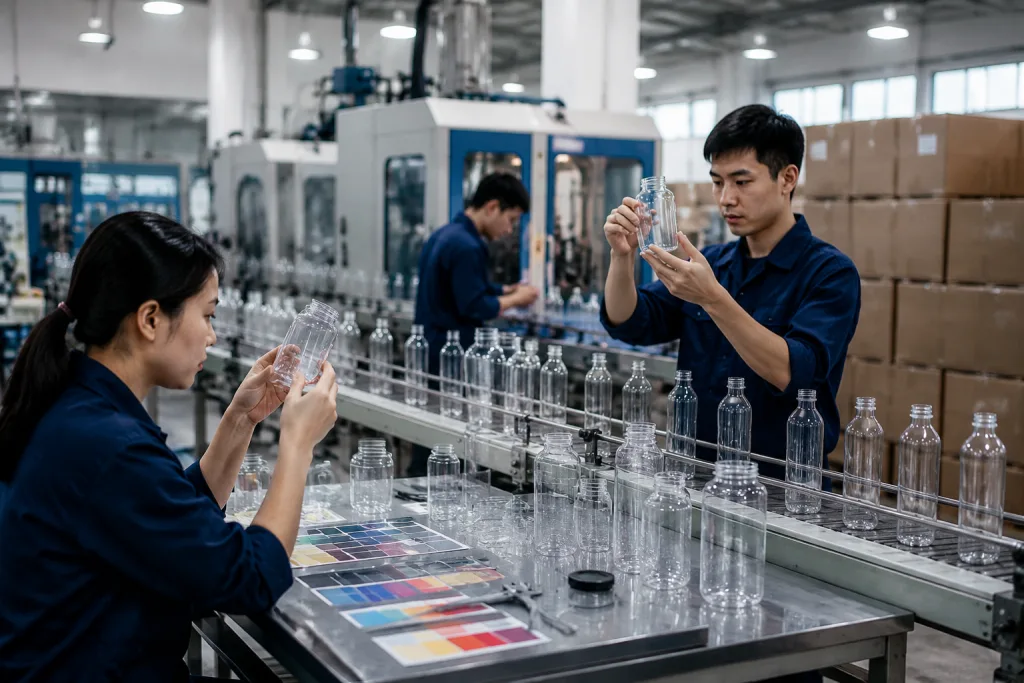
Key Takeaways
- PC and PP serve different jobs: PP usually wins on cost at USD 0.55-1.20, while PC is often USD 0.90-1.80 at 5,000 pcs FOB China
- Typical MOQ for custom color logo bottles is 3,000 pcs per SKU, with repeat orders shipping in 20-30 days from Zhejiang
- For EU and North America, ask for REACH, LFGB or FDA contact tests, plus AQL 2.5 final inspection before balance payment
- Wall thickness matters more than catalog photos: common PP body 1.8-2.5 mm, PC body 2.0-3.0 mm depending on drop target
You are not buying a bottle. You are buying a failure rate, a landed cost, a compliance file, and a re-order plan. That is why the phrase pc polypropylene bottle bulk creates confusion on the line and in the PO. PC and polypropylene are different materials. Full stop. They carry different risk profiles, different mold costs, different temperature limits, and different buyer use cases. Last month, QC pulled a sample where the buyer’s PO said “PP/PC same item,” and that single typo held approval for 2 days. If you group these materials together, you can approve the wrong product for your market, and we’ve seen this go sideways.
For buyers in Europe and North America, the better question is simple: which material fits your channel, your price band, and your testing requirement with the lowest total risk? This is the right question. From Zhejiang, China, we see the same pattern about 20 times a month. A retail promo order needs one answer. A gym chain, school program, or wholesale drinkware distributor usually needs a different one because drop test targets, odor limits, and repeat-order pricing are not the same. The numbers matter: MOQ from 3,000 to 5,000 pcs, lead time from 20 to 35 days, and reject thresholds tied to AQL 2.5. We run incoming resin checks and cap torque checks at 0.8-1.2 N·m before mass packing, because the math doesn’t work if the first shipment saves 3 cents and the reorder turns into a claim.
Start with the material split
The first correction is technical. PC is polycarbonate. PP is polypropylene. Buyers do send “pc polypropylene bottle bulk” on RFQs, and that wording stops the quote cold until we lock the resin. We have seen POs with “PP clear body” typed on line 3, which is the wrong question to ask because clear, cost, and compliance do not point to one material. In China, and especially in Zhejiang, the same bottle shape may be run in PP, PC, Tritan-like copolyester, or PETG based on your target price and compliance requirement.
PC is rigid, clear, and tough. It gives a glass-look body with lower break risk, and on the line we often see better shelf effect from a 1.8 mm clear PC wall than from an opaque PP body in the same mold family. Buyers use it for sports bottles, promotional shaker-style items, and some canteen bulk programs where transparency sells the item. PP is lighter and cheaper. It is also more opaque or translucent by nature. That makes it common for school bottles, utility bulk canteen orders, and price-sensitive drinkware bulk projects.
What matters is not the resin name by itself. It is the business result after sampling, testing, and freight.
- Unit cost: PP usually lands 15% to 35% below PC at the same size. On a 10,000 pcs run, that gap changes the whole margin discussion.
- Appearance: PC is clearer. PP hides scratches better after repeated handling, and QC pulled samples last season where matte scuffing showed on clear bodies after carton vibration.
- Heat tolerance: PP often handles hot-fill or dishwasher discussion better, but exact performance still depends on the lid, gasket, and wall design. A silicone seal that passes at 70C can still deform if the cap structure is weak.
- Drop resistance: PC can perform well on impact, but poor gate design or a thin wall still causes cracks. We have seen this go sideways at 1.5 mm on large-volume bodies.
If your target is the best wholesale drink bottle for a discount retail chain, PP usually wins on margin. The math works. If your buyer wants a clearer premium body with stronger shelf appeal, PC may justify the extra FOB cost, and the buyer will usually flag appearance first, not resin cost. Those are two different buying decisions, not two catalog pages for the same job.
A direct spec table buyers can use
Below is the side-by-side check procurement teams actually use to screen wholesale drinkware suppliers. These numbers come from production runs and caliper checks on the line, not from a lab sheet.
| Spec | PC Bottle | PP Bottle |
|---|---|---|
| Typical capacity | 500-1000 ml | 400-1000 ml |
| Body wall thickness | 2.0-3.0 mm | 1.8-2.5 mm |
| Visual finish | High clarity | Translucent to opaque |
| FOB price at 5,000 pcs | USD 0.90-1.80 | USD 0.55-1.20 |
| MOQ custom color/logo | 3,000-5,000 pcs | 3,000-5,000 pcs |
| Sample lead time | 5-10 days | 5-10 days |
| Mass production lead time | 25-35 days | 20-30 days |
| Drop test target | Usually 1.0-1.2 m | Usually 0.8-1.0 m |
| Best fit | Premium promo, clear sports bottle | School, utility, value retail |
Do not stop at the price row. You still need the lid structure, print method, and packing spec checked line by line. A flip-top lid with silicone straw can add USD 0.18 to 0.45 per unit, and an individual color box may add another USD 0.12 to 0.30. Last month a buyer flagged a carton mark because the PO said 24 pcs/ctn and the sample packing sheet showed 30 pcs/ctn. If you are sourcing drinkware wholesale for club stores or e-commerce, outer carton drop performance matters as much as the bottle resin. This is the wrong place to guess.
Factory rule of thumb: if a supplier quotes below the realistic floor, they usually take it back through thinner walls, lighter carton count, weak print adhesion, or loose gaskets. QC pulled the sample on one low-price order and found a 1.7 mm body where the approved spec was 2.0 mm. We ship enough of these to see the pattern. BottleForge Industrial in Zhejiang runs capacity around 600,000 units per month across multiple drinkware lines, and disciplined specifications are what keep cost surprises out of the order.
Match the bottle to the channel
Smart buyers do not ask which material is better. They ask which material fits the channel. A school fundraiser, a national distributor, and a brewery gift shop do not buy the same bottle, and this is the wrong question to ask at RFQ stage.
Promotional and value retail
PP is usually the safer pick for large wholesale canteen or canteen wholesale volume when the target FOB must stay under USD 1.00. If your brand plans 20,000 pcs for a back-to-school launch, PP gives you more room when freight jumps and the buyer pushes for markdown support. We run these jobs with 0.8 mm to 1.0 mm wall thickness, and the math does not work if you start with a clearer resin just because the sample looked better on the table.
Gym, outdoor, and premium shelf presentation
PC works when clarity closes the sale. For fitness chains or corporate gifting, a transparent body with one-color silk screen can look more premium without moving into stainless pricing. QC pulled the sample on one recent line check because the print sat 2 mm low, and that small miss matters more on clear bottles. That is why some distributors still ask for PC in bulk drinkware tenders.
Brewery and bar-adjacent programs
This is where buyers mix categories all the time. A bottle quote does not answer a bulk growler, growler wholesale, or beer growler bulk inquiry. Growlers are usually stainless or glass, sometimes with PP accessories but rarely PP bodies for serious beer retention. We have seen POs with "growler" typed on a 700 ml sports bottle spec sheet, and that mistake costs days. The same warning applies to beer tumbler bulk and beer tumbler wholesale; those are usually double-wall stainless or insulated plastic, not simple hydration bottles.
Likewise, an alcohol flask bulk or alcohol flask wholesale bulk request points to a different product family, usually stainless steel with food-contact lining and leak-tested cap threads. If your sourcing brief includes alcohol flask in bulk, beer growler wholesale bulk, or beer tumbler in bulk, split those RFQs from your PP bottle program. We ship flask caps only after thread gauge checks and vacuum leak tests, so folding that into one bottle inquiry just creates noise. Mixing them under one bottle inquiry wastes days and usually gets you generic quotations from China that are hard to compare.
Good sourcing starts when each use case has its own performance target, not when every drinkware item gets squeezed into one spreadsheet.
Cost drivers nobody should ignore
Unit price in pc polypropylene bottle bulk projects usually moves on four cost points: mold status, decoration, lid structure, and packing ratio. Resin matters, but this is the wrong question to ask first. On our line, a 0.3 mm wall-thickness change or a tighter neck tolerance can move cost faster than buyers expect.
- Mold status: An existing mold usually saves USD 2,000 to 8,000 in tooling. If you open a new body mold or change the cap core, development normally stretches to 25 to 40 days, and we still need to check first-shot dimensions with calipers before mass production.
- Decoration: One-color silk screen is still the low-cost option. Heat transfer, wrap printing, or in-mold labels add cost, and QC pulled samples before for print offset over 1.5 mm, which turns into real scrap.
- Lid complexity: A screw cap is cheaper than a flip straw or push-button lid. More parts mean more hand assembly, more leak-test points, and more buyer pushback once the straw valve or spring starts failing after drop test.
- Packing: Egg-crate partition, polybag, color box, PDQ tray, or Amazon-ready pack all change carton cost and cbm. We ship some packs in a 63 x 42 x 38 cm carton, and the math does not work the same once the buyer asks for gift-style presentation.
A simple 700 ml PP bottle with screw cap, one-color logo, and bulk pack can sit near USD 0.62 to 0.78 FOB at 5,000 pcs. Move to a 750 ml PC body with carry loop, two-color print, and individual box, and you can land at USD 1.35 to 1.70. Big gap. Freight makes it wider because larger gift-style packing cuts container efficiency by 10% to 25%, and we have seen buyers miss that after only checking piece price.
If you buy for North America under retailer compliance, add inspection and testing cost into the model from day one. A third-party final inspection at AQL 2.5/4.0 may cost USD 280 to 420 per day in Zhejiang, China. Basic food-contact testing can run from a few hundred dollars upward depending on lab scope. Last year, one buyer flagged a carton label typo on the PO, and the relabel charge hurt more than the inspection fee would have.
If your program also includes growler bulk, wholesale growler, or alcohol flask wholesale items, quote them separately by packaging format. Stainless categories behave differently because welding, vacuum testing, and freight class are a different cost structure. We run vacuum hold checks on the flask side, not the PP bottle line, and trying to average everything into one “drinkware” target price usually hides the real margin.
Compliance, testing, and quality checkpoints
If you sell into Europe or North America, a pretty photo approval means nothing if the bottle fails compliance. Ask which tests match the market and the claim on the PO. Typical buyer requests include FDA food-contact for the US, LFGB for Germany, and REACH screening for the EU. If the bottle is for children, ASTM and CPSIA-related checks may also come into play depending on accessories and age grading. We usually ask for the exact lid, straw, and gasket combination up front because QC pulled a sample last month where a 2 mm silicone seal changed the test scope.
Here is the practical checklist we recommend before deposit release:
- Material declaration: resin grade, color masterbatch, silicone gasket spec.
- Migration or food-contact reports: from a recognized lab, tied to the actual SKU where possible.
- Leak test protocol: 100% air-pressure or inverted water test for assembled bottles.
- Drop test standard: define height, angle, and pass criteria before production.
- AQL plan: usually critical 0, major 2.5, minor 4.0 for final inspection.
- Packaging approval: barcode, FNSKU if needed, carton mark, carton dimensions, and pallet pattern.
Buyers often ask if a factory has BSCI or ISO. That is not the main question. Those help on supplier screening, but they do not replace product testing. We have seen factories with a clean social audit still ship lids with uneven torque at 0.8 to 1.0 N.m or print sitting 3 mm off-center. Ask for real production photos, on-line QC records, and defect sorting standards.
At our Hangzhou, Zhejiang operation, repeat custom orders normally run 20 to 30 days after artwork and pre-production sample approval. We run that timing only when the spec sheet is locked. If you change print position, cap color, or insert card after production starts, the math does not work and lead time turns into a guess. One buyer flagged a carton mark typo after molding had started, and the line lost 3 days waiting for corrected inserts.
How to issue an RFQ that works
Most bad quotations start with a loose RFQ. If you want clean comparisons for drinkware wholesale, spell out the spec sheet. We see this every week: one factory quotes PP, another quotes PC, one packs 60 pcs per carton, another builds 24 gift boxes into the price. The sheet looks busy. The math does not work.
Your RFQ should include:
- Capacity in ml or oz
- Target material: PC or PP
- Body color and transparency requirement
- Lid type: screw, flip, straw, carry loop
- Logo method and print colors
- Target price band and order quantity
- Compliance market: US, EU, UK, Canada
- Packing requirement: bulk, color box, Amazon FBA, retail shelf
- Incoterm: FOB Ningbo, FOB Shanghai, or delivered terms
If you also source adjacent categories such as beer growler in bulk, beer growler wholesale, beer tumbler wholesale bulk, or alcohol flask wholesale, split each category into its own line with its own test standard and MOQ. We have seen buyers combine bottles and flasks on one PO, then QC pulled the sample and found the wrong drop-test standard tied to the plastic item. A practical MOQ for custom plastic bottles is often 3,000 pcs per model per color. For stainless items like a wholesale growler or flask, MOQ may start at 1,000 to 3,000 pcs depending on finish and stock tooling.
Good buyers ask one more question: what is the repeat-order plan? If a supplier keeps color masterbatch records, logo screens, and carton artwork on file, the second order usually runs faster and with fewer arguments about shade drift. We ship reorders off the same artwork file all the time, and the buyer usually cares about one thing: does Pantone 2995C still match the approved sample within the 2 mm logo position tolerance? That is where a disciplined factory in China beats a rock-bottom first quote.
Send your bottle RFQ and get a workable quote
Share capacity, material, lid, logo, packing, and target market. We will respond with realistic MOQ, FOB pricing, and lead time from Zhejiang, China.
Frequently asked questions
Should I choose PC or PP for a 10,000-piece promotional bottle order?
If your target FOB is under about USD 1.00 and the bottle is for mass promotion, PP is usually the better fit. At 10,000 pcs, a standard 600-750 ml PP bottle with one-color silk screen and bulk packing may land around USD 0.60-0.85 FOB China. A similar PC bottle often lands around USD 0.95-1.40. Choose PC when clarity matters to retail appeal or when your customer wants a more premium feel. Choose PP when margin, lighter weight, and simpler reorders matter more. Ask the factory to quote both on the same lid, packing, and print spec so you compare honestly.
What MOQ is realistic for custom logo plastic bottles from China?
For custom logo orders, 3,000 pcs per SKU is a common workable MOQ, though some stock molds can start at 1,000 to 2,000 pcs with limited color choices. If you want a custom Pantone body, custom lid color, and retail box, expect 3,000 to 5,000 pcs. A fully new mold usually requires higher commitment or tooling cost, often USD 2,000 to 8,000 depending on body and cap complexity. In Zhejiang, factories that promise very low MOQ on highly customized bottles often recover the margin through higher unit price, thinner packing, or slower lead time. For distributors, it is usually smarter to standardize 2 or 3 core sizes and scale repeats.
What compliance documents should I request for Europe and North America?
At minimum, ask for food-contact test reports relevant to your market. For the US, FDA food-contact compliance is standard. For Europe, many buyers ask for LFGB and REACH-related screening, especially if the product enters Germany or large EU retail channels. If the bottle is marketed to children, additional checks tied to accessories, coatings, or labeling may be required. Also request a material declaration, gasket specification, and final inspection report under an agreed AQL plan such as critical 0, major 2.5, minor 4.0. If the order goes to Amazon or major retail, confirm carton labels, FNSKU, and barcode placement before mass production, not after.
How long should lead time be for a repeat bottle order?
For a repeat order using an existing mold and unchanged artwork, 20 to 30 days after deposit and artwork approval is normal from an organized China supplier. A first custom order usually takes longer: 5 to 10 days for pre-production samples and about 25 to 35 days for bulk production. Add 7 to 15 days if you need new mold changes, special packaging, or retesting. During peak season, some factories quote the same lead time but actually queue production. Ask for a realistic production slot, not only a shipping promise. If you need 10,000 to 30,000 pcs before a retail launch, lock the order at least 45 to 60 days ahead.
Can one supplier handle bottles, growlers, tumblers, and flasks together?
Sometimes, but you should not assume all categories share the same strength. A factory may be excellent on PP and PC bottles yet average on stainless vacuum items. Plastic bottles, beer growlers, beer tumblers, and alcohol flasks involve different tooling, leak testing, welding, and finishing controls. If you bundle categories, ask for separate quotations, separate QC plans, and proof of past shipments by category. For example, a plastic bottle line may run 600,000 units per month, while a stainless growler line may have a different MOQ, often 1,000 to 3,000 pcs, and a different lead time. One supplier can coordinate, but category-specific capability matters more than convenience.