Key Takeaways
- For pc drinkware wholesale, a realistic MOQ is usually 1,000-3,000 units per SKU, with 25-35 day production after sample approval
- Polycarbonate drinkware needs tighter control on wall thickness, usually around 2.0-3.5 mm depending on bottle size and drop test target
- AQL 2.5 for major defects and AQL 4.0 for minor defects is a practical inspection baseline for wholesale drinkware orders
- Decoration, mold cavity count, and packaging can shift FOB pricing by 12%-30% more than buyers expect
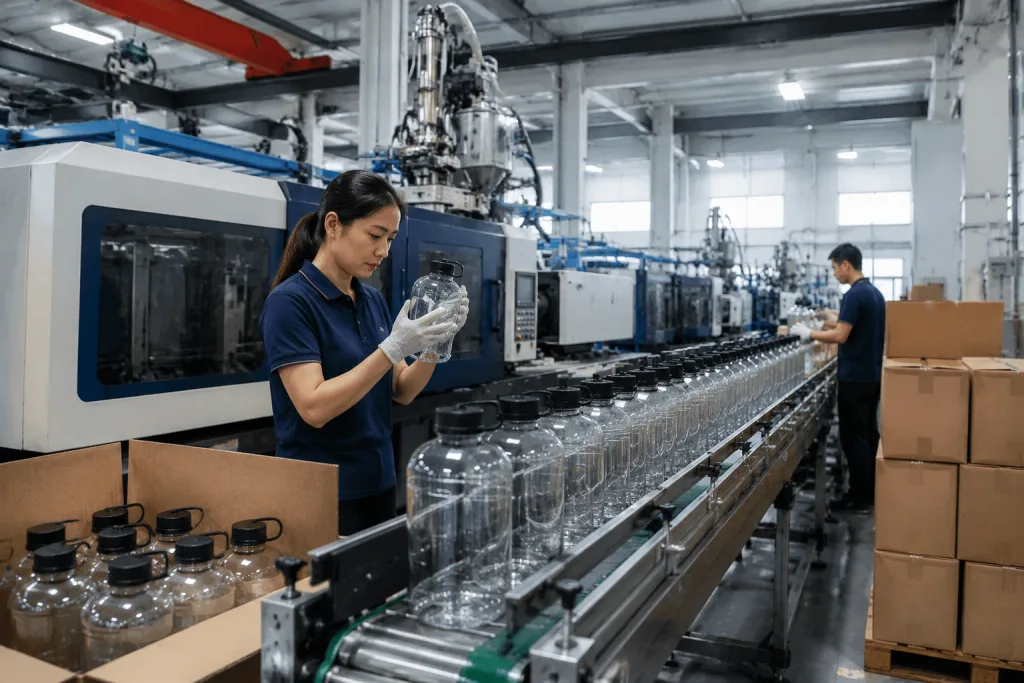
You can buy pc drinkware wholesale from China at a low unit price and still lose margin on freight, failed testing, cracked lids, or print rejects. We see this on the line all the time. The quote looks complete, but the spec sheet is still soft, and that is where projects go sideways. A "22 oz bottle" is not a production standard. Resin grade, wall thickness in mm, lid thread fit, drop test level, print method, and carton pack all shift your landed cost.
If you handle sourcing for a brand or distributor, you need a tighter checklist. This is the wrong question to ask: "Who has the cheapest bottle?" In Zhejiang, 20 or 30 factories can quote bulk drinkware, canteen wholesale, or a bulk growler program, but only a smaller group will hold repeatable tolerances and give you clean compliance files when QC pulled the sample and the buyer flagged a lid leak. At BottleForge Industrial in Hangzhou, Zhejiang, our typical MOQ starts at 1,000 to 3,000 units per SKU, with lead times around 25 to 35 days and monthly output above 400,000 units.
What are you really buying?
When you ask for pc drinkware wholesale, you are buying a commercial spec, not a generic bottle. It has to survive filling, decoration, carton drop, and end-user abuse on the shelf and after sale. We see sourcing problems start when buyers treat PC as one material line item. That is the wrong question to ask. Lock five points early: resin grade, capacity tolerance, wall thickness, lid construction, and compliance destination. On our line, QC pulled the sample and measured wall at 2.3 mm on one side and 2.0 mm on the other; that gap alone changed drop performance.
A 750 ml wholesale canteen for retail does not run like a gym sports bottle. The body weight, grip area, and lid cycle count are different. We ship beer tumblers for promo sets too, and the buyer usually flags sink marks near the logo panel faster than they flag weight. Clear PC sells because it takes impact well and looks close to glass, but the spec still has to match the job. If the bottle needs to survive repeated drops from 1.0 to 1.2 meters, body geometry matters as much as resin, and we have seen this go sideways when a shoulder radius was cut by 1.5 mm to save weight.
- Capacity: ask for brimful capacity and practical fill capacity, not one number. We have seen 780 ml brimful sold as 750 ml usable, and the buyer flagged it after first pilot fill.
- Weight: specify target grams with tolerance, usually within plus or minus 3% to 5%. On a 750 ml body, 68 g vs 74 g is not a small gap.
- Wall thickness: common range is 2.0 to 3.5 mm depending on capacity and shape. We check it with an ultrasonic thickness gauge, not by eye.
- Lid leak standard: static leak test and inverted leak test should both be stated. A flip-top that passes 30 minutes inverted can still fail after 500 cap cycles.
- Use case: cold beverage only, ambient use, or mixed retail use. Put it on the PO, because we have received "cold dring bottle" as a typo and then had to reconfirm the full spec.
If you are comparing drinkware bulk quotations from suppliers in Zhejiang or other parts of China, ask each factory to quote against the same sheet. Do it line by line. One plant prices a lighter bottle at 66 g, another assumes no individual polybag, and another leaves out compliance cost for the destination market. We run into this every month with 3 to 5 quote sets. The cheapest quote is often the least defined quote, and the math does not work once testing, packing, and claim risk are added back in.
How should you compare factory quotes?
A practical RFQ for wholesale drinkware should read like an engineering brief, not a shopping request. We see buyers ask for pricing from one photo, then lose 18 days fixing specs that should have been locked on day one. For canteen bulk, growler wholesale, or alcohol flask wholesale bulk programs, put every factory into the same quote sheet. QC pulled samples before where the wall thickness was 0.4 mm off because the buyer only sent a reference image. That is not a quote problem. It is an input problem.
Ask for FOB Ningbo or FOB Shanghai, not just EXW, unless you already control domestic pickup in China. Ask for mold status at the same time. Existing mold, modified mold, and new mold are different commercial cases, and the math does not work if you compare them as one bucket. A low unit price can hide a USD 1,800 to 6,500 tooling cost, depending on complexity and cavity count. We have seen quotes look sharp until the mold drawing showed 2-cavity instead of 4-cavity, which changed output on the line and changed the real cost.
Quote checklist buyers should request
- Unit price by quantity break: 1,000 / 3,000 / 5,000 / 10,000 pcs
- MOQ by color and by logo
- Sample charge and sample lead time, often 5 to 10 days for pre-production
- Tooling cost, cavity count, and mold ownership terms
- Packing spec: each box, egg crate, divider, shrink wrap, or polybag
- Master carton size, gross weight, and loading quantity per 20GP and 40HQ
- Compliance included or excluded: REACH, LFGB-related component declarations, CPSIA or ASTM where relevant
For products like a wholesale growler or beer growler bulk line, also ask whether the lid and seal are standard or custom. Replacement lid availability matters. If your reorder depends on a custom cap from a second supplier, your real lead time can slip by 7 to 12 days. We ship reorders every month where this is the hidden delay, and the buyer flagged it only after the PO showed the wrong cap code. Good China suppliers say it up front. Weak ones wait until after deposit.
A usable quote lets you estimate landed margin. A decorative quote only tells you what the salesperson hopes you will buy.
Which specs reduce claims later?
The fastest way to cut claims is to lock test methods before production starts. We see most post-shipment disputes come from five points: leakage, scratch resistance, odor, color difference, and print durability. Write those into the approval standard before the line runs, or the buyer and factory will read the same PO two different ways.
For PC bottles and tumblers, the spec sheet needs dimensions and performance checks. That applies whether you are buying the best wholesale drink bottle for a retail chain or an alcohol flask in bulk for promotional distribution. Functional failures cost more because they hit the full lot of 3,000 or 30,000 pcs; cosmetic defects can sometimes be sorted at final inspection with AQL 2.5. This is the wrong question to ask: "Is the sample okay?" Ask what passed, how it was checked, and what the reject limit is.
- Leakage: no visible leakage after 30 minutes inverted and 10 cycles of shake test. QC usually puts absorbent paper under the lid line, because one slow seep at the spout will turn into a claim.
- Drop test: filled bottle dropped from 1.0 meter on hard surface, 3 orientations minimum. We normally mark base, side, and cap impact points on the sample before testing.
- Print adhesion: cross-hatch or tape test after 24-hour curing. If the ink supplier asks for longer curing, write the exact hours on the sample card.
- Dishwasher statement: only claim this if validated. Do not guess. We have seen buyers push for the icon on gift-channel orders, then flag fading after 12 cycles.
- Color tolerance: approved against signed master sample under standard light box. D65 light box check is standard on our floor, and the approved chip should stay with the PO file.
- Odor: no abnormal resin or seal odor after 24 hours closed. QC pulled the sample, closed it for 24 hours, then checked the bottle body and silicone ring separately.
For canteen wholesale and growler bulk projects, thread fit and gasket compression need extra attention. A bottle can pass a static bench test and still fail after transport if cap torque is drifting. We ask the factory to set a torque window, often in kgf.cm, and record actual readings during pilot production on at least the first 30 pcs. If that record is missing, we've seen this go sideways.
If the factory says "same as previous order" but there is no archived approved sample and no signed artwork position file, treat it as a warning. One common miss is simple: logo 3 mm higher than last order, or a Pantone note missing from the revised PO. In Zhejiang, the better factories keep revision control for artwork, pantone references, and packaging files. That discipline saves more money than pushing for another USD 0.03 off the unit price.
What compliance and audit points matter?
Compliance is where new buyers waste money or miss a real risk. We see both. You do not need every report on the list. You need the reports that match your market, item use, and retail channel. For Europe and North America, most wholesale drinkware programs ask for a practical file set: raw material declarations, migration-related documents where the item and decoration require them, and social or quality records if the buyer’s vendor manual calls for them. On our side, QC usually checks the BOM revision first, down to the ink and silicone ring, before we quote testing.
For PC drinkware sold into the EU, ask for REACH SVHC declarations and keep a documented bill of materials for resin, color masterbatch, seal, and print ink. For North America, your customer may ask for California Proposition 65 screening, CPSIA support for children-oriented items, or ASTM-related references if the product is marketed for kids. This part matters. A kids line carries a different compliance load than an adult beer tumbler in bulk or beer growler wholesale bulk project, and we have seen buyers mix those two on one PO.
Minimum file set worth asking for
- Business license and export registration details
- BSCI, Sedex, or equivalent social audit if your channel requires it
- ISO 9001 certificate if claimed
- Material declarations from upstream suppliers
- Recent third-party test reports tied to similar SKU construction
- Inspection standard with AQL levels, usually AQL 2.5 major / 4.0 minor
Be careful with recycled-content claims. This is the wrong question to ask: “Do you have a sustainable option?” Ask what part actually contains recycled content: carton, lid, strap, or the bottle body itself. Buyers in Europe are checking this more closely now, especially in Germany, France, and the Nordics. Last season one buyer flagged a hangtag claim because the bottle body was virgin resin and only the mailer box had recycled content. That kind of loose claim creates retailer trouble later.
None of this means the supplier has to be huge. It means they need control on the line. A mid-sized Zhejiang factory with 6 to 8 molding lines, documented incoming inspection, and a stable QA team is usually a better fit than a trader with polished English and weak factory visibility. We have seen 20,000-piece programs run smoothly with a 2 mm wall-thickness check, signed IQC records, and one QA lead who stays through shipment. The math does not work if the factory cannot show who approved resin, who signed color, and who released the final packout.
How do MOQ, pricing, and lead times move?
Procurement managers usually ask us for one benchmark number. That is the wrong question to ask. In pc drinkware wholesale, the quote moves after we check five things on the costing sheet: cavity output, bottle gram weight, lid parts, print process, and packing. On the line, a clear 600 to 750 ml PC bottle with a standard screw lid might run 15 seconds per shot, while a colored canteen wholesale SKU with soft-touch finish and two-position silkscreen needs extra handling at the spray booth and print table. The FOB gap is not small.
From current China supply conditions, a standard PC bottle can start around USD 1.10 to 2.40 FOB at 3,000 to 5,000 units. Larger or more specialized items such as wholesale growler formats, beer growler in bulk requests, or multi-part alcohol flask wholesale orders go higher when the lid has metal hardware, silicone rings, or a carry loop. Individual box packing can add USD 0.18 to 0.65; we see this jump when buyers ask for 350 gsm color boxes instead of a plain white box. Laser engraving, heat transfer, or wrap print can shift cost another 5% to 18%. QC pulled one sample last month because the wrap print drifted 2 mm at the seam, so print cost is not just ink.
Lead time needs to be split into stages before anyone promises an ETD:
- Stock sample confirmation: 2 to 4 days
- Pre-production sample with logo: 5 to 10 days
- Mass production: 25 to 35 days after deposit and approval
- Peak season buffer in China: add 7 to 10 days before major holidays
MOQ needs careful reading. Some factories write 3,000 pieces MOQ, then the PI shows 3,000 per color, per lid, or per print design. We have seen this go sideways after a buyer planned 6 colors at 500 pcs each and the molding team rejected the schedule. For drinkware bulk programs with several SKUs, ask whether mixed colors or mixed artwork can sit inside one master order. A factory running 400,000 units per month can sometimes support that if the carton size, insert tray, and barcode label stay common.
The useful negotiation is not always unit price. The math often works better when you ask for shared carton design across SKUs or common lids across sizes. We also ship orders where sample charges are credited back after the deposit, but put that line on the PO; one buyer flagged it after a typo changed “refund sample fee” into “reorder sample fee.” Small wording, real argument. These changes improve reorder economics without shaking the production plan.
What should you inspect before shipment?
Pre-shipment inspection is where your sourcing work either holds up or falls apart. If you buy wholesale drinkware without a documented inspection checklist, you are asking sales, injection, packing, and warehouse teams to guess the same standard from memory. We see this go sideways on 8,000-piece orders: the PO says 72 pcs/ctn, the line packs 60, and nobody catches it until the CBM changes.
For PC items, inspect function and finish together. Clear cups expose scratches, gate marks, flow lines, and color drift faster than opaque PP or stainless pieces. Buyer-approved golden samples are not paperwork decoration. QC should have the signed sample on the table, the final artwork file, carton spec, barcode placement map, and a caliper ready for body thickness checks in mm.
Pre-shipment checklist
- Verify quantity completed and packed versus PO
- Check net weight and body thickness against approved sample
- Run leak test on random sample set from packed cartons
- Confirm logo position, pantone match, and print adhesion
- Check carton drop resistance and inner packing integrity
- Scan barcode, FNSKU, shipping marks, and carton labels
- Review assortment ratio if the order includes mixed colors or sizes
If your order includes wholesale growler, beer tumbler wholesale, or alcohol flask bulk items together in one shipment, make the QC plan SKU-specific. One passed test does not cover the shipment. A growler handle joint can crack under a 5 kg pull test, a tumbler rim can show a sharp burr after trimming, and a flask cap seal can leak after 30 seconds upside down.
For Amazon or DTC channels, packaging errors often cost more than small cosmetic defects. Wrong FNSKU placement or carton over-weight can trigger receiving delays and chargebacks. We had a buyer flag a 16.8 kg carton because their warehouse limit was 15 kg, even though the cups passed inspection. Experienced buyers now approve shipping marks and carton artwork with the same discipline used for the product itself.
The right target is simple: catch the problem in Zhejiang before the container leaves China. After sailing, the math gets ugly: discount, rework at destination, or write-off. QC pulled one sample late last season with a missing suffocation warning on the polybag; fixing it here took 2 days, fixing it after arrival would have taken 18 days.
When does PC make commercial sense?
PC is not the answer for every product. That is the point. We use it when the buyer brief calls for clear walls, drop resistance, lower freight weight than glass, and a better hand feel than cheap PP or PET. For a 500 ml cup, we usually see PC come in around 85-110 g, while glass can sit near 230-280 g before packing. That carton weight matters when we ship 3,000 pcs by air for an event order. PC makes sense for wholesale drinkware, wholesale canteen, and selected growler wholesale programs in hospitality, events, outdoor retail, and institutional supply, where breakage claims can eat the margin.
It makes less sense when the product story is built around stainless insulation, boiling-water use, or a clean metal/glass sustainability pitch. Then PC is the wrong question to ask. Your best wholesale drink bottle may belong in another material family, and a supplier should say that before the mold deposit is paid. We have seen a buyer flag this after the PO because their retail page promised hot tea use at 100 C, while the sample label only supported cold beverage positioning.
Use this decision filter before you place a PO:
- Choose PC when impact resistance and visual clarity drive the sale, such as stadium cups, school canteens, or poolside drinkware where QC checks for cracks under a drop test.
- Choose PC when freight cost and unit weight need control, especially for 1,000-5,000 pcs trial orders moving by express or LCL.
- Be careful with PC if your marketing needs high-heat usage claims; the line must match the claim, not the other way around.
- Be careful with PC if your retail customer requires a narrow sustainability story, because the buyer may reject the copy before they even test the sample.
For procurement managers, the test is repeatability. Can the supplier in China deliver the same clarity, cap fit, print quality, and carton performance on the second and third order? We check cap fit with a go/no-go gauge and pull printed samples after curing, because a 0.3 mm cap mismatch can turn into leakage complaints. If every reorder needs fresh corrections, the first shipment was not a success, even if the opening FOB price looked attractive.
That is why signed documentation beats persuasive quoting. In Zhejiang, the best factory relationships are built on signed specs, realistic MOQs, controlled QC, and honest talk about what the product can and cannot do. We run better orders when the spec sheet includes resin grade, wall thickness, carton drop standard, print artwork version, and packing method. One typo on a PO, such as “clear blue” instead of “clear smoke,” can stop the line for half a day.
Send your RFQ and spec sheet for a workable quote
We will review your pc drinkware wholesale requirements, flag risk points, and quote MOQ, FOB pricing, compliance scope, and lead time clearly.
Frequently asked questions
What MOQ should I expect for pc drinkware wholesale in China?
For a standard existing-mold item, 1,000 to 3,000 units per SKU is a realistic MOQ in China. If you need custom color, custom lid, or multiple logo versions, the practical MOQ often moves closer to 3,000 to 5,000 units. Some factories in Zhejiang will quote 500 pieces, but that usually means stock color, stock lid, and limited decoration options. Always ask whether MOQ is per SKU, per color, per logo, or per shipment. For mixed programs such as canteen bulk plus beer tumbler bulk, you may be able to combine one order value while keeping separate SKU minimums. That is often more useful than chasing an artificially low MOQ with poor production efficiency.
How do I know whether a pc bottle quote is actually comparable across suppliers?
Use one RFQ sheet and force every supplier to quote against it. Include capacity, bottle weight, wall thickness target, resin requirement, lid type, decoration method, packaging, compliance market, and trade term such as FOB Ningbo. Ask for quantity breaks at 1,000, 3,000, 5,000, and 10,000 pieces. If one supplier quotes a 2.1 mm wall and another assumes 2.8 mm, the cheaper quote is not cheaper in any useful way. The same applies to packaging. An individual box can add USD 0.20 to 0.60. You should also ask for carton dimensions and gross weight, because freight can erase a small unit-price advantage very quickly.
What tests matter most before I approve mass production?
Start with the tests that trigger the highest-value claims. For PC drinkware, that usually means leak testing, drop testing, print adhesion, odor check, and color approval against a signed master sample. A practical standard is 30 minutes inverted with no leakage, plus a shake test and a 1.0 meter filled drop test in at least three orientations. If the product is for children or a regulated retail channel, add the exact compliance documents your market requires rather than assuming generic reports are enough. For transparent products, you should also define scratch tolerance and cosmetic acceptance, because visual defects are easier to see than on opaque bulk drinkware.
Can I source wholesale growler, canteen wholesale, and alcohol flask bulk items from one supplier?
Sometimes yes, but only if the supplier actually manufactures or tightly controls all three categories. Many suppliers can quote wholesale growler, wholesale canteen, and alcohol flask wholesale because they have trading access, not because they have process control. That matters when you need consistent QC, shared packaging standards, and synchronized lead time. A mixed shipment can work well if the supplier has compatible production planning and a clear incoming inspection process for outsourced parts. Ask which items are made in-house, which are outsourced, and who owns final QC. If more than one-third of the order is outsourced, expect higher lead-time risk and require a stricter pre-shipment inspection plan.
What lead time buffer should I build for a first order from Zhejiang?
For a first order, plan 5 to 10 days for pre-production samples and 25 to 35 days for mass production after approval and deposit. Then add a buffer of 7 to 10 days if your order falls near major China holiday periods or if it includes custom packaging from a second supplier. If there is new tooling, add another 15 to 25 days depending on mold complexity and sampling rounds. For a retailer launch, many buyers build a total purchasing window of 50 to 65 days before vessel departure. That is more realistic than trusting a best-case promise, especially when your order includes multiple SKUs like drinkware wholesale, growler bulk, and beer tumbler wholesale bulk in one shipment.