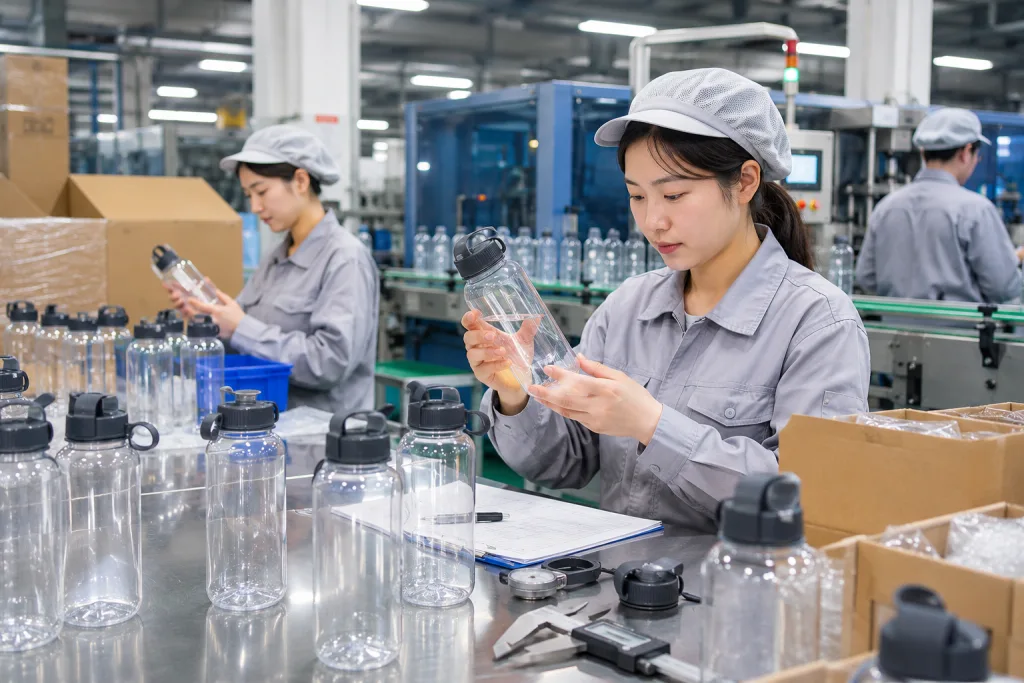
Key Takeaways
- Start with end use first: PC drinkware works well for impact resistance, but you still need wall thickness, lid fit, and compliance checked before approving a 3,000-5,000 unit MOQ.
- Decoration choice changes both cost and defect risk; a one-color silkscreen may save USD 0.12-0.25 per unit versus wrap printing, but it usually tolerates fewer branding details.
- Ask for factory controls in numbers: AQL 2.5, leak test rate 100%, lead time 25-35 days, and monthly capacity above 300,000 units are more useful than generic quality claims.
- For Europe and North America, require clear documentation on REACH, LFGB or FDA-contact testing, packaging specs, and FOB terms before paying a deposit.
You can get a usable quote for custom drinkware in one day. It usually takes two to four weeks to see whether the supplier behind that quote can hold color, pass compliance, and ship on time. That gap is where most sourcing mistakes happen. If you are buying from a pc drinkware supplier for retail, promotion, or distributor programs, the real job is not collecting prices. It is screening risk before you lock tooling, artwork, and inventory cash. On our line, QC pulled a first-off sample at 30 minutes and found the lid color already drifting from the approved Pantone chip.
Buyers in Europe and North America usually face the same four decisions: material fit, decoration method, MOQ versus margin, and factory control. In Zhejiang, China, there are many capable canteen manufacturers and canteen suppliers, but capability is uneven. A supplier offering USD 1.85 per unit on a 5,000-piece order may still cost you more than a USD 2.15 offer if reject rates, carton inefficiency, or delayed approvals force rework. We have seen this go sideways over a 3 mm logo shift and a PO typo on packing count. You need a screening method that holds up under production, not a brochure.
Decide What PC Should Do
The first call is simple: is polycarbonate fixing the actual use problem, or are you picking it because the rendering looks good? We see buyers start with shape, color, and logo position, then backfill the material choice later. That is the wrong question to ask. A pc drinkware supplier should ask where the bottle will run: gym, school canteen order, outdoor use, stadium cup program, travel set, or a distributor line. PC earns its place when you need low weight, glass-like clarity, and better drop survival on the line and in daily use. We’ve shipped programs where the buyer wanted a glass look, but the 1.2 m drop check kept breaking PETG samples. PC solved that fast.
PC bottles are not interchangeable. The real differences sit in wall thickness, neck finish, lid fit, and molding stability from batch to batch. For a 600 ml bottle, ask for the actual spec, not sales talk: body weight, wall thickness range, and tolerance. QC pulled one sample last month where the PO said “6000 pcs” but the neck drawing had a 43 mm finish from an older mold revision; that kind of mismatch causes cap fit trouble later. A serious canteen factory will tell you if the body runs 2.0-2.5 mm wall thickness, what the gram weight is, and how that affects clarity, squeeze feel, and drop performance.
The trade-off is plain. Thicker walls improve hand feel and cut crack risk, but they push resin cost up and add shipping weight carton by carton. Lighter bodies can hit a lower FOB, but we’ve seen this go sideways when the line starts showing sink marks, panel deformation, or gate blush after molding. For event-driven canteen promotional volume, that math may still work. For a premium customizable drinkware range on retail shelves, the math often doesn’t work once the buyer flagged cosmetic rejects above AQL 2.5.
Ask these questions early:
- Is the resin virgin food-contact grade PC?
- What test standard is used for leak resistance and drop performance?
- What are the bottle weight, wall thickness, and tolerance?
- Which markets has this exact model shipped to: EU, UK, US, or Canada?
At least 20 canteen vendors in China can offer a similar silhouette from stock molds. Fewer will explain why one structure holds up better over 5,000 opening cycles, repeated dishwasher exposure, or cold-fill use with a 0.3 mm thread tolerance. That matters more than a clean rendering. We run into this all the time: the buyer likes the picture, then QA finds stress whitening around the neck after the first cap-life test.
Choose Compliance Before Decoration
Buyers often spend too much time on logo print, then come back to compliance later. That order causes delays. If your pc drinkware supplier is shipping to Europe or North America, clear the compliance file before you sign off mass production artwork. For some SKUs, that means FDA contact compliance, REACH, LFGB, California Proposition 65 screening, or ASTM-related testing if the item targets children. We have seen a 12-day approval turn into 18 days because the buyer approved the print file first and asked for the LFGB report after.
This is where experienced canteen manufacturers pull ahead of trading-only operations. A solid supplier will tell you which tests apply to the bottle body, lid, straw, silicone ring, paint, and print layer, and they should do it without guessing. Change one component and the test scope can change with it. Buyers running a customized canteen or customized growler program miss this point all the time. They assume the old report still works after changing ink, cap colorant, or handle material. QC pulled the sample on one run because the silicone ring hardness changed from 50 shore to 60 shore, and the buyer had not updated the file.
A test report is only useful if it matches the actual construction you are buying: same material family, same decoration, same food-contact parts.
There is a cost trade-off, but this is the wrong question to ask if you only look at lab fees. Fresh third-party testing adds time and cost. Skipping it can leave you with customs holds or retailer compliance claims that cost more. In Zhejiang, China, factories that run export programs usually have a working lab setup and outside test partners, so the cycle moves faster. We normally quote 10-15 days for sample approval plus added testing before mass production, while bulk production itself may run 25-35 days. On the factory floor, even a 0.2 mm change in a lid insert or a new spray color can trigger a report check.
What to confirm in writing
- Applicable standards by destination market
- Whether reports are model-specific or material-family based
- Whether logos, coatings, and colorants affect testing scope
- Who pays for new tests and how long they take
- AQL standard for final inspection, commonly AQL 2.5
If your supplier cannot answer these points directly, take that as a sourcing signal. You do not need perfect paperwork on day one. You do need a supplier that can map the path clearly, say who owns each test, and explain why the buyer flagged one item on the PO.
Price the Order Beyond Unit Cost
The third decision is commercial: how do you structure the order so the margin holds and the warehouse does not fill up with dead stock. Most buyers start with unit price. That is the wrong question to ask. You need total landed cost. On custom drinkware, the quote moves with MOQ, whether the mold already exists, the print method, accessory count, packaging style, and how many units we can run per carton without crushing the side wall. We have seen a low bottle quote lose money fast after a 32 ECT carton failed a drop test and damage claims started.
For an existing PC bottle with a one-color logo, typical MOQ is 3,000-5,000 units per color. Some canteen distributor programs can mix colors if the lid and body stay standard, and we run those on the same line with shared components. New tooling or a special structure pushes MOQ up. If you need a custom canteen body, a new lid, or a customized growler concept, expect mold cost and a longer schedule, more like 12 days vs 18 days just on sample and fit check stages depending on the part. For mass programs, the math works if annual volume is above 20,000-50,000 units. Below that, we have seen this go sideways after the buyer flagged slow sell-through.
Ask your pc drinkware supplier to break the quote into components:
- FOB unit price
- Tooling or setup charges
- Print cost by method and color count
- Inner box and master carton cost
- Sample charges and refund terms
- Extra cost for barcode, FNSKU, or retail labeling
For Amazon or retail distribution, packaging details matter more than first-time buyers expect. We ship enough of these programs to say that clearly. A supplier handling distributor canteen or distributor growler accounts should already be talking about carton drop resistance, barcode placement, and pallet configuration. You should not have to drag that out of them. If your program needs mail-order durability, ask for packaging validation, not just “export carton” on the PI; QC pulled the sample on one run last year because the barcode sat across the carton seam and the scanner missed it.
The trade-off is simple. Higher MOQ usually drops FOB by a few cents to a few tenths of a dollar, but it also raises inventory exposure. A canteen customizable line for a seasonal promotion often needs the smaller run, even if the unit price is higher by $0.08 or $0.15. A canteen distributor stocking a standard assortment can buy deeper if carton utilization is stable and repeat demand is proven. On our side, a 24-pack master carton often prices out better than a 20-pack because the cube works better, but only if the bottle height and divider thickness fit cleanly.
Good sourcing decisions are rarely about the lowest quote. They are about whether the quote still works after defects, freight, and replenishment timing are added back in. We check that at PO stage, because one typo in the labeling line or the wrong FNSKU placement can eat the savings you thought you had.
Audit the Factory Operating Reality
Every supplier deck looks polished. The real question is what the factory controls each week on the line, not what it shows in a showroom. When you review a pc drinkware supplier, ask for operating numbers, not broad claims. A canteen manufacturer or canteen factory with export experience should give you monthly capacity, normal lead time, peak-season lead time, QC flow, and compliance status such as BSCI or ISO-related systems where applicable. If they cannot pull those figures in 10 minutes, we've seen that go sideways.
Take a Zhejiang factory claiming 400,000 units per month. That figure should line up with the injection machines you saw, the number of assembly benches, and decoration output per shift. If the plant molds bottle bodies in-house but sends silkscreen and assembly to 2 or 3 outside workshops, defect control gets split fast. That is not a deal breaker, but it must be visible. We have had buyers assume they were dealing with one integrated source, then QC pulled the sample and found three carton styles from three process owners.
Factory questions worth asking:
- What percentage of production is for export markets?
- Which processes are in-house: injection, blow molding, silkscreen, pad print, laser, assembly?
- What is the standard in-line QC and final QC procedure?
- Are leak tests done 100% or by sampling?
- Can they support pre-shipment inspection by your agent?
If this is your first China buy, ask for a current production video, packaging-line footage, and defect photos from an actual run. A solid canteen supplier should send that without drama. We ship these files all the time. What you need is predictability: stable resin supply, SOPs at each station, and a QC team that rejects cosmetic drift before your inspector shows up. One useful detail is the defect board near packing—scratches over 3 mm, logo shift, and wrong cap match should already be tagged there.
This matters more on customizable canteen and customized drinkware programs with multiple SKUs. Add one cap color, one strap, and one extra insert card, and the pick-and-pack error rate jumps. A factory with tight line control can still run that mix; a loose operation usually cannot. This is the wrong question to ask: “Can you make it?” Better ask how they separate 12 SKUs at assembly and what happened on the last mixed-order inspection.
Match Decoration to Use and Warranty
Decoration is where the logo idea hits the line. Buyers ask for wrap graphics, gradients, metallic effects, and raised finishes, but the right call depends on how the bottle is used and what warranty you plan to stand behind. A pc drinkware supplier should spell out the durability trade-off in plain language. One-color silkscreen is usually the lowest-cost option for simple logos, and we run it fast on canteen promo orders once the mesh is approved. Full-wrap transfer, special coatings, or layered print stacks look stronger on shelf, but they add cost and create more defect points. We have seen registration drift show up after a 500-piece pilot, and that is where the math stops working.
For a standard custom drinkware order, common options are silkscreen, heat transfer, pad print, and laser marking on compatible parts. The choice comes down to logo area, artwork detail, and how much rubbing the bottle will take in daily use. If the bottle is going to schools, gyms, or field giveaway programs, simple and durable usually wins. A 1 mm line on a pad print may look clean on artwork and fail after handling tests. If the bottle is a customized canteen for corporate gifting, stronger visual impact may justify extra sorting cost because QC pulled the sample and the buyer accepted a wider cosmetic range.
Trade-offs buyers should price honestly
- One-color silkscreen: lower cost, faster setup, good for 3,000+ units
- Multi-color wrap print: larger branding area, higher reject risk when color registration shifts by 0.5 mm
- Soft-touch or painted finishes: stronger appearance, more testing needed for adhesion and migration after tape test and aging test
- Laser on lids or metal trims: durable, but limited to compatible materials
Do not approve from digital mockups alone. Ask for pre-production samples made with the actual process, actual color, and actual base material. For canteen customized or customizable growler projects, request rub testing, dishwasher guidance if claimed, and a written cosmetic standard that defines acceptable print shift, pinholes, and color variance. We ship against that document. If the supplier cannot set those limits before production, you will be arguing after goods are packed, and we have seen that go sideways over something as small as a logo shift the buyer flagged at 2 mm.
That is the pattern to avoid. Set the acceptance rule early, then let the factory run against a target both sides understand.
Build a Shortlist You Can Actually Use
Once you have quotes and samples, the choice is usually not good supplier versus bad supplier. It is weaker point versus weaker point. Build a shortlist scorecard around your actual program, not generic sourcing talk. If you sell into canteens, replenishment speed and SKU stability often matter more than saving $0.08 on the opening order. If you are launching a new custom growler or customizable drinkware range, reply speed on drawings and practical engineering comments matter more. We run into this every month. One buyer asked for the lowest unit price, then came back after sample review because the lid thread was off by 0.3 mm and the factory had no fix plan.
A workable scorecard usually has five factors: commercial fit, product consistency, compliance readiness, communication speed, and packaging execution. Weight them. For example, you might assign 30% to quality and compliance, 25% to delivered cost, 20% to lead time reliability, 15% to packaging and labeling capability, and 10% to communication. The percentages can move, but the scoring discipline matters. It stops the loudest salesperson from winning. QC pulled the sample, checked color against the Pantone chip under a light box, and found the print sat 2 mm low on one option. That kind of detail belongs in the score, not in someone's memory.
In China, and across Zhejiang, you will see canteen manufacturers, canteen vendors, and canteen distributors working under different models. Some are true factories with molding, printing, and packing on one line. Some are hybrids that outsource 2 or 3 key steps and still quote well. Both models can work if you write the limits down. This is the wrong question to ask: "Are you a factory?" Ask which process they control themselves, what they subcontract, and who owns the QC record. We have seen this go sideways when a buyer assumed the supplier had in-house screen printing, then lead time slipped from 12 days to 18 days because the print shop was outside.
Before placing the PO, lock these items in the purchase contract or order confirmation:
- Approved sample reference and revision date
- Exact material and color specifications
- Packaging spec and carton marks
- Inspection standard and defect criteria
- Lead time, shipping term, and balance payment trigger
If a supplier handles those details cleanly, you are already past most avoidable risk. We ship smoother orders when the carton mark, barcode position, and inner pack count are fixed before mass production. The buyer flagged one PO last season because "24 pcs/ctn" was typed as "24 pc/ctn," and the warehouse read it as mixed loose pack. Small typo, big mess. A dependable pc drinkware supplier is not the one promising everything. It is the one cutting ambiguity before production starts.
Shortlist your next pc drinkware supplier with real numbers
Send your target volume, market, decoration method, and packaging needs. We will reply with MOQ, FOB pricing, compliance path, and realistic lead time.
Frequently asked questions
What MOQ should I expect from a pc drinkware supplier?
For an existing bottle shape with standard lid and one-color print, MOQ is commonly 3,000 to 5,000 units per SKU or colorway. Some factories in Zhejiang, China can be flexible on mixed cap colors if the body stays unchanged, but that usually affects unit price. If you need a fully custom canteen or customized growler with new tooling, the practical MOQ often starts at 5,000 to 10,000 units, sometimes higher depending on mold cost and assembly complexity. Always ask whether MOQ applies per color, per print design, or per shipment. Those are not the same thing, and buyers often find out too late.
How do I check whether a canteen manufacturer is really a factory?
Ask for specific operating proof, not just a catalog. A real canteen factory should show its registered company name, production address, process list, and current production footage. Request monthly capacity, such as 300,000 or 400,000 units, and then compare that with the number of molding and decoration lines shown. Also ask which processes are outsourced. Many capable suppliers use outside print houses, but you need to know that up front. For a first order, require a video call from the workshop floor, not only the sample room. If they cannot show assembly, QC, and packing areas, treat that as a risk signal.
Which compliance documents matter most for Europe and North America?
That depends on the item and market, but for food-contact drinkware you usually start with FDA-related compliance for the US, REACH for the EU chemical framework, and often LFGB when EU buyers want stricter food-contact confidence. If the product targets children, ASTM or other child-safety standards may also matter. The key point is matching the report to the actual product construction. If you change the ink, coating, straw, or silicone seal, the old report may no longer be enough. Ask for test reports dated within a reasonable recent period and confirm whether they cover the exact model, decoration, and food-contact parts you are buying.
What lead time is normal for customized drinkware orders?
For repeat models with approved artwork, 25 to 35 days after deposit and sample sign-off is a common production window. Pre-production sampling usually takes 5 to 10 days, depending on print method and whether packaging also needs approval. New tooling, fresh testing, or complex retail packaging can push the full cycle to 40 to 60 days. Peak season before summer promotions or year-end gifting will extend that. Ask your canteen supplier for separate timing on sampling, testing, bulk production, and booking export space. A single lead time number is not enough for planning your launch date.
What quality standard should I put on the PO?
Use a written inspection standard with measurable checkpoints. For many B2B drinkware orders, AQL 2.5 for major defects is a reasonable starting point, but the PO should also specify what counts as a major or minor defect. Include leak testing, odor check, print adhesion, color variance tolerance, and carton condition. If branding is important, add acceptable limits for print shift and scratches. For high-volume canteen promotional orders, you may allow slightly broader cosmetic tolerance than for retail shelf programs. The important part is writing the rule before production. If you wait until pre-shipment inspection, you are already negotiating from a weaker position.