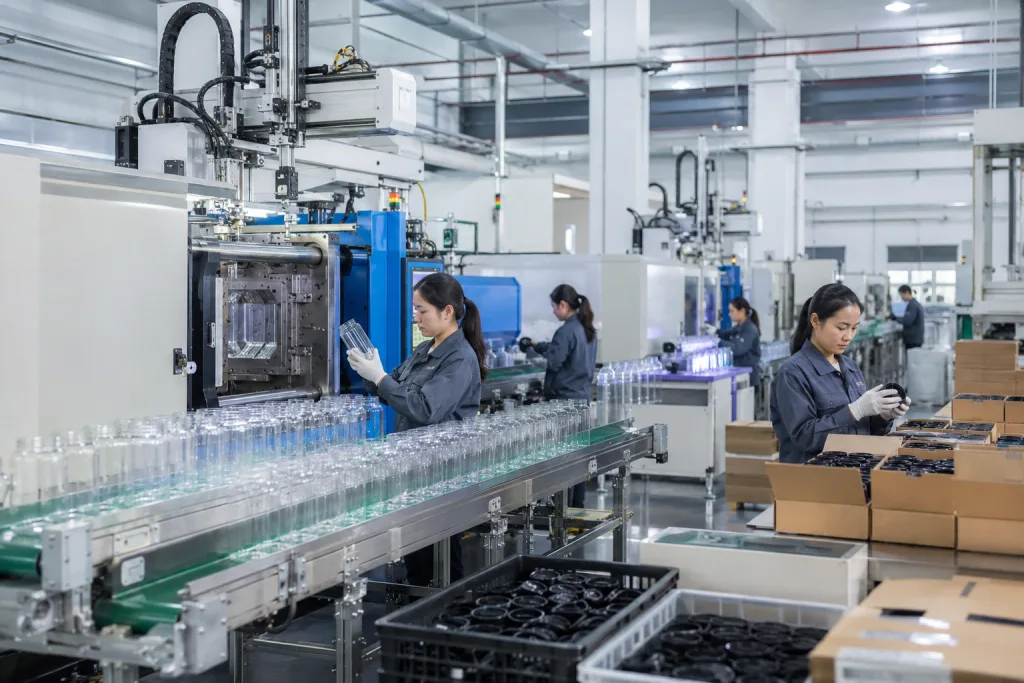
Key Takeaways
- For custom PC bottles, realistic MOQ is often 3,000-5,000 units per SKU, while new mold projects usually start closer to 8,000-10,000 units
- Standard lead time from sample approval is typically 25-35 days, with pre-production samples in 7-12 days and mold development in 20-30 days
- AQL 2.5 for major defects and 4.0 for minor defects is a practical inspection baseline for customized drinkware export orders
- Decoration, lid complexity, and compliance testing can move FOB cost by 8%-25%, even when bottle volume stays the same
You are not buying a bottle. You are buying repeatability: same resin lot, same 0.2 mm wall-thickness window, same lid torque, same logo position, same carton drop result, same shipment week. That is why choosing a pc drinkware manufacturer is about process control, not catalog photos. We see buyers come to China with a target FOB and a sketch, then the line starts showing haze, stress cracking near the shoulder, weak threads, or decoration wear long before the promised 200 dishwasher cycles. QC pulled one sample last month with logo offset by 1.8 mm, and the buyer flagged it at once.
If you source from Zhejiang or another part of China, ask practical questions. Can the factory hold color from lot to lot within the approved masterbatch standard? Is the real MOQ for a custom canteen 3,000 pcs or 10,000 pcs once you include mold setup and color change? Which tests are standard, and which ones add cost per SKU? A factory in Zhejiang with 400,000 units per month can still be the wrong fit if sampling discipline is loose; this is the wrong question to ask if all you care about is monthly capacity. We have seen POs delayed 12 days vs 18 days over one typo in artwork approval, so this guide focuses on the questions procurement managers actually ask, with a checklist you can use before you place a PO.
What You Are Really Buying
When you ask a pc drinkware manufacturer for a quote, the first sheet usually shows capacity, model options, and logo methods. That is not the full buy. For B2B orders, you are buying a controlled production system for custom drinkware, with records the line can repeat from batch 1 to batch 6. We look at color drift, transparency, thread engagement, gasket compression, and print position with a go/no-go gauge and sample board. This is the wrong question to ask if price is your only filter.
PC, or polycarbonate, gets picked for good reason: tough, light, and clear. We ship it for sports bottles, canteens, and foodservice programs where drop resistance matters. PC also shows every shortcut on the molding side. A dryer set 10°C off, short drying hours, weak mold cooling, or the wrong gate position can leave splay, haze, or stress marks around the shoulder. A capable canteen factory should be able to discuss resin grade, drying hours, and visual defect limits without pausing, not just shape changes and lid color swatches.
Your shortlist should include questions like these:
- What resin source is used, and is lot traceability recorded?
- What wall thickness range is typical, such as 2.0-2.8 mm for a mid-size bottle body?
- How many units per month can the plant produce for this category?
- What is the standard defect policy under AQL?
- Can the factory support both stock models and canteen customizable projects?
At BottleForge Industrial in Zhejiang, China, these points carry more weight than broad claims about being a canteen manufacturer. We have seen buyers push hard on unit price, then flag thread fit after pilot run because the supplier could not explain a 0.3 mm neck variation. For a procurement manager, the wrong supplier is usually not the highest quote. It is the factory that cannot explain process variation in plain numbers, or show why QC pulled the sample.
Questions To Ask Before Sampling
Sampling is where buyers lose either two weeks or two months. We see it on the line all the time. If your program needs a custom canteen, customizable drinkware, or a customized growler style body, do not start with artwork. Start with the structural brief. This is the right first move, because a 0.3 mm wall change or a new neck finish will affect mold cost, leak risk, and sample timing before your logo file matters.
Minimum brief for first quotation
- Target volume: 500 ml, 750 ml, 1,000 ml, or other
- Body material: virgin PC, recycled content if applicable, and color requirement
- Lid style: screw cap, flip straw, carry loop, or tethered cap
- Decoration: silk screen, heat transfer, IML, laser for metal parts, or wrap print
- Packaging: polybag, egg-crate divider, gift box, PDQ, or Amazon-ready pack
- Compliance market: EU REACH, LFGB where required, or US ASTM/CPSIA if relevant to kids' items
Then ask the factory what is standard and what is custom. A reliable canteen supplier should say it plainly: changing lid geometry is a tooling job; changing bottle color is not. A stock bottle with custom Pantone body and one-color print may sample in 7-10 days. A fully canteen customized body with new tooling may need 20-30 days for mold work, plus another 5-7 days for correction. We have seen buyers mix these together on one RFQ, then push for the same timeline. The math doesn't work.
A good sample process gives you bad news early. That is a feature, not a problem.
Ask for the sample approval path too. You want a pre-production sample signed against a simple spec sheet: dimensions, net weight, wall thickness target, logo position, carton spec, and drop test standard. QC pulled a sample last month that looked good by eye but came in 11 g light and failed the 1.2 m drop test with a cracked hinge. Many canteen vendors can send attractive hand samples. Far fewer can hold the same result once they run 5,000 units on production tooling.
If you work with a canteen distributor or distributor drinkware importer instead of direct factory purchase, ask the same questions anyway. We have seen this go sideways when the PO said “smoke grey” but the approved chip was closer to Pantone 430 C, and nobody caught the mismatch before mass production. The chain is only as strong as the original process controls in China.
MOQ, Price, And Cost Traps
Most buyers ask MOQ first. Fair enough, but this is the wrong question to ask if you skip the cost structure behind it. For a standard PC sports bottle with one-color print, a realistic MOQ from a canteen manufacturer in China is often 3,000 pieces per color per size. We run this type of order on the line with a 1-color screen and standard lid set, and that MOQ usually keeps the setup cost from going sideways. For more complex customized drinkware with special lids, mixed materials, or premium packaging, 5,000 pieces is common. A full custom mold for a customizable canteen or customizable growler project can start at 8,000-10,000 pieces depending on tooling amortization.
FOB price is where buyers get misled by partial quotes. A bottle body is only one cost layer. Ask the supplier to break out these items, and ask for the numbers in writing because we have seen POs with the packaging line missed and one typo changed a 24-pack carton to 12-pack:
- Body and lid unit cost
- Decoration cost by method and color count
- Tooling or setup charges
- Packaging cost per unit
- Carton quantity and carton gross weight
- Testing cost if third-party lab reports are needed
For example, a stock 700 ml PC bottle may sit around a low single-digit USD FOB price depending on resin grade, lid complexity, and print. Change one-color silk screen to wrap transfer, add a custom lid insert, and pack it in a gift box, and FOB can jump 15%-25% fast. QC pulled the sample on one project like this, and the gift box alone added 0.18 USD per unit before master carton labor. That is not supplier padding. It is real labor, scrap, and packing cost. The math does not work if someone promises custom trim and retail packing at the same base price.
Ask about scrap assumptions on transparent colored PC. Dark smoke and amber usually run more predictably than very light translucent tones. We check this with a color chip and first-shot sample, and the buyer flagged a pale blue once because the lot drift was visible under store lighting. If the project is canteen promotional and the client insists on a bright custom tint, you need to know whether the factory has a history of holding that color over multiple lots.
Serious canteen suppliers and canteen vendors should explain payment terms clearly. Common export terms are 30% deposit and 70% balance before shipment, with tooling paid upfront. We usually put carton gross weight, CBM, and mold charge on the same quote sheet so there is no argument later. If a supplier is vague on costing detail, expect trouble when your buyer wants a rollover order or cost-down exercise. We have seen this go sideways after mass production, especially when the first quote skipped testing fees or insert packing labor.
Compliance And Quality Checks That Matter
Procurement teams in Europe and North America do not need sales talk. You need clean paperwork and inspection points the line can run every day. For PC drinkware, the test package changes by lid structure, decoration, and destination market, but a reliable pc drinkware manufacturer should already know the drill for REACH, LFGB-related material expectations where applicable, California Proposition 65 awareness, and product-specific migration or safety reports from recognized labs. We usually start from the BOM and resin lot record, then match each food-contact part to the required file set. If a supplier needs two weeks just to explain which seal grade they used, that is the wrong question to ask.
For quality control, use a checklist operators and inspectors can follow without guessing. On our floor, QC pulled the sample against the sealed golden sample and torque gauge before the shift started. A typical export standard for finished bottles might include:
- AQL 2.5 major, 4.0 minor at final random inspection
- Leak test: 100% inline or batch test depending on lid design
- Drop test: 1.0-1.2 meter packed drop on key faces and corners
- Dishwasher or abrasion test for printed decoration where required
- Torque check on screw lids to avoid leakage and thread damage
- Odor check after molding and packing
If you are buying a custom canteen for school, outdoor, or retail channels, also ask about migration risk from silicone seals, straws, or color masterbatch. We have seen this go sideways when the PC body passed, but a straw pigment or soft seal did not match the claimed grade. One buyer flagged a 0.5 mm seal change on a repeat PO because the backup vendor used a different shore hardness. A disciplined canteen factory in Zhejiang should give BOM-level clarity for each food-contact part, down to supplier name, material spec, and where it sits in the assembly.
Checklist for approval before mass production:
- Golden sample signed by buyer
- Approved Pantone reference or color chip
- Barcode placement confirmed, including FNSKU if Amazon-bound
- Carton mark format approved
- Inspection criteria shared in writing
- Lab test scope confirmed before production, not after
This is where canteen manufacturers start to separate. The better factories do not wait for final inspection to find trouble. They control it from resin receiving through packing release, and they keep records that tie the incoming lot, molding date, and packing result together. We run that chain because the math does not work any other way.
How To Judge A Factory Visit
If you can visit China, do it. A two-hour walk through a Zhejiang plant tells you more than twenty emails and three polished slide decks. If travel is not practical, ask for a live video audit and make them walk the same route, from raw material racks to final packing. You are checking one thing: do they run a factory, or are they a trading office showing borrowed samples on a clean table.
Look for proof, not staging. In the molding area, check whether resin storage is sorted and whether hopper dryers are labeled by material; for PC, one wrong load or poor drying shows up fast as splay, haze, or brittle parts. On the line, see whether workers use torque fixtures, leak-test jigs, and print position guides with actual stop points in mm. In packing, carton labels should match the work order and PO, not a handwritten note taped to the side. QC pulled a sample like this for us once because one digit on the PO was wrong.
Ask direct questions:
- How many injection machines are used for drinkware bodies and lids?
- What is monthly output for this category: 200,000 units, 400,000 units, more?
- What is the normal lead time in peak season?
- How are incoming silicone, colorant, and packaging materials inspected?
- What social and quality audits are available, such as BSCI or ISO-based systems?
A strong canteen supplier answers fast and stays on the question. If every answer turns into a sales pitch, that is the wrong signal. We have seen buyers ask about showroom size while skipping machine count; this is the wrong question to ask. If you are evaluating a distributor canteen program or working through canteen distributors in Europe, still ask how the original plant runs, what MOQ they hold, and who signs off final inspection. The distributor can add local service, but the manufacturing risk still sits at the source factory.
For buyers sourcing custom growler or distributor growler formats, pay extra attention to handle assembly, wide-mouth thread consistency, and cap sealing after repeated opening cycles. This is where field claims start. The buyer flagged it on one project after 300 open-close cycles because the cap held on the first test but lost seal on the second sample set. Cosmetic defects get attention in a meeting, but closure failure costs money in the market. The best factories in China know that, so they test the cap as hard as the body.
Choosing The Right Production Model
Not every project needs a new mold. In our factory, a lot of B2B programs start from an existing bottle platform and change the outside only—print, body tint, lid color, or carton marks. That route is usually faster for canteen custom, customized canteen, or canteen customizable orders tied to promotions, loyalty campaigns, and retail test runs. We run these on existing steel tools, so the line loses less time on setup and sample approval.
Use this decision logic:
- Stock model plus logo: best if you need MOQ control, a faster launch, and a tight target price; common MOQ starts at 3,000 pcs per color
- Stock model plus color and packaging changes: best if your brand needs shelf distinction without paying for new tooling; we usually confirm Pantone against a signed chip before mass run
- Modified lid or accessory: best if drinking function or carrying use matters more than changing the bottle body; we often adjust a strap, cap profile, or straw part first
- Full OEM mold: makes sense only if your annual volume can cover tooling and validation cost; this is the wrong question to ask if forecast is still soft
For example, if your annual demand is only 12,000 units across three colors, a fresh body mold rarely pays back. The math doesn't work. You are usually better off with a proven platform from a canteen manufacturer or canteen vendor that offers custom body tint, print, hangtag, and carton branding. We have seen buyers push for a new silhouette at this volume, then cut one color after the first PO and leave the tool underused. If your forecast is 80,000-120,000 units per year with stable repeat business, then a full customized growler or bottle body starts to make sense.
Lead time follows the same logic. A stock model may ship 25-35 days after sample approval. A new mold project often stretches to 45-60 days for first mass production, especially if testing must be completed before booking. That gap is real on the factory floor: QC pulled the sample, the mold shop asked for a 0.3 mm tweak at the neck finish, and the first trial lost 4 days. If you supply retail windows or Amazon replenishment, we have seen this go sideways fast.
If you manage multiple SKUs, standardizing lids or shared components across the line is usually the better move. It cuts spare-part complexity, keeps MOQ in range, and gives your canteen distributors or wholesale partners fewer after-sales complaints. One buyer flagged this after receiving 6 cap types with one PO, and their service team hated it. A practical factory in Zhejiang, China should help you simplify the product architecture, not keep adding variation that slows sourcing and creates dead stock.
Get a factory-grounded quote for your next PC bottle
Send your target volume, artwork, packaging, and compliance market. We will review MOQ, tooling route, and realistic lead time before you place a trial order.
Frequently asked questions
What MOQ should I expect from a pc drinkware manufacturer for a custom order?
For a stock PC bottle with custom color and one-logo print, expect around 3,000-5,000 units per SKU. If you need a new lid, special accessory, or premium gift box, MOQ often moves closer to 5,000 pieces. For a fully new body mold, many factories in China will guide you toward 8,000-10,000 units to spread tooling and setup cost sensibly. Always ask whether MOQ is per color, per size, or per combined order. Some suppliers quote 3,000 units but mean one color only, which changes the economics fast. Also confirm whether replacement parts, like straws or seals, have separate minimums.
How long does production usually take for customized drinkware?
For an existing model, pre-production samples are usually ready in 7-12 days after artwork and Pantone confirmation. Mass production then takes about 25-35 days after sample approval and deposit. If your project includes a new mold for a custom canteen or customizable growler, add 20-30 days for tooling and first trial, sometimes longer if thread fit or sealing needs adjustment. Peak season in Zhejiang and wider China can add 7-10 days, especially before major holidays. If you need lab testing before shipment, factor in another 5-8 working days depending on test scope and lab queue.
What quality documents should I ask a canteen factory to provide?
Ask for a specification sheet, material declaration, packaging specification, and a clear QC standard tied to AQL. A practical baseline is AQL 2.5 for major defects and 4.0 for minor defects. If the product is for food contact, request relevant test reports for the complete product or key materials, depending on your market requirements. For retailer programs, ask for carton drop test results, leak-test method, and barcode placement approval. If social compliance matters to your organization, ask whether the factory has BSCI or equivalent audit records. Good canteen manufacturers in China should also be able to show traceability from resin lot to finished batch.
Is it better to buy through canteen distributors or directly from the factory?
It depends on volume and internal resources. If you buy 3,000-10,000 pieces occasionally and need local service, canteen distributors can simplify communication, warehousing, and after-sales handling. If your annual demand is larger, your artwork changes often, or you need tighter cost control, buying direct from a canteen manufacturer in Zhejiang or other parts of China usually gives you better transparency. The direct route works best when your team can manage specs, sample approvals, inspections, and shipping detail. The distributor route works best when speed, local invoicing, and lower management load matter more than shaving a few percentage points off FOB cost.
What are the most common mistakes when sourcing custom drinkware from China?
The biggest mistake is approving a sample without a written spec. That invites disputes over color tolerance, wall thickness, logo placement, and packaging. Another common error is comparing FOB prices without matching decoration method, carton quantity, or test scope. Buyers also underestimate closure risk: many complaints come from lid sealing, straw fit, or gasket quality rather than the bottle body. A fourth mistake is ignoring inspection standards until goods are finished. Set AQL, leak test, and carton drop requirements before production starts. Finally, many teams choose a canteen supplier based on fast replies alone instead of checking whether the factory can actually control repeat orders at 3,000-10,000 unit scale.