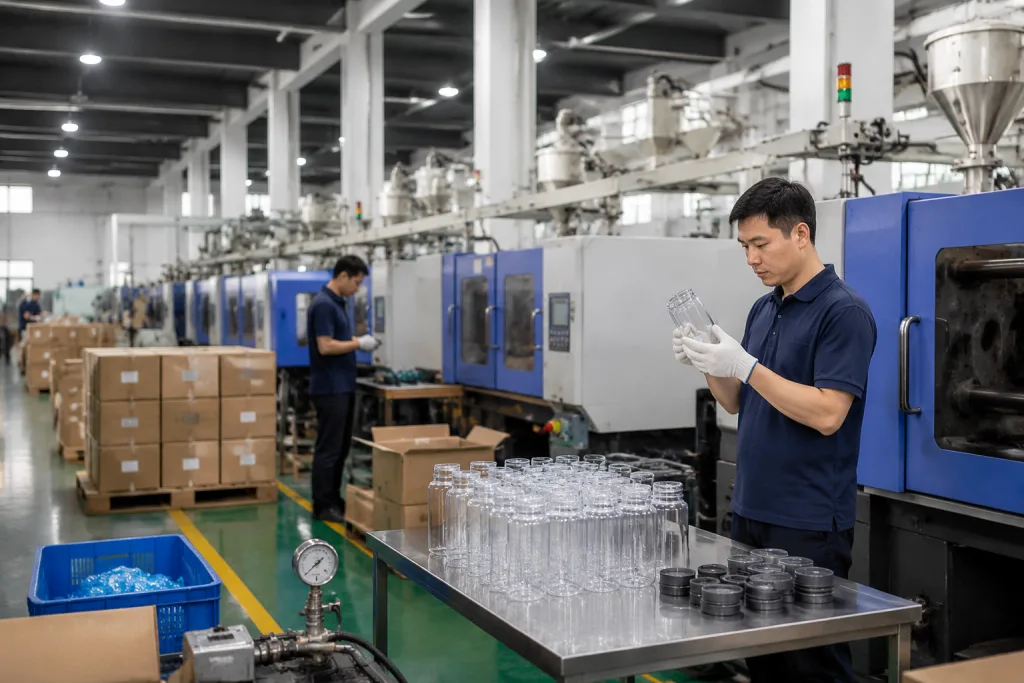
Key Takeaways
- A usable RFQ should lock 12-18 line items, including PC grade, wall thickness, capacity tolerance, logo method, packaging, AQL, and target lead time of 30-45 days
- Typical MOQ from a Zhejiang, China factory is 3,000-5,000 pcs per color for stock molds, while custom color lids or new molds can push MOQ to 10,000 pcs
- Pre-production sampling usually takes 7-12 days; bulk production takes 25-40 days after deposit and approved golden sample
- For bulk shipments, define inspection at AQL 2.5 major / 4.0 minor and specify FOB Ningbo or Shanghai, carton drop test, and barcode placement in the PO
You can buy polycarbonate bottles and tumblers from 20+ factories across China and get a low price fast. That part is easy. The hard part is getting the exact bottle, lid, logo, compliance file, carton marks, and ship window you already promised your customer. Most mistakes start before the line runs: vague RFQs, missing PO items, or blind assumptions on material safety and print wear. We’ve seen a PO miss a 6 mm logo offset and the buyer flagged the sample the same day.
From Zhejiang, we see the same issue with new buyers in Europe and North America. They ask for custom drinkware, collect three quotes, then compare unit price only. This is the wrong question to ask. Then the sample lands with the wrong wall thickness, no REACH test plan, and a lid leak rate nobody wrote down. QC pulled the sample, checked it on a digital caliper, and found the wall came in 0.4 mm under target. If you want a canteen custom program that scales, your RFQ has to convert cleanly into a controlled bulk order.
Start with the commercial brief
A one-line RFQ for a 700 ml bottle gets you a one-line price. That is not a workable sourcing method. A solid pc drinkware factory needs the commercial brief first so we can quote the right resin, mold setup, decoration process, and packing spec. If you are a brand owner, canteen distributor, or distributor drinkware buyer, send the brief before the RFQ sheet. On our side, sales will mark up the drawing and the line will ask the same missing questions anyway.
Your brief should answer the market basics: where you sell, who uses the product, and what shelf price or landed cost you need. A US promo project and a Germany retail sports line do not buy the same bottle, even at the same 700 ml capacity. For canteen promo orders, buyers usually push unit cost and lead time; we have shipped those in 12 days versus 18 days by using stock color resin and a standard carton. For an outdoor retail program, the buyer flagged scratch marks after a 24-hour rub test, so finish stability, dishwasher guidance, and color consistency mattered more than saving USD 0.06. This is the wrong question to ask: “What is your best price?” Ask what spec fits your channel.
Put these PO-relevant points in the brief
- Sales channel: retail, e-commerce, corporate gifting, club, school, distributor growler, or canteen vendor program
- Target quantity: 3,000 pcs pilot run, 10,000 pcs launch, or rolling forecast by month
- Destination market: US, Canada, UK, EU, which drives ASTM, CPSIA, REACH, or LFGB testing needs
- Price target: for example FOB Ningbo under USD 1.85 for a 700 ml PC sports bottle
- Product family: custom canteen, customizable growler, shaker, tumbler, or kids bottle
BottleForge Industrial in Hangzhou, Zhejiang typically handles 600,000 units per month across multiple drinkware lines, but capacity means little if the spec is loose. If you need a canteen customizable range with matching lids and colors, state it on day one. We have seen POs with a typo in the carton mark, wrong cap insert, and no Pantone callout, then the buyer asks why the sample and bulk do not match. A lot of canteen manufacturers quote low on a stock bottle, then add cost later for exact Pantone matching, individual polybags, or custom master cartons. The math doesn't work if those items were always part of the program.
A low quote with open specifications is usually an expensive order waiting to happen.
Build an RFQ that prevents rework
The RFQ is where buyers keep margin or lose the project. In a pc drinkware factory, unit price moves on details that never show up on a mood board. Polycarbonate can look crystal clear and take a drop test, but clarity, impact performance, food-contact declarations, and surface finish still change with resin source and process control. We see this on the line. Two approved-looking samples can run with different haze after drying if the resin lot shifts. If you are sourcing custom drinkware from China, write the RFQ so a new production manager can read it cold at 8:30 a.m. and still run the order right.
At minimum, your RFQ should state exact capacity, weight target, and dimensional limits. A 700 ml bottle can mean 700 ml brimful or 700 ml usable fill to the shoulder. That one line changes tooling, fill test method, and carton count. It also changes hand feel. We have had buyers flag a bottle as “too light” after first sample because the PO said 700 ml but never said usable fill, and the body came out 18 g under their sales sample. Do not leave it open. This is the wrong question to skip.
- Material: PC body, PP lid, silicone seal; request virgin food-grade resin only
- Wall thickness: for example 2.2-2.8 mm on the body, depending on shape and impact requirement
- Capacity tolerance: ±3% is common; tighter tolerance may increase reject rate
- Weight tolerance: typically ±5 g to ±8 g on injection parts
- Color: Pantone code for lid, body tint percentage, and whether color approval is under D65 lighting
- Decoration: silk screen, heat transfer, IML, pad print, or laser on a metal badge; define adhesion and abrasion standard
- Leak standard: upside-down 30 minutes, no visible leakage; straw lids need separate criteria
- Packaging: egg-crate, inner box, color box, barcode label, FNSKU, carton dimensions and max gross weight
- Trade term: FOB Ningbo, EXW Hangzhou, or DDP if agreed separately
If you are working with canteen suppliers or canteen vendors for a private-label line, ask for mold status at the quoting stage. Is it a stock mold with no mold fee, an exclusive modified mold, or a fully new tool? The answer changes MOQ, lead time, and what we can still adjust after sample approval. A stock mold may support MOQ 3,000 pcs per color. A modified cap or handle can raise MOQ to 5,000-10,000 pcs and add 15-25 days. We have seen this go sideways when a buyer approved a stock body, then added a custom handle and expected the same lead time. The math doesn't work. Good canteen factory quoting is about what is fixed, what is still negotiable, and whether QC pulled the sample from a stock tool or a fresh T1 mold.
Review supplier replies like an engineer
When quotes come back, do not compare only the FOB number. Check what is inside the price. One canteen manufacturer quotes a PC body with a PP lid and a basic seal. Another quotes a 0.6 mm thicker wall, higher-grade silicone, and individual polybag packing. The second quote can be USD 0.18 higher and still save money after claims, repacking, and missed delivery windows. We have seen buyers miss this, then QC pulled the sample and found the lid seal was the wrong hardness.
Ask every candidate supplier for the same five documents or statements. Use the same checklist for all 5 suppliers, whether they are canteen manufacturers in Zhejiang or factories in other parts of China. This is not paperwork for show. It tells you fast who runs a controlled line and who is quoting off a rough spreadsheet with no confirmed data.
- Specification confirmation sheet: not just a proforma price list
- Testing basis: REACH, LFGB, FDA food-contact statement, ASTM or CPSIA if relevant to children
- Quality standard: AQL level, leak test method, appearance criteria, and carton drop test
- Capacity and lead time: sample in 7-12 days, bulk in 25-40 days, with exact output estimate
- Audit status: ISO 9001, BSCI, Sedex, or customer audit readiness if your account requires it
For distributor canteen business, consistency matters more than a one-off bargain. If you reorder every quarter, ask how the supplier controls color lots, logo alignment, and lid fit batch to batch. Ask for the actual method. We want to hear about incoming resin checks, first-article approval, and in-process patrol inspection every 2 hours on the line, not a sales reply that says "stable quality." If they cannot explain it, expect variation. We have seen this go sideways over a 1.5 mm lid-fit shift that the buyer flagged only after goods reached the warehouse.
Check the quote structure too. A workable quote from a pc drinkware factory should break out unit price, sample charge, screen charge, mold fee if any, packaging adders, and testing cost. For example, a 700 ml stock-mold custom canteen might be quoted at USD 1.28 FOB Ningbo for 5,000 pcs, plus USD 45 per color screen charge and USD 120 for a pre-production sample set. That is a usable quote. A quote that says USD 1.10 all in, details later, is not. Frankly, this is the wrong quote to approve, because the missing lines usually come back later as carton upgrade, insert card, or leak-test labor.
Lock the sample before placing deposit
Buyers get impatient at sample stage, and bulk problems start there. You do not need a pretty sample. You need a decision sample. For customized growler, customizable canteen, or customized drinkware projects, approve against the future PO and approved artwork file, not somebody’s memory from a 30-minute meeting. We have seen one missed lid note on a PO turn into 2,000 units with the wrong sip opening.
Run the sample in 3 checkpoints, but make each one do a job. First, a plain structure sample checks size, grip, lid fit, and thread engagement; on the line we usually check neck tolerance in mm and open-close feel by hand. Second, a color and logo sample checks decoration, logo position, and Pantone match under daylight box review. Third, the golden sample locks every approved point and becomes the production reference that QC pulls during bulk. For stock molds, this cycle usually takes 7-12 days. If you need cap modifications or custom inserts, expect 15-25 days. Buyers ask how to make it faster; this is the wrong question to ask if the sample still has open points.
What the sample PO should include
- Item code and revision number
- Exact resin and component list
- Logo artwork version and Pantone references
- Packing method and barcode location
- Functional checks: leak test, drop test height, top-rack dishwasher guidance if claimed
- Compliance plan: lab selected, test scope, and who pays
If you buy for canteen distributors or a canteen vendor network, ask the factory to send photos and short test videos, not just approval photos on a white table. A clear video of a 1.0 meter drop test on the packed unit tells you more than a sales promise. If your program includes custom growler or distributor growler SKUs, request cap torque guidance and handle load check as separate points. Larger vessels fail differently from standard sports bottles; QC pulled one 64 oz sample last season where the handle was fine empty but stressed at 6 kg load.
Do not release deposit for mass production until the factory signs off the approved sample and you have the final carton layout. This sounds basic. Still, we ship too many rescue orders because bulk started while barcode positions, warning marks, or recycling symbols were still being argued over. Then goods are ready, the packaging is wrong, and the math does not work. One common mess is a 15 mm barcode shift that the buyer flagged only after outer cartons were printed.
Write the bulk PO line by line
A bulk purchase order should read like a shop-floor instruction sheet. If you buy from a pc drinkware factory for Europe or North America, most arguments later start with one missing PO line. We have seen this go sideways over a lid color note, a 55 mm logo size, even a PO typo in the item number. This applies to a brand owner, canteen distributor, canteen distributors group, or a distributor drinkware importer handling 6 or 12 accounts at once.
Write line items, not loose comments. A clean PO lets the factory convert the file straight into BOM, production order, artwork sheet, and packing instructions without 8 rounds of email. On our side, the line will usually check the PO against the dieline, Pantone callout, and carton spec before material issue.
- Product: 700 ml PC bottle, clear smoke tint, PP screw lid, silicone seal, carry loop
- Order quantity: 5,000 pcs total, 2 colors, 2,500 pcs each
- Unit price: USD 1.28 FOB Ningbo
- MOQ basis: stock mold, MOQ 2,500 pcs per color
- Decoration: 1-color silk screen, logo width 55 mm, adhesion pass cross-hatch test
- Packing: 1 pc per polybag, 24 pcs per export carton, carton max 14 kg gross
- Marks: item no., color, PO no., made in China, barcode label on side panel
- Inspection: AQL 2.5 major / 4.0 minor, based on ANSI/ASQ Z1.4 single sampling
- Testing: food-contact compliance per destination market, report before shipment if required
- Lead time: 30 days after deposit, artwork approval, and golden sample sign-off
- Payment: 30% deposit, 70% before shipment against inspection pass and copy docs
If you run a canteen customized assortment, add substitution rules in black and white. Example: no material or colorant substitution without written approval. This is not a small point. The buyer flagged this on one order after QC pulled the sample and found the smoke tint shifted by one shade from the approved chip. If you ship to Amazon or 3PL channels, define FNSKU size, carton label format, pallet standard, and oversize limit. A canteen factory can follow those details, but not if they land 2 days before loading.
Buyers in China sourcing programs should attach the approved sample photos and packaging layout directly to the PO. We ship smoother when those files sit in the same packet as the order, not buried in old email threads. One approved layout with carton dimensions, barcode position, and seal direction has saved us from repeat questions more than once.
Control production, inspection, and shipping
Once the deposit is paid, your job is not over. Stay involved at 3 control points: pre-production, mid-production, and pre-shipment. No need to send daily messages. Ask for the right proof at the right time. A solid canteen supplier should handle this without excuses. On our side, we usually lock these points against the signed PO and the approved sample sealed in the sample room.
At pre-production, ask for the final BOM, color chips, artwork proof, and packaging confirmation. Ask for the carton marks too; we have seen a single PO typo on the barcode suffix hold shipment for 2 days. At mid-production, request line photos, the first packed carton, and the actual completed quantity, not a vague percentage. For orders above 10,000 pcs, pay for a mid-line inspection. This is money well spent, especially on customized canteen or customizable growler programs with 2 lids, straws, seals, and inserts running at the same time. QC pulled the sample once on a 12,000-piece order and found the silicone ring sitting 1 mm high, which turned into leaks after capping.
Before balance payment, book a pre-shipment inspection against your approved AQL. For most drinkware, AQL 2.5 major and 4.0 minor is practical. Critical defects should be zero tolerance: sharp edges, food-contact contamination, cracked bodies, major leaks, wrong logo, wrong barcode, or mixed carton content. This is the wrong question to ask: “Can we skip inspection if the factory looks experienced?” We have seen this go sideways on clean-looking goods that failed on barcode mix-up and torque spread.
- Appearance checks: haze, black specks, sink marks, logo offset, color mismatch; QC usually checks under a standard light box because translucent PC can hide shade shift in warehouse light
- Function checks: thread fit, seal compression, leak test, cap torque consistency; on the line, we often use a torque tester and a vacuum leak check for random samples
- Packing checks: barcode scan, carton count, carton weight, drop test, pallet stability; the buyer flagged it once when carton weight was short by 0.8 kg and 24 pcs were missing from one pallet row
- Document checks: invoice, packing list, test reports, COO if needed, booking details; check consignee spelling and HS code before the goods reach port
Typical lead time from a Zhejiang, China factory is 25-40 days for stock-mold PC drinkware after approvals. Ocean transit to the US East Coast can add 30-40 days; to Western Europe, often 28-35 days port to port. Do not plan against factory lead time alone. Build backward from warehouse receipt. If your customer launch is fixed, the math does not work if you approve artwork late and still expect the original ex-factory date. We ship plenty of orders where 3 lost days on approval turn into a missed vessel cut-off.
Reliable canteen vendors and canteen manufacturers should tell you where risk still sits: color matching on translucent PC, scratch sensitivity during bulk packing, or seal fit on new lid designs. That kind of pushback matters. It lets you make a decision before booking containers. On our floor, scratch marks often show up after final packing, not during molding, so we sometimes suggest an extra PE bag or divider even if the buyer pushes back on unit cost.
Know when PC is the right choice
Not every project should use polycarbonate. We say that early because we've seen buyers force PC into jobs where it does not belong, then the line gets blamed later. A pc drinkware factory makes sense when you need clear walls, solid drop performance, and a shaped bottle that would come out heavier in glass or cost more in stainless steel. We run a lot of 500 ml to 1,000 ml sports bottles in PC for this reason. Body weight stays down, and the clarity still shows fruit slices or fill level. On our floor, a 1.8 mm wall is a common starting point for this type of bottle.
Use conditions need a straight answer. If the customer wants vacuum insulation, PC is the wrong choice to ask about. If the item is for rough school, dorm, or institutional use, body clarity is not the main issue; wall thickness, rib layout, and lid structure decide whether the bottle survives 1,000 passes through daily handling. For a custom growler or customized growler concept, define the job first: cold beverage transport, shelf display, or daily refill use. The spec changes fast. We have had a buyer flag cap cracks on a sample set, and the root cause was not the PC body at all but a thin hinge pin on the lid.
For B2B programs, PC usually fits these cases:
- Retail and promotional sports bottles from 500 ml to 1,000 ml, especially where low unit weight matters for freight
- School or campus reusable bottles where impact resistance matters, and where QC pulled drop-test samples from 1.2 m
- Lightweight custom drinkware for event programs and distributor canteen channels, often starting from a 3,000 pcs MOQ stock mold
- Programs needing visible beverage level or fruit infusion display, where the buyer wants the contents to sell the bottle
If you are comparing canteen factory options in China, ask how the supplier positions PC against Tritan-like copolyester, stainless steel, or glass. This is the right question. "Which material is best?" is the wrong one. A good factory will give you a direct answer on cost, durability, compliance, and decoration limits, and they should be able to show where each line starts to fail. We ship both plastic and metal programs, and the math doesn't work if a supplier pushes one material for every brief. That usually ends with one container shipped and no repeat PO.
For first orders, keep it tight. One stock mold, two colors, one logo position, one packaging method. We have seen this go sideways because a first PO tried to mix 4 SKUs, 3 print methods, and an inner box change after sample approval. Start with a clean bulk run, then build out canteen customized families, custom growler variants, or broader customizable drinkware assortments after the first shipment passes inspection and lands without claims.
Send your RFQ and get a workable factory quote
Share your target spec, quantity, market, and packaging plan. We will review the details and reply with practical MOQ, lead time, and compliance options.
Frequently asked questions
What is a realistic MOQ from a pc drinkware factory?
For stock molds, a realistic MOQ is usually 3,000 to 5,000 pcs per model, often split by 1 or 2 colors. Some factories in Zhejiang, China will accept 2,000 pcs for a repeat order or a very simple clear bottle, but you should not plan on that for a first run. If you need custom lid colors, special inserts, or exclusive mold changes, MOQ often moves to 5,000-10,000 pcs. New tooling can go higher depending on the part count. Ask whether the MOQ is per color, per logo, or per shipment. Those are not the same thing, and that is where many first-time B2B buyers get caught.
How long does sampling and bulk production usually take?
For a stock-mold project, plain samples can be ready in 3-7 days, and logo or color samples usually take 7-12 days after artwork and Pantone confirmation. If you are changing the cap, handle, or bottle base, allow 15-25 days for revised samples. Bulk production is commonly 25-40 days after deposit, approved golden sample, and packaging sign-off. During peak season, add 7-10 days. Shipping is separate: ocean freight to Europe is often 28-35 days port to port, and to North America 20-40 days depending on coast and routing. If your launch date matters, build the calendar from warehouse delivery backward, not from factory completion.
What compliance documents should I ask for on custom drinkware?
Ask for a food-contact declaration based on your destination market and then confirm what testing is actually needed. For the EU, REACH and sometimes LFGB-related requirements are common discussion points. For the US, buyers often ask for FDA food-contact statements, and ASTM or CPSIA can matter if the item is intended for children. Also request material information for PC body, PP lid, and silicone seal. If the product carries a special claim such as dishwasher safe, ask how that claim was validated. For serious accounts, include the test scope in the PO before bulk begins. Testing after production is slower and more expensive than defining the standard up front.
How should I compare quotes from different canteen manufacturers?
Compare the specification, not just the unit price. Put all replies into one sheet and line up body material, wall thickness, resin grade, seal material, logo method, packaging, MOQ, lead time, testing, and trade term. A quote of USD 1.18 EXW Hangzhou is not automatically better than USD 1.31 FOB Ningbo if the second one includes thicker walls, better packing, and fewer add-on charges. Also compare what the supplier refused to fix in writing. If they avoid defining leak standard, capacity tolerance, or AQL, the low price is carrying hidden risk. Good B2B sourcing means paying for the right control points, not chasing the lowest opening number.
What are the most important PO terms to avoid bulk order disputes?
The most important terms are item specification, approved sample reference, quantity by color, unit price, packaging, inspection standard, compliance requirement, lead time start point, and payment release condition. State whether lead time starts after deposit only, or after deposit plus artwork and sample approval. Define AQL, usually 2.5 major and 4.0 minor, and list critical defects as zero tolerance. Include carton dimensions, gross weight limit, barcode type, and shipping marks. If you allow substitutions, say exactly where. If you do not, write no material, component, or color substitution without written approval. These details stop most arguments before they start.