Key Takeaways
- For most outdoor canteen wholesale programs, 18/8 stainless with 0.5 mm inner and 0.4 mm outer wall is the safest starting spec at MOQ 1,000 pcs/color
- Vacuum canteens usually add USD 1.20-2.80 per unit versus single-wall, but can reduce customer returns tied to condensation by 15-30%
- A 64 oz bulk growler works for beer and camping channels, but shipping cost per unit can run 35-50% higher than a 32 oz canteen bulk SKU
- Typical Zhejiang, China lead times are 7-10 days for stock samples, 15-20 days for pre-production samples, and 35-45 days for mass production
You can buy a canteen that looks fine in a photo and still land the wrong SKU for your market. We usually see it after the first sample hits the table: the bottle comes in at 420 g and feels heavy for hiking retail, the mouth is too narrow for ice, the powder coat fails a carton drop, or the MOQ sits too high on a seasonal style. Small spec mistakes get expensive fast.
Most buyers do not need more options. They need a tighter comparison between canteen wholesale, bulk growler, and alcohol flask bulk programs based on real use cases. At our Zhejiang factory in China, we start with capacity, steel grade, insulation, and decoration limits before we talk about colors; QC pulled too many early samples where the finish looked good but the spec sheet was already off. That cuts bad sampling rounds and shortens development from 45 days to closer to 25. Asking for color first is the wrong question.
Start with the comparison table
If you are comparing outdoor canteen wholesale offers, start with a short spec table, not catalog photos. This is the right question to ask first. A clean table shows where margin gets squeezed, where compliance claims get risky, and which SKU actually fits your channel. We use this format with buyers in Europe and North America when they ask us to quote wholesale canteen, wholesale growler, and wholesale drinkware in one sourcing plan. On our side, sales usually checks body thickness and MOQ first, then the line confirms whether 0.5 mm stock is enough for the target price.
- Single-wall canteen, 18/8 stainless: 20 oz to 40 oz, 0.5 mm body, non-insulated, typical FOB China price USD 2.10-3.60 at 3,000 pcs. Best for value retail, event programs, and dry-use outdoor kits where the buyer wants freight down and retail under control.
- Vacuum canteen, 18/8 stainless: 18 oz to 64 oz, double-wall, copper-plated vacuum optional, FOB USD 3.80-7.90 at 1,000-3,000 pcs. Best for hiking, gifting, premium private label, and stronger wholesale drink bottle placement. We run these with vacuum testing on the line, and QC pulled the sample more than once because the lid torque was off.
- Bulk growler: 32 oz to 64 oz, screw or swing cap, vacuum or single-wall, FOB USD 5.20-11.50 at 1,000 pcs. Best for beer programs, camping, and outdoor hospitality. Buyers often ask for swing caps first, then flag leakage risk after the pre-production sample.
- Alcohol flask wholesale: 6 oz to 12 oz, curved or flat body, captive cap, FOB USD 1.30-2.80 at 2,000-5,000 pcs. Best for souvenir shops, hunting channels, and gift sets. We have seen POs with the cap finish typed wrong, and that small typo turns into approval delays.
- Beer tumbler bulk: 12 oz to 30 oz, vacuum with splash lid, FOB USD 3.20-5.90 at 1,000-2,000 pcs. Best for outdoor beverage sets and brewery merchandise. The buyer usually wants a lower lid cost here, but the math doesn't work if they still expect gift-box presentation.
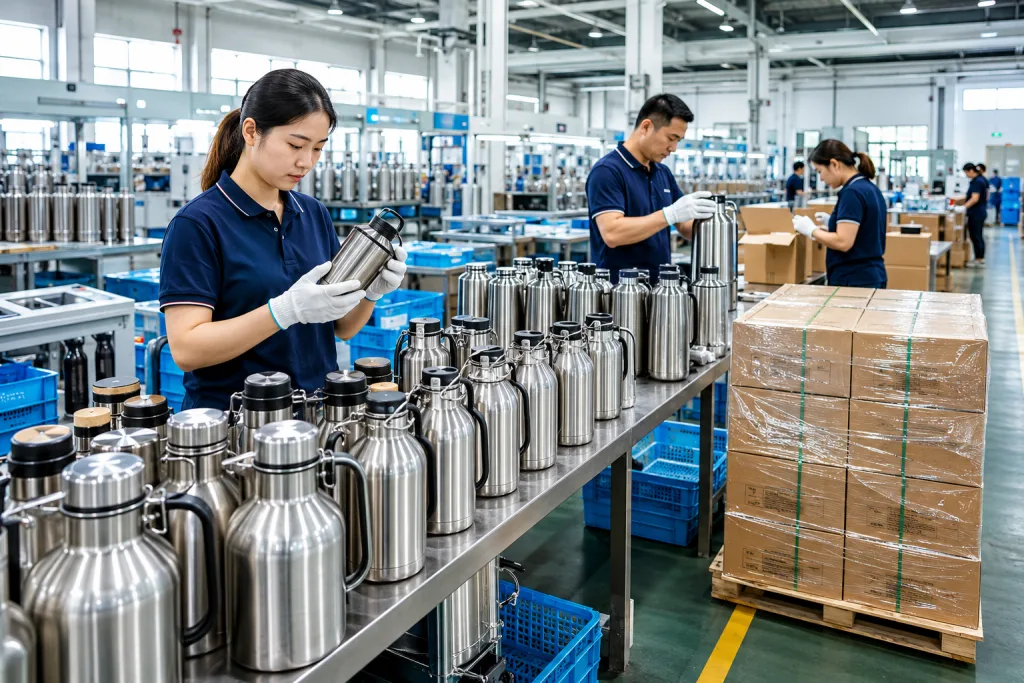
When buyers ask which one is safest, the answer is usually the middle: a 32 oz or 40 oz vacuum canteen wholesale SKU with powder coating and a leak-tested screw lid. We ship that size range again and again because it works across outdoor, gym, and travel retail. Later, you can add matching drinkware bulk extensions without forcing a full new mold direction. At BottleForge Industrial in Zhejiang, China, our monthly output is about 450,000 units across bottles, tumblers, and growlers. The pattern is plain. Broad-use bottles reorder faster than niche shapes. Our leak test bench catches the same issue every season: fancy shapes get attention, but standard bodies move.
How each format fits the end use
A canteen is not just a bottle with a loop. End use decides sell-through. We see returns and dead stock when the buyer guesses the use case wrong, then the shelf story falls apart after the first PO.
Outdoor canteen
For a hiking chain, park shop, or outdoor brand, the canteen bulk program needs to stay simple: easy to carry, hard to dent, easy to rinse out on the trail. The safe size band is 26 oz to 40 oz. Below 24 oz, users complain it is not enough for a day trip. Above 40 oz, the math does not work for repeat carry unless the channel is overlanding or camp gear. On our line, 0.5 mm body thickness usually gives a better balance than chasing heavier weight just to sound premium.
Bulk growler
A growler bulk item fits buyers who want cold retention and a larger serve format. For beer growler wholesale, 64 oz is still common in North America, but 32 oz ships better online because dimensional weight is lower and carton efficiency is cleaner. If you need beer growler in bulk for brewery merchandise, ask for an inner electropolished surface and a cap with food-grade silicone gasket. QC pulled a sample last season where the gasket smell was the buyer’s first complaint. For carbonated storage, this is the wrong claim to push. A lot of stainless growlers are fine for short transport, not for long-term pressure holding.
Alcohol flask bulk
Alcohol flask in bulk sells more on gift appeal than hydration use. Buyers often overestimate repeat demand, so keep the first order lean. A 6 oz flask with laser logo at 3,000 pcs is easier to test than a high-MOQ leather-wrap version. We have seen this go sideways when a buyer insisted on a wrap version, then flagged glue edges at inspection. It fits hunting, fishing, and seasonal gift channels, but it is not the core volume driver in wholesale drinkware.
Beer tumbler bulk
Beer tumbler wholesale works best as an add-on SKU. If you already run canteen wholesale, a 20 oz tumbler can share decoration, carton style, and pallet planning. That cuts setup waste on the line and keeps assortment building practical without opening too many molds. One buyer even had a PO typo switching 20 oz to 30 oz, and that one number changed the master carton count fast.
You do not need every format. You need the few SKUs your channel can reorder without heavy explanation at the shelf.
The specs that change landed cost
Two bottles can look almost the same on screen and still be USD 1.50 apart. We see that on the line all the time. The gap usually sits in four places: steel spec, body build, lid parts, and decoration. If you are buying drinkware bulk, check these item by item against the quote and the sample in hand, not just the rendering on the PO.
- Steel grade: 18/8 stainless steel is standard for food-contact bottles and growlers. 18/0 is cheaper and works for some outers, but corrosion performance is lower. We have had buyers in coastal markets flag rust spots after salt-spray exposure, so this is not a small detail.
- Wall thickness: Common specs are 0.4 mm outer and 0.35-0.5 mm inner. Thicker steel gives better dent resistance, but it also adds weight and raw material cost. On a 64 oz body, even a 0.05 mm change is enough for QC pulled samples to show a different gram weight.
- Vacuum structure: Double-wall vacuum with copper coating usually gives better thermal retention. It can add around USD 0.20-0.40 per unit versus standard vacuum. We check this after vacuuming and coppering because poor retention claims often trace back to process control, not the spec sheet.
- Lid assembly: A simple PP screw lid with silicone ring costs far less than a metal cap with handle, bamboo top, or straw assembly. Lids can account for 15-25% of total unit cost. This is the wrong question to ask if you only compare bottle body cost; on some SKUs the lid is where the quote moves most.
- Surface finish: Spray paint is cheaper, but powder coating generally performs better in abrasion testing. Textured powder coat also hides transit scratches better. We run cross-hatch and rub tests, and smooth glossy finishes usually show marks faster once cartons start shifting in shipment.
- Packaging: Egg-crate dividers, white box, color box, PDQ tray, and mailer-safe packaging all affect carton count and freight efficiency. A box that is 8 mm taller can cut pcs per carton, and then the freight math doesn’t work the way buyers expect.
For outdoor canteen wholesale, a practical baseline is 18/8 steel, vacuum insulation, powder coat, leakproof screw lid, and individual polybag plus white box. At 1,000 pcs, that often lands around USD 4.20-6.50 FOB China depending on size and lid. If you need retail-ready packaging, add USD 0.25-0.80. If you need a premium bulk growler with handle lid and custom carton, expect the jump. We have seen buyers mix up canteen wholesale pricing with a full private-label program, then push back on a quote that is actually normal for the spec.
Ask your Zhejiang supplier for actual weight tolerance, not just nominal weight. A 10-15 gram swing across production can point to unstable material control, and that usually shows up later in dent performance or vacuum failure rates. Weigh 10 pcs from the same batch on a digital bench scale before shipment; if the spread is loose, QC should stop the lot.
MOQ, lead time, and sampling reality
MOQ is where good sourcing plans get forced back to stock models. The usual mistake is treating mold MOQ, color MOQ, and decoration MOQ as one number. They are not the same, and this is the wrong question to ask at the start. On our line, a buyer will say "I need 1,000 pcs" and then add two lid options, three Pantone colors, and a wrap print. That is how the quote moves fast.
A standard outdoor canteen wholesale program from China often works like this:
- Stock shape, stock lid, one Pantone powder coat: MOQ 1,000 pcs per size/color
- Mixed colors on one body shape: sometimes 500 pcs/color if total order reaches 3,000 pcs
- New lid or custom mold: mold charge USD 2,000-8,000 and higher MOQ depending on tooling complexity
- Laser logo: low setup cost, easy for 1,000 pcs
- Silkscreen or heat transfer: better for larger graphics, but decoration rejection risk is higher if artwork is thin or wraps over curved areas
Lead time matters just as much. At our factory in Zhejiang, China, stock samples usually take 7-10 days. Pre-production samples with custom logo and finish take 15-20 days. Mass production is normally 35-45 days after sample approval and deposit. From August to November, add 7-15 days if the PO includes multiple SKUs like canteen bulk plus beer tumbler wholesale bulk. We run into this every autumn. QC pulled the sample last season because the powder coat gloss on two colors did not match the approved chip.
If you are launching on Amazon or selling into a seasonal outdoor chain, work backward from the ship date. You may need FNSKU labeling, drop testing, and carton mark approval before shipment. Carton marks sound small until a buyer flags a typo on the PO and 4,000 export cartons need recheck. That is why a slightly higher MOQ on a stable stock mold is often the better call than pushing a custom shape too early. Buyers chasing the lowest MOQ usually spend more on sampling delays, split shipments, and dead time. We have seen this go sideways.
Quality points buyers should inspect first
Most factories can send a good-looking sample. Batch repeatability is the real test across 5,000 or 20,000 units. For outdoor canteen wholesale, start with function before appearance. On our line, QC pulled plenty of shiny first samples that still failed on the vacuum bench.
- Leak test: 100% air-pressure or vacuum leak check on insulated bottles. Ask for the method, the failure threshold, and whether they test after capping or before. We usually see buyers ask for the report but skip the reject standard; that is the wrong question to ask.
- Vacuum retention: Request a thermal test benchmark, for example hot retention after 6 or 12 hours under defined fill conditions. Ask for fill volume, starting water temperature, and ambient test condition, because 95C fill at 23C room temp does not read the same as a looser shop-floor check.
- Coating adhesion: Cross-hatch adhesion and abrasion testing for powder coat. This matters for outdoor handling and freight rub marks. A 1 mm cross-hatch grid and a simple tape pull already tell you a lot before shipment.
- Material compliance: REACH for Europe, LFGB where required, and FDA-contact expectations for North America. For kids items, ASTM can also come into the discussion, though canteens are usually adult-focused. We have seen POs with "304 stainless" typed correctly on page one and changed to a vague "stainless steel" on the packing note, so check the paperwork line by line.
- AQL plan: AQL 2.5 for major defects and 4.0 for minor defects is a common outgoing inspection basis. Put that in writing before production starts, not after QC pulled the sample and the buyer flagged scratches around the base seam.
- Factory systems: ISO-managed process control and social compliance such as BSCI help reduce procurement risk, especially for larger retailers. Ask who signs the in-process record on the line and who closes corrective action when defects repeat.
For bulk drinkware and growler wholesale, check thread engagement carefully. A cap that feels fine on one sample can cross-thread in mass production if neck tolerances drift by 0.3 mm. We have seen this go sideways. For alcohol flask wholesale bulk, hinge and cap retention are frequent weak points, and a 1-meter drop check exposes them fast. For beer tumbler in bulk, lid fit and straw hole flashing are more common issues than the steel body itself.
Ask how the factory handles incoming raw material verification and whether they keep vacuum aging records by lot. If the answer is vague, step back. A decent supplier in China should explain IQC, in-process checks, and final inspection in plain language, with records tied to a lot number, not broad claims. We run into buyer pushback on this because they want speed, but the math does not work if one mixed lot creates a full rework.
Which SKU should you buy first
If you are building a private-label line or testing a new category, do not open with the most complex item. Start with the SKU your team can reorder without rechecking every detail on the line. We have seen first POs stall over a 2 mm logo shift and a lid insert color change.
For most buyers, the first-choice matrix looks like this:
- Outdoor retail and e-commerce: 32 oz vacuum wholesale canteen, powder coat, loop lid, 1-color logo. This is usually the cleanest starting point. The freight math works, the use case is obvious, and QC can check powder coat and logo position fast against one approved sample.
- Brewery and beverage merchandise: 64 oz beer growler wholesale bulk plus 20 oz beer tumbler bulk as a bundle or matching set. We ship this pairing often because the finish can stay consistent across both items, and the buyer gets a better shelf story with one color card and one set of carton marks.
- Gift and souvenir: 6 oz alcohol flask wholesale with laser engraving and black gift box, but keep first PO under one container equivalent unless demand is proven. This category looks simple, but gift box damage and engraving alignment are where QC pulled the sample more than once.
- Promotional volume: single-wall drinkware wholesale if target price matters more than thermal performance. That is the right call for budget programs, especially when the buyer flagged a hard ceiling that vacuum construction cannot meet.
If you ask me for the safest opening order, I would not tell you to buy five categories. I would tell you to run one 32 oz or 40 oz outdoor canteen wholesale SKU, one decoration method, and one carton standard. That is the right question to ask. Once that stabilizes, add one adjacent item such as a growler wholesale or beer tumbler wholesale bulk option that uses similar finishing. We run these add-ons on the same finishing logic, which cuts approval work and keeps palletization simple at the warehouse.
The strongest sourcing plans are boring at the start. They use proven molds, realistic MOQs, and clear compliance targets. A 3,000 pcs opening run with one carton spec is easier to control than a mixed PO with four lid styles. We have seen this go sideways when a buyer tries to launch too much at once, then finds one typo on the PO and two packaging revisions holding the full shipment. That is how buyers turn a single wholesale canteen order into a repeat drinkware bulk program instead of a one-season trial.
Compare your canteen specs before placing the PO
Send your target capacity, price point, and market. We will recommend the right canteen, growler, or flask setup with MOQ, FOB pricing, and lead time.
Frequently asked questions
What is a realistic MOQ for outdoor canteen wholesale?
For a standard stainless bottle on an existing mold, 1,000 pcs per size and color is realistic. Some factories in China will quote 500 pcs, but that often excludes custom powder coat, logo, or retail packaging. If you need mixed colors, you may get 500 pcs per color when the total order reaches 3,000 pcs. Custom lids or new molds push MOQ higher and can add tooling charges from USD 2,000 to USD 8,000. For first orders, buyers usually do better with a proven stock shape at 1,000-3,000 pcs than with a low-MOQ custom body that delays production and raises defect risk.
Should I choose single-wall or vacuum canteens for wholesale?
It depends on channel and target retail price. Single-wall is cheaper, usually around USD 2.10-3.60 FOB for common sizes at 3,000 pcs, and suits event programs or value retail. Vacuum canteens cost more, often USD 3.80-7.90 FOB depending on size and lid, but they carry better margins and lower complaints about condensation. For outdoor retail in Europe and North America, vacuum is usually the better long-term choice because users expect thermal performance and dry handling. If your line is positioned as premium or giftable, start with vacuum. If the program is promotion-led and price-capped, single-wall may still work.
What tests and certificates should I ask for on bulk drinkware?
Ask for food-contact compliance relevant to your market first. For Europe, REACH and sometimes LFGB are common discussion points. For North America, FDA-contact expectations are standard. On the factory side, ask whether they run 100% leak tests on insulated items, what AQL level they use for final inspection, and whether they have ISO-based quality controls. AQL 2.5 major and 4.0 minor is a common baseline. If the order is for a retailer, BSCI or similar social compliance may also matter. For growlers, ask about gasket material and cap sealing tests. For coated bottles, ask for adhesion and abrasion test results.
Is a 64 oz growler a good first order for wholesale growler programs?
Only if your sales channel clearly supports it. A 64 oz growler is standard enough for breweries and camping use, but it is heavier, more expensive to ship, and more niche than a 32 oz or 40 oz canteen. FOB pricing can range from about USD 6.50 to USD 11.50 depending on vacuum construction and cap type, and freight per unit can be 35-50% higher than mid-size bottles. For first-time buyers, a 32 oz growler or a standard outdoor canteen often moves faster and gives cleaner reorder data. If you do start with 64 oz, keep packaging simple and avoid over-customized accessories.
How long does custom logo canteen production usually take from China?
For standard molds, allow 7-10 days for stock samples, 15-20 days for pre-production samples with logo and finish, and 35-45 days for bulk production after approval. Add another 7-15 days in peak season or if the order includes multiple categories such as canteen wholesale plus beer tumbler wholesale bulk. If you need custom packaging, barcode work, FNSKU labels, or third-party inspection booking, build that into the schedule early. Sea freight timing is separate, so most buyers plan backward from the warehouse delivery date, not the factory ex-work date. If your deadline is fixed, choose stock shapes and simple decoration.