Key Takeaways
- Typical MOQ for outdoor canteen bulk is 1,000 to 3,000 pcs per SKU, with 7-10 day sample time and 35-45 day production
- A 64 oz vacuum growler often lands at USD 5.80-8.90 FOB China depending on steel grade, lid structure, and decoration
- For stable quality, set inspection at AQL 2.5/4.0 and define heat retention, leak test, coating adhesion, and carton drop standards in writing
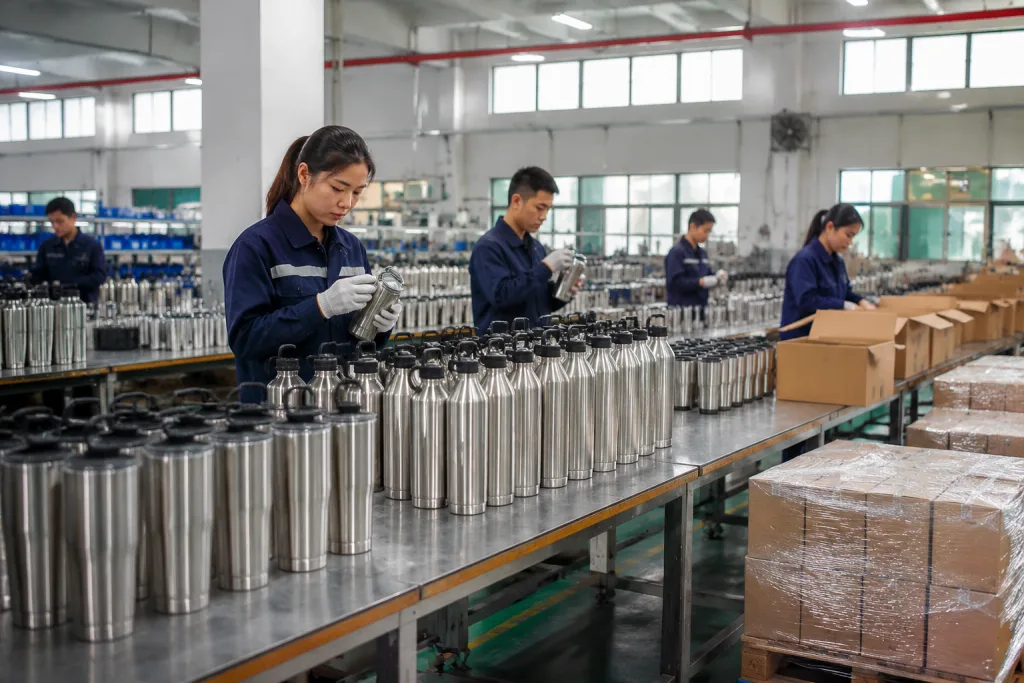
- A factory with 300,000-500,000 units/month capacity in Zhejiang can usually support mixed drinkware bulk programs across canteens, tumblers, and growlers
You are not buying a sample for a photo shoot. You are buying outdoor canteen wholesale bulk that has to survive production, customs, compliance checks, and field use. Different job. The wrong question is “What is your best price?” We hear it on first calls every week, and it usually hides the real risk. Ask this instead: “What exactly am I getting at that price, and what can break between deposit and delivery?” On our line, QC pulled a sample with a 0.3 mm dent near the base seam that looked fine in photos and failed after carton vibration.
Buyers sourcing from Zhejiang, China usually compare three or four factories, but 4 quotes often are not apples to apples. Steel grade, vacuum performance, coating durability, logo method, carton drop resistance, and AQL standards can shift landed cost by 8% to 20%. We ship for retail, promo, outdoor, and brewery accounts, and we have seen one PO typo on logo size turn a clean order into a rework fight. If you handle wholesale drinkware, you need a checklist that answers buying questions before you approve a PO. Otherwise, the math doesn't work.
What should you define first?
Before you ask for quotes on outdoor canteen wholesale bulk, fix the commercial brief first. This is where 7 out of 10 sourcing mistakes start. A buyer writes “similar to sample,” the line fills in the blanks, and two weeks later QC pulled the sample and the neck diameter is off by 1.5 mm from what the cap needs. For a wholesale canteen program, lock six points up front: capacity, material, insulation type, lid structure, decoration method, and compliance market. That is the baseline. Anything less is guesswork.
If you are buying for outdoor retail, gifting, or private label, your canteen bulk spec should usually include:
- Capacity: 18 oz, 24 oz, 32 oz, 40 oz, or 64 oz for growlers
- Body material: 18/8 stainless steel, usually SS304 for inner and outer; some budget projects use SS201 outer only
- Construction: single wall or double wall vacuum
- Wall thickness: common range 0.4 mm inner + 0.5 mm outer for vacuum bottles
- Mouth style: narrow mouth, wide mouth, screw cap, chug lid, bamboo lid, or tether cap
- Finish: powder coat, spray paint, polished, brushed, electroplated, or base coat for print
If you also buy bulk growler, beer growler bulk, or beer tumbler wholesale bulk under one program, say it on day one. We run combined color plans for these sets all the time, and the math is simple: one Zhejiang factory can line up tooling, color batching, and carton counts faster when the full SKU list is clear. On one recent PO, the buyer flagged color drift between a canteen and tumbler set; after we moved them into the same powder line run, finish waste dropped by 3% to 5% and shade matching got tighter across the shipment.
Practical rule: if your RFQ does not specify steel, wall thickness, insulation, logo size, packaging type, and test standard, your first quote is only a rough guess. This is the wrong question to ask at quote stage. We have seen this go sideways over a typo on a PO and a missing drop-test requirement. It is not a sourcing decision.
What MOQ and price are realistic?
Buyers usually ask for one clean number on MOQ and FOB. That is the wrong question to ask. On outdoor canteen wholesale orders, MOQ is driven more by decoration and packing than by the bottle body itself. We run standard unbranded colors from 500 pcs per size in regular production. Custom color plus logo usually starts at 1,000 pcs, because the line needs coating setup and logo approval. If you add a new mold, a special lid, or a gift box with a custom insert, MOQ often moves to 2,000 to 3,000 pcs per SKU. Last month a buyer flagged a 2 mm logo shift on a pre-production sample, and that kind of detail is exactly why low-quantity custom runs get expensive fast.
Typical FOB China ranges
- 18-24 oz single wall canteen: USD 1.60-2.80
- 18-24 oz vacuum canteen: USD 3.20-5.20
- 32-40 oz vacuum outdoor canteen: USD 4.50-6.80
- 64 oz wholesale growler: USD 5.80-8.90
- 16-20 oz beer tumbler bulk: USD 2.60-4.20
- 6-8 oz alcohol flask wholesale bulk: USD 1.20-2.20
Those ranges are based on FOB Ningbo or Shanghai, standard export carton, and normal decoration like one-color silkscreen or laser marking. If you move to premium powder coat, add roughly USD 0.18-0.45. If you need individual polybag plus white box, add USD 0.10-0.25. A custom color gift box adds about USD 0.35-1.20 depending on structure, insert, and board thickness. We have seen the math go sideways when a buyer wants a rigid box on a low-ticket flask; the packaging cost starts eating the margin. QC pulled one white box sample last quarter with a crushed corner after drop test, so carton spec matters more than people expect.
From our side in Hangzhou, Zhejiang, mixed wholesale drinkware programs usually run best with one of these order structures:
- 1,000 pcs x 3 SKUs with shared color family
- 3,000 pcs one hero SKU for retail launch
- One 40HQ mixed program combining canteen wholesale, bulk drinkware, and growler wholesale items
Low MOQ is not free. If a supplier takes 300 pcs for a custom vacuum bottle, they will recover that cost in the unit price, looser color control, or weaker packaging terms. We ship these orders every week, and small custom runs are where buyers get surprised most often.
Which materials actually matter?
You will see 20 factories write “food grade stainless steel” on the quote sheet and stop there. Ask for the full material stack. For outdoor canteen wholesale bulk, the standard setup for Europe and North America is SS304 inner and SS304 outer on vacuum bottles. Budget programs often switch to SS304 inner with SS201 outer to save about $0.18–$0.35 per unit on a 500ml bottle. That works for some promo orders, but if you want better corrosion resistance and a cleaner premium story, SS201 outer is the wrong place to cut. On our line, QC checks steel thickness with a micrometer, often 0.4mm inner and 0.5mm outer on mid-range models.
Lids need the same level of detail as the bottle body. The quote should list polypropylene, Tritan, silicone gasket, and any stainless cap insert, not just “plastic lid.” If your buyers need alcohol flask in bulk or beer growler wholesale, check what actually touches the liquid: plastic, silicone, or metal. Then ask whether the gasket is rated for acidic drinks or alcohol exposure. We have seen this go sideways when a buyer approved a sample with a clear gasket, then the PO listed black silicone by mistake and the smell test failed at incoming inspection.
Useful buyer questions:
- Is the bottle BPA free and can you provide test reports?
- Can you support REACH for EU and FDA/LFGB related food-contact testing if needed?
- For kids or promotional channels, can the item pass relevant ASTM migration or physical safety checks where applicable?
- What is the measured vacuum retention at 6 hours and 12 hours?
If you source best wholesale drink bottle programs for outdoor use, do not ignore coating. Powder coating looks simple. It is not. Ask for coating adhesion results, scratch test standard, and whether the factory runs an automatic line or a semi-automatic line. We run cross-hatch adhesion checks with 3M tape, and the line speed changes the finish consistency more than most buyers expect. A cheap matte black bottle can look fine on day one, then show edge wear after one retailer shelf cycle or 200 carton rubs in transit.
China has thousands of drinkware suppliers, but process control is not the same. In Zhejiang, exporters with a steady bulk business usually keep records for incoming steel inspection, vacuum spot checks, and leak-test rates by batch, often 13 pcs per lot for spot check and 100% leak test on final packing. If a factory cannot show those records, unit price is not the main issue. The bigger risk is rework, claims, and a late shipment when QC pulled the sample and found pinhole leakage.
How do you judge factory capability?
A factory visit should settle three points in 10 minutes: can they build it, do they control the line, and will they ship on the date on the PO? Too many buyers judge from showroom samples. That is the wrong question to ask. On the shop floor, check the leak tester, check the welding station, and check whether production boards show actual output by line.
For wholesale drinkware and canteen wholesale, ask for these operating facts:
- Monthly capacity: for example 300,000 to 500,000 units/month across bottles, tumblers, and growlers
- Lead time: 7-10 days for pre-production samples, 35-45 days for repeat custom orders
- Audit status: BSCI, ISO 9001, or retailer-specific social audits if required
- QC standard: incoming, in-line, and final inspection with AQL 2.5 major / 4.0 minor
- Export experience: Europe and North America packaging, labeling, and pallet rules
If you buy drinkware bulk for Amazon, club retail, or outdoor chains, ask who applies the barcode, where the FNSKU goes, who checks carton marks, and what drop test standard they run. We have seen buyers send a PO with one digit wrong in the carton size, and that small typo turned into a warehouse chargeback. If you buy growler bulk or beer growler in bulk for breweries, ask about pressure limits, intended-use wording, and cap structure for carbonated or non-carbonated filling. Many decorative growlers are not built for active carbonation pressure. QC pulled samples before with lid deformation after pressure hold, so this point needs a straight answer.
Checklist for capability review:
- Do they make the body in-house or outsource semi-finished shells?
- Is laser welding done in-house?
- Can they color match Pantone within a practical tolerance?
- Do they run 100% leak testing or random sampling only?
- Can they provide packaging engineering for mail-order channels?
If a Zhejiang factory answers with numbers, machine names, and process limits, that is a good sign. If every answer is “no problem,” you still know nothing. Ask what laser welder they run, what leak-test pressure they use, and how many cartons per pallet they ship to North America. The math does not lie.
What compliance and QC should you write into the PO?
Do not accept vague wording like “export standard.” Write the inspection points and compliance terms into the purchase order and artwork approval sheet. This matters fast when one PO mixes outdoor canteen bulk, alcohol flask wholesale, and wholesale growler items, because the lid builds, seal points, and pack-out risks are different. We have seen one PO typo on lid code turn a 38 mm growler cap into a flask cap request, and the line stopped until the buyer confirmed.
Your PO should state at minimum:
- AQL level: commonly 2.5 major / 4.0 minor
- Leak test: 100% before packing for vacuum bottles and flasks
- Vacuum performance: for example hot retention target after 6 hours and 12 hours
- Logo standard: placement tolerance in mm, color code, adhesion requirement
- Coating standard: no visible scratch from 30 cm under normal light, cross-hatch adhesion if agreed
- Carton standard: export carton burst strength, drop test requirement, pallet spec if needed
For Europe, ask at RFQ stage whether you need REACH-related declarations or lab testing for coatings and food-contact parts. Waiting until mass production is the wrong move. For North America, buyers often ask for FDA-related contact safety support plus retailer packaging compliance, and the buyer flagged missing warning copy on a master carton more than once. If your program includes kids items, the compliance path gets stricter than standard wholesale drinkware. This is the wrong question to ask late.
Third-party inspection is cheap compared with claim cost. In China, a pre-shipment inspection often runs US$300 to US$600; one failed container can burn a few thousand dollars in rework, markdowns, or disposal before anyone argues freight liability. We usually tell new buyers to inspect the first two orders, even on a simple SKU. QC pulled the sample, found 3 leaking units in a 200-piece check, and that saved the shipment.
The cheapest way to improve quality is to define it before production. The most expensive way is to debate it after the goods are on the water.
How should you plan packaging and shipment?
Packaging changes the freight math. It also drives breakage rate and warehouse handling cost. For canteen bulk and drinkware wholesale, we usually run one polybag, one white box, then master carton. That setup covers most B2B channels and keeps packing speed stable on the line. Retail gift box, mailer box, PDQ display, or barcode application should be quoted separately because labor jumps fast and carton size can shift by 20 to 40 mm with one insert change.
If you source beer tumbler in bulk, beer growler wholesale bulk, or alcohol flask bulk for gifting, ask for carton cube data before you sign off packaging. This is the right question. A lower unit price gets wiped out fast by bad carton efficiency. We have seen custom gift box designs increase container cost per unit by 12% to 18% because of wasted space. One buyer pushed for a rigid lid-and-base box last season, then flagged the load plan when the 40HQ fit dropped short by 1,800 sets.
Basic shipment checklist:
- FOB Ningbo or Shanghai vs EXW comparison
- Master carton size and gross weight under your warehouse limit
- Barcode, FNSKU, or retailer label position file
- Palletized or floor-loaded instruction
- Spare parts ratio for straws, lids, and gaskets if applicable
Lead times in China usually move with decoration and packaging approval. If artwork is confirmed on Monday and the Pantone chip is signed off by Thursday, we ship pre-production steps into the next queue and production can move. If the buyer changes logo size after pre-production sample approval, the line stops and the schedule slips. QC pulled one sample last month because the PO file had a 3 mm logo shift from the approved artwork. For most custom outdoor canteen wholesale bulk orders, realistic timing is:
- 2-3 days for quote revision
- 7-10 days for sample
- 3-5 days for sample approval loop
- 35-45 days mass production
- 5-10 days trucking and port handling before vessel departure
If you are buying in season for spring outdoor launches, back-calculate from shelf date, not from PO date. We have seen this go sideways when a buyer books to PO timing and forgets the extra 5 days for carton mark approval.
When does a mixed program make sense?
Most brand owners do not run one SKU forever. We often start with outdoor canteen wholesale bulk, then add a bulk growler, alcohol flask wholesale bulk, or beer tumbler wholesale line for the same buyer account. A mixed program works when the brand language, finish, and packaging style stay aligned across categories. On our line, that usually means one Pantone set, one logo size file, and one outer carton style within a 3 mm print position tolerance.
The commercial upside is straightforward. You cut sampling cycles, combine freight, and get better production slots when we ship the items together. A mixed drinkware bulk order also helps you hit MOQ with less dead stock. Instead of pushing 3,000 pcs into one slow-moving shape, you may run 1,000 pcs each across three coordinated items. Buyers ask for this after the first forecast miss, and the math on single-SKU loading often does not work.
Mixed programs fail when specs start drifting. Outdoor canteens, wholesale growler products, and alcohol flask in bulk lines do not share the same lid performance, coating method, or carton protection, even if the finish looks matched on the shelf. We have seen this go sideways when a PO used one foam standard for all three SKUs and QC pulled the sample with dented shoulders on the flask pack test. Keep one master spec file per SKU and one summary table for shared details like Pantone, logo position, and barcode rules.
Use this quick sourcing checklist before paying deposit:
- Final approved sample signed and dated
- Confirmed steel grade and wall thickness
- Lab test or declaration list agreed
- Inspection level written into PO
- Packaging artwork approved with carton marks
- Production timeline with ship window confirmed
- Balance payment terms and claim procedure stated
If a supplier in Zhejiang or elsewhere in China can support this level of detail, your risk drops fast. Last month, one buyer flagged a carton mark typo on the PO before deposit, and that saved a full reprint after mass production. If the factory resists basic spec control because “we always do it this way,” this is the wrong question to argue about. You are not buying reliability yet. You are buying hope.
Send your canteen RFQ with specs, not guesses
Share capacity, steel grade, logo method, target price, and delivery window. We will review MOQ, FOB cost, compliance, and production risk before you place the PO.
Frequently asked questions
What is a normal MOQ for custom outdoor canteen wholesale bulk?
For a standard stainless steel canteen with custom color and one logo, a practical MOQ is usually 1,000 pcs per size and color. If you choose a stock color and simple laser logo, some factories in China may accept 500 pcs. If you need a new lid, gift box, or special coating, MOQ often moves to 2,000-3,000 pcs per SKU. Mixed orders can help. For example, 1,000 pcs each of a 24 oz canteen, 40 oz bottle, and 16 oz tumbler is often easier for a Zhejiang factory to schedule than 3,000 pcs of one difficult item. Always ask whether MOQ is based on body, lid, color, or packaging, because suppliers use those terms differently.
How long does production take for wholesale canteen orders?
If your artwork and packaging are already approved, repeat orders often run in 30-40 days. New custom orders are safer at 35-45 days after sample approval. Sampling usually takes 7-10 days, and packaging mockups can add another 3-7 days if you need retail boxes. During peak season, vessel booking and trucking in China may add 5-10 days before departure. If you are sourcing for Europe or North America spring launches, place the order 90-120 days before required warehouse date. If the order includes bulk growler, alcohol flask wholesale, and custom display packaging in one shipment, build in extra time because decoration and carton approval are the common delay points.
What quality checks matter most for bulk drinkware?
For stainless wholesale drinkware, the must-have checks are leak testing, vacuum retention, logo adhesion, coating finish, dimensional tolerance, and carton drop performance. We recommend 100% leak testing for vacuum bottles and flasks, plus final inspection at AQL 2.5 major and 4.0 minor. Ask the supplier to define the retention target, such as hot water performance after 6 and 12 hours, rather than saying only “good insulation.” If the product is powder coated, request a coating adhesion standard and visual standard under normal light at 30 cm. For retail programs, confirm barcode readability and carton mark accuracy. First orders should use a third-party pre-shipment inspection even if the product looks simple.
Is SS304 necessary, or can I use SS201 outer walls to save cost?
SS304 inner is the safer choice for food-contact quality and corrosion resistance. For the outer wall, some budget promotional programs use SS201 to reduce cost by a small amount, often around a few percentage points depending on market steel prices. That can be acceptable for entry-level projects, but if you want premium positioning, stronger long-term durability, or easier compliance discussion with customers in Europe and North America, SS304 outer is cleaner and simpler. For outdoor canteen wholesale bulk sold under your own brand, we generally advise 304/304 unless price pressure is severe. If a supplier offers 201 outer, ask them to state it clearly on quotation and sample record so there is no ambiguity later.
Can one factory handle canteens, growlers, tumblers, and flasks together?
Yes, if the factory is genuinely set up for mixed stainless programs. A capable Zhejiang manufacturer may produce 300,000-500,000 units per month across bottles, tumblers, growlers, and flasks, but you still need to confirm which items are made in-house and which are outsourced. Ask about shared color runs, lid sourcing, vacuum welding, and packaging lines. Mixed sourcing works best when finishes and branding are coordinated, such as one powder coat family across a canteen bulk line, a beer growler bulk SKU, and a beer tumbler wholesale bulk SKU. The advantage is lower freight fragmentation and smoother MOQ planning. The risk is spec confusion, so keep separate approved drawings and QC points for each SKU.