Key Takeaways
- A workable MOQ for a custom canteen project is often 1,000-3,000 units per SKU, with 35-55 day lead time after sample approval
- For 18/8 stainless insulated canteens, FOB China pricing commonly starts around USD 3.20-6.80 depending on size, coating, lid, and decoration
- Ask for AQL 2.5 inspection, REACH/LFGB or FDA contact compliance, and drop/leak testing before you approve mass production
- A reliable canteen manufacturer should state monthly capacity, such as 300,000-500,000 units, not just promise fast delivery
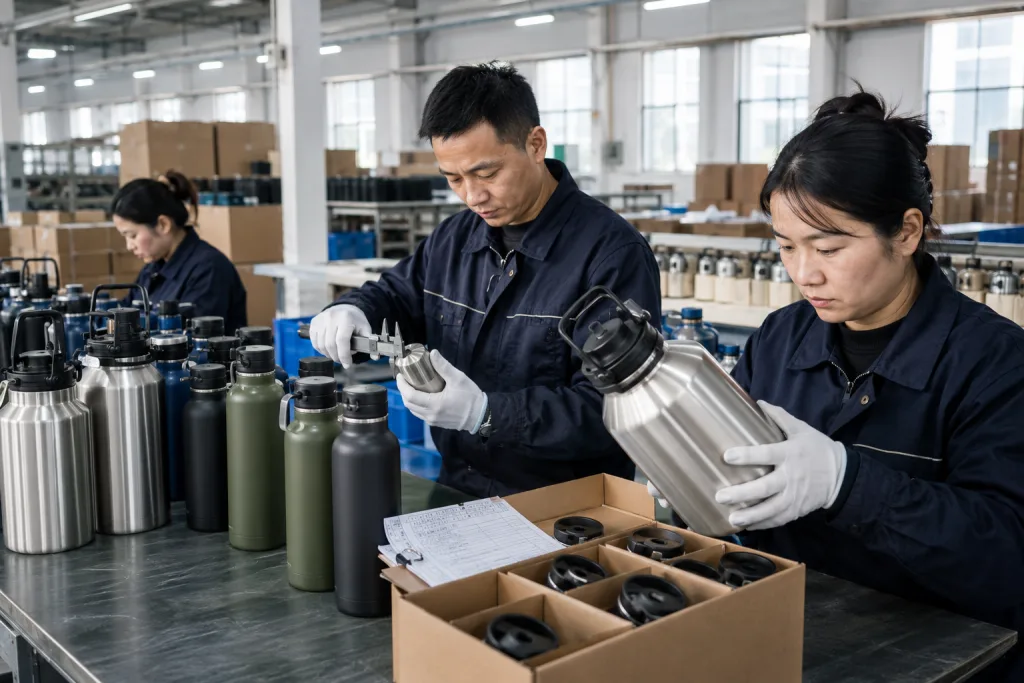
You are not buying a souvenir bottle. You are buying a product that needs to get through freight, retail handling, trail use, and the complaint email that lands 3 weeks after launch. That changes how you screen an outdoor canteen vendor. A clean catalog shot tells you almost nothing about steel grade, vacuum yield, coating adhesion, leak risk, or whether the factory can hold the same matte finish across 20,000 units. On our line, QC pulled samples where the color delta was visible after the second powder pass, even though the photo looked perfect.
Most new buyers start with the wrong question: price. The better sequence is material first, then compliance, process control, and lead time, and only then does the quote mean much. In Zhejiang, a buyer can compare 6 suppliers in one week and still miss the difference between a factory that runs its own leak test bench and a trading setup passing work around by WeChat. We have seen this go sideways. The gap shows up later in 12 days vs 18 days, failed inspections, rework, and small issues like a PO typo on lid color that turns into 3,000 wrong units.
What should you ask first?
Start with the use case, not the logo method. For an outdoor canteen vendor order, ask where the piece will sit on the shelf and who carries it: camping retail, resort merchandise, corporate gifting, school programs, hunting, or supermarket promotions. A 750ml single-wall bottle for a trail shop is not the same build as a 1000ml vacuum item for a resort gift set. We run into this on sample benches: the same artwork file passed, but QC pulled the sample because the lid loop failed a 5 kg pull test.
If you are sourcing from a canteen factory in Zhejiang or elsewhere in China, send a short technical brief before asking for price. The brief should state capacity, single-wall or double-wall, target weight in grams, steel grade, lid style, finish, decoration position, target compliance market, packaging, and required incoterm. Loose inquiries create fake comparison. One buyer sent only “750ml outdoor bottle, logo, best FOB,” and three factories quoted three different wall thicknesses: 0.4 mm, 0.5 mm, and 0.6 mm.
Use this first-contact checklist
- Capacity: 500ml, 750ml, 1000ml, or larger outdoor format
- Construction: single-wall stainless, vacuum insulated, or plastic body with sleeve
- Material: 18/8 stainless steel for body; PP or Tritan parts for lids where needed
- Decoration: silk screen for flat color logos, laser engraving for steel exposure, heat transfer for full artwork, or powder coat with logo window
- Compliance: REACH, LFGB, FDA, California Proposition 65 if relevant
- Packaging: egg-crate bulk pack, white box, color box, or PDQ display
- Commercial terms: MOQ, tooling cost, sample time, production time, FOB or DDP
A serious canteen vendor answers with numbers: MOQ 1,000 pcs per color, sample time 7 days, mass production 35 days after deposit and artwork approval. If the reply only says “best price” or “we can do all,” push back. We have seen this go sideways when a buyer planned canteen customizable options across 6 colors, then the PO had one color code typo and the line packed 300 pcs in the wrong shade. A dependable canteen manufacturer or canteen supplier should tell you what is standard, what needs tooling, and what will raise cost on a canteen promotional order with multiple artwork versions.
Which canteen specification actually fits?
Not every custom canteen needs insulation. Buyers over-spec this item all the time because vacuum bottles look more premium on the shelf. For hiking, school camps, and price-sensitive distributor programs, single-wall stainless is often the better call. It runs lighter, usually 20-35% cheaper, and makes it easier to hit a promo target like FOB $2.80 instead of $3.60. We’ve seen this go sideways when the buyer asks for vacuum first and checks the budget later.
Here is the practical breakdown most canteen distributors use:
- Single-wall stainless: best for low weight, basic outdoor use, and canteen promotional campaigns. Typical wall thickness is 0.4mm-0.5mm, and the line usually runs faster with fewer weld rejects.
- Double-wall vacuum stainless: best for temperature retention and higher perceived value. Common body structure uses 0.4mm inner and 0.5mm outer wall, with vacuum checked on the leak tester after sealing.
- Wide-mouth growler style: works if the same line extends into custom growler or customizable growler programs for camping or beverage retail. A 63mm or 78mm mouth opening gives better fill access and easier cleaning.
For most North American and European B2B buyers, 18/8 stainless steel is the safe default. If a canteen factory quotes unusually low pricing, ask if they are using 201 stainless on non-contact parts or thinner gauge steel. That is where cost gets cut. It may still be acceptable for some projects, but you should know before approving samples. QC pulled the sample on one order last year and found the base dented too easily under a simple drop check; the math didn't work after replacement claims were added back in.
A canteen customized for outdoor retail should balance durability, carry comfort, and carton efficiency. Ignore one, and the landed cost usually goes up later.
If you need a customized canteen with a webbing strap, carabiner cap, or textured coating, ask whether those parts are standard or outsourced. Outsourced accessories in China often add 5-10 days to production; we see 12 days vs 18 days on the same body when the strap is in-house versus bought outside. For a customized drinkware line extension, also check if the same lid family works across bottle, tumbler, and growler shapes. That keeps tooling and spare-part complexity under control. On the factory floor, this matters more than buyers expect: one shared cap thread can save one extra mold and one carton spec, while mixed lid families usually create packing mistakes on the line.
How do MOQ and price move?
This is where about 6 out of 10 first-time buyers get caught. MOQ is not one fixed number; it moves with the body, finish, logo process, and packaging. A canteen manufacturer may quote 1,000 units MOQ, but that often means 1,000 units for an existing body shape, one stock color, and one logo position. Split the order into four Pantone-matched powder coat colors and two gift box designs, and the math changes fast. We run this on the coating line every week: a 300 pcs color batch can waste more powder and line-change time than the buyer expects.
Typical export ranges from China look like this:
- Single-wall 750ml stainless canteen: MOQ 1,000 pcs, FOB USD 2.10-3.60
- Vacuum 750ml outdoor canteen: MOQ 1,000 pcs, FOB USD 3.80-6.20
- Wide-mouth customized growler 1.2L-1.9L: MOQ 500-1,000 pcs, FOB USD 6.50-11.80
- Custom color box: usually adds USD 0.28-0.75 depending on print coverage and insert
- Laser engraving: often USD 0.08-0.20 per position
- Silk screen: usually USD 0.05-0.18 per color per position
If you buy as a canteen distributor or supply canteen distributors in several markets, ask for MOQ by color assortment. Get it in writing. Some Zhejiang factories can combine 300 units per color into a 1,200-unit total if the bottle body, cap, carton, and logo file stay the same. Others will push back because one coating line change takes 35-50 minutes, and QC still has to pull samples for color difference, adhesion, and visual dust spots. We have seen this go sideways when the PO says "assorted colors" but the artwork file names do not match the color list.
Ask how sample charges convert before you approve artwork. A fair setup is USD 50-100 for simple pre-production samples, with partial refund after order placement. New mold or cap tooling is a different discussion. A serious canteen customizable project with a new lid or handle can require USD 2,000-8,000 tooling depending on complexity, cavity count, and whether the silicone gasket needs its own mold. If a canteen vendor avoids that cost early, this is the wrong question to leave until after the buyer signs off on the 3D drawing.
What proves the factory is real?
You do not need the biggest canteen factory in China. You need one that runs output under control. Ask questions the production team should answer in one email, without sales fluff: monthly capacity, number of vacuum furnaces, in-house powder coating or outsourced, normal leak-test method, and the AQL level on final inspection. We ask buyers to get specific here because this is where trading companies get exposed fast. If someone cannot tell you whether the line uses air-pressure leak testing or a water bath, the buyer should pause.
Good indicators from a capable canteen manufacturer or canteen supplier include:
- Capacity: for example 400,000 units per month across bottles and tumblers, with line balance that matches real output instead of one big headline number
- Lead time: 7-10 days for samples, 35-45 days for repeat production, 45-55 days for new decoration or packaging
- Audit readiness: BSCI, ISO 9001, Sedex, or customer social audits where relevant, with records ready instead of “we can arrange later”
- Quality system: incoming material checks, in-line inspection, 100% leak test, final random inspection at AQL 2.5; QC pulled the sample and logged the defect, not just photos in a chat
- Documentation: test reports for food-contact materials, coating, and physical performance, plus matching PO details so the logo size is not typed 85 mm on one sheet and 58 mm on another
In Zhejiang, 20 to 30 established drinkware plants sit close to metalworking and packaging suppliers, and that matters on real orders. A canteen customized with gift packaging, hangtags, and spare seals depends on more than steel forming. We have seen this go sideways when the body is ready but the silicone seal is delayed by 4 days or the gift box crush test fails. A factory with stable local suppliers in Zhejiang and nearby areas of China usually recovers faster because it can switch a carton vendor, rebook foam inserts, and keep shipping on the same schedule.
If you are buying custom drinkware for a broad catalog, ask whether the supplier also handles customizable drinkware categories beyond canteens. This is the right question to ask for year two, not day one. A canteen vendor already running tumblers, sports bottles, and customized growler formats is often better set up for SKU expansion because the tooling team, coating line, and packaging crew already deal with mixed orders. We ship these mixed containers all the time; a shop focused on one body style only can struggle once the MOQ splits into 1,000 canteens and 1,000 tumblers.
How do you avoid quality surprises?
Set inspection points before the PO is approved. We have seen buyers wait until pre-shipment inspection, then the buyer flagged scratches on the powder coat or a logo sitting 4mm off the approved sample. That is late. At that stage, the line is finished, cartons are taped, and the math doesn't work. Your PO needs to lock the spec, the test method, and the acceptance standard.
For outdoor canteen programs, the controls should be simple, measurable, and written into the file we run on the floor:
- Leak test: 100% testing before packing
- Vacuum performance: specify hot and cold retention benchmark, for example 12 hours hot and 24 hours cold for mid-tier vacuum models
- Coating adhesion: cross-hatch tape test standard agreed in advance
- Salt spray or corrosion check: especially for coastal or rugged-use products
- Drop test: packed drop test from 76cm or 1m depending on carton spec
- Logo tolerance: define position tolerance, often within plus or minus 2mm
Ask your canteen supplier if they send material or finished samples to third-party labs for REACH, LFGB, or FDA-contact testing. QC pulled the sample from one 5,000-piece run last month after a lid odor complaint, and this is exactly where weak paperwork shows up. If you sell into the EU, be careful with recycled-content or sustainability claims unless the factory can support them with documents. Same issue for coatings sold as dishwasher safe. We have seen this go sideways.
For Amazon, retail chain, or catalog buyers, add packaging controls early: barcode scanability, carton drop performance, inner pack counts, and master carton weight. One master carton at 21.8 kg can already trigger pushback from a warehouse team. If you are a distributor growler or distributor drinkware buyer serving 6 or 8 end customers at the same time, one packing error can hold up multiple shipments.
The phrase canteen customized should mean controlled variation, not improvised variation. This is the wrong question to ask: "Can you match the sample?" Ask whether the supplier can issue a pre-production approval sheet with photo references, dimensions, and tolerance notes before mass production. If they cannot, expect inconsistency. We ship enough repeat orders to say that plainly.
When should you customize deeper?
Not every order needs a new mold. We tell buyers this all the time because the math doesn't work for every launch. In about 7 out of 10 outdoor canteen projects, an existing body with custom powder coat, packaging, and logo treatment gets the job done. That route is faster if you are testing a new outdoor range or opening a canteen distributor channel. Existing molds cut upfront cost and usually keep lead time inside 40-45 days after sample approval. On the line, we can move from approved PMS chip to coating sample with a 60° gloss check before bulk starts.
Go deeper on canteen customization only if it protects margin or fits the channel plan. This is the right question to ask. Good reasons include:
- an exclusive silhouette for a retail chain that does not want the same bottle body showing up in open-market wholesale
- a proprietary cap or carry system, such as a wider TPU strap slot or a lid profile that needs a 1.5 mm seal adjustment after drop test
- a higher fill volume not available in standard tooling, like moving from 32 oz to 40 oz without changing carton count
- a family look carried across customized canteen, tumbler, and growler items, with matching shoulder lines instead of just the same paint code
In those cases, ask the canteen manufacturer for a staged development plan. We run it in a simple order: 2D drawing, 3D rendering, prototype sample, function test, pilot run, then production. For custom drinkware projects with new tooling, 45-60 days for development is normal before mass production starts. Anyone promising a fully new customizable canteen in two weeks is likely skipping validation. We have seen this go sideways at the pilot stage, where QC pulled the sample and found the cap torque drifting outside spec after 200 open-close cycles.
Also think about reorder economics. A canteen customizable program that looks good on the first PO but needs five custom parts from five canteen suppliers gets messy fast. We ship repeat orders every week, and simple assemblies are easier to source and inspect. They are also easier to forecast. One buyer flagged a lid insert from supplier B that was 0.8 mm off the approved drawing, and the whole assembly backed up.
Buyers in Europe and North America now ask for the same visual identity across customized drinkware collections. Fair request. Just make sure the factory can hold color consistency across different substrates and shapes. Matching a matte forest-green powder coat on a custom canteen and a customizable growler is not hard for an experienced China supplier, but it still needs control against a signed standard. In our factory, QC checks color against the master panel under a light box before packing, because stainless bodies and larger growler curves do not read the same if the coating window drifts.
What should the PO lock down?
A purchase order is there to stop the “that’s not what we discussed” problem. We see this on the line all the time. A detailed PO cuts disputes fast; a vague one turns every scratch, logo shift, and weight claim into an argument. This applies whether you buy from a canteen vendor direct or through canteen distributors. Last month a buyer flagged a 2 mm logo offset that was never fixed on the approved file, and the whole claim came back to the PO pack.
Your final PO package should include:
- Approved sample reference: signed or photo-approved with date
- Full specification sheet: dimensions, capacity tolerance, net weight, material grade, finish code, accessory list
- Decoration artwork: vector files, PMS reference, logo size and position
- Packaging spec: unit pack, insert, carton size, carton marks, pallet rule if needed
- Inspection rule: AQL level, defect definitions, rework procedure
- Commercial terms: FOB Ningbo or Shanghai, payment terms, balance release condition
- Compliance documents: required test reports before shipment
For Zhejiang and wider China shipments, 30% deposit and 70% against inspection approval and shipping documents is still the standard structure we ship under. If the order is a canteen promotional run tied to an event date, lock in a late-shipment clause or at least 2 checkpoints: packaging approval and production start. This is the wrong question to ask after mass production begins. We have seen a PO with the carton mark typo carried into 1,200 master cartons because nobody froze the artwork sign-off.
Good canteen manufacturers do not push back on this level of detail. They want it. QC pulled the sample, matched it to the sealed approval, and the case closed in 10 minutes instead of dragging for 10 days. If you want a customized canteen or custom growler program that reorders smoothly for years, the PO stage is where you lock the job down. The math does not work any other way.
Source your outdoor canteen program with fewer surprises
Send your target capacity, material, logo method, packaging, and order quantity. We will review feasibility, MOQ, and lead time before you commit.
Frequently asked questions
What MOQ should I expect from an outdoor canteen vendor?
For standard existing molds, most outdoor canteen vendor quotes start at 1,000 units per SKU. Some canteen manufacturers in China will accept 500 units for larger customized growler shapes or trial orders, but unit pricing usually rises by 8-15%. If you need custom color box packaging, Pantone powder coating, or several logo versions, ask whether MOQ applies per color, per print, or per carton design. A realistic starting point for a serious custom canteen program is 1,000-3,000 units, with sample approval in 7-10 days and production in 35-45 days. If a supplier offers 100 units on a fully canteen customized project, check whether they are actually producing or just reselling small stock lots.
Is it better to buy from a canteen factory or a trading company?
Either can work, but you should know which one you are dealing with. A canteen factory usually gives you better control on production details, faster answers on technical issues, and more stable repeat quality. A trading company can help if you need mixed categories, lower communication load, or combined shipments from several canteen suppliers. The key is transparency. Ask for factory audit documents, monthly capacity, in-house processes, and who handles quality claims. A real factory in Zhejiang or another manufacturing area in China should be able to state capacity like 300,000-500,000 units per month and explain its AQL process. If the seller cannot answer basic production questions, treat them as a coordinator, not a manufacturer.
What compliance documents should I request for Europe and North America?
For Europe, buyers commonly request REACH and LFGB-related food-contact testing, depending on the product structure and market. For North America, FDA-contact compliance is common, and some accounts also ask about California Proposition 65. If the canteen has coatings, plastic lids, silicone seals, or straws, make sure those components are covered, not just the steel body. You should also ask for recent lab reports, not generic templates from years ago. On the quality side, request 100% leak testing and final inspection to AQL 2.5. If you are buying customized drinkware for retail chains, add carton testing and barcode checks. Compliance should match the exact canteen customized configuration you are buying, including decoration and packaging when relevant.
How much should a custom stainless outdoor canteen cost?
For FOB China pricing, a 750ml single-wall stainless custom canteen often lands around USD 2.10-3.60 depending on steel thickness, cap style, and decoration. A 750ml vacuum insulated version is more commonly USD 3.80-6.20 FOB. If you add textured powder coating, gift box packaging, two-position print, or accessory straps, the price can move up by USD 0.40-1.20 per unit. A custom growler or customizable growler in 1.2L-1.9L usually costs more, often USD 6.50-11.80 FOB. If you get a very low canteen vendor quote, ask what was excluded: packaging, testing, spare seals, logo setup, or thicker gauge steel are the usual missing items.
How can I make reorders easier after the first launch?
Keep the first program disciplined. Use an existing body mold if possible, reduce unnecessary part variations, and approve a full spec pack before deposit. Ask your canteen supplier to archive signed artwork, powder coat standard, packaging dieline, and approved sample photos. It also helps to standardize lid families across your custom drinkware range so your custom canteen, tumbler, and distributor growler items do not all require separate spare parts. On reorders, stable factories in China can often shorten lead time to 30-40 days if the decoration and packaging are unchanged. Reorders become difficult when the first order was loosely documented. Good canteen manufacturers treat the first PO as the template for every future shipment.