Key Takeaways
- For a 750 ml single-wall custom canteen, practical MOQs in China are often 1,000-3,000 pcs per color, with FOB prices around USD 2.10-3.80 depending on cap and print
- A pre-production sample should lock 5 points: volume tolerance, leak test, logo position within ±1.5 mm, color match, and carton drop performance
- Typical mass production lead time is 25-35 days after deposit and artwork approval; repeat orders can drop to 20-25 days at 300,000 units/month capacity
- Use an AQL plan such as 2.5 major / 4.0 minor and require REACH or LFGB contact-material compliance before balance payment
You are not buying a souvenir bottle. You are buying a product that needs to survive a 1.2 m drop test, stay sealed in a backpack, pass chemical testing, print your logo cleanly, and hit a target cost that still leaves margin for your channel. We’ve seen first orders go sideways for 3 plain reasons: the drawing is missing neck and thread dimensions, the decoration claim is too aggressive for the finish, or the QC plan starts after the line already ran 2,000 pcs.
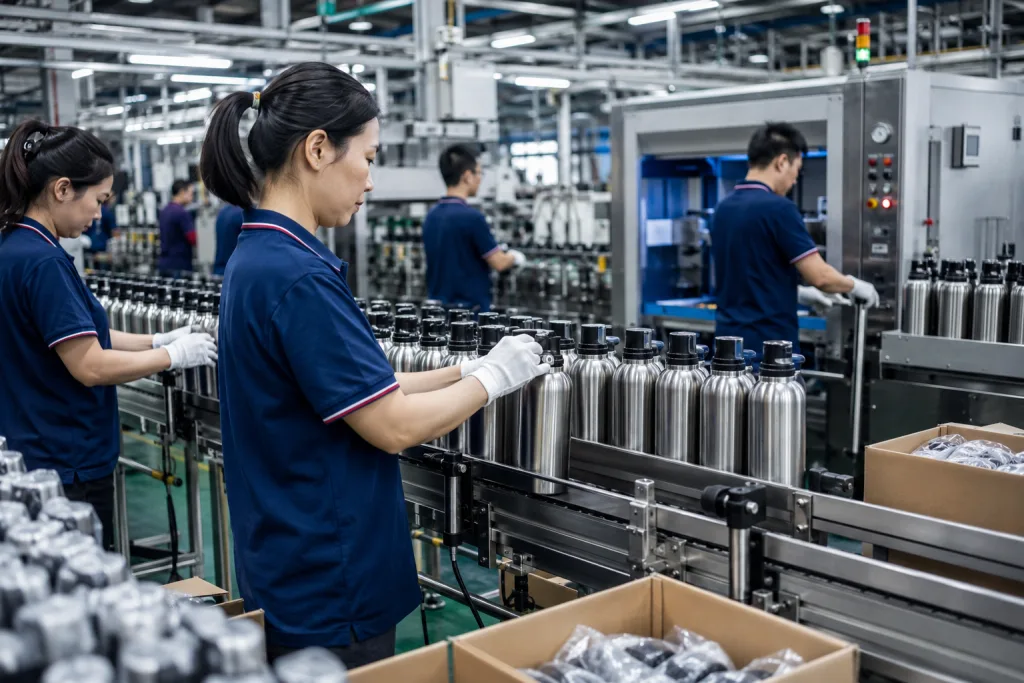
The better way is to run the order like a controlled project from day one. At our canteen factory in Zhejiang, China, we usually walk buyers through the same checkpoints: capacity and steel grade, cap structure, artwork limits, pre-production sample, AQL inspection, and shipping terms. QC pulled the sample more than once because a PO had a 750 ml body matched with a 63 mm cap callout, and the buyer flagged leakage later. If you source for retail, events, or a canteen distributor program, those checkpoints matter more than a polished quotation sheet. Frankly, the quotation is not the hard part; getting the spec right is.
Start with the order brief
Put the buyer in a real PO meeting. A procurement manager in Europe needs a customized canteen for a spring outdoor promotion: 750 ml, powder-coated bottle, screw cap, one-color logo, hangtag, and retail box. Landed cost is fixed. The warehouse team also set a hard limit of 15 kg per master carton because their pallet math is tight. That is a usable brief because it gives the factory a product target, pack-out requirement, and cost ceiling on day one.
The weak brief is the one that says only custom canteen, matte black, good quality. We have seen this go sideways. The line runs a sample in one texture, the buyer meant another, and then QC pulled the sample and the whole approval loop slipped 4 days. A serious canteen supplier should ask for these details up front:
- Material: 18/8 stainless steel, 304 body, and whether cap contact parts also need food-grade PP or a defined silicone grade
- Construction: single-wall if weight matters for outdoor use, or double-wall if insulation is part of the selling point
- Capacity and tolerance: 500 ml, 750 ml, 1000 ml with acceptable variance, usually ±3%
- Surface: powder coat, spray paint, brushed finish, or raw stainless, with a sample chip or finish code if you have one
- Decoration: silkscreen, heat transfer, laser engraving, or wrap print, plus logo size in mm and print position from base or shoulder
- Packaging: polybag, egg-crate divider, white box, color box, PDQ, or FNSKU labeling, with carton count per master
- Compliance market: REACH for EU, California Proposition 65 where relevant, and ASTM packaging tests if retail drop durability matters
If you are comparing outdoor canteen suppliers in Zhejiang or elsewhere in China, watch who pins down the brief first. This is the right question to ask. It changes scrap rate, approval cycles, and margin. A capable canteen manufacturer will turn your brief into a specification sheet before mass production starts, with dimensions, net weight, wall thickness, finish code, logo area, and carton data. On our side, that sheet usually gets checked against a 2D drawing and a cap gauge before we ship pre-production samples.
Choose the construction before decoration
Most buyers start with logo size and Pantone. Wrong starting point. For outdoor canteen suppliers, decide the body construction first, then talk decoration. The main commercial split is single-wall versus vacuum insulated. Single-wall is lighter, lower cost, and common for event giveaways, hiking promos, and entry retail. Vacuum models need tighter process control on the line—especially after the vacuum test station—and they carry a higher FOB, but the resale math usually works better.
For a practical B2B order, here is how the numbers usually behave:
- Single-wall 750 ml stainless canteen: body thickness around 0.4-0.5 mm, MOQ 1,000 pcs, FOB Zhejiang, China about USD 2.10-3.20 depending on cap and coating
- Double-wall vacuum 750 ml canteen: inner 0.4 mm / outer 0.5 mm is common, MOQ 1,000 pcs, FOB about USD 4.20-6.80
- Custom growler 1.2-1.9 L with handle or wide mouth: MOQ often 500-1,000 pcs, FOB about USD 6.50-11.50
Cap design drives more claims than new buyers expect. A simple PP screw lid with silicone ring is cheaper and usually better on leak performance than a multi-part lid with extra moving pieces. We have seen buyers push for straw lids on outdoor SKUs, then flag leaks after a 1.2 m drop test or rough carton handling. Straw lids look good on shelf, but they add leakage risk and replacement-part trouble. If you run a canteen distributor program, or manage 6 to 12 canteen distributors across markets, standardizing cap families cuts after-sales cost fast.
Ask for the hidden specs
Do not stop at capacity. Ask for neck finish dimensions, thread profile, gasket hardness, and whether the supplier uses welded or seamless body construction. QC pulled a sample last month where the PO had the logo right but the thread pitch was off, so the backup cap did not fit. If your canteen custom program includes carabiners, webbing sleeves, or canteen promotional accessories, test the full assembly, not the bottle alone. We have seen this go sideways. The bottle body passes, then the accessory fails at 8 kg load or the stitching opens, and that becomes the complaint. Good canteen manufacturers know the weakest part sets the return rate.
Price the project like a buyer
A canteen quote is only useful when the supplier breaks out the cost drivers. If you send RFQs to 5 vendors and get 5 one-line prices back, push them. Ask for tooling, decoration, packaging, and test charges as separate lines. We’ve seen this go sideways after sample approval, when the buyer flagged a missing mold fee or a drop-test charge that never showed on the first sheet.
A clean cost model for a 2,000-piece order may look like this:
- Bottle unit FOB Ningbo: USD 2.75
- One-color silkscreen print: USD 0.08
- Pantone-matched powder coat upgrade: USD 0.12
- Custom color box: USD 0.28
- Barcode label / FNSKU: USD 0.03
- Pre-production sample with courier: USD 80-150, often refundable against the order
Then ask what changes the number. This is the right question. Does the MOQ apply per SKU, per color, or per logo? If you need 4 colors at 500 pcs each, some canteen suppliers will take it; others add a surcharge because the coating line loses efficiency and the screen setup gets spread too thin. At BottleForge Industrial, our practical MOQ for many standard stainless models is 1,000 pcs per design, and monthly output can reach 300,000 units when components are standard. On the line, a color change is not just paperwork; it is cleaning the hopper, resetting the jig, and pulling a new first-off sample for QC.
Low price is useful only when the supplier can repeat it on the second and third PO without changing steel gauge, carton spec, or inspection standards.
If you are sourcing customized drinkware for a distributor drinkware catalog, check margin after duty and freight, not only ex-works. A USD 0.20 saving can disappear fast if the supplier packs badly and you lose 8-12% of container utilization. We ship by carton cube every week, and one 5 mm increase in box width across a master carton can change loading math more than buyers expect. Carton dimensions are a commercial issue, not just a warehouse issue.
Lock the sample before mass production
This is the point where a custom canteen order gets under control. You do not need 10 sample rounds. You need one engineering sample with fixed dimensions and structure, then one approved pre-production sample that matches the line. The first checks fit. The second checks finish, print, pack-out, and basic performance. On our floor, we usually mark the approved sample with date, PO number, and cap code before it goes into the sample cabinet.
For the approved sample, ask the canteen factory to document these checks:
- Capacity verification at room temperature, for example 750 ml ±3%
- Net weight, such as 265 g ±5%
- Leak test: filled, inverted for 30 minutes, then shaken 20 cycles
- Coating adhesion, typically cross-hatch tape test on powder coat
- Logo position tolerance, often within ±1.5 mm from artwork centerline
- Thread engagement and cap torque range
- Carton drop test, for example 76 cm on one corner, three edges, and six faces if retail packed
If the order is canteen promotional for an event deadline, do not skip sample approval to save 4-5 days. We have seen this go sideways. The line runs 1,000 units, then QC pulled the sample and the matte finish measured 8 gloss units higher than the signed piece, or the logo wrapped 2 mm too close to the side seam. That is where schedules break, not at sample stage.
Artwork needs manufacturing limits
Not every logo fits every process. Fine serifs below 0.2 mm line width often fill during silkscreen, especially if the mesh count is not matched to the ink. Large metallic areas look good on paper but scratch fast in outdoor use. Laser engraving holds up well, but the mark on brushed steel does not match the mark on powder coat. If your customer wants a customizable canteen with individual names, ask early if the factory runs variable data engraving at scale and what the hourly output is. A standard bulk logo run might ship at 3,000 pieces in a shift; named units are a different job, and the math does not work if nobody checked throughput first.
Build QC into the production plan
The best canteen supplier is not the one promising zero defects. It is the one showing where defects get caught. For outdoor canteens, the complaint list is usually boring but expensive: leaking lids, dented bodies, weak print adhesion, shade mismatch between lots, and odor from cap parts. End-of-line inspection is too late. We run a 24-hour standing leak check on the first approved pieces because one bad silicone ring groove can turn into 3,000 wet cartons.
A practical QC flow for customized canteen production in China should include:
- IQC: incoming stainless tubes, lids, silicone rings, and packaging checked against approved specs, with calipers used on mouth ID and gasket thickness before the line starts
- IPQC: weld appearance, neck forming dimensions, powder coat thickness, and print registration checked during line startup, not after 800 pcs are already sprayed
- FQC: leak tests, visual checks, logo position, barcode scan, carton markings, and a shake test after cap assembly
- OQC: final random inspection to AQL 2.5 major / 4.0 minor before shipment, including carton count and PO item code check
Ask for defect photos from past orders. A mature canteen manufacturer will classify defects clearly: body dent over 3 mm, visible scratch over 10 mm, print void over 1 mm, wrong accessory, mixed carton quantity, and so on. That wording matters because your third-party inspector needs objective criteria. We have seen this go sideways when a buyer wrote “minor scratch acceptable” on the PO, then QC pulled the sample and found 18 mm scratches across the logo area.
If your market is the EU, request food-contact declarations and REACH-related compliance for relevant materials. For North America, buyers often ask for BPA-free declarations for plastics, plus factory social audits such as BSCI or Sedex if the order supports a chain retailer. Certificates are not production control. A LFGB report does not catch a loose cap thread, so ask how the factory links each material batch to the job card and carton label.
Zhejiang, China has 40-plus competent drinkware clusters around Yongkang, Wuyi, and Hangzhou supply routes, but process discipline still changes from one canteen factory to another. If a supplier cannot show a basic inspection SOP, sealing test method, or traceable lot code system, treat that as a red flag even if the sample looks fine. Samples are easy. The line at 10,000 pcs is where the truth shows up.
Plan shipping before production finishes
Shipping trouble usually starts with packaging decisions made in the last week. If you buy from outdoor canteen suppliers on FOB terms, lock the delivery route before the line starts packing: 3PL, Amazon prep center, retail DC, or promo distributor. Each route changes labels, carton marks, and sometimes the master carton spec. We see this go sideways when a PO just says “standard export packing” and the buyer flagged the gap after QC pulled the sample carton.
An Amazon-driven customized drinkware order often needs FNSKU labels, suffocation warnings on polybags, and tighter carton size control, sometimes down to a 5 mm carton tolerance. A canteen distributor serving outdoor stores may ask for inner cartons sorted by color plus bilingual carton marks. A retail chain may push for ISTA-minded carton performance even without asking for ISTA reports on paper. This is the wrong question to ask: “Can you pack it later?” No—by then the insert die-cut and carton print file are already on the floor.
Get these numbers confirmed on the PO:
- Units per inner and master carton
- Carton dimensions and gross weight, preferably below 15 kg if your warehouse requests it
- Palletization plan if shipping to Europe or North America DCs
- FOB port, usually Ningbo or Shanghai for Zhejiang production
- Booking window and cargo ready date
State lead times like you mean them. For a standard canteen customized with existing mold and normal packaging, 25-35 days after deposit and sample approval is common. Add 7-10 days if you are developing a new lid, matching an unusual Pantone on textured powder coat, or using a custom insert tray. From August to November in China, we run with less slack on the line, not more. Last season, one buyer wrote “ASAP” on the PO and still needed 12 days for carton artwork approval—that math doesn’t work.
If this is your first order with a canteen manufacturer, split the risk. Start with one SKU, one finish, and one print method, even if the MOQ is 1,000 pcs. Repeat orders should earn complexity. Launching six SKUs with three cap styles sounds efficient on paper, but we’ve seen it expose weak spots fast. One inspection finding tells the story: body weight held at 285 g, but the straw lid leak rate failed on 3 out of 20 samples because the supplier was stronger in custom growler production than in lightweight outdoor canteen bodies.
What a good first PO looks like
A good first order with outdoor canteen suppliers should be boring on purpose. That part is correct. Say you place 2,000 pcs of a 750 ml single-wall bottle in two body colors, 1-color silkscreen, standard screw cap, and white box. Keep it there. We run first POs like this because the line is easier to control: one production sample approved, REACH-related material documentation on file, and a pre-shipment inspection at AQL 2.5/4.0. Deposit is 30%, balance against inspection pass and shipping documents. On our side, QC usually checks neck diameter with a digital caliper before packing starts. That is a manageable first PO.
After the supplier proves repeatability, then you build the customizable drinkware program: personalized names, gift box bundles, or a customized growler line for outdoor and beverage channels. Starting with all of that on PO1 is the wrong question to ask. The first PO should answer the commercial basics the factory floor actually has to hit:
- Does the canteen supplier hold dimensional consistency lot to lot?
- Can the factory repeat your color within acceptable tolerance?
- Are packing quantities accurate?
- Does communication stay precise when issues appear?
- Does the real lead time match the promised lead time?
Experienced buyers know this already. Newer teams usually learn it after one bad shipment. We have seen a 1 mm base wobble turn into a full rework discussion, and we have also seen a simple PO move cleanly because the spec stayed tight. The best canteen distributors and brand owners are not chasing the perfect sample. They want a canteen manufacturer in Zhejiang, China that repeats the agreed standard month after month, carton after carton. That is what turns a one-off custom canteen into a supply line you can ship against without six months of claim handling.
Send your canteen spec for a real factory review
Share your target price, capacity, logo, and packaging needs. We will review feasibility, MOQ, lead time, and likely QC risks before you place a PO.
Frequently asked questions
What MOQ should I expect from outdoor canteen suppliers?
For standard stainless models using existing molds, most outdoor canteen suppliers in China will quote 1,000 pcs per SKU as a workable MOQ. Some can go down to 500 pcs, but usually with fewer color options or a surcharge of USD 0.15-0.40 per unit. If you want a new cap mold, custom body shape, or premium retail box, the practical MOQ often moves to 3,000-5,000 pcs. For a custom growler with more complex hardware, 500-1,000 pcs is common because unit value is higher. Always ask whether MOQ applies per color, per print design, or per master SKU. That detail changes your real cost more than the headline MOQ does.
How do I compare canteen manufacturers beyond price?
Use a short scorecard. First, check response quality: did the canteen manufacturer ask for wall thickness, seal spec, packaging, and compliance market, or just send a quote? Second, compare sample discipline: do they provide drawings, weight, capacity, and test notes? Third, review QC controls: AQL standard, leak-test method, and lot traceability. Fourth, check capacity and lead time. A factory shipping 200,000-300,000 units per month with a normal 25-35 day lead time is usually easier to scale with than a workshop that cannot commit. Finally, confirm export basics such as FOB Ningbo or Shanghai, carton data, BSCI or similar audit status if needed, and whether they have experience with retail or distributor drinkware programs.
What tests matter most for a custom canteen order?
For most B2B canteen orders, start with five essentials: leak test, capacity check, coating adhesion, logo durability, and packaging drop performance. A practical leak test is 30 minutes inverted plus a shake test. Capacity should stay within about ±3%. Powder coat should pass a simple cross-hatch tape adhesion check. Printed logos should resist rubbing and basic handling without flaking. If you sell in retail boxes, ask for a carton drop test from 76 cm. For EU sales, request food-contact documentation relevant to REACH or LFGB requirements depending on your program. If the product includes plastic lids or straws, ask specifically for BPA-free declarations and odor checks after assembly.
How long does a canteen customized order usually take?
A normal first order using an existing mold usually takes 25-35 days after deposit, artwork approval, and sample sign-off. Sampling itself often needs 5-10 days, plus courier time. If you are matching a custom Pantone powder coat, developing a new lid, or building a custom gift box insert, add roughly 7-10 days. During peak export months in China, especially August through November, do not build your launch plan on best-case timing. A safer schedule is sample approval in week 2, production complete by week 6 or 7, inspection immediately after, and vessel booking based on confirmed cargo-ready date. Repeat orders with no spec changes can sometimes ship in 20-25 days.
Is FOB the best term for a first order from a canteen supplier?
For many buyers, yes. FOB is a practical middle ground because the canteen supplier handles export clearance to the named port, while you control the forwarder, ocean rate, and destination charges. That gives you better visibility than CIF when you are still learning the supplier’s packing discipline. For a first PO from Zhejiang, China, FOB Ningbo is common because it is efficient for many drinkware factories in Zhejiang. If your order is small and urgent, air shipment or express may make sense for part of the volume, but check carton dimensions carefully because dimensional weight can hurt. Whatever term you choose, make sure the PO lists unit count, carton count, gross weight, and shipping marks before production ends.