Key Takeaways
- A 500-750ml stainless steel custom canteen usually lands at MOQ 1,000-3,000 pcs with FOB China pricing around USD 2.80-6.90 depending on steel grade, coating, and lid type
- For outdoor use, 18/8 stainless steel with 0.4-0.5mm outer wall and leak-tested cap torque gives better field performance than thinner promotional builds
- Logo method changes both cost and durability: silkscreen can save USD 0.08-0.20 per unit, while laser engraving typically adds stronger long-term wear resistance
- AQL 2.5 final inspection, REACH or LFGB testing, and drop-carton validation reduce chargebacks far more effectively than chasing a 3% lower unit price
You are not buying a stock bottle. You are buying a canteen that has to pass a 1.2 m drop test, hold temperature after 6 hours in the test rack, clear REACH or FDA testing, print your logo without ghosting, and still hit the landed cost after ocean freight. Cheap ex-works quotes look good on a spreadsheet. The real job is matching the spec to the sales channel, whether the order goes to retail shelves, gifting, outdoor specialty, or distributor drinkware programs.
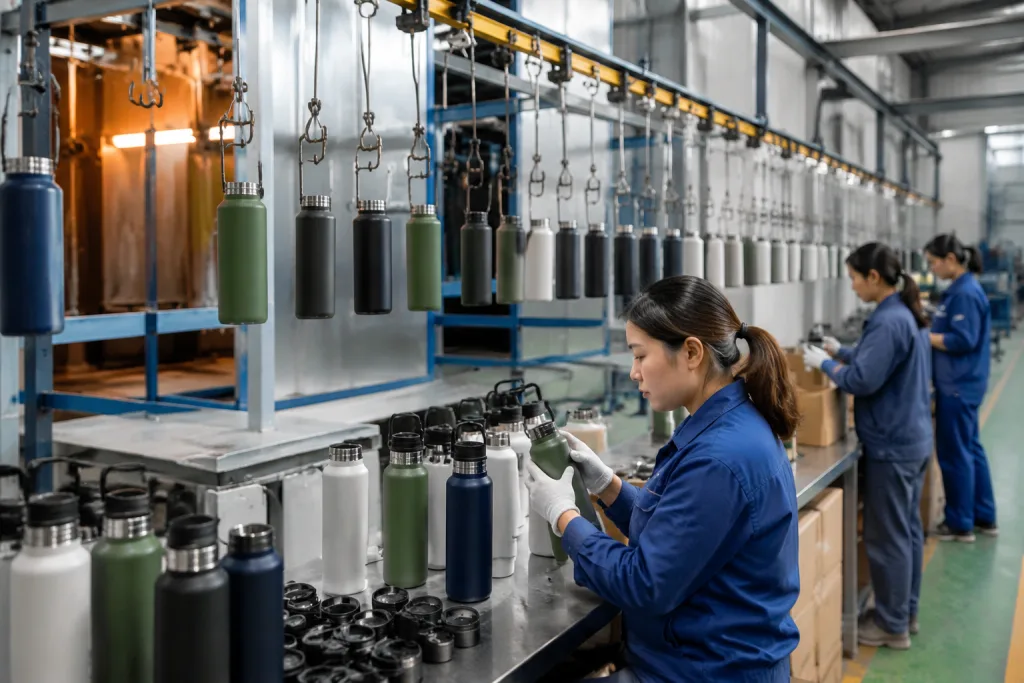
From Zhejiang, China, we see the same mistake every season: buyers compare photos and skip wall thickness, lid thread fit, coating line yield, and packing labor. QC pulled one sample last month with a 0.28 mm body wall where the PO asked for 0.35 mm; the photo looked fine, but the math did not work. A capable canteen manufacturer should show where the cost sits. At BottleForge Industrial in Zhejiang, typical MOQ starts at 1,000 units per color, lead time runs 25 to 35 days, and output reaches 300,000 units per month when tooling and artwork are approved.
What buyers compare first
Shortlisting an outdoor canteen supplier starts with the wrong filter for a lot of buyers. Factory age and catalog count look nice on a slide deck, but they do not tell you whether the line can repeat the same SKU at 3,000 pcs without drift. What matters first is spec discipline. We need to see if the factory can hold the same build at scale, trace the material inputs, and keep decoration loss under control. For Europe and North America, ask for a side-by-side spec table before final quotation. We’ve seen buyers skip this step, then QC pulled the sample and found a 0.3mm wall-thickness gap against the approved unit.
A workable comparison usually starts with five columns: material, insulation structure, capacity, decoration method, and compliance route. That table saves time. A single-wall aluminum or stainless custom canteen for events may be cheap, but it fits canteen promotional use better than hiking retail. A double-wall vacuum customized canteen costs more, but the margin usually works better in outdoor stores and premium gifting. On our side, we run this comparison before mold signoff, because the math does not work if the buyer wants retail performance on a promo-grade body.
- Material: 18/8 stainless steel, 18/0 stainless steel, aluminum, Tritan, glass
- Construction: single wall, double wall vacuum, copper-plated vacuum
- Capacity: 500ml, 600ml, 750ml, 1L are the common outdoor sizes
- Decoration: silkscreen, heat transfer, powder coat + logo, laser engraving
- Compliance: FDA, LFGB, REACH, Proposition 65 where needed
If your program is for a canteen distributor or distributor growler account, ask the canteen vendor how many SKUs they run monthly with identical lids and cartons. Ask for the number, not “many.” If they ship 12 SKUs on one shared stopper set, replacement risk is lower than a factory running 3 custom lid threads that only fit one body. If your business is private label outdoor retail, focus more on thermal retention, powder coat adhesion, and drop resistance. We test this on the floor with lid torque and carton drop checks, and the buyer flagged it once when a PO typo changed a 750ml bottle to a 700ml insert card. A canteen supplier that talks only about shape options and not production tolerances is usually a trading layer, not a real canteen manufacturer.
Good factories in China quote by the real build: steel grade, gram weight, coating passes, stopper type, and packing standard. Weak suppliers quote by photo.
Head-to-head spec table that matters
Here’s the head-to-head table most buyers actually use on calls with us. Don’t ask which style is “best.” Ask which build still leaves margin after freight, carton count, and a 3,000 pcs MOQ.
Single-wall vs vacuum canteen
- Single-wall stainless canteen, 600-750ml: FOB China around USD 2.80-3.90 at 3,000 pcs. Weight about 180-260g. We ship these for promo canteen programs, school sports events, and distributor projects where the buyer flagged a hard ceiling price on the PO. No real heat retention.
- Double-wall vacuum canteen, 500-750ml: FOB China around USD 4.20-6.20 at 1,000-3,000 pcs. Weight about 280-420g. This is the retail line. It also fits employee gift orders and outdoor specialty accounts. On the line, QC pulled more dent-risk samples once body weight dropped under about 300g, so the math does not work if you chase price too far.
- Copper-lined vacuum canteen, 500-750ml: FOB China around USD 5.50-6.90 at 1,000 pcs. Better thermal performance, usually 8-12% higher cost than standard vacuum. Better fit for premium custom canteen launches. We usually check the vacuum retention batch with an infrared thermometer and 95°C hot water fill before mass run.
Material and wall choices
- 18/8 stainless steel: preferred for food contact, corrosion resistance, and long-term taste neutrality. Most serious buyers ask for this first, and they are right to do it.
- 18/0 stainless steel: lower cost, acceptable in some structures, but less ideal for premium outdoor canteen positioning. We’ve seen this go sideways when a buyer wants premium shelf pricing but starts from the cheaper steel grade.
- Outer wall thickness: 0.4mm is common; 0.5mm gives a sturdier hand feel and fewer dents in transit. The difference shows up fast at incoming inspection once cartons take a hit from a 60 cm drop.
- Inner wall thickness: 0.3-0.4mm is standard on insulated bodies. We run a wall-thickness gauge during first article check because 0.02mm off spec is enough to change weight and dent rate.
For a custom growler or customizable growler, move up in capacity and handle strength. A 64oz growler with vacuum body and wide-mouth lid often needs stronger weld area, heavier carton partitions, and more careful cap leak testing. We normally use a torque tester on the cap and run upside-down leak checks for 30 minutes. A lot of canteen manufacturers can form the body; fewer can hold lid fit batch after batch at scale.
If you are buying for canteen distributors, standardizing neck finish and lid family across multiple bodies can reduce spare-part complaints by 20-30%. Ask your canteen vendor whether the same stopper tooling serves 500ml, 750ml, and 1L bodies. We had one PO with a 1L lid code typed wrong, and it created rework on 2,400 pcs. Sounds minor. It is not once repeat orders start.
Best fit by use case
The right canteen customizable program depends on your sales channel. We see two mistakes on the line all the time: buyers overbuild promo pieces and strip down outdoor retail SKUs too far. Both squeeze margin. This is the wrong question to ask: “What is the cheapest bottle?” Ask what the channel will actually tolerate. On one recent PO, the buyer even typed 5,000 pcs as 500 pcs, and the whole cost target was off before sampling started.
Promotional and event channel
If you need a canteen customized with a simple 1-color logo and a hard delivered-price ceiling, a single-wall 600ml bottle or entry vacuum 500ml body is usually the clean answer. We run standard powder coat colors, skip custom-molded lids, and ship with opp bag plus egg-crate carton to hold cost. MOQ can start at 1,000 pcs per colorway from a canteen factory in Zhejiang, China. For this channel, speed and decoration control matter more than 12-hour heat retention claims. A 120-mesh screen prints cleaner than a rushed multi-pass logo, and buyers flag logo blur faster than they ask about insulation data.
Outdoor retail and specialty
Here you need tighter specs. Ask for 18/8 stainless steel, vacuum body, tested leak-proof cap, and durable powder coating. For camping, hiking, or hunting, the bottle should have a scratch-resistant finish, a mouth wide enough for brush cleaning, and a cap you can open with gloves on. QC pulled one sample last month with a 0.4 mm powder miss near the shoulder; promo buyers let that pass, retail buyers do not. Shelf presence matters too, so packaging often moves to color box or kraft box with insert. That adds roughly USD 0.28-0.75 per unit depending on print and structure. We’ve seen this go sideways when the gift-style box looks good but fails a drop test at the corner.
Corporate gifting and loyalty
For customized drinkware in gifting, perceived value does the heavy lifting. Matte powder coat, laser engraving, and a gift box can support a higher landed cost if the finish is clean. We would pick a supplier with a stable coating line over one showing 300 shapes and weak decoration control. The math doesn't work if logo rejects eat your margin after packing. On gifting projects, the buyer flagged logo placement drift of 2 mm on a front panel and rejected 600 pcs in one shot. That happens fast.
Growler and beverage takeaway
If you need a customized growler for beverage programs, put cap sealing and handle comfort ahead of shape novelty. For carbonated fill, confirm the lid and gasket are built for that use. Not every custom growler body is suitable, and any factory saying yes to everything is selling trouble. We check gasket compression on the bench and watch for pressure loss before shipment. A serious canteen manufacturer will tell you the limit instead of pushing a sample that comes back leaking.
Where cost really moves
Most buyers stare at the body shape first. That is the wrong question to ask. On a canteen quote, the bigger cost moves usually sit in wall weight, finish, lid parts, and packing. We see this on the line every week. If you compare 3 suppliers, send the same checklist each time, down to logo size in mm and box type, or the quotes turn into apples vs oranges fast.
- Steel grade and weight: heavier 18/8 bodies cost more, and the jump is not just material. A body that runs 320 g instead of 285 g uses more steel, dents less in drop checks, and feels better in hand. QC pulled the sample on one project because the buyer wanted a “premium feel” but approved the lighter weight by mistake.
- Vacuum process: standard vacuum vs copper plating can move cost by USD 0.25-0.60. This is a real gap. We run both, and copper-plated vacuum usually gives the factory less room on process drift during temperature retention checks.
- Powder coating: standard colors are cheaper than Pantone-matched finishes; textured coats cost more than smooth. A custom Pantone is not just powder cost; it can mean extra color testing and sample approval. The buyer flagged a brown once because it was 1 shade warm under warehouse light, so the math doesn't work if you expect stock-color pricing.
- Logo process: silkscreen is usually the budget option; laser engraving and wrap transfer increase price. On straight-wall bottles, the line runs silkscreen faster. Wrap transfer adds alignment control, and laser adds machine time per piece.
- Lid complexity: carry loops, bamboo inlays, metal handles, and molded spouts add both part cost and assembly labor. A simple screw lid and a lid with 4 extra parts do not belong in the same cost discussion. We have seen assembly time shift by 6-12 seconds per unit on lids that looked “almost the same” on the drawing.
- Packaging: plain white box may cost USD 0.18-0.30; printed gift box may cost USD 0.45-1.10. Carton size matters too. A gift box that is 8 mm taller can change outer carton pack-out and freight efficiency, and buyers usually miss that on the first RFQ.
For a typical 750ml custom canteen, changing from standard black powder coat with 1-color silkscreen to Pantone powder coat plus laser logo and printed color box can increase FOB China pricing by USD 0.70-1.40 per unit. That is normal. We ship this kind of upgrade mix all the time. It is not overcharging if the supplier is actually building to spec and not quietly downgrading the finish or box board.
Tooling is another point buyers get wrong. If your canteen customized project uses an existing body with standard lid, you may pay no mold fee or a small decoration setup charge. If you want a unique cap, shoulder, or handle, expect new tooling. Basic accessory tooling can start around USD 800-2,500. Full body tooling is much higher, and we have seen this go sideways when the forecast was only 3,000 pcs. A new handle tool sounds cheap on paper until the first T1 sample shows sink marks and the buyer wants revisions.
A practical canteen vendor should also quote trade terms clearly. FOB Ningbo or Shanghai remains common from Zhejiang. If you need DDP or palletized delivery to an FBA prep warehouse, ask for those services as separate line items. We usually break out pallet cost, label work, and delivery booking so the quote is readable. One PO even came in with “FBO” typed instead of “FOB,” and that small typo stalled approval for a day.
How to verify a real factory
Not every canteen supplier is a factory. Some are traders. That is not always a problem, but you need to know who you are buying from because it changes lead time, price visibility, and how fast issues get fixed. We have seen buyers lose 12 days on a simple lid revision because the sales contact had to check with another plant after every comment.
Ask direct questions and wait for numbers. How many units per month does the line run for stainless vacuum bottles? What is the normal MOQ for your target item? What are lead times in low season and peak season? A real canteen manufacturer will answer with production data, not sales talk. For example, a stable stainless line may quote 300,000 units per month, MOQ 1,000 pcs for standard vacuum bottles, sample lead time 5-7 days, and bulk production 25-35 days after deposit and artwork approval. If they cannot tell you whether they use an auto laser welding station or a manual setup, the buyer should pause there.
- Audit documents: BSCI, ISO 9001, Sedex if relevant to your channel
- Material compliance: REACH, LFGB, FDA, BPA-free declarations, test reports by SKU family
- QC system: incoming inspection, in-line checks, AQL 2.5 final inspection, leak test records
- Export detail: carton marks, barcode placement, FNSKU labeling, pallet spec if needed
Also ask for defect photos from past runs and the corrective action report. Serious canteen factories in China will talk about real problems: pinholes in coating after powder cure, logo misalignment by 1.5 mm, vacuum loss from a bad weld, lid torque drifting above spec, or carton burst in drop test. QC pulled the sample, the buyer flagged it, and the factory should be able to say what changed on the line after that. If a supplier says they never have issues, this is the wrong answer. We have seen this go sideways more than once.
For canteen distributors and canteen vendors handling multiple customer brands, response time matters as much as price. If replacement lids take 45 days every time, the math does not work. A lower FOB offer gets eaten by backorders, claims, and air freight on service parts. Good suppliers plan common components in rolling stock, and they can tell you stock quantity by item code, sometimes down to 2,000 pcs of one black PP lid sitting near the assembly line.
Artwork, testing, and packaging decisions
Buyers usually push this part too late, and then the vessel is ready while the order still cannot ship. We have seen a 12-day job stretch to 18 days because the buyer approved the bottle color first but held the gift box dieline and LFGB sample. For customized drinkware going to Europe and North America, decoration sign-off, test scope, and packaging structure need to be fixed early. This is not admin work. It moves the ship date.
Artwork and decoration
For simple canteen promotional orders, 1-color silkscreen is still the workhorse. We run it every day on the line with a 1.5mm logo tolerance target, and the cost math works for MOQ 1,000 better than most buyers expect. For better durability or a cleaner premium look, laser engraving is the safer choice, especially on powder-coated vacuum bottles, where buyers often flag ink wear on the corners after rub testing. If the logo has gradients or 3 or 4 colors, heat transfer can fit, but QC should pull the sample for adhesion and abrasion checks before bulk approval. A customized canteen that looks fine in the sample room but fails after 100 dishwasher cycles comes back as a claim, and we have seen this go sideways.
Compliance and testing
For food-contact drinkware, ask what reports already exist and what needs fresh testing. Before PI approval, the buyer and factory should confirm REACH screening, LFGB for Germany or EU-focused programs, FDA-related compliance for North America, and Proposition 65 where applicable. If the item includes silicone gaskets, paint, or bamboo accents, check that each material stream is covered by the file set. This is where small misses happen: one gasket hardness change from 50 to 60 Shore A, one new bamboo lid vendor, one PO typo on the item code, then the sample sent to the lab does not match mass production. The wrong question to ask is only “Do you have a certificate?” The right question is whether the report matches this exact build.
Packaging and transit
Packaging is not just branding. It is a damage-control system. For e-commerce, use stronger mail-order packaging and validate carton drop performance; on our side that usually means a 5-layer outer carton and corner protection after the first drop test sample gets a dented shoulder. For retail master cartons, confirm gross weight stays in a range the downstream warehouse will accept, often under 15kg if that is their limit. For Amazon-oriented projects, FNSKU label placement and barcode scannability should be checked at pre-shipment stage, not after 2,000 units are packed and the buyer flagged a label covering the seam.
A practical rule: if your project is customized growler or large-format outdoor canteen, spend more on dividers and top protection. The extra USD 0.10-0.18 per unit is usually cheaper than dent claims and repacking labor after arrival. We ship enough tall bottles to say this plainly: a 1.2mm pulp divider beats a cheap paper insert every time.
Questions to settle before PO
Before you place the purchase order, ask the supplier to put the commercial terms and technical points on one approval sheet. It sounds fussy. It saves money. On our side, this is usually a 1-page sign-off with the final PDF artwork, carton mark, and bottle drawing checked against the PO, because we have seen one typo in a lid code turn into 3,000 wrong assemblies on the line.
- Confirmed spec: capacity, dimensions, net weight, steel grade, wall thickness, color code, lid type, gasket material
- Confirmed decoration: method, logo size, Pantone references, placement tolerance
- Confirmed QA: leak test standard, AQL level, vacuum retention claim, carton test requirement
- Confirmed commercial terms: MOQ, unit price, tooling charge, sample cost, lead time, payment term, FOB port
- Confirmed packaging: unit pack, carton quantity, carton size, gross weight, shipping marks
If you buy from China more than twice a year, tell your outdoor canteen supplier to keep one golden sample and one sealed approved packing sample. We store both in a labeled carton by PO number, and QC pulled the sample more than once when a repeat order came back 4 or 6 months later on a different line. Without that reference, color drift of 1 Pantone step or a 2 mm logo shift turns into an argument fast. We have seen this go sideways.
For first orders, I would rather see a buyer place 1,000-2,000 units on the correct spec than 5,000 units on the cheapest one. This is the wrong question to ask: “How low can the price go?” The better question is whether the spec will survive production, inspection, and sell-through. The wrong custom canteen creates more cost in claims, markdowns, and missed reorders than the price gap suggests. A good canteen supplier will push back if the wall thickness is too thin, the gross weight is over 18 kg per carton, or the lead time does not match the decoration process. That is what you want from a long-term canteen manufacturer in Zhejiang, China: not the fastest yes, but the reliable yes.
Get a canteen spec review before you place PO
Send your target capacity, channel, artwork, and price point. We will recommend the right build, MOQ, and compliance path from our Zhejiang production team.
Frequently asked questions
What MOQ should I expect from an outdoor canteen supplier?
For standard stainless steel outdoor canteen models, MOQ is usually 1,000 pcs per color for existing bodies and lids. If you want custom Pantone coating, gift box packaging, or multiple logo positions, 2,000-3,000 pcs often gives better pricing and smoother production. New lid tooling or unique body shapes can push MOQ higher, especially for a customized growler or large 1L canteen. In Zhejiang, China, many factories will quote low MOQ at first, but then limit color options or decoration choices. Ask for MOQ by SKU, by color, and by packaging type, not just one headline number.
How do I compare prices from different canteen manufacturers fairly?
Use one locked specification sheet and send it to every supplier. Include steel grade, wall thickness, capacity, lid material, coating finish, logo method, packaging, and inspection standard. A 750ml vacuum custom canteen can vary by more than USD 1.00 per unit simply because one quote uses 18/8 stainless, 0.5mm outer wall, laser logo, and printed box while another uses thinner material and plain carton. Also confirm trade terms such as FOB Ningbo or Shanghai. If one canteen vendor prices ex-works and another prices FOB, you are not comparing correctly. Always ask for carton dimensions and gross weight too, because freight can erase a small unit-price advantage.
Which is better for outdoor retail: single-wall or vacuum canteen?
For outdoor retail, vacuum is usually the better choice. A double-wall vacuum canteen in 500ml to 750ml gives better perceived value, stronger margins, and more practical field use. Standard performance claims are often 6-12 hours hot and 12-24 hours cold depending on test conditions and whether copper plating is used. Single-wall bottles are lighter and cheaper, but they fit promotional or event demand better than camping and hiking channels. If your target customer is paying retail outdoor pricing, they usually expect insulation, better powder coat durability, and a leak-tested lid. Single-wall still has a place, but mostly when budget matters more than performance.
What compliance documents should I ask a canteen supplier for?
For Europe and North America, start with food-contact compliance relevant to your market: FDA-related declarations, LFGB for many EU programs, and REACH screening for materials and coatings. If your item includes silicone seals, paint, bamboo, or plastic lids, make sure those components are covered too. For retailer or corporate programs, ask whether the canteen factory has BSCI, Sedex, or ISO 9001 records available. On quality control, request leak-test standards and final inspection at AQL 2.5 or your own level. If the canteen customized project is for children, gift sets, or special channels, additional testing may be needed. Good suppliers in China will tell you what existing reports can be shared and what must be tested on the final production sample.
How long does a custom canteen order usually take?
For an existing model with standard lid, sample lead time is often 5-7 days after artwork confirmation. Bulk production normally takes 25-35 days from deposit, approved pre-production sample, and final packaging signoff. In peak season, especially before Q4, 35-45 days is more realistic. New tooling adds time. A custom lid may need 20-30 extra days for mold and validation before mass production starts. If you need barcode labeling, palletization, or Amazon prep such as FNSKU application, add a few days and confirm that service before the order is booked. The shortest quoted lead time is not always the safest one if coating, testing, or packaging details are still unresolved.