Key Takeaways
- A reliable custom canteen program usually starts at 1,000-3,000 pcs per SKU, with sample approval in 7-12 days and mass production in 30-45 days
- For outdoor use, 18/8 stainless steel with a 0.5-0.6 mm inner wall and vacuum leak testing beats low-cost painted aluminum in durability
- Ask every canteen supplier for AQL 2.5 inspection, REACH or LFGB material declarations, and carton drop-test data before paying the balance
- Factories in Zhejiang, China with 300,000+ units/month output can support distributor drinkware projects better than small workshops with unstable subcontracting
Any outdoor canteen supplier directory will give you 200 or 500 names. That part is easy. The hard part is spotting the real factory behind the photos. We have seen trading companies lift workshop images, copy FDA or LFGB claims from someone else’s catalog, and still miss basic production control. If you buy for retail, promo, or distribution in Europe or North America, small errors turn into chargebacks fast: wrong steel grade, thin powder coat, missing REACH paperwork, or a cap leak issue that shows up after a 0.3 MPa air-pressure check on the line.
Put suppliers side by side and the picture gets cleaner. A real canteen factory in Zhejiang, China should answer with numbers, not sales talk: MOQ, wall thickness in mm, lead time in days, AQL level, and print limits by process. At BottleForge Industrial in Hangzhou, Zhejiang, China, we run canteens as an engineering product first and a branding surface second. QC pulled samples last month where the buyer flagged color first, but the bigger issue was a PO typo on lid spec. This is the wrong question to ask if you start with logo size before you confirm build, sealing, and compliance. That gap is usually what separates a smooth reorder from a container of problems.
What belongs in your shortlist
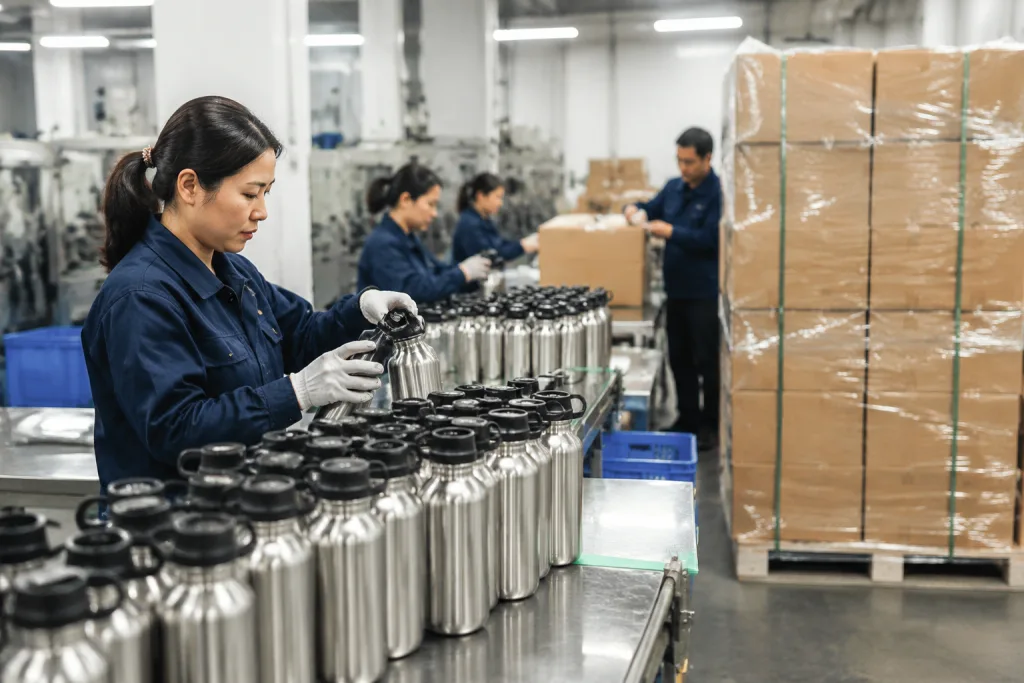
Most buyers pull 20 to 30 names from an outdoor canteen supplier directory. That is too many. Cut it fast with hard filters. First ask what the company actually is: factory, vendor, or distributor. This is the right question to ask early, because we have seen POs get stuck for 9 days just because the buyer assumed a trader owned the line. A canteen manufacturer controls tooling, welding, vacuuming, painting, and final inspection. On our floor that means tube cutting, seam welding, vacuum test, powder coat, and AQL 2.5 packing check under one roof. A canteen supplier may combine 2 or 3 factory resources and offer a wider model range. A canteen distributor usually fits local stock programs, not factory-direct OEM development.
For a B2B buyer, a working shortlist usually includes suppliers that can show:
- Clear MOQ by model: for example 1,000 pcs for a standard 18 oz bottle, 3,000 pcs for a new lid color, 5,000 pcs for a fully new mold. If a supplier gives one flat MOQ for every SKU, the math does not work.
- Production capacity: not just “large factory,” but something measurable such as 400,000 units/month. Ask how many lines they run and whether that number is based on 1 shift or 2.
- Compliance scope: REACH, LFGB, FDA-contact statements, BSCI or Sedex social audit if your retailer requires it. QC pulled samples before where the supplier had FDA paperwork but no matching test report for the final lid set.
- Decoration range: silk screen, laser engraving, heat transfer, UV print, embossed logo, or base sticker with barcode. Ask for artwork limits too, like a 180 mm wrap print area or 0.2 mm minimum line width.
- Outdoor product logic: leakproof lids, carabiner cap options, scratch resistance, and packaging that survives parcel delivery. We ship drop-tested mailer packs, because retail cartons that look fine on the pallet can fail fast in courier handling.
If the supplier cannot explain these basics in one email thread, move on. One clean reply should cover MOQ, lead time, test scope, decoration limits, and packing method. If it takes 6 emails to get straight answers, it usually gets worse after deposit. The best canteen suppliers in China are not always the cheapest on the first quote. They are the ones that cut surprises after payment — like lid fit issues, wrong barcode stickers, or a PO typo on color code BK-03 that the buyer flagged too late. That matters more when you are buying canteen custom programs for retail shelves, canteen promotional campaigns, or large distributor canteen accounts.
Head-to-head by product specification
Plenty of buyers compare canteen suppliers on unit price alone. That is the wrong question to ask. Put every factory on the same spec sheet instead, down to 0.5 mm wall thickness, lid style, print method, carton pack, and test standard. Once we run quotes this way, weak suppliers show up fast because they miss details, change materials, or leave blank lines on the RFQ.
Basic comparison fields
- Body material: 18/8 stainless steel, 18/0 stainless, aluminum, Tritan, or recycled plastic.
- Structure: single wall or double wall vacuum.
- Capacity: 500 ml, 750 ml, 1,000 ml, 1.5 L.
- Wall thickness: 0.4 mm, 0.5 mm, 0.6 mm.
- Finish: spray paint, powder coat, brushed, polished, rubber finish.
- Lid type: screw cap, chug cap, straw lid, loop cap, bamboo insert cap.
- Decoration: 1-color print, wrap print, laser, raised badge.
- Testing: vacuum retention, leakage, salt spray, dishwasher, drop test.
For outdoor use, the safer standard is still a double-wall stainless custom canteen in 18/8 steel with a 0.5 mm inner and 0.5 mm outer wall. Heavier, yes. Better in the field too. We have seen aluminum win on price, then go sideways after a 1.2 m drop test or after the buyer flagged coating concerns on the inner wall. A typical 750 ml vacuum canteen should keep water cold 18-24 hours and hot 8-12 hours under normal lab conditions, and QC usually checks the vacuum point with a vacuum gauge before the sample set leaves.
A supplier that avoids wall-thickness details is usually hiding cost-down choices you will discover after samples arrive.
If you need canteen customizable options for a broad catalog, lock the range to 3 core sizes: 500 ml, 750 ml, and 1 L in the same body style. The math works better. One neck finish, one cap platform, fewer tooling changes on the line. That cuts spare-part headaches for canteen distributors and distributor growler buyers, especially on mixed-carton repeat orders. When you ask for quotes, request FOB Ningbo or FOB Shanghai, packaging dimensions, gross weight, and units per carton. We ship this data on day one, often with a carton drawing and a note if the PO has a typo like 1,000 ml written as 1000 L. A Zhejiang exporter with regular volume should already have that template ready.
Which build suits which channel
Not every custom drinkware project needs the same canteen. We’ve seen this go sideways. A buyer specs a premium build for a low-margin promo run, then gets stuck on a $0.60 gap at PO stage; or they push a budget bottle into outdoor retail and returns start after the first dent test on the packing bench. Use-case fit is the first filter, not the logo print.
Promotional and event use: For a canteen promotional run of 5,000-20,000 pieces with tight target pricing, single-wall stainless or BPA-free plastic is usually the right call. Unit cost can be 25-40% lower than vacuum bottles. The trade-off is plain: weaker insulation and a lighter hand feel. On our line, these projects often run with a simpler silk screen setup and a 500 pcs/color carton split. Good fit for charity walks, tourism merchandise, and 30- to 90-day campaign windows. If the buyer expects “premium” at this price, the math doesn’t work.
Retail brand programs: For store shelves, a customized canteen needs to take abuse, returns, and review photos under bad lighting. Double-wall 18/8 stainless is the safer bet. You want a powder coat that passes a 24-hour salt spray check at minimum and a cap seal that clears leak testing after repeated torque cycles. We usually check lid torque with a digital torque meter, and QC pulled the sample twice last season because a gasket sat 0.8 mm off groove. That small miss becomes a one-star review fast. This is where a serious canteen manufacturer earns the order.
Outdoor and camping channels: Weight, dent resistance, and cap security matter more than decoration complexity. A textured powder coat, integrated loop lid, and narrower diameter for side-pocket fit usually sell better than glossy finishes. We ship more 73-75 mm bodies into hiking channels than wide decorative shapes because they fit backpack pockets better on the sell-through side. If you are sourcing through an outdoor canteen supplier directory, ask who already supplies hiking, camping, or hunting categories. That question beats asking who has the biggest catalog.
Growler and larger-format programs: For custom growler or customizable growler demand, the buying logic changes. A 64 oz or 1.9 L growler needs stronger handle welds, wider-mouth cleaning access, and pressure-safe lid design if carbonated drinks are involved. Many canteen manufacturers can make small bottles well but struggle with large-body consistency. We’ve seen handle pull tests fail at under 18 kg on poor welds, and that is a freight-claim problem waiting to happen. Ask for seam photos, handle pull-test data, and real packing weight. The same applies to customized growler and distributor growler programs where freight damage can destroy margin.
In practice, a canteen customizable line works best when you split the catalog into three bands: entry, core, and premium. Give each band a job. We run this way because it helps the sales team explain why one customized drinkware option is $2.80 FOB and another is $6.90 FOB, instead of acting like every bottle does the same work. Even a typo on a PO can cause confusion here—last month one buyer wrote “vacum” on the spec sheet and their own team quoted the wrong band back internally.
Price gaps that actually matter
One canteen supplier can come in 12% lower than another. That is usually not factory magic. The gap is normally in the spec: steel grade, wall thickness in mm, vacuum pass rate, packing standard, or how much inspection the line actually runs. This is the right question to ask, because we have seen buyers compare two FOB numbers while one sample was 304 throughout and the other had 201 in a lid part.
For a standard 750 ml stainless outdoor bottle made in Zhejiang, China, you might see these rough FOB ranges:
- Single-wall 18/8 stainless: USD 2.10-2.90 at 3,000 pcs
- Double-wall vacuum painted: USD 3.60-4.80 at 3,000 pcs
- Double-wall powder coated: USD 4.10-5.40 at 3,000 pcs
- Premium cap with carry loop or mixed material insert: add USD 0.25-0.80
- Retail color box: add USD 0.18-0.45
If one canteen vendor quotes well below that range, ask sharp questions. Is it 18/8 outside and 201 steel in the lid? Is the powder coat 45 μm instead of 60 μm? Are logos hand-applied after masking, or are they done on a stable fixture? Is the outer carton 3-layer, not 5-layer? Does QC pull every vacuum piece for leak testing, or only sample 32 pcs per lot? We ship plenty of bottles where the buyer flagged dented gift boxes first, not the bottle itself.
For canteen custom or custom drinkware projects, cost climbs fast when small adds start stacking up. A custom PMS body color needs paint setup. A new lid mold or custom handle means tooling and trial shots. Wrap-around print registration is slower on the line; if artwork drifts 1.5 mm, QC pulled the sample and held the run. Individual polybag, color box, and master carton marks all add packing labor. Amazon FNSKU labeling or retail ticketing sounds minor, but at 3,000 pcs it is still a manual step.
The cheapest quote can still be the correct one if the spec is clean and the supplier is straight about the limits. What matters is whether the factory can break cost out in plain numbers. A dependable canteen factory in China should tell you that cutting MOQ from 3,000 to 1,000 pcs may add USD 0.35-0.60 per unit because paint setup, carton plate charges, and inspection labor get spread over fewer units. If a supplier cannot explain that math, the math does not work.
How to audit suppliers remotely
You do not always need to fly to China to choose between canteen manufacturers. You do need a tighter remote audit process than back-and-forth messages on a marketplace. Start with documents, then samples, then a live line check. That order works.
Ask each canteen supplier for a current business license, factory audit if available, and recent test reports for similar products. Ask for files issued within the last 12 months, not a PDF from 3 years ago with an old company chop. REACH declarations matter for Europe. LFGB is useful for Germany and nearby markets. FDA-contact statements are common for North America. ASTM is more relevant if the product is for children, but if the factory also makes kids bottles, it usually tells us the QC routine is stricter. We have seen buyers miss a simple mismatch where the business license name and the test report applicant name were not the same company.
Then ask for a live video call from the production floor. Do not ask for a polished sales deck. Ask them to walk the line with the phone and stop at each station: tube cutting, forming, welding, vacuuming, painting, logo application, packing. Ask to see a digital vacuum gauge, a laser marking machine, or carton stacks with PO numbers. If they claim to be a canteen factory but cannot show the line, they may be a canteen vendor outsourcing everything. This is the wrong question to ask: “Can you make my product?” The better question is: “Show me where you make it.” We have seen this go sideways when a supplier could show samples but not a single welding fixture.
Sample evaluation should be structured:
- Leak test: upside-down for 2 hours, then shake test.
- Finish test: tape adhesion check and scratch resistance.
- Odor check: hot water hold for 30 minutes, then smell lid and body.
- Fit and torque: thread engagement should feel clean, not gritty.
- Drop test: packed sample from 76 cm on edges and corners.
For bulk orders, require an inspection standard in writing. AQL 2.5 for major defects and AQL 4.0 for minor defects is common for drinkware. Define what counts as critical, major, and minor before production starts. At BottleForge Industrial, we normally lock pre-production sample approval, logo artwork sign-off, and carton marks before mass production because that is where most preventable mistakes start. QC pulled one sample last month where the logo was correct, but the carton mark carried a PO typo and the inner count was packed 24 pcs instead of 25 pcs. With a capacity above 300,000 units per month, we still treat inspection planning as a front-end job, not something to improvise before shipment. The math does not work if you wait until goods are packed to define defects.
Customization limits buyers should know
Every buyer wants more customization. Normal request. The problem is scale: some changes run smoothly on the line, and some turn into new tooling, lower yield, or another round of compliance testing. If you want custom canteen output without avoidable delays, ask first what stays within the current setup and what forces a mold change, thread check, or fresh leak test on the vacuum station.
Easy changes: body color, standard logo print position, laser engraving, basic hangtag, carton marks, and standard cap color swaps. We run these every week. On a standard 304 stainless bottle, if parts are in stock, these changes usually add only 5-10 days, and QC pulled the sample from the same jig without touching the neck dimension.
Moderate changes: mixed finishes on one body, two-logo applications, custom lid assembly using standard thread platforms, or gift-box packaging. These are workable, but approvals get tighter. A two-logo job sounds simple until the buyer flags 1.5 mm position drift between sides, or the gift box fails a 1A drop test and we have to re-cut the insert.
High-friction changes: new body mold, non-standard thread design, custom gasket geometry, embossed steel body patterns, or large bamboo components. This is where the math often stops working. We have seen MOQ move to 5,000-10,000 pcs fast, with tooling lead time at 20-35 days before samples, and the first T1 sample still comes back for thread correction after the go/no-go gauge check.
This matters most if you are buying custom growler, customizable canteen, or customized growler items for a distributor drinkware program. Large sizes magnify risk. A cap that seals on a 500 ml bottle can fail on a 1.5 L body because gasket compression changes under torque, and we have seen this go sideways during a 24-hour upside-down leak test. That is why experienced canteen manufacturers ask for prototype checks before mass-production artwork; this is the right sequence.
If your target is speed, build your canteen custom range around existing molds and put the budget into decoration, packaging, and accessories. Buyers in Europe and North America often get better margins that way. We ship those programs faster too—think 12 days versus 18 days on repeat structures—while a fully new shape often starts with one sales idea and ends with a PO typo, revised artwork, and no extra sell-through at retail.
Where strong programs usually win
The best supplier is not the one with the biggest catalog page in an outdoor canteen supplier directory. It is the one that fits your channel, your margin target, and your risk tolerance. We see this on the line all the time. A canteen distributor with repeat wholesale demand usually cares more about ±0.5 ΔE color control and spare-part continuity for lids and straws. A retail launch buyer will flag paint dust, logo position, and how the carton looks when QC pulled the sample. A promotional canteen order at 20,000 pcs usually comes down to ship date, carton count, and whether the math works on unit cost.
In China, especially in Zhejiang, the stronger OEM drinkware programs usually share the same operating habits. They standardize parts across models, quote lead times that the line can actually hit, and answer test questions without dancing around them. For a repeat model, 7-10 days for pre-production sample confirmation and 30-40 days for bulk is normal if decoration and packaging are already locked. For a new mold custom canteen project, 45-60 days is more believable, because you still have tool correction, leak test checks, and pilot run review. If someone promises much faster, this is the wrong question to skip—ask what process step got cut.
After-order practicality matters more than most buyers expect. Can the supplier load mixed-SKU containers with a clear packing list by carton? Can they print FNSKU, pallet labels, or bilingual cartons without a last-minute PO typo turning 12,000 labels into scrap? Can they hold one approved logo standard across custom canteen, custom growler, and customizable growler items so your brand does not drift 2 mm higher on one factory's screen print than another's? This is where good canteen suppliers separate themselves from names that look fine on a spreadsheet.
If you narrow your shortlist with hard specs, compare by use-case fit, and push every canteen manufacturer for real production numbers, the directory gets useful fast. Ask what they run per day, ask the MOQ by colorway, ask how they pack for Amazon or retail. We've seen this go sideways six months later when the reorder lands and the approved lid, coating, or carton spec is suddenly "similar." That is the difference between buying a bottle and building a drinkware program that can reorder cleanly six months later.
Compare your canteen shortlist with factory-level numbers
Send your target specs, quantity, and channel. We will review MOQ, material, decoration, testing, and lead time for the right outdoor canteen program.
Frequently asked questions
What is a normal MOQ when buying from a canteen manufacturer in China?
For standard OEM models, MOQ is usually 1,000-3,000 pcs per size or color. A simple 750 ml stainless bottle with one logo may start at 1,000 pcs if the factory already has stock components. If you want a custom PMS body, matching lid, and retail box, 3,000 pcs is more common. For a fully new mold or a custom growler with new cap tooling, expect 5,000-10,000 pcs plus tooling cost. Serious factories in Zhejiang, China will split MOQ by body style and by finish, because paint setup and packaging drive cost as much as the steel body itself.
How do I tell if a canteen supplier is a real factory or just a trading company?
Ask for three things: a business license, a live video walkthrough, and process-level answers. A real canteen factory can show forming, welding, vacuuming, painting, and packing areas, and will discuss wall thickness like 0.5 mm or 0.6 mm without hesitation. They should also state monthly output, such as 300,000 or 400,000 units. A trading company may still be useful, but often cannot confirm AQL standards, vacuum leak testing rates, or exact lead times by workshop step. If answers stay vague after two rounds of questions, treat that as a sourcing risk.
Which material is best for an outdoor custom canteen?
For most outdoor B2B programs, 18/8 stainless steel is the safest choice. It gives better corrosion resistance than lower grades, works well for double-wall vacuum insulation, and handles rough use better than coated aluminum. A practical build is 0.5 mm inner wall plus 0.5 mm outer wall for a 500-1,000 ml body. Single-wall stainless is cheaper, usually by USD 1.00-1.80 per unit, but it does not insulate and feels less premium. Plastic can work for low-cost canteen promotional projects, but for camping, hiking, and retail outdoor channels, stainless usually returns fewer complaints and better repeat orders.
What quality documents should I request before placing a purchase order?
At minimum, ask for material declarations and recent test reports for comparable items. For Europe, request REACH and, if relevant to your market, LFGB supporting documents. For North America, ask for food-contact statements and any retailer-specific testing history. On the production side, confirm written inspection criteria such as AQL 2.5 major and AQL 4.0 minor, plus leakage and carton drop-test requirements. If your customer cares about social compliance, request BSCI or Sedex audit status. The documents do not replace a sample review, but they quickly show whether the supplier manages drinkware as a real export product.
How long does a customized drinkware order usually take from sampling to shipment?
For an existing bottle shape with standard components, sampling usually takes 7-12 days after artwork and color confirmation. Bulk production then takes about 30-45 days depending on quantity, finish, and season. If the order includes a new cap mold, embossed body, or custom growler structure, sampling can stretch to 20-35 days and mass production to 45-60 days. Add another few days for inspection and booking. If a supplier promises a complex canteen customized order in under 20 days total, you should ask exactly which steps are being compressed, because that timing is not typical for stable OEM production.