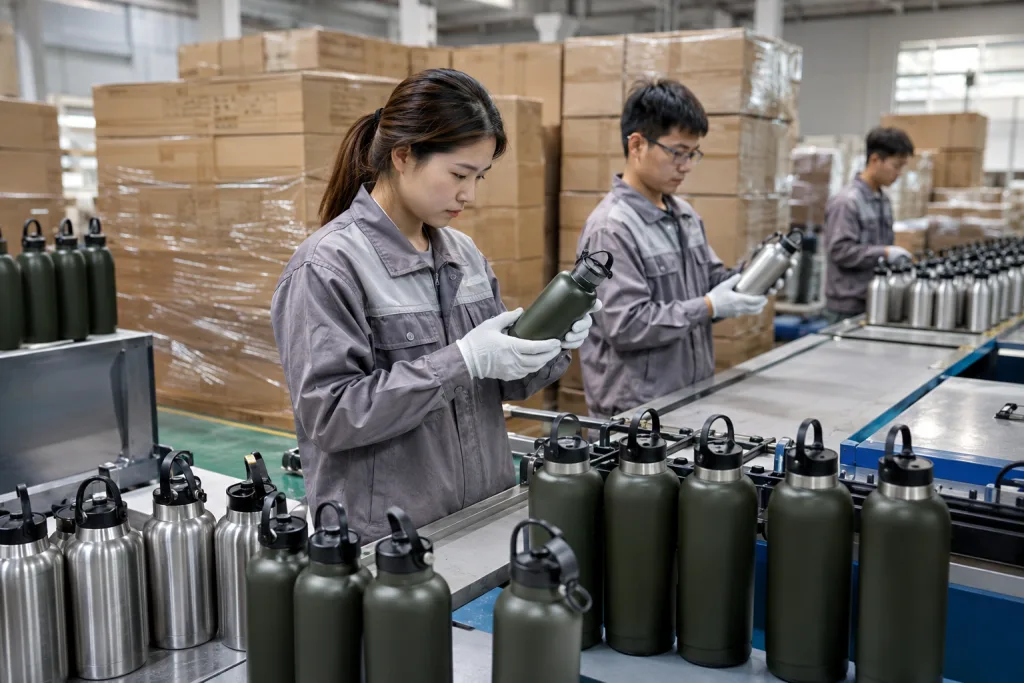
Key Takeaways
- For most outdoor canteen promotional orders, practical MOQ starts at 1,000 units per color, with custom mold changes usually from 3,000 units.
- A 500 ml single-wall stainless canteen often lands at USD 1.85-2.80 FOB China; double-wall vacuum versions are commonly USD 3.60-6.50 FOB.
- Standard production lead time from Zhejiang, China is typically 25-35 days after sample approval and deposit, plus 3-7 days for final inspection and booking.
- Set AQL at 2.5 major / 4.0 minor and confirm REACH, LFGB or FDA-contact compliance before mass production, not after cargo is packed.
You are not buying a souvenir. You are buying a product that has to survive backpacks, cold mornings, summer events, and a marketing budget checked line by line. Outdoor canteen promo projects fail for simple reasons. The bottle looks good in a photo, then the handle cracks after a 1.2 m drop test, the logo scuffs on the line, or the landed cost comes in 18% above plan after packaging and testing.
If you are comparing a canteen manufacturer in Zhejiang, China with a trader, or trying to qualify new canteen suppliers for Europe or North America, ask about production first, not the catalog. This is the wrong question to ask: “What is your best price?” A reliable canteen custom program is more than color and logo. It is steel grade, wall thickness, coating, AQL, compliance, carton drop performance, and a lead time you can schedule against. We have seen buyers flag a nice sample, then reject mass goods because QC pulled the sample and found a 0.15 mm wall change, a weak powder coat edge, or even a PO typo that switched the carton spec.
What should you define first?
Define the use case first. Decoration comes later. A proper brief for outdoor canteen promotional products should lock five points before you ask any canteen vendor for pricing: capacity, insulation need, carry method, sales channel, and compliance market. On our side, the sales sheet is not even complete until those five boxes are filled. Skip them, and 3 quotes that look close on paper will be pricing 3 different bottles.
Example: a 750 ml single-wall custom canteen for a hiking event is not the same item as a 530 ml vacuum customized canteen for retail gift packs. The first usually targets low FOB cost and lower weight; we often check it on the line with a simple hanging scale because 40 g extra per unit adds up fast on 10,000 pcs. The second usually needs a powder-coated body, retail-grade box, barcode placement, and tighter cosmetic standards. If you sell through distributor drinkware channels in North America, carton labels, FNSKU placement, and damage tolerance carry more weight than they do for a one-off local event. Buyers push back on this point all the time, but this is the wrong question to ask: “What is your best price?” Ask what build the quote is based on.
- Capacity: 500 ml, 650 ml, and 750 ml are the most quoted outdoor sizes.
- Construction: single-wall for budget campaigns; double-wall vacuum for premium canteen promotional programs.
- Lid style: screw cap with tether, bamboo top, carry loop, or leak-resistant sports lid.
- Finish: spray paint, powder coating, satin steel, or full-wrap transfer.
- Packaging: bulk pack, white box, kraft box, or shelf-ready retail carton.
A serious canteen factory asks these questions on the first round. If a canteen supplier sends one blanket price without clarifying construction, test standard, or packing, treat it as a rough number. We’ve seen this go sideways. At BottleForge Industrial in Hangzhou, Zhejiang, we usually quote with two build options, sometimes three, because buyers often start with vacuum insulation and then pull back after they see unit cost and shipping cube. Last month QC pulled the sample on a retail set because the PO had a barcode position typo, 12 mm off the approved panel. Catching those details early saves time and stops a redesign after the customer presentation is already approved.
Which material and build fit outdoors?
For outdoor canteen promotional sourcing, 18/8 stainless steel is still the safest mainstream choice. It holds up well in wet use, takes knocks better than aluminum, and passes food-contact review more smoothly in Europe and North America. On our line in Hangzhou, this is the material most buyers come back to after testing cheaper options. Aluminum works for low-cost canteen customizable campaigns, but it dents fast; QC pulled one sample last month with a shoulder ding straight out of carton drop test. Tritan or recycled plastic fits lightweight sports use, but outdoor buyers still ask for the heavier steel feel. That pushback is common.
Ask your canteen manufacturer for exact body thickness. Don’t accept “standard gauge.” A common range is 0.4 mm to 0.5 mm for single-wall stainless and around 0.4 mm outer with 0.3 mm inner for vacuum designs. Cheap samples often hide thin gauges under heavy coating; we check this with a micrometer after paint, because the coating can fool the eye. A bottle that looks solid can still oil-can when squeezed. If your buyers are hikers, camp retailers, or outdoor event distributors, request a cap torque test and handle pull test. We’ve seen this go sideways. A decorative lid loop that fails at 6 kg is a complaint waiting to happen, and the buyer flagged exactly that on a PO last season.
Practical material choices
- 304 stainless steel: best all-round option for custom drinkware and customized growler projects; stable supply, easy to run, and accepted by most outdoor accounts.
- 316 stainless steel: higher corrosion resistance, usually 8-15% higher cost, useful for premium lines; the math doesn’t work for every promotion, so ask where the bottle will actually be used.
- Aluminum: lower weight and lower price, but lower dent resistance; good for high-volume giveaways if the buyer accepts more surface marks.
- Tritan: clear appearance, BPA-free positioning, good for sport-focused customizable drinkware; mold parting lines need checking before approval.
For outdoor use, the lid matters as much as the bottle. A poor PP cap with weak silicone sealing will cause more returns than a minor dent on the body.
If you are building a custom growler or customizable growler for camping and beverage carry, insist on a wider mouth finish, stronger handle geometry, and a more robust closure. This is the wrong question to ask: “Can you make it look like our sketch?” Ask how the hinge pin, thread fit, and handle load were tested. Not every canteen factory that makes standard water bottles is good at growler-style tooling. We ship plenty of bottles, but growlers are a different job. Ask for photos of similar production, not just a drawing, and ask what the handle held in kg before failure.
How do you compare prices honestly?
Most buyers ask for pricing before the spec is locked, then compare the wrong line. Compare the delivered spec, not only unit FOB. We see this every week on the line. A single-wall 600 ml canteen may come in at USD 2.05 FOB Ningbo from one canteen supplier and USD 2.28 from another, but the lower quote often strips out the logo plate setup, inner polybag, export carton upgrade, or REACH test support. QC pulled one sample last month where the carton was changed from 5-ply to 3-ply without being called out. After you add those missing items back, the “cheap” offer often costs more.
For normal China sourcing, break the price into these parts:
- Unit price: bottle, lid, seal, standard finish. Ask for body weight in grams and wall thickness in mm, or the math doesn't work.
- Decoration: one-color silkscreen, laser engraving, heat transfer, or 360-degree printing. A 25 mm logo is not priced the same as a full-wrap print.
- Packaging: egg-crate bulk pack, individual box, insert card, barcode label. We ship plenty of orders where the barcode label alone adds a repacking step.
- Sampling: digital mockup, pre-production sample, tooling sample. The buyer flagged it once because the PO typo said “mat black” instead of “matte black,” and the sample had to be redone.
- Testing: third-party lab fees for LFGB, FDA, REACH, or CA Prop 65 where required. This should be listed clearly, not buried.
- Logistics: FOB, CIF, DDP assumptions, palletization, and booking seasonality. August space and November space do not price the same.
Typical FOB China numbers for outdoor canteen promotional business are plain enough if the spec is complete. Basic 500-750 ml single-wall stainless: USD 1.85-2.80 at 1,000-3,000 units. Vacuum insulated canteen customized builds: USD 3.60-6.50 depending on finish and lid. A custom growler in 32 oz or 64 oz usually starts higher because of material weight and carton volume. One 64 oz body can add 0.18-0.25 kg of stainless versus a smaller canteen, and freight follows that weight. If a canteen vendor quotes far below these ranges, ask what was removed. We’ve seen this go sideways. Usually it is wall thickness, coating quality, or packaging.
Look at MOQ logic too. This is the wrong question to ask if you only ask for the lowest MOQ on day one. In Zhejiang, 500 units is common for a repeat colorway we already run, but a new body color, new logo, and custom box usually push the real MOQ to 1,000 units. For cap color changes or accessory sets, 2,000-3,000 units is more realistic. We run trial batches, but setup waste is still setup waste. Honest canteen distributors like this breakdown because they can quote their own customers without getting squeezed later.
What decoration survives field use?
Outdoor bottles take a beating: zippers, concrete drops, hard scrub brushes. Office mugs do not see that. Your decoration has to match the abuse. For canteen promotional programs, we usually run four options on the line: silkscreen, laser engraving, heat transfer, or a full powder-coat body with a second mark.
Silkscreen is still the low-cost option for simple logos, usually adding around USD 0.05-0.12 per color on decent volumes. On a smooth single-wall body, it prints clean. Scratch resistance is the weak point. We have seen QC pulled the sample after a carton rub test and the white ink scuffed at the shoulder. Laser engraving costs more, often USD 0.10-0.25 depending on area, but the mark holds up well on coated stainless. For premium canteen customizable orders, this is often the safer call. Heat transfer and water transfer give you gradients and small detail, but the result lives or dies on lacquer and curing. If the oven window is off by 8-10°C, the print can fail fast.
If you want a retail-looking customized drinkware line, powder coating plus laser is hard to beat. It covers minor body marks, feels better in hand, and stands up better outdoors. Ask the canteen manufacturer for coating thickness and the adhesion test they actually run. A cross-hatch adhesion check and 3M tape pull are the basics. We also like to see coating thickness around 60-80 μm on the body. For dishwasher claims, get the claim in writing with cycle limits. This is the wrong question to ask: “Is it dishwasher safe?” Ask “How many cycles, at what temperature, and what changed on the sample after test?” We have seen this go sideways. Plenty of factories use “dishwasher safe” loosely. For promotional drinkware, hand-wash is still the safer recommendation unless you have verified testing.
Checklist before approving artwork
- Confirm logo position from bottom seam and from handle orientation.
- Request pantone match tolerance, especially on matte powder-coated surfaces.
- Check if seam lines or dimples affect print area.
- Verify barcode, FNSKU, and country-of-origin label placement.
- Approve a real pre-production sample, not only a digital rendering.
A capable canteen supplier should tell you if your logo lines are too fine for a curved body or a 15 mm print height. That is not pushback from the factory. That is QC before mass production turns your brand mark into a blur.
What compliance and QC do you need?
If you buy for the EU or North America, compliance is part of the product cost, not back-office paperwork. For stainless custom drinkware, we usually prepare food-contact test support, material declarations for plastics and silicone, and audit records if the end customer asks for them. Common requests are REACH, LFGB, FDA-contact references, CA Prop 65 awareness, BSCI audit status, and ISO-based factory process controls. On the factory floor, this starts with basic traceability: steel batch record, silicone lot number, and the PO copy clipped at the line. If a buyer asks for compliance after mass production starts, we’ve seen this go sideways.
Set inspection rules before deposit payment. Not after. AQL 2.5 major / 4.0 minor is standard for drinkware, though premium retail programs often tighten it after the first pilot run. Your checklist should cover leak test, odor check, logo placement, vacuum performance for insulated units, carton drop condition, and quantity count. For outdoor canteen promotional products, add finish consistency because matte coating shows shade shift faster than gloss; QC pulled the sample once on a black bottle where the delta was visible across 2 cartons under 6500K light. Buyers flag that fast.
Ask the canteen factory how they test vacuum retention, and ask for the actual method. This is the right question. A practical benchmark for a 500 ml double-wall bottle is hot retention around 8-12 hours and cold retention 12-24 hours depending on construction and environment. We run spot checks with hot water fill, cap-on timing, and probe readings at set intervals. Do not sell the top end of those numbers unless your own protocol confirms it. Lab conditions and sales claims are often 12 hours vs 8 hours in real use, and the math doesn’t work if your customer prints the higher number on retail packaging.
- Incoming QC: steel grade check, plastic resin confirmation, gasket dimensions; we normally measure silicone rings to the drawing in mm.
- In-process QC: weld check, coating cure, print registration, lid fit; on printed orders, the line watches registration drift after the first 200 pcs.
- Final QC: leak test, visual inspection, barcode scan, drop check; one missed barcode digit on a PO can hold shipment at warehouse intake.
A mature canteen manufacturer in China should be comfortable with third-party inspection. We ship plenty of orders with SGS, BV, or client-appointed teams on site. If a supplier pushes back on inspection access, that warning is bigger than a unit price that is $0.18 lower. Transparent factories know the drill.
How should you manage sampling and timing?
Lead-time trouble usually starts at sampling. We see buyers lose 10 days because the exact lid, finish, or box artwork was never locked, and then the line stops while emails go back and forth. For canteen customized sourcing, split the sample stages. First, approve the bottle model. Second, approve decoration position and color; on our side we check logo height with a steel ruler in mm before we send photos. Third, approve packaging. If you ask for one “final perfect sample” with everything at once, you usually wait 12 days instead of 7 and still get a partial revision. This is the wrong question to ask.
Normal timing from Zhejiang looks like this: stock-shape sample in 3-5 days, logo sample in 7-10 days, pre-production sample in 10-15 days, mass production in 25-35 days after deposit and final approval. Before summer promotions or holiday gifting, add 7-12 days. A factory with 300,000 units monthly capacity may still be blocked by caps or coating, not body forming. Ask where the real choke point is. We run into this all the time: the bottle body is ready, but the powder-coat oven schedule is full, or the cap supplier is 6 days late.
Be realistic about custom tooling. A new cap, handle, or body base for a customizable canteen adds 20-35 days for tool making and validation, plus mold charges from roughly USD 1,500 to USD 8,000 depending on complexity. We’ve seen this go sideways on a 1,000-unit trial order because the math doesn’t work. If your quantity is only 1,000 units, skip new tooling unless the margin is strong or the program has repeat potential. On the factory floor, even a small base change means checking draft angle, sample fit, and drop-test performance before QC signs off.
The fastest project is usually a standard body with a smart lid choice, custom coating, and controlled packaging. Buyers often over-customize the wrong parts.
If you work with canteen distributors or need split shipments for multiple countries, confirm shipping marks early. One misplaced carton mark can hold up warehouse receiving and cost more than the bottle itself. Last season, a buyer flagged one PO because “Made in China” was printed on the side panel instead of the short side, and 240 cartons had to be relabeled by hand. It was a small print detail. It still burned two days.
When is a supplier actually reliable?
A reliable canteen supplier is not the one with the best-looking catalog. It is the one that answers technical questions straight, flags production risk before the line starts, and keeps the same standard across repeat POs. That’s the test. When we screen canteen manufacturers for B2B work, we look at export history, MOQ rules, written QC flow, material declarations, and how they handle defects after final inspection. One factory-floor clue: if they can’t tell you the neck gauge or lid torque range in writing, we’ve seen that go sideways.
Ask each canteen vendor these blunt questions:
- What is your real MOQ by color, by logo, and by package?
- What percentage of orders ship on time in the last 6 months?
- What is your normal defect rate on final inspection?
- Can you support BSCI or similar audit requests?
- How do you handle rework or credit if leakage exceeds AQL?
Good canteen suppliers answer with numbers, limits, and conditions. Weak ones answer with slogans. A serious canteen factory might say: MOQ 1,000 units per design, repeat orders 500 units if the same coating line is available, normal lead time 30 days, rework on major leakage defects above agreed AQL, and vacuum test done with a 0.03 MPa check before packing. That is useful. “No problem, best quality” tells you nothing. The wrong question to ask is “Are you reliable?” Ask how they handle a leaking lot of 86 bottles instead.
If you are building a distributor canteen or distributor growler line, put repeatability ahead of novelty. Your second and third orders matter more than the first sample. We ship plenty of launch orders that look fine, then the buyer flags a lid fit issue on the repeat because the silicone ring changed by 0.5 mm or the carton mark on the PO had one typo and mixed two logo versions. These are common headaches: color drift, lid fit changes, carton inconsistency. A factory in Zhejiang or broader China that keeps records by PO, coating batch, and artwork revision will save you expensive arguments later. That is how custom drinkware sourcing gets easier over 3 orders, not just on sample day.
Get a practical outdoor canteen quote from Zhejiang
Send your target size, quantity, logo method, and delivery date. We will quote realistic MOQ, FOB pricing, and lead time without padding the spec.
Frequently asked questions
What MOQ should I expect for a custom outdoor canteen order?
For a standard stock-shape outdoor canteen promotional order, the practical MOQ is usually 1,000 units per size and color. Some canteen manufacturers will accept 500 units for repeat orders if you keep the same coating and lid, but new logo placement, new cap color, or custom gift box often pushes MOQ back up. If you need a new mold for a lid or body change, expect 3,000 units or more to make the numbers work. For custom growler formats, MOQ can start around 1,000 units but carton size and material cost make small runs less attractive. Always ask for MOQ by bottle, by lid, and by packaging separately.
Is single-wall or vacuum insulated better for promotional outdoor use?
It depends on price target and brand position. Single-wall stainless is lighter and cheaper, often USD 1.85-2.80 FOB China for 500-750 ml at volume, so it works for mass events and giveaway programs. Vacuum insulated models usually run USD 3.60-6.50 FOB, but they feel more premium and support higher resale or campaign value. If your buyers will use the canteen outdoors for several hours, vacuum is easier to justify. If the goal is broad distribution at tight budget, single-wall is often the smarter canteen promotional choice. Just do not market single-wall bottles for hot liquids without clear safety guidance.
What tests should I require before shipment to Europe or North America?
At minimum, set an inspection standard and confirm food-contact compliance support for the exact materials used. For EU programs, buyers commonly ask about REACH and LFGB-related food-contact testing. For North America, FDA-contact references and CA Prop 65 awareness may be relevant depending on materials and customer requirements. On the QC side, set AQL at 2.5 major and 4.0 minor unless your retail customer requires tighter control. Add leak testing, odor check, logo adhesion check, barcode scan, and carton drop review. For vacuum items, ask for heat retention verification. These checks cost far less than replacing a defective shipment.
How long does production usually take after sample approval?
For standard bottle shapes from a canteen factory in Zhejiang, China, mass production usually takes 25-35 days after deposit and final sample approval. A logo sample may take 7-10 days, and a full pre-production sample with custom packaging can take 10-15 days. During peak export periods, add another 7-12 days for coating, packing, and vessel booking pressure. If you add a new mold, development can add 20-35 days before normal production even starts. The best way to protect timeline is to lock lid style, pantone color, barcode placement, and box artwork before you approve the first production schedule.
How can I tell if I am dealing with a real factory or just a trading company?
Ask technical and process questions that a trading company often cannot answer cleanly. A real canteen manufacturer should explain wall thickness, steel grade, coating method, leak test process, MOQ by component, and normal lead time without vague language. Ask for workshop photos by process, not only showroom images. Request recent third-party inspection experience, audit status such as BSCI, and examples of export carton specs. You can also ask what monthly capacity looks like; a direct canteen factory may quote figures like 300,000 units per month across standard stainless lines. Traders are not always bad, but you should know who controls production before you place a large PO.