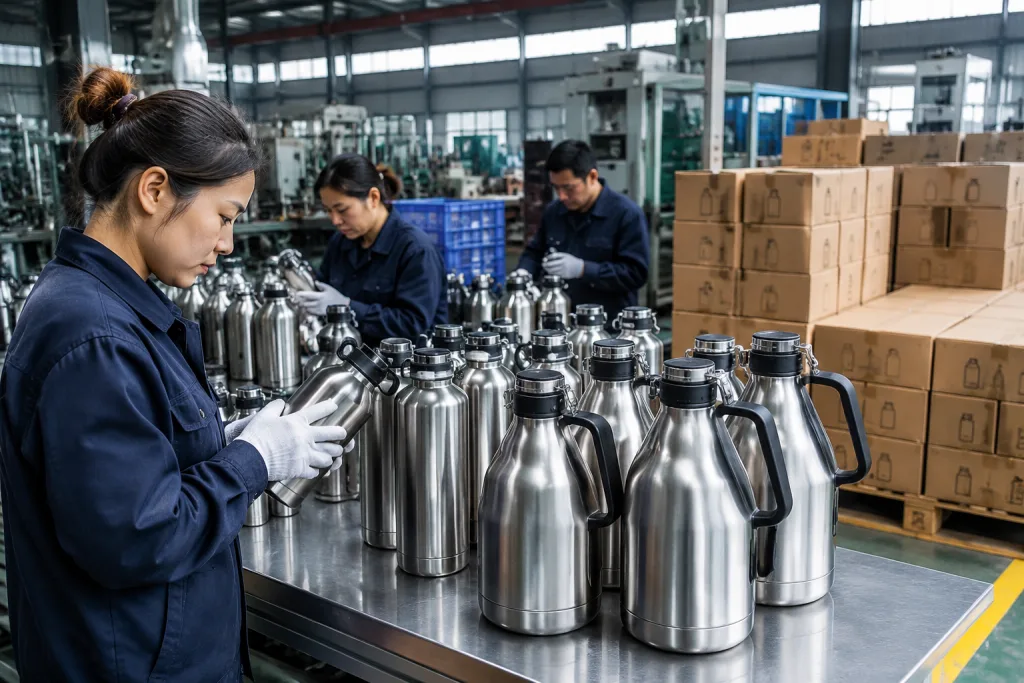
Key Takeaways
- For most promo programs, 18/8 stainless steel canteens at 500-750 ml hit the best balance; MOQ usually starts at 1,000 pcs per color
- Single-wall canteens can land 20-35% cheaper than vacuum models, but they are a poor fit for hot-fill and premium outdoor positioning
- Silkscreen is usually the lowest-cost logo method at USD 0.08-0.18 per color, while laser engraving adds durability at roughly USD 0.20-0.45
- A realistic production plan from Zhejiang, China is 7-12 days for samples and 30-45 days for mass production after approval
You are not buying a souvenir. You are buying a branded bottle that has to survive warehouse stacking, a 1.2 m drop test, retail handling, and actual trail use. This is where outdoor canteen promos fail. The mockup looks sharp, then the lid leaks, the body dents at the shoulder, the logo shifts on the line, or the target price wipes out your margin. More inspiration will not fix that. A tighter buying spec will.
Most procurement teams in Europe and North America need to lock four decisions early: body material, insulation level, branding method, and packaging/compliance scope. Once those are set, MOQ, unit cost, and lead time are easier to control. We run into the same pattern every season in Zhejiang. Buyers who fix these points up front get cleaner samples, fewer than 2 revision rounds in most cases, and a better landed cost. If you skip this step, we've seen it go sideways fast—the wrong question to ask is how to shave $0.20 before the bottle spec is even settled.
Start with the four hard choices
If you are sourcing outdoor canteen promotional products, skip the color chart first. Lock four decisions that drive the quote: material, construction, decoration, and delivery format. Buyers who skip this usually ask 5 quote rounds from 3 or 4 suppliers, then compare prices built on different specs. We see this on the line all the time: same 750 ml body, different wall thickness at 0.4 mm vs 0.5 mm, and the numbers look close until the sample lands.
- Material: 18/8 stainless steel, aluminum, Tritan, or glass with sleeve. For outdoor use, stainless usually wins because it takes abuse better and compliance is simpler to manage. We run more 304 stainless outdoor bottles than anything else, and buyer pushback on denting drops fast once they hold the sample.
- Construction: single-wall or double-wall vacuum. This choice moves cost more than logo size does. On one recent RFQ, the buyer kept negotiating print area while the real gap was single-wall versus vacuum, almost USD 1.10 per unit at 3,000 pcs MOQ.
- Decoration: silkscreen, heat transfer, powder coat with laser, digital print, emboss, or wrap label. Match the method to the artwork, order volume, and how hard the bottle will be used. QC pulled a sample last month where a wrap label edge lifted after rub testing, while the powder coat plus laser version passed clean.
- Delivery format: bulk pack, color box, mailer, or retail-ready set. Packaging often adds USD 0.18-1.20 per unit and changes carton drop results. This is where orders go sideways: a nice box is useless if the master carton fails a 76 cm drop test or pushes freight weight up by 1.8 kg per carton.
The practical way to brief a canteen manufacturer is simple: lock those four items, then ask for final pricing. Give a target size such as 530 ml, 750 ml, or 1,000 ml. State whether the product is for event giveaway, dealer channel, e-commerce, or retail. This is the wrong question to ask late in the process. A distributor canteen order for a hardware chain needs different packaging than a customized growler for brewery merchandise, and we have seen POs held up over one small carton mark typo.
At BottleForge Industrial in Zhejiang, our planning team can produce about 450,000 units per month across stainless drinkware lines, but capacity does not fix indecision. You still need the use case first. A custom canteen for hiking clubs needs lower dent risk and a carabiner-friendly neck radius; we check that with go/no-go gauges at the forming station. A custom drinkware campaign for a bank may care more about logo consistency and freight efficiency than thermal retention. Decide what must be true on day one, and the sourcing work gets cleaner fast.
Match material to the job
Don’t let every factory steer you to the same shell material. For outdoor canteen promotional products, the right pick comes down to target price, use case, and the compliance file you need the supplier to hand over without excuses. We’ve seen POs where the buyer wrote “304 inside” and forgot to define the outer body, then the quote gap started at USD 0.18 per piece. Small detail. Big swing.
18/8 stainless steel
This is the standard for outdoor programs that need fewer headaches. It takes abuse, resists rust, and is usually the cleanest path for REACH-related declarations plus LFGB or FDA contact compliance from a capable China supplier. On the line, we run 0.4-0.5 mm inner and outer walls for vacuum models, and 0.5-0.6 mm for single-wall bodies, checked with a micrometer before forming. Stainless also gives you better finish options: powder coating, laser engraving, and a stronger premium look on shelf. FOB pricing for a basic 500-600 ml single-wall stainless canteen often starts around USD 1.65-2.30 at 3,000 pcs. Vacuum versions typically start around USD 2.80-4.60 depending on lid and coating. Buyers ask for the cheapest vacuum bottle first; this is the wrong question to ask. Ask what dent rate and finish standard you can accept.
Aluminum
Aluminum cuts weight and helps on low-cost promotions, but it dents faster, and the inside liner decides whether the bottle stays usable after the first few fills. If the coating is weak, taste complaints show up fast. QC pulled the sample once on a 750 ml run because the liner smell was obvious after a 60°C water hold test. Aluminum fits projects that need lower freight weight and a retail-style shape, though the inspection plan has to be tighter. We’ve seen this go sideways when the buyer approved the pre-production sample and skipped liner adhesion checks.
Tritan or other BPA-free plastics
Plastic brings the unit cost down and opens up more color choices. It works for big-volume custom canteen programs for schools, races, or summer events, where MOQ pressure is real and the budget is fixed. A 5,000-piece run in mixed translucent colors is normal. Still, outdoor buyers in Europe are moving toward stainless because it feels tougher in hand and sells better as a premium item. The math doesn’t work if you save USD 0.40 on the bottle and lose the order on perceived quality.
For most B2B buyers, stainless is the safer choice unless unit price below USD 2.00 is the main objective.
If you also source a custom growler or customized growler line, stainless gives you more room to keep one quality system across SKUs. That matters for a canteen distributor running mixed programs for 6 or 8 customers at the same time. Fewer material systems mean fewer test plans, fewer complaint patterns, and cleaner replacement planning. On factory paperwork alone, that can mean one incoming material standard instead of three, and less confusion when the buyer flagged a lid-fit issue that actually came from body tolerance.
Pick insulation by use, not hype
The fastest way to waste budget is putting double-wall vacuum on every canteen program. The fastest way to get complaints is calling single-wall “good enough” because it is only a promo item. We see both. Last month a buyer flagged a 500 ml single-wall sample after 20 minutes on an outdoor table because the body started sweating through the kraft box.
Single-wall canteens fit event handouts, short-run outdoor promos, and dealer packs where price gets checked line by line. They are lighter and usually 20-35% cheaper than vacuum models in the same capacity. Carton density is better too, so freight per unit often drops once we run the packing math. The trade-off is plain: single-wall bodies sweat with cold drinks, transfer heat fast, and feel less premium in hand. If your brand message is hiking, camping, or jobsite use, this is the wrong place to save USD 0.30. On the line, we can feel the difference before the gloss sticker even goes on.
Double-wall vacuum canteens cost more, but they fix condensation and hold temperature at a level buyers actually notice. A typical 500 ml stainless vacuum canteen can hold hot temperature reasonably for 8-12 hours and cold for 16-24 hours, depending on lid design, ambient conditions, and fill level. Those are not lab guarantees; they are buying benchmarks we use after QC pulled the sample and checked the seal at the vacuum port. Vacuum construction also gives the bottle more hand feel. That matters in premium canteen customized projects, especially when the wall thickness is 0.4 mm outer and the buyer expects a solid grip.
- Choose single-wall if: target FOB is under USD 2.30, the campaign runs for one event or a 2-week push, and reach matters more than long service life.
- Choose vacuum if: the item supports retail, loyalty redemption, outdoor clubs, premium employee kits, or distributor drinkware programs where repeat use is the whole point.
Ask your canteen vendor for net weight, gross weight, and carton quantity before you approve samples. Ask early. Freight changes the real ranking between two designs more often than buyers expect, and we have seen a 750 ml vacuum body that looked only USD 0.40 higher than single-wall end up costing 18% more landed because carton count dropped from 36 pcs to 24 pcs. We ship by carton math, not sample-table impressions.
If your customer also wants a customizable growler or distributor growler SKU, keep the insulation story consistent. Buyers catch mismatches fast. A premium canteen paired with a thin-wall growler that turns warm after one hour makes the set feel patched together, and we have seen this go sideways after mass production because the PO said “vacum growler” on one line and nobody caught the typo until artwork approval. A coherent product family sells better and cuts complaints across the line.
Decoration is where margins disappear
Most custom drinkware projects look profitable until the artwork file lands on the factory floor. Then the quote changes. A 4-color logo with tight registration, metallic gradient, or full wrap can eat margin fast, especially if the body has a shoulder curve or rough powder coat. We’ve seen buyers send a clean PDF, then our screen room checks it on the jig and finds the safe print area is 12 mm shorter than expected. This is the part to pin down with your canteen manufacturer or canteen vendors, not after sample approval.
Silkscreen is still the low-cost option for a lot of canteen promotional orders. For a simple 1-2 color logo, USD 0.08-0.18 per color per position is normal. It runs well on straight-wall sections; on heavily curved bodies, the line can stretch and the buyer flags fuzzy edges on text under 1.2 mm. We run this method every week, but this is the wrong question to ask if your artwork has gradients or photo detail.
Laser engraving holds up well and looks clean, especially on powder-coated stainless. Expect around USD 0.20-0.45 depending on size and coverage. On outdoor programs, that durability matters because the mark will not chip the way poor print does. QC pulled a sample last month where the engraved logo was 0.8 mm off center on the bottle axis, and the customer still rejected it, so placement control matters as much as the process.
Heat transfer or digital print is the usual answer for complex artwork, fine detail, and gradients. Cost often starts at USD 0.25-0.60, and surface prep matters more than buyers expect. If the base body is low cost, the decoration math doesn’t work sometimes; a USD 1.80 canteen with a USD 0.55 print stops being a cheap promo piece. On the line, we also watch for dust points before transfer because one speck under the film can ruin a 500 pcs lot appearance.
Questions you should ask before approving art
- What is the maximum print height and width on this exact body?
- Will the seam, curve, or powder coat texture affect line sharpness?
- Is there a color tolerance standard for repeat orders?
- Can the logo survive tape test, rub test, and dishwasher simulation if required?
AQL matters here. For mass production, many buyers use AQL 2.5 for major defects and 4.0 for minor defects, but decoration-heavy orders often need a tighter visual standard on the logo zone. Write that into the PO. We’ve even had a PO with the logo position typed as “front canter” instead of “front center,” and that small typo turned into a full email chain during inspection.
If you need canteen customizable products for repeat campaigns, standardize decoration early. Use the same logo method across your customized canteen, customized drinkware, and customized growler range so reorders stay predictable. The factories in Zhejiang that keep repeat orders stable usually lock three things: fixed jigs, approved Pantone chips, and logo placement tolerance such as +/-1.5 mm. A first sample that looks good is not enough. We’ve seen this go sideways when the sample was hand-placed but bulk production ran on a different fixture.
Audit the supplier beyond the sample
A pre-production sample tells you less than most first-time buyers expect. The sample is usually hand-finished, QC pulled the sample, and the team checked it one by one off the line. The real test is repeatability at 1,000, 5,000, or 20,000 units, with the same weld, the same coating, and the same logo position at normal line speed.
To assess canteen suppliers, check process control and paperwork, not the showroom shelf. Ask direct questions. This is the right question to ask.
- What is your standard MOQ by model and color? Many stainless canteen manufacturers start at 1,000 pcs per color or 3,000 pcs mixed sizes, and buyers push back on split colors once they see the coating changeover time.
- What is your normal sample lead time? A real answer is usually 7-12 days for logo samples, not "this week" with no artwork confirmation or Pantone sign-off.
- What is your bulk lead time in peak season? For drinkware in China, 30-45 days after deposit and approval is common, and we've seen 12 days turn into 18 days just waiting on packaging approval with one PO typo.
- Do you have BSCI, ISO 9001, or social compliance audits relevant to your customer base?
- Can you support REACH, LFGB, FDA, California Proposition 65, or ASTM-related testing where needed?
Inspection planning needs to be locked before mass production starts. For stainless custom canteen orders, we run in-process checks on vacuum rate, leak test, coating adhesion, logo position, and drop resistance of the lid assembly; on the floor that usually means vacuum hold checks, a simple air-pressure leak station, and a cross-hatch adhesion cutter. Final random inspection should cover carton marks, barcode scan, quantity count, and accessory count. If you supply Amazon or similar channels, FNSKU labeling and master carton weight limits must be controlled at the packing line, where each carton is weighed in kg before sealing, not patched later in a warehouse. We've seen this go sideways.
A capable canteen supplier should speak plainly about defect patterns. Every category has them. On outdoor canteens, the usual misses are base dents, off-center logos, color mismatch between lid and body, dust under coating, and thread fit inconsistency. Good canteen manufacturers in Zhejiang, China do not act like these defects never show up. They show the control point, the inspection record, and the acceptance standard the buyer flagged during approval.
Price the full landed program
You are not buying FOB only. You are buying the full program: sampling, packaging, testing, freight, duty, and the replacements when QC pulled the sample and the logo sat 2 mm off-center. This is where first-time buyers get outdoor canteen promotional products wrong.
Build the cost stack first. Suppose you need a 620 ml vacuum stainless customized canteen with powder coat and a one-color logo. Your FOB might be USD 3.40 at 3,000 pcs. Add a color box at USD 0.32, export carton upgrades at USD 0.06, third-party testing amortized at USD 0.04, and inspection at USD 0.03-0.06. Sea freight and duty vary, but they can easily add another USD 0.55-1.20 depending on destination and season. Your delivered cost is now around USD 4.40-5.00 before margin. Short math. No mystery.
Now put that next to a single-wall version at USD 2.10 FOB with lower freight because the shipment runs lighter per carton. The invoice gap looks like USD 1.30. Landed, the gap can hit USD 1.50 or more, and we have seen it go wider in peak season when booking moved from 12 days to 18 days. That premium only works if your sell-through or brand value pays for it. If not, the math does not work.
Useful cost controls
- Use one body color across customer programs and change only the logo decoration where possible. We run this setup often because one powder batch is easier to control on the line.
- Standardize lids. Lid tooling changes sound small, but the buyer flagged this before after a PO typo forced a cap swap and delayed approval.
- Choose common capacities such as 500 ml, 650 ml, or 750 ml to avoid custom carton inefficiency. A non-standard height can leave 8-12 mm dead space in the shipper.
- Reserve premium packaging for retail or gift channels; bulk programs rarely need it. A plain master carton usually ships better than a fancy insert that gets crushed anyway.
If you are a canteen distributor or work with canteen distributors across regions, keep a core platform strategy. One body, two lid options, then decoration choices based on channel needs. This is the right question to ask. It gives you a manageable custom drinkware line without loading the warehouse with slow SKUs at 500 pcs here and 800 pcs there. The same logic works if you also sell a custom growler range through a distributor growler channel. You protect margin by limiting complexity, not by pushing the factory for prices that fall apart after inspection and freight.
Build a spec that survives reorder
The last buying decision is not the PO. It is the spec pack that stays on file for the reorder. If shipment one passes and shipment two comes back with a color shift, 18 g less body weight, or a different insert layout, the record was too thin. We have seen this go sideways after one buyer changed jobs and the new team worked from an old PDF on the line.
Your spec should list body dimensions in mm, capacity tolerance, net weight tolerance, steel grade, wall thickness, lid material, gasket material, coating type, Pantone reference, logo location, logo size, packaging layout, carton drop requirement, barcode standard, and inspection plan. For drinkware, net weight tolerance is not a minor line item. QC pulled the sample once on a 500 ml body and found a 20-30 g drop; that usually points to thinner steel and weaker dent resistance, not factory magic. This is the wrong question to skip.
For outdoor canteen promotional products, add use warnings where needed: hand-wash only, not for microwave, not for carbonated storage unless tested, not for hot liquids in single-wall models, and age grading if the product sits near kids categories. If you run a distributor canteen program in Europe or North America, ask for artwork approval sheets and keep a golden sample on both sides. We also like the PO to show the exact warning copy—once the buyer flagged a typo in “micorwave” after 3,000 color boxes were printed.
Good reorder control matters most on seasonal canteen custom and canteen customized projects. Teams change fast. The line gets rescheduled. Steel cost moves by the week. A solid spec keeps the product stable even if the forming mold is moved, the spray booth operator changes, or procurement swaps a gasket source at a 5,000 pcs MOQ. The math does not work if every reorder starts from memory.
The practical goal is simple: choose a customizable canteen that fits the channel, then lock a spec that a competent China factory can reproduce without guesswork. If your supplier can meet MOQ, hold 30-45 day lead times, and follow the agreed AQL and compliance file, you are not buying a one-off promotion. You are building a repeatable custom drinkware program. That is how we ship reorder three looking like reorder one.
Get a workable canteen quote, not a guess
Send your target capacity, logo method, packaging level, and destination market. We will quote the right canteen options with MOQ, compliance path, and lead time.
Frequently asked questions
What MOQ should I expect for custom outdoor canteens?
For stainless outdoor canteens, a normal MOQ is 1,000 pcs per color per model, though some canteen manufacturers in China will quote 500 pcs for leftover colors or trial orders with limited decoration. If you want a fully custom mold, MOQ usually jumps to 3,000-10,000 pcs depending on the lid and body complexity. Printed color boxes can add their own MOQ, often 1,000 pcs. If you are a distributor drinkware buyer, the best route is usually to select an existing body and customize logo, coating, and packaging. That keeps tooling cost at zero and lets you test the market before expanding to a custom growler or companion SKU.
How do I choose between single-wall and vacuum canteens for promotions?
Choose single-wall when budget is tight, target FOB is below roughly USD 2.30, and the item is meant for short-term brand exposure like events, dealer incentives, or bulk giveaways. Choose vacuum when the product supports outdoor use, retail resale, employee gifting, or a premium loyalty campaign. Vacuum models usually cost 20-35% more ex-factory, but they reduce condensation and give 8-12 hours of practical heat retention and 16-24 hours for cold. For a customized canteen that should represent an outdoor brand well, vacuum is usually the safer commercial choice. Freight and carton count should be checked before final approval because heavier bottles affect landed cost.
What tests and compliance documents should I ask a canteen supplier for?
At minimum, ask for material declarations and food-contact test reports that match your market. For Europe, REACH and often LFGB are common checkpoints. For North America, FDA-related food-contact compliance is standard, and some buyers also require California Proposition 65 screening. If kids are involved, ASTM-related requirements may apply depending on the product design and channel. On the factory side, ask whether they have ISO 9001 and social audit records such as BSCI if your customer requires them. For mass production, set an inspection plan using AQL 2.5 major and 4.0 minor unless your brand needs tighter visual standards on logos or retail packaging.
Which logo method is best for outdoor canteen promotional products?
There is no universal best method; it depends on artwork and abuse level. Silkscreen is usually cheapest at about USD 0.08-0.18 per color and works well for simple logos. Laser engraving on powder-coated stainless costs more, often USD 0.20-0.45, but it is very durable and looks premium. Heat transfer or digital print is best for gradients, photos, and complex brand graphics, usually around USD 0.25-0.60. If your bottles will be used outdoors, handled roughly, or sold through a canteen distributor network, laser on powder coat gives fewer complaints over time. For low-cost event programs, silkscreen is still the practical choice if the print area is suitable.
How long does production take from sample approval to shipment?
For standard models from Zhejiang, China, plan 7-12 days for a pre-production sample with logo, then 30-45 days for bulk production after deposit and sample approval. During peak drinkware season, especially before summer promotions and Q4 gifting, lead times can stretch to 50-60 days if the order includes custom packaging or uncommon colors. Third-party lab testing can add 5-10 business days if reports are not already available for the same material system. If you need Amazon prep such as FNSKU labels, suffocation warnings, or retail inserts, confirm those details before mass production starts. Late packaging changes are one of the most common causes of missed vessel bookings.