Key Takeaways
- Most outdoor canteen programs land between 1,000 and 3,000 units per SKU, with FOB China pricing commonly at USD 2.80-7.90 depending on size, steel grade, and decoration
- 18/8 stainless steel with 0.4-0.5 mm body thickness is the standard safe choice for Europe and North America; thinner walls usually save only 3-6% but raise dent risk
- For vacuum models, realistic production lead time is 30-45 days after sample approval; rush jobs under 25 days usually reduce decoration options or increase defect risk
- AQL 2.5 for major defects, leak testing at 100%, and REACH/LFGB/FDA documentation matter more than the lowest quoted unit price
You can buy a canteen from almost any trading company in China. Easy part. The hard part is buying the right custom canteen for your market without inheriting dent claims, lid leaks at 0.03 MPa vacuum test, weak print adhesion, or a price that looked fine on the sample PO and fell apart at 5,000 pcs. If you source for retail, promo, or distributor canteen programs in Europe or North America, the job is simple to describe and hard to execute: match the use case to the spec, then place it with a factory that can hold neck, thread, and base tolerances on the line at volume.
At BottleForge Industrial in Hangzhou, Zhejiang, we hear the same request dressed up in different wording: canteen custom, canteen customizable, customized drinkware, or a customizable growler for outdoor channels. The labels change. The buying checkpoints do not. You need clear comparisons on steel grade, wall construction, coatings, decoration, compliance, MOQ, and lead time before you approve tooling or release artwork, and this is where buyers lose time. One buyer flagged a 1 mm logo shift on a powder-coated sample last season; another cared only about whether the lid passed 24-hour inversion. Same product category, different risk. Ask the factory how they run QC, what the real MOQ is by color, and whether the quoted lead time is 12 days or 18 days once cartons are confirmed—the math doesn't work if the sample price is the only number that looks good.
Start with end use, not catalog photos
Most buyers start by asking for a 500 ml, 750 ml, or 1,000 ml bottle and a quote. That gets a price fast, but not the right spec. Start with end use and sales channel. A retail outdoor chain, a canteen distributor, and a promotional buyer will not buy the same bottle, even if the catalog photos look almost identical. We see this on the line all the time: same silhouette, different cap torque, different coating standard, different carton test.
If the product is for hiking, camping, or worksite retail, durability usually wins. We run 18/8 stainless steel, powder coat at 60 to 80 microns, a threaded leakproof cap, and 0.5 mm body thickness on larger bottles because store returns get expensive fast. Buyers ask for soft-touch paint and thin walls to save cost; this is the wrong question to ask if the bottle will be dropped on gravel. If the project is for event giveaway or corporate gifting, a single-wall customizable canteen often makes better sense. It weighs less, loads more units per carton, and saves 20-35% against double-wall vacuum construction.
For alcohol, coffee, or cold brew programs, some orders should be a custom growler, not a standard canteen with a sports cap swapped on. A growler format usually starts at 32 oz or 64 oz, with a wider mouth and often a heavier handle or swing-top option. That changes tooling cost, carton drop results, and unit math. Last season, QC pulled the sample on a 64 oz body because the handle weld shifted 1.5 mm after the drop test. We've seen this go sideways when the buyer tried to force a canteen platform into a beverage refill program.
- Retail outdoor: vacuum insulated, premium coating, stricter cosmetic tolerance; buyers often check color delta and dent marks at final inspection
- Promotional: single-wall, fewer color SKUs, stronger focus on logo yield and packing cost; MOQ pressure usually starts at 1,000 pcs per color
- Distributor drinkware: broad size matrix, stable replenishment, lower MOQ by mixed colors; the PO often needs clear carton marking by size code
- Foodservice or beverage programs: growler-specific closure and pressure expectations; closure fit and leak test matter more than catalog styling
In Zhejiang, the factories that handle these categories well are not always the same shops. One supplier may ship promo bottles fast but miss on powder coat consistency or laser alignment; another may be strong on premium outdoor drinkware but hold hard on MOQ at 3,000 pcs per color. The right outdoor canteen OEM manufacturer is the one built for your channel. Not the one with the longest PDF catalog.
Head-to-head spec table that matters
Compare canteen factories with one spec table, and make each supplier fill every line item. No blanks. No soft wording. That cuts out half the sales pitch on day one. We use this format on the line because a missing number—like 0.45 mm body thickness or a lid PP grade—usually turns into a problem after the PO is signed.
Core comparison points
- Material: 18/8 stainless steel, 18/0 stainless steel, aluminum, Tritan, or glass-lined
- Construction: single-wall, double-wall non-vacuum, double-wall vacuum
- Body thickness: 0.4 mm, 0.45 mm, 0.5 mm, and lid gauge where relevant
- Capacity tolerance: usually plus or minus 3%
- Weight tolerance: usually plus or minus 5 g to 10 g depending on size
- Decoration: silk screen, heat transfer, 3D UV print, laser engraving, digital wrap
- Testing: leak test, vacuum retention, coating adhesion, salt spray, dishwasher cycles
- Compliance: REACH, LFGB, FDA, Prop 65, ASTM where applicable
- MOQ: by model, color, and logo process
- Lead time: sample days, production days, re-order days
A quote without wall thickness, coating spec, and test plan is not a real quote. It is just a starting number.
For a working benchmark, a 750 ml single-wall stainless canteen custom order might sit at USD 2.80-3.60 FOB China at 1,000-3,000 units. A 750 ml vacuum insulated customized canteen with powder coat and one-color print often lands around USD 4.90-6.40 FOB China. A 64 oz customized growler with a specialty lid can move into USD 7.20-9.80 depending on handle tooling and packing. This is where serious factory talks start. If a price comes in far below this, ask what got cut: steel grade, wall thickness, powder weight, or carton drop standard. We have seen QC pull the sample and find a 20 μm coating where the approval sample was closer to 35 μm.
BottleForge Industrial in Zhejiang runs around 600,000 units per month across stainless and mixed-material lines, with standard MOQ from 1,000 units per model and 300 units per color for selected stock bodies. Those numbers matter. A factory that fits your launch order may miss your refill window later. We ship buyers from trial orders into repeat POs every month, and the usual pushback is lead time, not price: 12 days vs 18 days on repeat stock bodies changes the math fast. This is the wrong question to ask if you only focus on opening MOQ; ask what the line can actually repeat without color drift, lid mismatch, or a logo position shift of 2 mm.
Material choices and where they win
Material choice is where first-time B2B buyers either overpay by 6-10% or cut the wrong corner. For an outdoor canteen OEM manufacturer shipping into Europe and North America, 18/8 stainless steel is still the safest default. It gives solid corrosion resistance, buyer acceptance at retail, and cleaner support for food-contact paperwork. On the line, we run 0.4 mm sheet for small bodies under 550 ml; for 750 ml to 1,200 ml canteens, 0.5 mm is the better call if dent resistance matters. QC pulled a 750 ml sample last year after the drop test left a flat spot near the lower radius. Too thin.
18/0 stainless can trim raw material cost by 3-5%, but this is the wrong question to ask on a premium custom drinkware line. You save a little on the quote, then lose it in rust photos, weak shelf feel, and buyer pushback after the first wet-season shipment. Aluminum still has a place in lightweight cycling canteens or heritage-style promotional programs. Watch the liner. Taste complaints usually start there, and our incoming inspection checks coating coverage around the rolled mouth because that is where misses show up first.
For a customizable growler, stainless is still the practical option. Glass looks clean on shelf, but mixed logistics are rough on it. We have seen this go sideways when 24 pcs master cartons were stacked under cookware cartons and the distributor found broken necks during inbound checking. If you ship pallets to canteen distributors or distributor growler accounts, stainless gives you fewer claims and stronger carton performance. The math works.
- 18/8 stainless: best all-around choice for custom canteen and customized growler programs where corrosion resistance, shelf feel, and food-contact support all matter
- Aluminum: light and lower cost, but dent-prone; liner quality, mouth coverage, and taste testing need tighter control
- Tritan: works for sports formats with clear bodies and color lids, less convincing for premium outdoor positioning
- Glass: niche and attractive, but freight cost and damage claims need to be priced in from the start
One more point buyers in China often miss until the PO is already signed: lid material matters almost as much as body material. PP lids with food-grade silicone are standard and cost-efficient. Tritan lids look cleaner in a showroom, but they scratch faster in bulk packing. Stainless caps add perceived value, plus weight and one more assembly station. Ask your canteen factory for the exact resin grade, gasket hardness, and spare-part availability for re-orders after 12 months; we once had a buyer flag a PO typo where the lid was written as PP but the approved sample used Tritan.
Insulation, lids, and real outdoor performance
Outdoor buyers should ask how the bottle will be used, not just chase a lab sticker. We hear "24 hours cold, 12 hours hot" in RFQs every week, and the buyer flagged it last month because two suppliers tested in different rooms. The right question is the test condition. A serious canteen manufacturer should state fill temperature, ambient temperature, and measurement point. For vacuum bottles, we run a common internal check at 95 degrees C fill, 20 degrees C ambient, and target above 42 degrees C after 12 hours, measured with a probe through the center neck. Cold retention often starts with ice water near 4 degrees C. Check the setup.
Single-wall products make sense for trail use when weight and packability beat thermal retention. Our 750 ml single-wall body can come off the line around 180 g before cap, which matters when the buyer is selling to hiking clubs. Vacuum bottles fit commuting, camping, and gifting better. Double-wall non-vacuum is the awkward middle ground unless the shape requires it, and we have seen this go sideways when a buyer expected vacuum performance from a cheaper shell.
Lid selection changes return rates
- Simple screw cap: lowest leak risk, best for outdoor and wholesale orders where cartons get stacked 5 layers high
- Flip straw lid: easier drinking, but the silicone valve, straw tube, and hinge pin create more warranty questions
- Chug cap: good sports positioning, with seal checks needed around the thread and gasket seat
- Swing-top or specialty growler lid: right for custom growler use, weak fit for channels that need simple spare parts
If you are sourcing for canteen distributors, keep lid counts low. Every extra lid variant creates inventory drag and after-sales confusion; one PO we saw even mixed "straw lid black" and "sports lid black" on the same SKU. For a launch, two lid options are usually enough. For a mature distributor drinkware program, maybe three. After that, the math does not work.
Ask every canteen vendor whether lids are shared across multiple bottle diameters. Shared platform lids cut tooling cost and reduce future MOQ pressure. A canteen supplier that can use one cap family on 500 ml, 750 ml, and 1,000 ml bodies gives you easier replenishment, especially when the spare gasket MOQ is 3,000 pcs per size. We often steer buyers in Zhejiang and other markets toward this approach because it lowers risk more than a small unit-price discount ever will.
Decoration methods versus channel economics
A custom canteen can pass leak testing and still fail in the market if the logo scratches off in week two. New OEM buyers often leave decoration until the PP sample stage. Wrong question. We run logo tests before PP sample approval because print process, placement tolerance, and coating match decide whether the artwork survives packing, shelf display, and field use.
For canteen promotional projects, one-color silk screen is still the lowest-cost reliable choice. On powder-coated stainless, it gives solid opacity at low cost, usually with MOQ around 1,000 units per artwork. Laser engraving costs more but handles trail use better, especially when the buyer flagged “no peeling logo” on the PO. Heat transfer or digital wrap fits multi-color retail graphics, but unit price climbs and scrap can jump 3-5% if the coating thickness shifts by 8-10 microns on the line.
Typical add-on ranges for standard outdoor drinkware are clear: one-color silk screen might add USD 0.10-0.18 per unit, laser engraving USD 0.18-0.35, and full-wrap transfer USD 0.35-0.80 depending on size and coverage. Names change the job. If your canteen customizable request includes individual names, expect separate file checking, barcode matching, and slower handling, often 12 days vs 18 days for the same order size.
For Europe and North America, logo adhesion should not pass on visual approval alone. Ask for cross-hatch adhesion testing, alcohol rub testing, and dishwasher-cycle guidance in writing. QC pulled one sample last season where the print looked clean, then failed after 30 alcohol rubs with a white cotton cloth. If the canteen vendor says the item is dishwasher safe, define what that means: 20 cycles, 50 cycles, or simply that it survives household use with no warranty coverage.
Retail buyers usually do better with fewer SKUs that are executed cleanly. Distributors need broader color choice, but the math still has to fit the carton. We ship 24 pcs per master carton on many outdoor canteen programs, so a matte black, navy, white, and olive set often moves better than 12 low-volume colors that leave dead stock across canteen suppliers and distributor canteen accounts.
Factory controls that separate quotes from supply
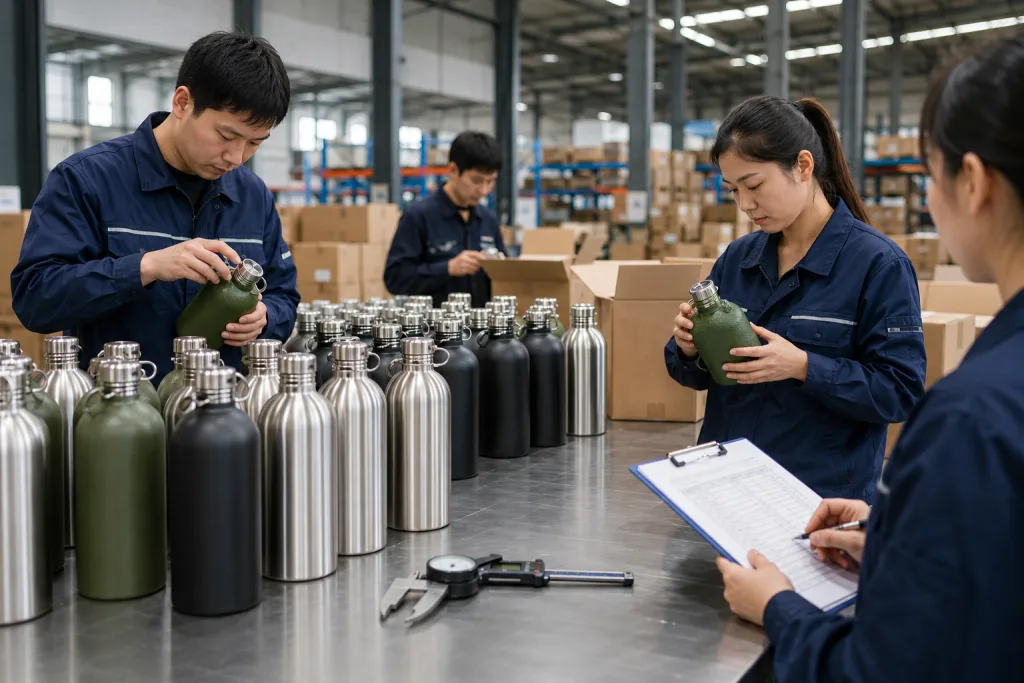
If you buy from China, a polished sample is the easy part. Mass production is where weak factories show. The gap between a canteen manufacturer and a dependable canteen supplier is shop-floor control: who signs off the 304 stainless coil, who checks the neck with a go/no-go thread gauge, and who stops the line when vacuum loss hits 3 pieces in one hour. Ask what happens from incoming steel to final carton. The unit price alone is the wrong question.
- Incoming material: steel grade verification with mill certificate matching, thickness checks by micrometer, food-contact declarations tied to the PO number
- In-process QC: neck thread gauge records, weld inspection under light, vacuum check after insulation, powder coat thickness in microns
- Final QC: 100% leak test, random drop test by carton, logo position audit against approved artwork, carton barcode verification by scanner
- Shipment release: AQL 2.5 major, 4.0 minor is common for B2B drinkware, with pulled cartons marked before loading
Good canteen manufacturers in Zhejiang should be able to discuss BSCI or Sedex social compliance without sending a recycled PDF from another workshop. ISO 9001 quality systems matter only if the records match the production line. For Europe, REACH and LFGB questions come up on about 7 out of 10 outdoor bottle projects we quote. For the US, FDA contact material compliance and Prop 65 awareness are baseline. Kids formats need ASTM-related discussion when the cap, straw, paint, or carry strap can be touched or chewed.
Lead time discipline is a hard filter. A real canteen factory should tell you sample lead time of 7-10 days for stock-body logo samples, 15-20 days for new molds or lid adjustments, and production lead time of 30-45 days after deposit and artwork approval. Re-orders on unchanged items can shorten to 25-35 days if powder stock, cartons, and silicone rings are already booked. If you hear 18 days for everything, the math does not work; we have seen that go sideways when the supplier borrows capacity and QC pulled the sample only after cartons were sealed.
At BottleForge Industrial, we ask buyers to approve one golden sample with signed dimensions, one packaging standard showing carton size and insert direction, and one barcode file version checked by scanner before mass production. Basic, yes. It prevents the disputes we see most often: Amazon FBA labels printed 2 mm off, retail window boxes using last season's SKU, and mixed-SKU distributor growler orders packed in the wrong master carton.
How to choose the right OEM path
There is no single best outdoor canteen OEM manufacturer. The right OEM path depends on your order size, sales channel, and how much risk you want to carry. If you are testing a new market, start with a stock-body program, limited decoration, and MOQ near 1,000 units; on our line, that usually means a 500-750 ml body from an existing mold and a 7-day sample cycle. If you are an established canteen distributor, or one of several canteen distributors building a private-label line, lock in shared-lid platforms, stable carton specs like 24 pcs per master carton, and documented compliance files before you ask for cosmetic extras. This is the wrong question to ask first if you start with cap color and logo size.
Use this simple head-to-head fit check:
- Best value launch: 500-750 ml single-wall stainless, one-color print, standard carton, MOQ that stays manageable for a first 1,000-unit run
- Best retail margin: 600-900 ml vacuum bottle, powder coat, laser mark, color retail box; we ship more of this setup for outdoor chains because shelf price usually holds better
- Best promo logistics: lightweight single-wall, 24-36 units per master carton, limited color range, less risk of carton weight getting pushed back above 15 kg
- Best outdoor premium: 0.5 mm body, robust cap, high coating consistency, lower cosmetic tolerance; QC pulled the sample twice last season for coating dust near the shoulder
- Best beverage extension: customized growler with wide mouth and replacement lid plan, because we have seen this go sideways once the first cap style gets discontinued
When comparing canteen vendors, ask one blunt question: what part of this project are you best at, and what part is likely to cause delay or claims? The honest answer tells you more than the quotation sheet. In China, especially in manufacturing clusters like Zhejiang, specialization is real. One supplier may be your best custom drinkware partner for insulated bottles, with a vacuum yield the buyer will accept, while another runs glass or infuser lines better. We had one PO last year with the lid code typed as "A12" instead of "A21," and that small mistake cost 12 days versus 18 days only because the supplier knew their own weak point early.
If you keep the spec table tight, match the bottle to the actual use case, and insist on documented QC and compliance, you usually avoid the classic OEM problems. The line gets cleaner. Claims drop. At final inspection, we want clear checkpoints like thread fit, coating adhesion, and leak test at AQL 2.5, not a vague comment that the finish looks nice. That is how a canteen customized project becomes a repeat program instead of a one-off purchase order.
Send your canteen spec sheet for a real quote
Share capacity, material, lid style, logo method, target price, and destination market. We will review fit, MOQ, compliance, and lead time clearly.
Frequently asked questions
What MOQ should I expect from an outdoor canteen OEM manufacturer?
For stainless outdoor canteens, a realistic MOQ is 1,000 units per model, often with 250-300 units per color if the body is a stock mold. If you need a new lid, custom handle, or unique base geometry, MOQ can rise to 3,000-5,000 units because tooling and setup costs must be absorbed. For a custom growler, expect higher MOQ if the closure is non-standard. You should also ask whether MOQ applies by body, by lid, or by finished SKU. That detail matters. Some canteen suppliers in China quote 1,000 units, then require one color only, which limits sell-through. If you are testing demand, ask for mixed-color production on a shared component platform.
How much does a customized canteen usually cost FOB China?
A practical FOB China range is USD 2.80-3.60 for a 750 ml single-wall stainless bottle with basic one-color print, and about USD 4.90-6.40 for a 750 ml vacuum insulated version with powder coating. Premium lids, retail gift boxes, or multi-color transfer graphics can push the unit price above USD 7.00. A customized growler in 64 oz format often lands around USD 7.20-9.80 depending on steel thickness and lid design. Ask your canteen manufacturer to break out bottle cost, lid cost, logo cost, packaging cost, and testing cost separately. That makes it easier to compare canteen vendors and negotiate changes without losing visibility.
Which tests and certificates should I request for Europe and North America?
For Europe, ask for REACH-related material declarations and LFGB test support where relevant for food-contact components. For North America, FDA food-contact compliance is standard, and Prop 65 awareness is important if coatings or accessories raise concern. On the factory side, ISO 9001 is useful, and BSCI or Sedex can matter for retail compliance. Product-level quality checks should include 100% leak testing, vacuum retention for insulated models, coating adhesion, and drop-test review on final packaging. For order inspection, AQL 2.5 major and 4.0 minor is a common baseline. If you are selling to major retailers, confirm barcode scan quality, carton labeling, and palletization rules before production starts.
How long does production take for custom drinkware orders?
For a stock-body custom canteen with standard decoration, expect 7-10 days for a pre-production sample and 30-45 days for mass production after sample approval and deposit. If you need a new mold, special lid, or customized growler closure, development can add 15-30 days before production even starts. Re-orders are often faster, typically 25-35 days, if materials and packaging stay the same. Be careful with promises under 25 days on vacuum insulated bottles. In China, fast lead times can be real, but they often depend on borrowed capacity, limited color options, or compressed QC. For reliable launches, build at least one extra week into your timeline.
Should I buy from a factory directly or through a trading company?
Direct factory buying usually gives you better technical visibility, cleaner revision control, and lower landed cost once your volume is above 1,000-3,000 units per SKU. It also helps when you need packaging changes, spare lids, or a canteen customized program that will be reordered for 12 months or more. A trading company can still be useful if you want mixed categories in one container or very low trial quantities. The key is transparency. Ask who owns production, who handles QC, and who will issue corrective actions if defect rates exceed AQL. For outdoor canteens, the more technical the project, the more value you usually get from speaking directly with the canteen factory.