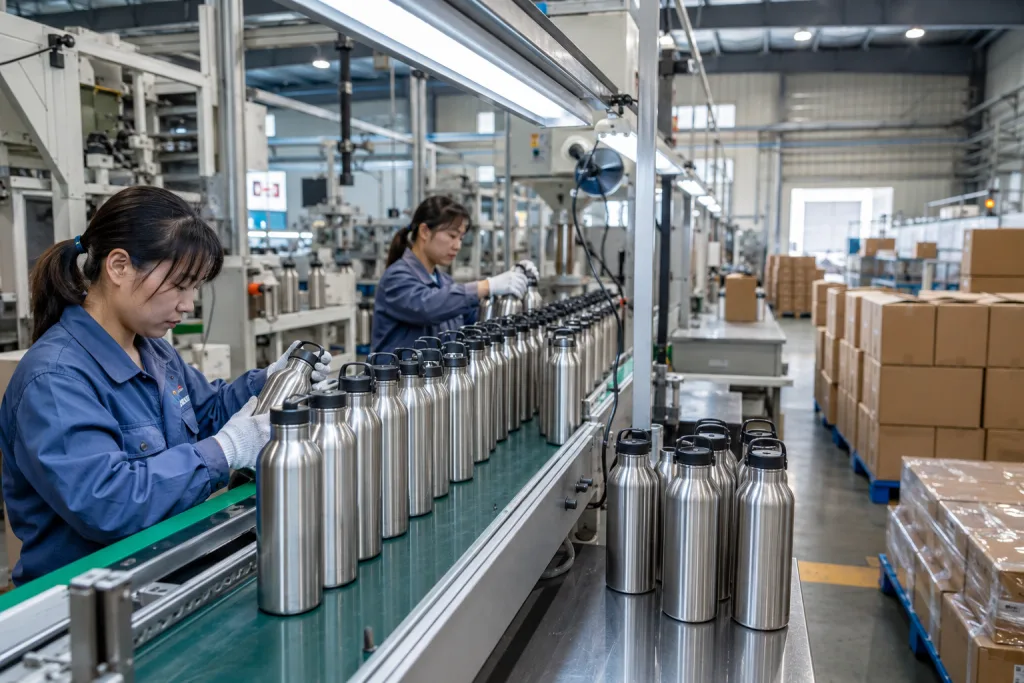
Key Takeaways
- 304 stainless with 0.5 mm inner and 0.45 mm outer walls is a common sweet spot for durable outdoor canteens
- Typical MOQ is 3,000 pcs per color for existing canteen molds, with 35-45 day lead time after sample approval
- Vacuum retention claims should be tied to test conditions, such as 12 hours hot at 95°C fill and 24°C ambient
- Use AQL 2.5 for major defects and confirm REACH, LFGB or FDA, carton drop, and leak test standards before PO
You can lose margin on an outdoor canteen order before the first sample leaves the line. Price is usually not the problem. The miss starts when a spec sheet gets read like sales copy instead of a production document. If you source custom drinkware for retail, events, or distribution, each line changes cost and yield: steel grade, wall thickness in 0.4 mm or 0.5 mm, lid thread fit, coating, logo method, carton drop standard, and AQL. We’ve seen this go sideways over a single PO typo on logo size.
At BottleForge Industrial in Hangzhou, Zhejiang, China, we see this every week. A buyer sends the same RFQ to 3 factories, gets 3 USD prices back, then learns one quote used 18/0 steel, another ran thinner walls, and the third left out mold charges. QC pulled the sample once and found a thread mismatch after only 2 lid turns; that order was already behind. If you want a reliable outdoor canteen factory in China, read the specification in the same sequence our export engineer and production planner use. This is the right question to ask first, not who is cheapest.
Start with body material
The first line on a canteen spec sheet should state the body material, not the color. On our line in Hangzhou, the practical baseline is food-contact stainless steel, and for export orders the inner wall is usually 18/8 or SUS304. If a quote says only stainless steel with no grade, stop there. QC pulled the sample on one PO last month and the lid contact ring was left unmarked. Ask straight: is the inner 304, is the outer 304 or 201, and do the lid contact surfaces match the same standard.
For Europe and North America, 304 inner steel is the safe default for custom canteen and customized drinkware programs. We have seen cheaper grades go sideways after 6 to 9 months of field use. Acidic drinks, salt spray, drop impact, rough washing, and hot-cold cycling expose weak material fast, especially in camping and hiking channels. This is the wrong question to ask if the buyer only asks for the cheapest shell. The buyer flagged rust spots on a 0.4 mm outer wall batch once, and office-use logic did not help in outdoor retail.
- 304 inner / 201 outer: lower cost, common on promotional orders at 3,000 pcs MOQ, and usually acceptable if the product is price-led.
- 304 inner / 304 outer: better corrosion resistance and a cleaner premium story, especially when the shell gets scratched on the trail.
- Tritan, PP, silicone parts: confirm BPA free and food-contact declarations, and check which parts actually touch liquid at the lid assembly.
Price impact is real. On a 32 oz vacuum model, moving from 201 outer to 304 outer may add around USD 0.18-0.35 per unit at 3,000 pcs, depending on steel prices in Zhejiang, China. The math does not work if your team spends weeks arguing over USD 0.18 but plans a USD 3-5 retail jump. For canteen promotional projects with tight budgets, 304/201 is still a valid choice. We ship both. Choose it on purpose, and write it clearly on the PO, because one typo in the body grade can cost 12 days instead of 3 once production starts.
Wall thickness, weight, and real durability
Buyers usually start with capacity: 18 oz, 24 oz, 32 oz, 40 oz. On our side, the first check is the metal build. It decides whether the shell forms cleanly on the hydraulic press, how it survives a carton drop, and what the freight bill looks like. On the spec, ask for inner and outer wall thickness in millimeters. For a stainless outdoor canteen factory, common numbers are 0.4 mm to 0.5 mm inner and 0.4 mm to 0.45 mm outer. QC pulled one 32 oz sample last month with 0.36 mm outer wall after polishing, and the buyer flagged dents before the pre-shipment inspection even started.
If you are sourcing a custom growler or customizable canteen for outdoor use, thin walls can save USD 0.12-0.25 per unit, but the math can turn bad after transit claims. We have seen 0.35 mm outer shells arrive with corner dents after 6 cartons were stacked under 18 kg master cartons. A 0.5/0.45 mm build usually feels solid in hand without becoming too heavy. Once you move to 64 oz formats or customized growler shapes, some factories may increase certain areas to 0.6 mm because larger cylinders deform more easily during vacuuming. Good call.
What your spec should include
- Body gauge or wall thickness by inner and outer shell, measured after polishing if the finish removes material
- Finished unit weight tolerance, usually plus or minus 3%, with the target gram weight shown on the PO
- Base construction, including anti-slip pad or bare steel, plus pad thickness if silicone is used
- Handle weld or rivet construction if the canteen has a side handle, with pull-test requirement in kg
Weight matters commercially. A lighter bottle reduces sea freight and courier sample costs. A heavier bottle feels more premium on shelf. You need the balance that fits your channel. A canteen vendor selling event giveaways may accept lower gauge. A canteen manufacturer serving outdoor specialty retail should not. This is where we push back, because a 12 g saving per unit can disappear after one AQL 2.5 inspection finds dents on the side wall. At BottleForge Industrial, our monthly output is around 450,000 units across tumblers, bottles, and canteens, and the pattern is steady: the products with the fewest claims are not the cheapest spec, just the clearest one.
A spec sheet without wall thickness is not a real spec sheet. It is just a sales sheet.
Insulation performance and mouth design
Vacuum insulation claims are one of the easiest places for quotes to get sloppy. We still see lines like keeps hot all day or 24-hour cold, and that is the wrong basis for a PO. A factory should state fill temperature, ambient condition, and test points. Example: hot retention tested with 95 degrees Celsius water, room temperature 24 plus or minus 2 degrees Celsius, measured after 6 and 12 hours. On our line, QC pulled the sample from the same batch and logged the surface temperature before the hold test. Cold testing should also state whether ice is included, because the result changes fast.
Mouth design changes thermal performance, cleaning, and field use. Small detail, big difference. A narrow-mouth canteen usually holds heat better and spills less on a trail; a wide-mouth custom canteen is easier to wash, easier to load with ice cubes over 25 mm, and works better for soup or powder mixes. We have had buyers push for a wide mouth because it looked stronger on shelf, then flag poor heat hold in user reviews. Match the mouth to the job, not the trend. If you sell through canteen distributors or distributor canteen channels, this choice needs to be tied to the end user.
- Narrow mouth 35-45 mm: better thermal efficiency, less splash on the move, classic outdoor profile.
- Wide mouth 50-65 mm: easier filling and brush cleaning, better for ice and multi-use drinks.
- Growler mouth: larger opening, usually paired with a carry handle and a heavier lid set.
For a customizable growler or custom growler project, ask if the neck thread is factory standard or customer-specific. That question matters. A custom thread often means mold revision, gauge confirmation, and 15-20 days added to the schedule; we have seen one PO held up over a 0.3 mm thread mismatch. Ask about leak testing too. A workable standard is 100% vacuum inspection plus leak test before packing, with random drop and torque checks during in-line QC. If the bottle is sold for carbonated beverages, it needs separate pressure and cap validation. Do not treat a standard vacuum canteen as safe for that use, because we have seen this go sideways.
Lids, seals, and accessory compatibility
The lid drives more claims than the bottle body. We see this on the line. Buyers often sign off the appearance sample, then rush past thread feel, gasket compression, and hinge fatigue, and that is where returns start after 2,000 to 5,000 units ship. A canteen factory should spell out lid material, seal material, closure type, and which bottle sizes share the same fit. PP lids are the standard run. Tritan caps make sense when the buyer wants to see the straw path or water level. Silicone gaskets should be food-grade, removable by hand, and checked for groove fit; QC pulled the sample last month and found a 0.6 mm flash edge that made cleaning harder.
If you are building a canteen custom range, shared accessories save money fast. We run this math all the time. One lid platform across 18 oz, 24 oz, and 32 oz bodies cuts SKU count, reduces spare-part trouble, and lowers future MOQ pressure from 3,000 pcs per color to one pooled buy. For canteen suppliers and canteen vendors selling to distributors, this matters more than saving USD 0.08 on one lid. This is the wrong question to ask. The better question is whether the same lid still fits after the neck spec shifts by 0.2 mm on the next PO.
Questions worth asking before approval
- What is the torque standard at packing, for example 8-12 kgf.cm?
- How many open-close cycles has the flip lid been tested for: 3,000, 5,000, or more?
- Is the gasket a standard ring or custom tooling part?
- Can straws, paracord handles, or shoulder sleeves be added later without new molds?
For Europe, ask for REACH compliance on all polymer and colorant components. For North America, buyers still ask us for FDA contact declarations on lid resin, color masterbatch, and the silicone seal set. If the project is for children or family outdoor use, ASTM-related testing on accessible components may also apply, depending on the final setup and small-parts risk under the cap. Do not leave this vague. We have seen this go sideways when replacement lids landed 18 days late instead of 12, leak rates moved above 1%, and the buyer flagged that the PO said “lid rev B” while the carton label was printed as “rev 8.”
Decoration methods and branding limits
Custom canteen projects get signed off from a render, then hit trouble on the line because the logo method does not fit the coating, the bottle curve, or the MOQ. We see this every month. On stainless canteens, the common options are silk screen, laser engraving, heat transfer, 3D digital print, water transfer, and powder coat with masked logo areas. Each one lands at a different cost point and takes abuse differently. Last month a buyer flagged a 0.8 mm logo shift on a curved shoulder area that looked fine in artwork and failed in mass production.
For simple one-color promotional orders, silk screen still works well. Setup is low, and unit cost can sit at USD 0.10-0.18 depending on print size and colors. We run this method all the time for 3,000 pcs and up. Laser engraving looks more premium and avoids color mismatch, but the result depends on the outer coating and how deep the beam burns through it. Full-wrap digital or transfer decoration gives stronger shelf impact for customized drinkware, but the reject rate climbs fast when artwork tolerance is tight; QC pulled the sample on one 5,000 pc order because the seam line drifted 1.2 mm.
- Silk screen: best for simple logos and lower cost, and it fits 3,000-10,000 pcs without pushing the math out of shape.
- Laser: durable, clean, and a good fit for premium outdoor canteen branding, especially on straight-wall areas where the fixture holds stable.
- Heat transfer or digital print: strong graphics, higher decoration cost, and tighter QC sensitivity on color jump, seam alignment, and adhesion.
Ask the outdoor canteen factory to define logo position tolerance, print adhesion standard, and color matching method before you place the PO. This is the right question to ask. If you need Pantone matching, state whether you want a visual match or an instrument-controlled target. On powder-coated bottles, coating thickness and cure quality matter because weak coating kills print adhesion; we check film build with a coating thickness gauge, usually around 60-80 um on this type of body. A salt-spray test and cross-hatch adhesion check on finished samples will save you from expensive back-and-forth later.
For a canteen distributor or distributor growler business, decoration choice changes how you stock and ship. Generic body colors with later-stage laser branding can cut replenishment time to 12 days vs 18 days on custom wrapped stock. Highly customized canteen artwork usually locks you into one customer and one forecast, and we have seen this go sideways when the PO had the wrong color code typed on line 3. Choose based on your replenishment model, not just the first order look.
Packaging, compliance, and shipment control
The bottom of the spec sheet is where 6 or 7 cost items usually hide. Inner pack, master carton size, barcode position, and audit requirements decide whether the goods enter your warehouse cleanly or come back as chargebacks. We ask buyers to lock each pack format on page one: polybag or no bag, egg-crate divider or white box, gift box size in mm, and pieces per master carton. For Amazon or club retail, carton weight limits and FNSKU label position matter as much as the bottle body itself. Last month the buyer flagged a 14kg carton that missed their 13.6kg limit by one bottle. The math doesn't work if packaging gets discussed after sampling.
Typical MOQ for existing outdoor canteen molds is 3,000 pcs per model, often split across 2-3 colors if decoration stays simple. New color box printing may require 1,000 pcs per design. Lead time from sample approval is usually 35-45 days in Zhejiang, China, while new mold development can add 20-30 days. We run those projects through die-line confirmation, color proof, and drop-test packing review before mass production starts. If someone offers 18 days for a fresh canteen customized project during peak season, ask hard questions. We've seen this go sideways, especially when the PO has a typo in the carton mark and the line has to stop for reprint labels.
Quality control should be written into the PO, not saved for later. Common practice includes in-line inspection, final random inspection, and AQL sampling. Many buyers use AQL 2.5 major / 4.0 minor. For more sensitive retail channels, you may tighten major defects to 1.5. Define what counts as a major defect: leakage after vacuum test, wrong logo position by 2 mm, coating peel, wrong capacity, sharp edge, unstable base, or failed drop test. QC pulled the sample once on a canteen with a burr around the mouth rim, and that one detail would have turned into a return claim.
- Factory audits: BSCI and ISO systems are common checkpoints, and buyers usually ask us for the latest report issue date before booking.
- Material compliance: REACH, LFGB, FDA depending on market, with lab reports matched to the exact lid and bottle SKU.
- Transit validation: carton drop test, usually 1A style internal standard or customer protocol, often with a 76 cm drop height on corner and edge.
- Trade terms: compare FOB Ningbo or Shanghai, not mixed terms; we ship both ports, but the local charge sheet must be lined up first.
If you are buying from canteen manufacturers in China for the first time, ask for a pre-production sample, a golden sample, and carton photos before balance payment. Ask for the outer carton measurement and shipping marks too. This is basic shipment control. On our side, QC signs the golden sample and tapes it in the sample room before we ship the balance-order lot.
Send your canteen spec for a factory-level review
We will mark up your drawing, target cost, MOQ, and packaging line by line so you can compare China suppliers on facts, not guesswork.
Frequently asked questions
What MOQ should I expect from an outdoor canteen factory?
For an existing mold, a practical MOQ is usually 3,000 pcs per model, sometimes split into 1,000 pcs each across 3 colors if the decoration is simple. If you need a custom color box, expect 1,000 pcs per box design. For a fully customized canteen with new tooling, MOQ may rise to 5,000 pcs because the factory needs to absorb mold cost and stabilize production yield. Lid-only MOQ is often 2,000-3,000 pcs per color. Always ask whether the quoted MOQ is based on one logo, one carton spec, and one finish. In China, many first quotes look flexible until artwork and packaging are finalized, then the real MOQ appears.
How do I compare two canteen factory quotes fairly?
Put both quotes into one line-by-line sheet. Check steel grade, wall thickness, capacity tolerance, lid material, coating type, logo method, packing format, and trade term. A quote at USD 3.65 FOB may look better than USD 3.92, but if the cheaper one uses 18/0 inner steel, 0.4/0.4 mm walls, and plain bulk packing, it is not the same bottle. Also compare lead time and testing scope. One canteen manufacturer may include 100% leak testing and AQL final inspection; another may not. Ask both factories to quote the same specification and the same Incoterm, usually FOB Ningbo or Shanghai, before you make a decision.
What tests matter most for a custom outdoor canteen order?
For most B2B buyers, start with leakage, vacuum retention, coating adhesion, and food-contact compliance. Leakage should be checked at 100% or close to it during production. Vacuum performance should be tied to a stated test, such as 95°C fill at 24°C ambient, measured after 6 and 12 hours. Coating adhesion can be checked with cross-hatch and tape tests. For Europe, ask for REACH and, where relevant, LFGB-related documentation. For North America, FDA contact declarations are common. If the canteen has a carry handle, flip spout, or straw lid, add cycle testing of 3,000-5,000 opens. For shipping, ask for carton drop validation before mass packing.
How long does a customized canteen project usually take?
If you use an existing bottle mold and only change color, logo, and packaging, expect about 7-10 days for pre-production samples and 35-45 days for mass production after approval and deposit. During peak season, 45-55 days is more realistic. If you need a new body mold or a custom lid, tooling can add 20-30 days before samples are ready. If the project includes multiple logo methods or retail gift boxes, artwork approval may add another 3-5 days. Good factories in Zhejiang, China will give you a stage-by-stage timeline: sample, material prep, production, packing, final inspection, and vessel booking.
Is it better to buy from a canteen manufacturer or a trading company?
It depends on your order structure. If you need one focused canteen line in volume, buying direct from a canteen manufacturer usually gives you better technical clarity, faster problem solving, and lower unit cost. If you need a mixed sourcing program with tumblers, glass bottles, kids bottles, and custom growlers in smaller quantities, a capable trading company can simplify communication and consolidation. The key is transparency. Ask who owns the tooling, where production happens, who runs QC, and who issues compliance paperwork. A direct factory in China should be able to show production capacity, such as 400,000-plus units per month, sample lead times, and inspection reports without hesitation.