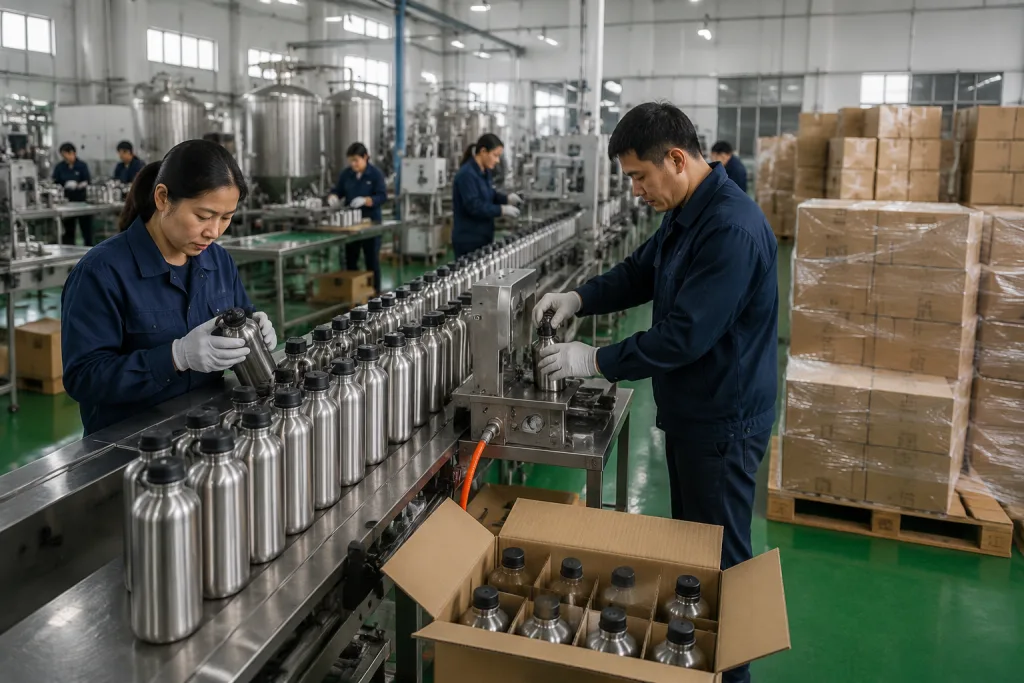
Key Takeaways
- Lock the use case first: single-wall canteens often land at USD 1.80-3.20 FOB, while double-wall vacuum versions commonly run USD 3.90-7.80 FOB at 3,000 pcs.
- Decoration drives both cost and risk: laser marking can add 2-4 days less than full wrap print and usually outlasts silkscreen by 2x to 3x in abrasion testing.
- MOQ is rarely one number: expect 1,000 pcs per style, 500 pcs per color, and 1,000 pcs per logo process as separate factory thresholds in China.
- Ask for AQL 2.5 inspection, REACH/LFGB or FDA material declarations, and a 30-45 day production window before deposit approval.
You usually do not lose money on a custom canteen order at the quoted unit price. You lose it in the quiet calls underneath: a 0.4 mm wall that dents in outdoor retail, a print that starts failing after 90 days, a gift box that adds 0.18 kg and pushes up freight, or a lead time that slips past your seasonal launch. We have seen this go sideways. If you buy outdoor canteens factory direct, those calls sit with your team, not a trader.
That is also the upside. A capable canteen factory in Zhejiang, China gives you tighter cost control, faster feedback, and one clear owner when QC pulled the sample and the buyer flagged the logo position on the PO. BottleForge Industrial in Hangzhou works with buyers in Europe and North America on runs from 1,000 units to 80,000+ units/month. The practical question is not whether factory direct is cheaper; this is the wrong question to ask. The real job is locking the first 4 decisions before the line runs.
Start with the four buying decisions
Most B2B buyers ask a canteen factory for a catalog and quote first. That is the wrong question. A factory-direct quote means little until you lock four decisions: construction, compliance, branding method, and delivery model. Leave one loose, and the price you signed on Monday gets revised on Friday after the line checks wall thickness with the micrometer and finds the spec changed.
Decision 1: construction. First decide what you are selling. An outdoor event canteen is different from a premium insulated custom canteen for retail, and both are different from a rugged bottle for workwear or tactical accounts. A 0.4 mm single-wall stainless body and a 0.5 mm double-wall vacuum body are not interchangeable. The weight changes, dent resistance changes, heat retention changes, and freight cost changes. We have had buyers flag a sample as “too heavy” after approval because no one matched the target weight in grams to the body structure.
Decision 2: compliance. EU and US projects get checked in different ways. Your canteen supplier should be ready for REACH and LFGB discussions for EU programs, and FDA-contact material expectations for the US, plus packaging tests if you sell through distribution or e-commerce. If you are a canteen distributor, the paperwork carries the same weight as the bottle. QC pulled samples before mass run because the PO said “LFGB bottle” but the lid gasket spec was typed wrong. We have seen this go sideways.
Decision 3: branding method. Printing choice affects claim rate more than buyers expect. A retail gifting canteen might need powder coat plus laser engraving. A promotion order might be fine with one-color silkscreen on bare stainless. The cheapest decoration on day one often costs more after scratches, return claims, or bad reviews. On our line, the buyer pushback usually starts after the 3M tape test or rub test, not when they see the first pre-production sample.
Decision 4: delivery model. Be specific on shipping terms and carton standard. Do you need FOB Ningbo or Shanghai, DDP to a 3PL, or FBA-ready labels and carton marks? A lot of canteen vendors can make the bottle. Fewer can ship it right. Carton drop resistance, pallet limits, barcode scan rate, and label position all matter, down to a 20 mm label offset that gets rejected at inbound. The math does not work if you save $0.12 on unit price and lose the shipment on carton compliance.
You should not compare suppliers until these four points are fixed. Otherwise, you are comparing guesses.
Choose construction by end use, not trend
Outdoor canteen programs go off track when the buyer picks the bottle that looked best at the Canton Fair booth, then uses it for a jobsite or school pack where it does not fit. Start with the end use. Hike, camp, worksite, school, promo giveaway, or retail shelf all need different construction. On our line, the first thing we check is bottle weight and mouth diameter before artwork, because a 44 mm mouth that works for retail can get pushback from camp buyers who want ice-fill.
Single-wall stainless or aluminum
For entry-level custom drinkware, single-wall still works. Typical capacities are 500 ml, 750 ml, and 1,000 ml. Unit FOB pricing from a Zhejiang canteen factory often sits around USD 1.80-3.20 at 3,000 pcs, depending on mouth shape, finish, and lid complexity. It ships light. The math works for promo. We usually see carton weight drop by 1.5-2.0 kg per case versus vacuum bottles, which matters once the order hits 500 cartons. The tradeoff is simple: it sweats with cold fill, and it does not hold temperature long. Buyers ask us to "make single-wall keep hot like vacuum." This is the wrong question to ask.
Double-wall vacuum stainless
If you need margin in retail, vacuum insulation is the safer pick. Common steel grades are inner 304 and outer 201 or 304, with wall thickness around 0.4-0.5 mm. A properly welded vacuum body should hold heat 6-12 hours and cold 12-24 hours depending on test conditions. Expect FOB pricing around USD 3.90-7.80 at 3,000 pcs. We run vacuum check on the line with the immersion tank, and QC pulled the sample last month on one lot because the bottom dimple depth was off by 0.3 mm after welding. Freight per unit rises, but shelf value rises too. In retail, that difference is what gets the buyer from USD 9.99 to USD 14.99.
Powder coat, bare steel, or painted finish
- Powder coat: better grip, better scratch performance, usually +USD 0.20-0.45. We see fewer complaint photos from warehouse handling.
- Spray paint: more color effects, but higher appearance variation batch to batch. Metallic colors are where the buyer flagged it most often.
- Bare stainless: lowest decoration risk, most industrial look. No coating line, fewer appearance rejects.
If you also source a custom growler or customizable growler in the same project, align thread standards and cap material early. We have seen this go sideways over one PO typo where the growler used one neck finish and the canteen used another, and the caps looked similar until assembly. Tooling savings are possible when neck finish and lid parts are shared across SKUs. Good canteen manufacturers in China will push platform parts for this reason. It is not laziness. It keeps spares, QC, and lead time under control, and it can cut replacement-cap MOQ from 5,000 pcs across two cap types to 3,000 pcs on one shared cap.
Know where factory direct really saves money
Outdoor canteen factory direct does not mean every order lands at a lower price than a vendor program or distributor buy. It means you can see the cost line by line. Different benefit. On our side, the quote usually breaks out bottle body, lid set, powder coat, print, and carton spec down to a 5-ply export carton.
Factory direct usually saves money in two clear spots, and sometimes a third. You cut out stacked margins from traders and licensed brands, and you get direct feedback from engineering before the PO is locked. That alone can remove cost fast; we have seen buyers ask for a 0.5 mm thicker silicone gasket, then drop it after the leak test data came back clean. The third saving comes when one factory packs the accessories together: spare lids, straws, hangtags, and gift boxes on the same line instead of buying them from 2 or 3 sources. That is where the math starts to work.
There are trade-offs. A distributor may hold stock nearby, accept mixed cartons, or support lower MOQs such as 120 pcs per color. A factory in Zhejiang is built around production thresholds, not convenience buys, and this is the wrong question to ask if your first concern is speed on a small run. On the line, powder coating and screen print setup time is the cost driver, not just stainless steel weight. You will hear numbers like:
- MOQ 1,000 pcs per model for existing molds
- MOQ 500 pcs per color for powder coating
- MOQ 1,000 pcs per logo artwork per print process
- New mold lead time 20-30 days if you change a lid or bottle shape
That is standard factory logic. If your program is under 1,000 pcs and you need stock fast, a distributor may fit better. If your program is 3,000-20,000 pcs, with repeat orders and private packaging, factory direct usually comes out ahead. We ship programs like this every month. Once volumes settle, a lot of distributor buyers move direct because a USD 0.35 lid and a USD 0.18 carton stop looking small when QC pulled the sample and the annual forecast shows 50,000 pcs.
Ask each canteen manufacturer to quote on the same basis: FOB port, exact carton pack, exact logo area, exact color count, and exact lid spec. Match the details item by item. We have seen this go sideways over one typo on a PO—24 pcs per carton quoted, 20 pcs per carton produced. If one quote leaves out leak testing, barcode labels, or inner boxes, it is not cheaper. It is incomplete.
Decoration is where returns usually start
Most buyers spend hours on bottle shape and miss the bigger risk: decoration durability. That is the wrong question to ask. Outdoor drinkware gets dragged through UV, bag friction, hand oils, and dishwash cycles, and we’ve seen returns start from a logo rub test on day 10, not from the body shape.
For a canteen customized with a simple corporate mark, laser engraving on powder coat is usually the safest industrial choice. On our line, the laser fixture holds logo position tighter before final packout. It can cost more than a one-color silkscreen, but it holds up better under abrasion and skips color registration problems. Typical add-on cost is USD 0.12-0.28 depending on logo size and location. Lead time impact is usually 2-4 days less than multi-pass wrap printing.
Silkscreen still works for canteen promo orders with a tight budget and short use cycles. Setup is cheap. Spot colors look clean. Still, check adhesion on the exact finish you picked, because matte powder and rubber paint do not behave the same. UV print gives you gradients and retail-style graphics, but curved surfaces are less forgiving, and QC pulled the sample more than once for edge scratching after only 20 rubs.
For a canteen custom program, ask for these checks before mass production:
- Artwork proof with dimensions in mm
- Pre-production sample in final color and finish
- Cross-hatch adhesion test result for printed areas
- Dishwasher or hand-wash recommendation printed on the insert
- Photo approval of logo position tolerance, usually within ±2 mm
If you are buying customized drinkware, customized canteen, or a customized growler range together, standardize the branding method by price tier. We run laser on premium SKUs and silkscreen on value lines, and that alone cuts one-off approvals. Last season one buyer flagged the same logo because the tumbler was engraved but the growler was printed 3 mm higher; the math doesn't work if your team has to reapprove every SKU. Good canteen vendors in China already know this keeps error rates down and makes the retail line look consistent across bottles, tumblers, and growlers.
Compliance, testing, and inspection discipline
Treat compliance as part of the buy decision, not as paperwork you chase the week before shipment. A solid canteen factory should know the rules for your sales market on day one, but you still need to lock the test scope in writing. “Food safe” is too loose. We’ve seen buyers approve a sample, then argue over seal migration test scope after the PO was stamped.
For stainless outdoor canteens, ask for a material declaration covering the body, cap, seal, and coating, then match that to test reports where they apply. For Europe, buyers usually ask for REACH, and some channels also require LFGB depending on the product and retail route. For North America, FDA-contact expectations come up on most programs. If the item is for children, check small parts, coating adhesion, and label claims harder; QC pulled the sample on one kids bottle last year because the straw bite valve detached under a pull check. If you also sell into distributor growler or distributor drinkware channels, your customer may ask for CPSIA-related declarations or a retailer protocol. This is the wrong question to ask late.
Inspection should be written into the PO. No exceptions. The practical baseline is AQL 2.5 for major defects and AQL 4.0 for minor defects, with specific check points for:
- Leak test: 100% in-line, upside down or vacuum pressure method
- Vacuum performance for insulated bottles: sampling by batch
- Finish consistency: color delta tolerance agreed in advance
- Thread and cap fit: torque and repeated open/close cycles
- Carton drop test: especially for e-commerce packs
At BottleForge in Hangzhou, Zhejiang, standard lead time is usually 30-45 days after deposit and sample approval for existing models, with pre-shipment inspection before balance payment. That is a normal China schedule, not a sales trick. We run existing models on that window if the artwork, carton marks, and barcode all clear before cutting packaging. Be careful with any canteen manufacturers promising 18-day mass production on a fully customized canteen with new packaging unless they show a line plan, packaging arrival date, and inspection booking; we’ve seen this go sideways over one PO typo in the carton spec.
Lead time, logistics, and packaging math
Delivery planning is where a decent quote turns into a workable order. If you buy factory direct, write the logistics assumptions as tightly as the bottle spec; we have seen one PO marked "ASAP shipment" with no ship mode, no carton limit, and no warehouse cut-off, and that order slipped 12 days.
Start from the full schedule, not only factory lead time. For an existing outdoor canteen model with custom logo and color, we usually run this sequence after artwork is confirmed on the Pantone sheet:
- 2-4 days for quotation revision and artwork check
- 5-10 days for pre-production sample
- 30-45 days for mass production
- 2-5 days for inspection and rework if needed
- Sea transit depending on lane, often 25-40 days to Europe or North America
This is why buyers ordering in August for an October launch often pay air freight for part of the order. The line gets tight before major holidays, and outdoor drinkware is seasonal. Last September, one buyer flagged a 3-week delay as a factory problem, but their color approval sat for 6 days.
Packaging needs more attention. A premium canteen customizable for e-commerce may need an E flute mailer, barcode label, suffocation warning, and carton drop performance; QC pulled the sample after a 76 cm drop test and found one corner split. A distributor canteen order for retail stores may use a plain brown inner box to cut cost by USD 0.08-0.20 per unit. On 20,000 pieces, the math changes fast.
Ask your canteen supplier for packed carton dimensions and gross weight before you approve the order. This is the wrong question to ask late. Freight can erase the savings on a cheap bottle, and a wider cap or gift box can cut units per carton by 10-20%; we ship plenty of orders where 6 mm on the lid changed the loading plan. For Amazon or 3PL work, confirm FNSKU label placement, carton marks, pallet pattern, and overpack rules before production starts. We have seen this go sideways when the buyer sent packaging notes after sampling instead of before mass production.
How to compare suppliers without fooling yourself
If you are speaking with three canteen manufacturers and two distributors, do not chase the lowest quote. Chase the lowest controllable landed cost with risk you can live with. Different thing. We’ve seen buyers save $0.18/unit on paper, then lose 18 days on cap rework after QC pulled the sample for a thread mismatch.
Use a weighted scorecard and stick to it. Give 30% to product fit, 25% to compliance and QC, 20% to total delivered cost, 15% to communication speed and engineering clarity, and 10% to production flexibility. Send the same question list to every supplier, right down to carton size and gasket material. This is where traders get exposed fast. A real factory answers with mold numbers, neck finish specs, and leak-test pressure; the email-forwarding supplier comes back with sales language and no data.
- Product fit: Are they already running similar outdoor canteen sizes, caps, and finishes on the line, or are you paying them to learn on your order?
- QC: Can they show AQL practice, leak testing, and corrective action examples, not just a generic inspection sheet with boxes ticked?
- Cost: Is the quote FOB with all packing, labels, and tooling explained, including the small items buyers miss like insert trays or laser logo fixture charges?
- Communication: Do they answer technical questions with numbers, not slogans? If you ask for wall thickness, do you get 0.5 mm or a sales pitch?
- Flexibility: Can they support running changes, spare parts, and repeat color matching, or will the buyer flag the second PO because the lid Pantone drifted?
For a lot of B2B buyers, the biggest factory is not the safe choice, and the smallest shop is not the cheap choice. The right supplier has enough capacity to protect your ship date without burying your order under larger programs. We run into this with 5,000-piece custom canteen projects all the time. Ask for actual monthly output and ask where your PO sits in the plan. If a supplier runs 300,000 units/month across drinkware lines and your urgent order is 3,000 pieces, this is the wrong question to skip. You need to know whether your job is on Line 3 next Tuesday or waiting behind a 50,000-piece tumbler program.
Factory direct works when both sides are precise. Send a tight brief, clear artwork, and packing details down to barcode position in mm, and a solid canteen supplier in Zhejiang can save you real money over 12 months. Send loose specs, and mistakes move faster. We’ve seen this go sideways over one PO typo: black strap requested in the email, navy strap on the signed order, 2,000 pieces packed before anyone caught it.
Get a factory-direct outdoor canteen quote that matches reality
Send your target capacity, material, logo method, packaging, and delivery term. We will quote MOQ, FOB price, sample timing, and compliance options clearly.
Frequently asked questions
What MOQ should I expect for an outdoor canteen factory direct order?
For existing bottle molds, a realistic MOQ is usually 1,000 pcs per model. Many factories in China also apply 500 pcs per color for powder coat or paint, and 1,000 pcs per logo artwork per decoration process. If you change the lid, add a new mold, or request custom packaging inserts, the effective MOQ can rise because setup cost must be spread somewhere. Some canteen suppliers will accept 500 pcs for a trial run on stock colors, but unit pricing may increase by USD 0.25-0.60 each. If you need under 500 pcs total, a local canteen distributor often makes more sense than a factory-direct custom program.
How long does a customized canteen order usually take from China?
For an existing model, plan 5-10 days for pre-production samples, then 30-45 days for mass production after deposit and approval. Add 2-5 days for inspection and any touch-up work. Sea freight from China to Europe or North America commonly adds 25-40 days depending on the lane and season. If you need a new mold for the cap or bottle body, add roughly 20-30 days before sample confirmation. Buyers often focus on factory lead time and forget artwork approval, packaging proofing, and booking delays. A practical planning window for a first customized drinkware order is 60-90 days door to port.
Which material is better for a custom canteen: aluminum or stainless steel?
For most B2B outdoor programs, stainless steel is the safer default. Single-wall stainless offers better dent resistance than thin aluminum and supports both bare and powder-coated finishes well. Double-wall stainless is the standard if you want thermal performance. Aluminum can still work for lightweight promotional use, especially when every gram matters, but coating consistency and denting risk need more attention. In FOB pricing, basic aluminum canteens may save a small amount, but not always once coating, cap quality, and packing are matched. If the product will be sold at retail above roughly USD 15, stainless usually gives you stronger perceived value and fewer complaint risks.
What compliance documents should I ask a canteen manufacturer to provide?
Ask for a bill of materials or material declaration covering body, lid, gasket, paint or powder coat, and packaging components. For EU sales, REACH-related information is commonly requested, and LFGB may be relevant depending on your channel. For the US, buyers often ask for FDA-contact compliance support. If the order targets children or major retailers, expect additional declarations and testing requests. Beyond paperwork, define the QC plan: 100% leak testing, AQL 2.5 pre-shipment inspection, and carton drop testing if the product ships through e-commerce. Documents without a matching inspection routine do not reduce your risk very much.
Is factory direct always better than buying from canteen distributors?
No. Factory direct is usually better when your order is at least 1,000-3,000 pcs per SKU, you want private packaging, and you expect repeat business. That is where transparent cost, direct engineering feedback, and spare-parts planning start to matter. Canteen distributors can be the better choice when you need mixed models, fast local delivery, lower MOQs, or easier credit terms. The right comparison is not only unit price. Compare landed cost, lead time, compliance support, and the cost of mistakes. A distributor can save money on small or urgent orders. A direct canteen factory in Zhejiang or elsewhere in China usually wins on larger, repeatable programs.