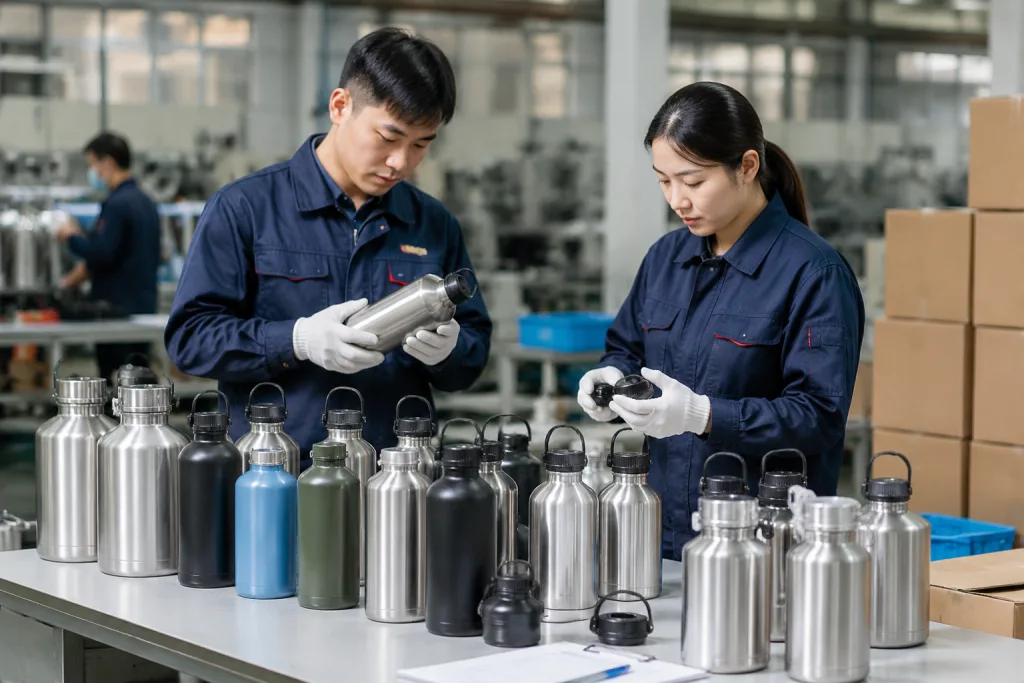
Key Takeaways
- For most stainless custom canteen programs, a workable MOQ is 1,000-3,000 units per model, with 35-45 day lead time after sample approval
- 304 stainless steel is standard for food-contact bodies; 316 is better for harsh outdoor use but usually adds 8%-15% to unit cost
- Typical FOB China pricing for a 500-750ml insulated custom canteen is USD 3.20-6.80 depending on steel weight, lid type, finish, and packaging
- Use AQL 2.5 for major defects and confirm REACH, LFGB or FDA, plus ASTM drop and leakage checks before shipment
If you buy for outdoor canteen distributors, you know the awkward part already: every canteen factory says it does custom work, but the real test is simple. Can they hit your target price, pass Europe or North America compliance, and ship the bulk order on time without drift from the approved sample? QC pulled the sample on one 5,000-piece run here and found the logo sat 2 mm low on the body. We have seen this go sideways.
From Zhejiang, China, this pattern shows up again and again on the line. A custom canteen project looks easy until you start checking steel grade, coating rub resistance, cap leakage at 0.03 MPa, logo method, carton drop performance, and MOQ by color. One buyer flagged a PO last month with “mat blcak” instead of “matte black,” and that small typo delayed sample confirmation by 2 days. If you buy custom drinkware for distribution, private label, retail, or canteen promotional programs, you need hard numbers and a checklist your team can run.
What buyers ask first
If you are talking with outdoor canteen distributors or vetting a new canteen supplier, buyers usually open with style or price. That is the wrong question to ask. The first check is channel fit. A custom canteen built for a national distributor program is not the same item as a 2,000-piece promotional run for an event brand, even if both use a 750ml body and look close on the shelf. On our line, the buyer flagged this more than once after seeing the same silhouette in two specs with a 0.4mm vs 0.5mm body.
Start with five basics: capacity, insulation, material, decoration, and route to market. A 530ml single-wall custom canteen for short outdoor use may land at FOB China around USD 1.60-2.40. A 750ml double-wall vacuum customized canteen with powder coating, laser logo, and carry lid may land around USD 4.20-6.80. Big gap. If a quote comes in too low, check the steel thickness and cap construction before you get excited. QC pulled the sample on one low-price project and found a thinner neck thread that failed after 3 torque tests at 1.8 N.m.
- Capacity: 500ml, 750ml, and 1L are the most practical sizes for outdoor resale, and 750ml usually moves fastest for dealer stock.
- Construction: single-wall works for low-cost programs; double-wall vacuum gives better field performance and leaves more margin for retail. We have seen this go sideways when buyers try to force vacuum specs into promo pricing.
- Steel: 18/8 stainless, usually SUS304 inside and outside; some canteen manufacturers offer SUS316 interior on premium SKUs where the buyer wants a stronger corrosion story.
- Decoration: silkscreen, heat transfer, digital print, laser engraving, or embossed logo all price out differently. Laser is clean. Heat transfer needs tighter artwork control, and we check logo position with a 2mm tolerance jig.
- Channel: retail, private label, distributor canteen, Amazon FBA, or institutional tender each need different packing, compliance files, and reorder speed. The math does not work if you quote one carton standard for all five.
At BottleForge Industrial in Hangzhou, Zhejiang, a normal MOQ starts at 1,000 units per design for standard molds, and monthly capacity can reach 300,000 units across bottle and tumbler lines. That matters. A canteen vendor with good samples but weak capacity becomes a problem when you need repeat orders inside 30 days. We run into this on seasonal outdoor programs where the first PO looks fine, then the second PO has a ship window of 12 days vs 18 days and the factory cannot hold coating color, lid fit, and carton drop performance together.
You are not just buying a bottle. You are buying repeatability: same weld, same coating, same lid fit, same carton performance, every reorder.
How to shortlist a canteen factory
A serious canteen factory answers practical questions fast, with drawings, test data, and carton specs. We usually send a 5-ply carton size, unit weight in kg, and a basic dimension sketch within 24 hours. If they only send polished photos and dodge numbers, keep moving. China has 1000+ competent drinkware suppliers, with a heavy cluster in Zhejiang, but the gap is real between trading-only sellers and factories that know what the line can actually hold at neck tolerance and weld consistency.
Shortlist with a hard filter
- Ask whether they are a canteen manufacturer or a canteen vendor using partner workshops.
- Request business license, audit status, and factory photos from forming, welding, vacuuming, coating, and packing areas.
- Check whether they work to ISO 9001 systems and whether they can support BSCI or SEDEX expectations if your customers require social compliance.
- Confirm food-contact testing history for REACH, LFGB, FDA, and California Proposition 65 where relevant.
- Ask for standard inspection level and final random inspection practice, such as AQL 2.5/4.0.
A good canteen supplier should tell you where the risks sit. This is the right question to ask. On our side, QC pulled the sample more than once and found matte powder coat on dark colors hides light handling marks better than glossy paint, especially around the base edge after carton drop tests. Bamboo lid inserts look good on a customizable canteen, but we have seen this go sideways in sea freight: if packing humidity control is weak and the desiccant count is short by even 1 bag per carton, defect risk goes up.
Ask about mold ownership and modification early. The buyer flagged this before on a PO where the lid color code was typed wrong, and that small mistake turned into 12 days of rework. Many canteen manufacturers in China run semi-custom programs off existing molds with new lid colors, Pantone powder coat, or logo decoration. That can cut development from 45 days to 15-20 days and avoid spending USD 800-3,000 on tooling for a shape that may never repeat. For 500 to 3000 pcs outdoor canteen distributor orders, the math works better on the first run with an existing mold.
Specs that change your margin
Two canteens can look the same in a sales photo and still land 20% apart on cost. We see this every week. The gap is usually in steel weight, vacuum pass rate, lid tooling count, finish yield on the line, and carton detail like a 2 mm EPE sleeve or divider insert. If you are building a canteen for outdoor distribution, this is where margin moves. Price is not the first question. We have seen buyers push unit cost down by $0.18, then lose it back in claims and repacks.
Start with the body. For a 500-750ml insulated custom canteen, outer wall thickness is commonly 0.4-0.5mm and inner wall 0.4mm. Heavier steel gives better dent resistance, but the math changes fast once QC weighs random pieces on a 0.1 g bench scale and you add freight on top. Then check the lid. A plain PP screw lid is cheap. A dual-material lid with stainless cap shell, carry loop, silicone seal, and inner thread insert costs more for a reason. Each extra part adds assembly seconds, another mold, and one more leak point. The buyer flagged this before on a 10,000-piece PO because the loop sat 1.5 mm off center.
- Single-wall custom canteen: lowest FOB cost, no heat retention, lighter freight cost. We usually ship these faster because the line skips vacuuming and weight stays lower by about 180-220 g depending on size.
- Vacuum insulated customized drinkware: higher landed cost, stronger retail value, better gross margin for outdoor channels. This is usually the better bet for distributors, and we run a vacuum hold test by batch instead of guessing from the sample room piece.
- Powder coat: good grip and durability, usually 3%-8% higher than simple spray finish. The texture helps in outdoor use, but scrap goes up if the coating builds too thick around the thread start.
- Laser engraving: permanent, clean for brand programs, but less visible on some brushed surfaces. QC pulled the sample on one order last month because the logo looked weak after bead blasting on 304 stainless.
- Full-wrap print: stronger shelf impact, but higher scrap risk during production. We have seen this go sideways when artwork registration drifts by 1 mm and the buyer wants the seam hidden behind the handle zone.
For a canteen customizable project, ask for the net weight tolerance, insulation test method, and leak test standard. Ask the factory to show the actual control sheet. If the canteen factory cannot tell you whether every unit is air-pressure tested or vacuum-retention checked by sampling, you have a control problem. This is the wrong question to ask: "Can you match the photo?" Ask how they test. On custom growler or customized growler projects, the bar is higher because one bad lid seal turns into a complaint as soon as the customer fills it. We run leak checks with an air-pressure tester, and the line records rejects by batch.
One practical rule: for distributor growler or custom growler orders, spend the extra money on lid sealing design before you spend it on premium gift boxes. That is the part your customer touches on day one. The box only helps the first photo. A thicker silicone ring, better thread engagement, or a cap structure that closes square will do more for sell-through than a fancy insert card with a typo on the PO.
Pricing, MOQ, and sample reality
Buyers ask for “best price” before the quote has legs. This is the wrong question to ask. Our costing desk needs eight items before the number means anything: capacity, steel grade, wall thickness in mm, lid type, surface finish, logo process, packing style, and order quantity. Last week a buyer sent only “750ml canteen, matte black,” and QC had to pull a stock sample just to check whether they meant 0.5mm or 0.6mm body steel. If you want a clean comparison between canteen vendors, send one specification sheet and ask everyone to quote FOB Ningbo or FOB Shanghai on the same basis.
Typical reference pricing from China for outdoor canteen distributors looks like this. We run these numbers against current 304 stainless sheet cost and carton CBM, so a heavy lid or thicker base will move the line item fast:
- 500ml single-wall stainless custom canteen: USD 1.60-2.40 FOB at 3,000 units
- 600ml vacuum insulated canteen custom: USD 3.20-4.60 FOB at 2,000 units
- 750ml premium customizable canteen with carry lid: USD 4.80-6.80 FOB at 1,000-2,000 units
- 64oz customized growler: USD 6.50-9.80 FOB depending on lid and finish
Logo setup is small money, but it still catches buyers on the PO. Silkscreen runs USD 40-80 per color per design, and the screen room will charge again if the artwork file arrives with the wrong Pantone code. Laser marking setup is lower. Custom color matching is included above MOQ in most cases, while soft-touch coatings or ceramic interior finishes add 6%-12% because the line needs slower curing and more scrap allowance. Individual color box packaging adds USD 0.28-0.85 per unit depending on board grade and print coverage; 350gsm white card is not priced like 400gsm kraft with full-bleed print.
Sampling is where new buyers lose days. A pre-production sample for a customized canteen takes 7-12 days if you use an existing mold and standard lid. A fully new shape takes 20-35 days for prototype and revision, and that assumes the 3D file matches the mold shop’s draft-angle check. Mass production lead time is 35-45 days after deposit and sample sign-off. In peak season from August to November, about 4 out of 10 canteen suppliers in Zhejiang and wider China stretch to 50-60 days because polishing, powder coating, and packing lines are already booked.
If your target is a launch date, reverse-plan from vessel departure, not from PO date. The math doesn't work if the buyer approves artwork on day 9, changes the color box barcode on day 14, then asks why the “30-day factory promise” missed the sailing. We ship after sample sign-off, packaging confirmation, and forwarder booking are locked. We’ve seen this go sideways over one typo on a PO: Ningbo listed as Shanghai, booking cancelled, 12 days lost.
Compliance and quality checkpoint list
Outdoor canteen distributors selling into Europe and North America should not treat testing as paperwork after the order. Lock the compliance package before we open the production order in ERP. The list changes by market and cap material, but the base items are predictable; last month QC pulled 3 samples because the silicone gasket spec on the PO did not match the approved drawing.
Buyer checklist before deposit
- Confirm the food-contact material declaration for stainless steel, PP, Tritan, silicone, and coating, including the exact grade or resin code used on the line.
- Request the test scope for REACH and LFGB for EU, FDA for US, and Proposition 65 if your customers require it, with the lab name written before deposit.
- For kids-related drinkware ranges, confirm ASTM and CPSIA relevance where applicable, especially straw lids, small parts, and printed coatings.
- Lock packaging specs, barcode placement, FNSKU label rules, carton marks, and drop-test expectations, down to label size in mm and scan position on the master carton.
- Agree on AQL levels, for example AQL 2.5 major and 4.0 minor, and state who pays if reinspection is needed.
For outgoing inspection, reject loose wording like “factory standard.” Write the checkpoints on the inspection booking: appearance, capacity tolerance, logo position, color match, leak test, vacuum retention sampling, carton drop, barcode scan, and assembly integrity. Be specific. For 750ml outdoor bottles we run leak testing with the cap tightened to the approved torque, then QC checks random pieces after 30 minutes upside down. If you are buying customizable drinkware for e-commerce, packaging control is product quality. A perfect bottle in a 3-ply weak carton still becomes a return.
Good canteen manufacturers in China usually support third-party inspection before balance payment. The cost is small beside a rejected container at destination; a 1-day inspection bill is easier to accept than 12 days of warehouse dispute and rework claims. Also check whether the canteen distributor or importer of record needs specific outer carton data, such as gross weight under 18kg or pallet height limits. We have seen buyers flag a carton at receiving because the gross weight printed on the mark was 19.2kg while the routing guide capped it at 18kg. The math does not work after the goods land.
One opinionated point: do not demand cosmetic perfection on powder-coated outdoor items. Set a realistic visual standard at arm's length, not under a spotlight from 10cm away. On the line, a 0.3mm dust point near the base is not the same as a scratch across the logo. This keeps defect arguments practical and yield stable.
What makes reorders smoother
The first PO gets the spotlight. Your margin usually shows up on reorder No. 2 and No. 3. The distributors who keep reorders clean usually lock 3 things early: specs, packaging, and artwork control. On our line, the buyer flagged a 2 mm logo shift on a repeat order and it delayed approval by 4 days. We've seen this go sideways.
After the first custom drinkware order is approved, build a full product file and keep it in one place. Include approved sample photos, net weight, dimensions, lid code, gasket material, Pantone references, logo size, carton spec, barcode file, and inspection record. Add the actual sealing torque range if you have it; we run checks with a torque tester on cap fit before mass production. If those details stay buried in email threads, the next run depends too much on whichever merchandiser picks up the PO, and that is the wrong setup for repeat business.
- Freeze the SKU: lock one BOM, one approved decoration method, and one carton spec. If the carton changes from 5-layer to 7-layer on a repeat PO, freight math changes fast.
- Watch MOQ by color: a 3,000-unit order split into six colors often creates cost creep or delay. We ship plenty of mixed-color orders, but 500 pcs per color is where coating efficiency usually starts to break.
- Use forecast windows: even a 60-day rolling forecast helps a canteen manufacturer reserve material and coating slots. A buyer gave us an 8-week view last spring, and we held powder coating capacity instead of pushing the order back 12 days.
- Review claim data: leakage, denting, paint chips, and barcode issues should feed the next QC plan. QC pulled the sample after one barcode scan failure, and the root cause was a print contrast issue on the outer carton.
If you are managing a canteen customized or customized drinkware program across several markets, standardize what you can and localize only what you must. Keep the bottle body common, then change packaging language or barcode by market. We often see buyers save one body mold and swap only the insert card or shipping mark; MOQ stays cleaner and the line runs faster. Running 4 bottle constructions for 4 markets sounds flexible, but the math doesn't work.
For outdoor and camping channels, there is a solid case for building a family of SKUs: 500ml canteen, 750ml canteen, and custom growler using the same cap language and brand finish. That gives the end customer a cleaner shelf story, and it gives you stronger buying power on repeat steel and coating runs. We buy 304 stainless by batch, and shared finishes across 2 or 3 sizes usually quote better than one-off bodies with separate color approvals.
When a canteen supplier in Zhejiang can quote, sample, produce, and repeat with low deviation, you stop chasing the headline unit price and start buying on total operating cost. That is the real test. We have seen buyers switch for $0.12 less per unit, then lose 18 days on repeat sampling because the new factory missed the lid code on the PO. Experienced buyers in China learn this fast because the cheapest quote is rarely the cheapest landed result.
Get a workable custom canteen quote, not guesses
Send your target size, quantity, market, and logo method. We will reply with MOQ, FOB pricing, lead time, and compliance checkpoints.
Frequently asked questions
What MOQ should I expect from outdoor canteen distributors or factories in China?
For standard molds, most canteen manufacturers in China will quote 1,000-3,000 units per model, often with one color included above MOQ. If you want multiple lid colors or several Pantone body colors, ask whether MOQ applies per SKU or per color. That changes the real cost. For a simple custom canteen with one logo and stock lid, 1,000 units is realistic. For a highly customized canteen with new tooling, special packaging, and several accessories, 3,000-5,000 units is more normal. Some canteen vendors advertise 300-unit MOQ, but that usually means stock goods with limited decoration choices. For serious private label distribution, focus on repeatable MOQ, not the smallest trial number.
How long does a custom canteen order usually take?
Assume 7-12 days for a pre-production sample using an existing mold, then 35-45 days for bulk production after deposit and sample approval. If you add new tooling, expect another 20-35 days depending on complexity. During peak season in Zhejiang and other China production clusters, lead time can extend to 50-60 days, especially for vacuum insulated bodies and powder-coated finishes. Shipping time is separate. Sea freight to Europe is often 30-40 days port to port, and to the US West Coast around 18-25 days under normal conditions. If your customer has a fixed launch date, work backward from ETD plus customs clearance, not from your purchase order date.
What tests matter most for customized drinkware sold in Europe and North America?
For stainless custom drinkware, you should at minimum confirm food-contact compliance for all relevant materials: stainless steel, plastic lid parts, silicone seals, coatings, inks, and adhesives if used. For Europe, buyers commonly ask for REACH and LFGB-related documentation. For the US, FDA contact material compliance is standard, and some programs also ask for California Proposition 65 screening. Beyond lab reports, practical production tests matter: 100% leak test where possible, vacuum retention sampling for insulated units, logo adhesion checks, and carton drop tests. If children are the intended users, ASTM or CPSIA relevance may apply. Put the test list in the PO or specification sheet so the canteen supplier cannot treat it as optional later.
Is it better to buy from a factory or a trading company?
A factory gives you better control over production details, lead time visibility, and corrective action when something goes wrong. A capable trading company can still be useful if they add real project management, consolidate mixed SKUs, and handle communication cleanly. The problem is that many canteen vendors present themselves like factories without giving you actual process control. Ask direct questions: who owns the tooling, where vacuuming happens, who performs final AQL inspection, and whether you can arrange third-party inspection before shipment. If the answers stay vague, you are probably not dealing with a strong manufacturing setup. For repeat distributor canteen programs, direct factory access is usually the safer path.
How do I control quality on a custom growler or outdoor canteen reorder?
Treat the first approved order as the master standard. Keep a technical file with approved sample photos, dimensions, net weight, steel specification, gasket material, finish code, logo location, and packaging details. Then require the same BOM and inspection points on every reorder. For insulated canteens and custom growler items, pay special attention to lid sealing and coating consistency. Set an agreed AQL, such as 2.5 for major defects and 4.0 for minor, and define what counts as a major defect before production starts. If you had leakage claims over 1% on the previous run, increase sampling around cap torque, seal seating, and air-pressure testing. Reorders fail when buyers assume the factory remembers everything.