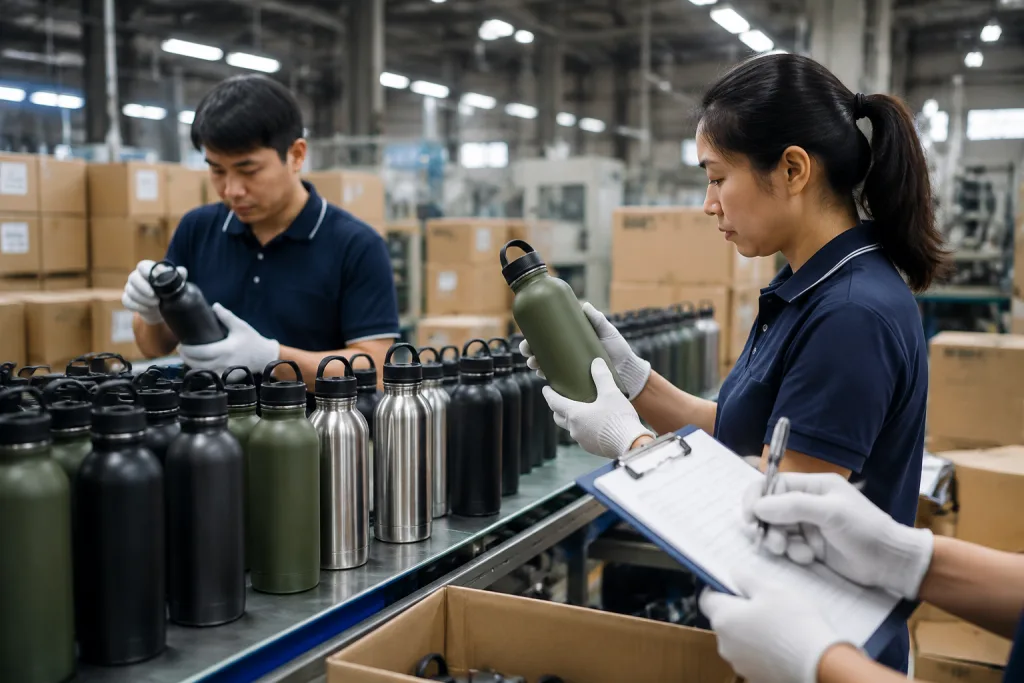
Key Takeaways
- A typical 18 oz to 32 oz stainless custom canteen runs about USD 2.80-6.90 FOB China, with decoration and lid style driving most of the spread
- Standard MOQ is usually 1,000 units per SKU, but stock-color bodies with one-color logo can start at 500 units
- New custom canteen projects usually need 35-55 days from sample approval to ex-factory shipment
- Powder coating, copper-plated vacuum insulation, and retail gift boxes can add 18%-40% to unit cost
If you buy for an outdoor canteen distributor, the hard part is rarely the bottle shape. The hard part is landing cost, decoration, compliance paperwork, and ship date at the same time. We see this every week on the line. Your sales team wants a custom canteen program at 3,000 units, while the warehouse asks for mixed colors, lower carton counts, and no leakage complaints after a 1.2 m drop test. Fair ask. Getting all of that into one PO without cost creep is where orders stall.
Most first orders go wrong at quotation stage. The factory price looks fine, then the extras show up: mold amortization, laser marking, drop-test packaging, and LCL freight damage risk. The buyer flagged this on one PO last month because “mat black” was typed as “matt back,” and QC pulled the sample before printing cards. Small error, expensive result. At BottleForge Industrial in Zhejiang, China, we build around 450,000 units per month, and the right questions stay the same: what drives cost, what MOQ means by color and lid, and whether you should book 12 days or 18 days before goods are ready to ship. Asking only for the lowest unit price is the wrong question.
What actually sets canteen cost
If you ask an outdoor canteen distributor or supplier for pricing, the number means little until you see the build. Structure drives cost first. A single-wall 304 stainless canteen promotional item in 500 ml may sit around USD 1.60-2.40 FOB Zhejiang, China at 3,000 units. A double-wall vacuum body in 18/8 stainless with copper lining can move to USD 3.40-5.20. Add a wide-mouth cap, paracord handle, powder coat, and custom box, and you can be at USD 5.80-6.90 fast. On our line, the jump usually starts with the vacuum process and the extra leak test, not the logo.
The second driver is weight and wall thickness. This part is not guesswork. A light single-wall body may use 0.4 mm outer material. A tougher vacuum body for outdoor retail often uses 0.5 mm outer and 0.4 mm inner. That extra steel matters, and buyers feel it in hand at once. So does the lid. A basic PP screw cap with silicone gasket is cheap. A stainless cap, bamboo insert, flip straw, or tethered cap adds material cost and assembly minutes. QC pulled samples last month where the bamboo insert sat 0.8 mm proud of the cap surface, and the buyer flagged it right away.
Decoration is where many canteen distributors lose margin because they quote before the artwork and finish are locked. We have seen this go sideways. A one-color silkscreen logo may add USD 0.08-0.18 per unit. Laser engraving is often USD 0.10-0.25 depending on size and speed. Full-wrap UV print can add USD 0.35-0.80. If you need a canteen customized with Pantone-matched powder coating, reserve an added USD 0.20-0.45 and 3-5 more production days for paint line scheduling. We run color cards before mass production, and if the sample is off under D65 light, the line stops.
- Lowest cost: stock shape, stock lid, one logo position, export carton
- Mid-range: vacuum body, powder coat, engraved logo, hangtag
- Highest cost: new mold, multi-part lid, gift box, barcode labeling, mixed packs
If you are sourcing custom drinkware from a canteen factory in China, ask for the quote split by body, lid, decoration, packaging, and testing. This is the right question. Without that breakdown, you cannot compare one canteen vendor to another in a practical way. We ship quotes like this every week, and once the PO had the lid code typed wrong by one letter, which changed the cap cost by USD 0.22 per unit.
MOQ tiers that change your quote
MOQ is not one number. For an outdoor canteen distributor, we usually price four minimums separately: body color, lid type, decoration method, and packaging. Buyers hear “MOQ 1,000” and read it as 250 black, 250 army green, 250 with a strap cap, 250 in a gift box. The line does not work like that. Last month QC pulled a pre-production sample where the PO said “matte sand,” but the approved color chip was PMS 7530C; that one typo changed the coating batch.
For a stock custom canteen, 500 units can work if you stay with an existing mold, one stock body color, one stock cap, and a one-color logo. Simple job. At 1,000 units, most canteen suppliers can open more choices on coating color or laser mark position because the fixture setup on the rotary laser is no longer eating the whole margin. At 3,000 units, the quote drops for a real reason: steel procurement, paint batching, and print setup waste spread across more units. Between 5,000 and 10,000 units, we can usually talk about mixed carton assortment, inner box options, or a second logo location without the same cost penalty, as long as the carton mark and barcode plan are clean.
A fully canteen customizable project sits in another lane. If you need a new silhouette, custom neck finish, unique cap, or integrated cup, you are paying for tooling. New body molds for stainless can be USD 2,500-6,000. Lid tooling can add USD 1,200-4,000 depending on cavities and mechanism. In those cases, practical MOQ often starts at 3,000-5,000 units per size, because the welding line needs stable output before the first-article scrap makes sense. A custom growler or customizable growler with a heavy-gauge body and swing-top closure may need higher volume; we have seen swing-top alignment fail by 1.5 mm and turn into a full rework lot.
You do not lower MOQ by asking harder. You lower effective MOQ by simplifying the spec.
If you are new to a canteen distributor or canteen manufacturer relationship, a sensible first PO is 1,000-2,000 units on one proven shape. Test the market first. We ship that as one color, one lid, one carton layout, then watch sell-through and complaint rate for 60-90 days. Expanding to a canteen customized family with extra colors or sizes before that is the wrong question to ask; the math works better after you know which SKU buyers reorder.
Lead-time ranges by order type
Lead time is where buyers get the soft answer: “about one month.” That answer is useless. Break it into sampling, material booking, line time, QC, and vessel booking. For standard customizable drinkware from Zhejiang, China, a pre-production sample with your logo usually takes 5-10 days. On our side, the logo film is usually checked on day 1 and QC pulled the sample before packing. If the factory needs a custom color spray-out or new package mockup, expect 7-12 days. We’ve seen this go sideways when the PO says “matte black” but no Pantone is listed.
After sample approval and deposit, normal bulk production for 1,000-3,000 units is often 25-35 days. For 5,000-10,000 units across several colors, 35-45 days is safer because the line has to change paint, lids, and carton marks, not just run more pieces. Peak season before summer promotions or Christmas can push that to 45-60 days. This is the wrong question to ask if you only ask for “factory lead time” and ignore booking space out of Ningbo. If you need a canteen customized with a new mold, add 15-25 days for tooling and first sample correction. A lid mold trial can lose 2 days fast if the hinge gap is off by 0.3 mm. That is why a new custom canteen program often lands at 50-70 days total before ex-factory release.
Typical timeline you can actually plan around
- Day 1-3: confirm spec, logo files, Pantone, packaging dieline; we also check PO typos, barcode version, and carton qty before the line starts
- Day 4-10: pre-production sample; for a laser logo or silk print, sample approval is usually faster than a new spray color
- Day 11-14: sample approval or correction request; the buyer flagged it more than once over logo size, like 28 mm requested but 25 mm printed
- Day 15-40: raw material, body forming, welding, polishing, coating, assembly; on stainless styles, weld cleanup and powder coating usually decide whether you stay on schedule
- Day 41-45: final inspection, carton marking, booking release; if QC runs AQL 2.5 and finds mixed inner cartons, shipment slips
For Europe and North America, do not forget transit. Sea freight from Ningbo can be around 25-35 days to major EU ports and 25-40 days to North America depending on coast and routing. We ship some urgent replacement orders by air, but the math doesn't work for most canteen programs once carton volume goes up. Rail or air changes the math, but usually only for urgent replenishment or high-value customized drinkware. If you sell through Amazon or retail distribution, reserve another 5-10 days for FNSKU labeling, pallet rules, appointment booking, or warehouse receiving delays. A missed pallet height by 20 mm is enough to get the booking pushed back.
Where custom features add money
Most outdoor buyers are not asking for the cheapest customizable canteen. They want the feature mix that sells through and does not come back with returns. We hear this on calls every month. The mistake is loading in premium details that a shelf price cannot carry; the math doesn't work once you add freight, carton drop risk, and a 3,000 pcs MOQ.
Vacuum performance is the cleanest example. A standard double-wall custom drinkware bottle may hold cold for 12-18 hours and hot for 6-10 hours under normal test conditions. On our line, copper-plated vacuum usually adds USD 0.18-0.35 per unit and one more check point after the vacuum oven. If the item is a distributor canteen for promo channels, that extra cost often stays on your side. For outdoor specialty retail, buyers will pay for it if the claim on the PDQ box is clear.
Lid complexity changes labor fast. A plain screw lid is simple. A straw lid, spout lid, or dual-function cap can add USD 0.25-0.90, plus a higher defect risk if tolerances are poor. We have seen QC pulled the sample and found a 0.3 mm gasket seating issue that turned into slow leaks after a 45-degree tilt test. For a customized canteen sold to hikers or campsite users, leakage is the wrong place to get clever. Ask your canteen vendor for torque standard, leak-test method, and gasket material. Food-contact silicone and BPA-free PP are routine, but still ask for REACH and LFGB or FDA declarations as needed.
Packaging hides margin. Export cartons are the default. Individual white boxes add around USD 0.18-0.35. Full-color retail boxes can be USD 0.45-1.20 depending on insert and board grade. We ship plenty of gift sets, and the buyer flagged it more than once after seeing the cube jump on a 62 x 41 x 38 cm master carton. If you need a customized growler or custom growler for gift or brewery channels, branded tube packaging looks strong on shelf, but freight climbs fast and we've seen this go sideways on lower-volume orders.
- Powder coat: better grip and a stronger retail look; on a 64 oz body we run this finish often, and the cost increase is usually manageable
- Soft-touch finish: feels premium in hand, but it marks easier; QC often spots rub lines after carton vibration tests
- Emboss or deboss: strong brand effect, but it usually needs dedicated tooling, and buyers push back once they see the mold charge
- Accessory bundle: boot, strap, carabiner, brush; useful on paper, but assembly errors go up fast on the packing line
A practical canteen factory will tell you which features sell and which ones just slow the line down. That is the better question to ask. A long options list looks good in a PDF, but it does not help if QC finds mixed lids from a PO with one digit typed wrong.
Quality controls you should budget for
Sample appearance is not enough. Bulk quality needs a control plan before we run the line. For custom drinkware, buyers in Europe and North America usually ask for AQL inspection at 2.5 major and 4.0 minor, and some retail-facing distributor programs tighten cosmetic limits after the first approval sample. At our Zhejiang plant, every vacuum item gets 100% leak testing, and QC pulled the sample every 30 minutes for vacuum retention checks, coating adhesion cross-hatch testing, and dishwasher-risk warnings where applicable.
If you are comparing canteen manufacturers, ask tighter questions. Ask about weld inspection after body forming, paint thickness by micron gauge, and any salt-spray target for coated parts. This is the wrong question to ask: "Does the sample look good?" For outdoor use, chip resistance is where claims start. We have seen a powder coat pass the sample table, then fail after packed-carton abrasion, with edge rub marks showing up before the goods even reached the warehouse.
Compliance adds cost and a few days, but skipping it costs more. Depending on your market, you may need REACH, LFGB, FDA food-contact declarations, Proposition 65 screening, or ASTM-related packaging considerations if the item targets children. We ship orders where one label copy change adds 3 days because the buyer flagged a PO typo on the age-grade statement. A BSCI-audited or ISO-managed canteen manufacturer is not automatically better, but structured documentation usually means fewer surprises during onboarding, and we have seen this go sideways when test reports and carton marks do not match.
Budget for third-party inspection if the order value justifies it. A pre-shipment inspection in China may cost roughly USD 300-450 per man-day plus travel. For a first order of 5,000 units or a canteen customized launch into a major chain, that spend is sensible. The math does not work if you save USD 400 on inspection and then eat a 1,200-unit repack because QC found mixed lids in one pallet row. If your canteen distributor partner resists inspections, treat that as a signal.
How buyers cut cost without damage
The easiest savings are usually not in the steel price. They come from cutting specs your end user will not pay for. For a first run, we usually keep the body shape on an existing mold, around 3,000 pcs MOQ, and share one lid across two sizes if the neck finish matches. Pick one decoration process. Do not stack silk screen, laser, and embossing on the same SKU unless the margin supports it; the math doesn't work for most distributor programs. Clean up the packaging too. Those moves can trim 8%-15% without making the canteen feel cheap.
Color planning matters. Mixed Pantone orders look good on a sales sheet, but each extra coating batch means line changeover, gun cleaning, and a fresh sample check. We run this every week. If you stay with two core colors instead of five, the line moves faster, and you will usually see a better quote with a shorter lead time, like 12 days vs 18 days on the same volume. Logo placement works the same way. One front position is easy; front, back, plus a bottom code is where buyers start paying for setup minutes they never asked about. QC pulled the sample last month on a PO with the logo shifted 1.5 mm because the buyer flagged three print positions on one bottle.
Think in freight terms, not only ex-factory price. A taller bottle with a decorative cap may add little at unit cost, then push carton cube up by 10%-20%, and that hits ocean freight right away. We have seen this go sideways. Before you approve packaging, ask for packed dimensions, units per carton, carton gross weight, and pallet pattern. Ask early. On our side, we also check carton compression and whether the packed case stays under 18 kg for easier warehouse handling. A pretty box that wastes container space is not a small problem.
Build the order around reorder speed. A 1,000-unit trial on a stock customizable canteen is usually the better call than jumping straight to 10,000 units on a fully customized design with tooling that needs months to pay back. This is the wrong question to ask: "How cheap is the custom mold?" The better question is how fast you can reorder after the first 300 units sell through. Once the item proves itself, then move to dedicated molds, custom growler extensions, or matching accessories. Good canteen vendors in China should walk you through that step by step. We ship plenty of repeat programs that started from one stock body and one shared cap, and that is often the safer way to build the line.
Get your canteen cost and lead-time quote
Send your target size, quantity, logo method, and packaging need. We will reply with a practical FOB quote, MOQ options, and production timing.
Frequently asked questions
What is a normal MOQ for an outdoor canteen distributor buying private label?
For a stock stainless model, normal MOQ is 1,000 units per size with one body color and one logo treatment. Some canteen suppliers in China will accept 500 units if you use an existing mold, stock lid, and simple one-color print. If you want mixed colors, multiple lid styles, or retail gift boxes, practical MOQ usually rises because each variation adds setup waste. For a fully customized canteen with new tooling, you should expect 3,000-5,000 units per size to make the cost work. If your forecast is uncertain, start with a standard shape and invest in decoration, not new molds.
How much should I budget for a custom stainless canteen order?
A realistic FOB China budget for B2B buyers is USD 2.80-4.50 for a standard 18 oz to 22 oz vacuum custom canteen at 1,000-3,000 units, using 304 stainless, powder coat, and a basic PP screw lid. A larger 32 oz to 40 oz bottle can run USD 4.20-6.90 depending on wall thickness, cap complexity, and packaging. Single-wall promotional units can be below USD 2.40. Add roughly USD 0.08-0.25 for logo marking, USD 0.18-0.45 for premium coating, and USD 0.45-1.20 for a full-color retail box. New tooling is separate and can add USD 2,500-6,000.
How long does a custom canteen order usually take from approval to shipment?
For an existing bottle shape from a Zhejiang, China canteen factory, count 5-10 days for a pre-production sample and 25-35 days for bulk production after approval and deposit. If the order is 5,000-10,000 units with several colors or more complex lids, 35-45 days is safer. During peak season, some canteen manufacturers quote 45-60 days. A new molded design adds around 15-25 days for tooling and sample correction, so total project timing can reach 50-70 days before ex-factory release. Then add ocean transit, which may be another 25-40 days depending on destination and port congestion.
Which quality checks matter most for outdoor canteens?
Leak prevention and coating durability matter first. You should ask for 100% leak testing on assembled units and clear standards for torque, gasket fit, and vacuum performance on insulated models. For retail orders, AQL 2.5 major and 4.0 minor is common, though some buyers tighten cosmetic criteria. Also request food-contact compliance such as REACH, LFGB, or FDA declarations based on your market. If the canteen has powder coating, ask about adhesion and abrasion resistance. For a first order above 3,000 units, many buyers also book a third-party pre-shipment inspection in China at roughly USD 300-450 per man-day.
Is it better to buy a stock model or develop a fully customized canteen?
For most new B2B buyers, a stock model is the safer first move. You avoid tooling costs, keep MOQ around 500-1,000 units, and shorten lead time by about 15-25 days. You can still create a strong private-label result with powder coating, laser engraving, packaging, and accessories. A fully customized canteen makes sense when your forecast supports 3,000-5,000 units per size and you need a shape or lid that is not available in standard molds. If you are testing a market, use a proven body first, then move into dedicated tooling only after you see repeat orders and acceptable return rates.